
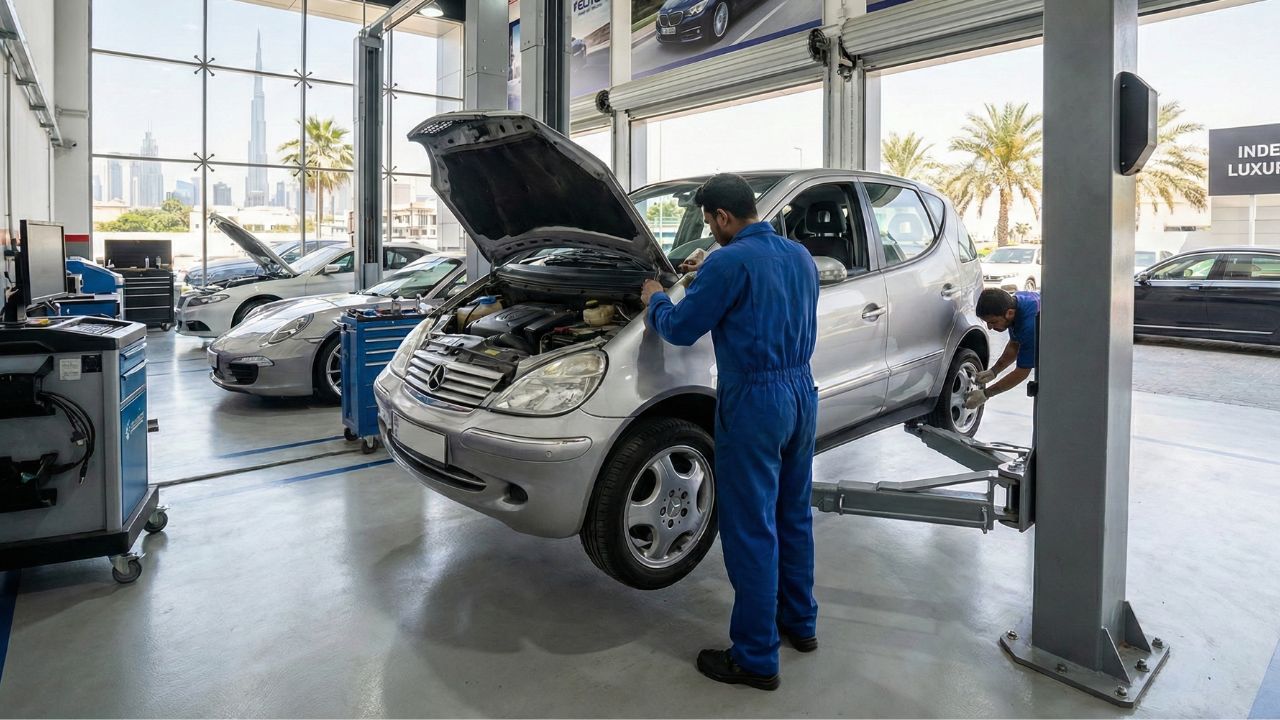
Picture this: You’re navigating the intricate lanes near Dubai Marina in your Mercedes-Benz A-Class (W168), and suddenly you notice that familiar German precision feels slightly off. Maybe the steering responds with a fraction of hesitation, or perhaps the air conditioning—your lifeline in Dubai’s relentless heat—struggles to maintain that crisp 18-degree comfort zone you’ve come to depend on. Your A-Class might be Mercedes-Benz’s entry into the compact segment, but that doesn’t mean it deserves entry-level care.
The W168 generation of the A-Class represents something fascinating in automotive history. Launched between 1997 and 2004, this first-generation model challenged conventional thinking about what a Mercedes could be. With its sandwich floor construction and clever packaging, the W168 packed Mercedes engineering into a surprisingly small footprint. Yet this innovative design also means your A-Class demands mechanics who understand its unique architecture, not technicians who treat every car like a puzzle with interchangeable pieces.
Dubai’s automotive repair landscape resembles a vast desert with occasional oases of genuine expertise. You’ll find countless workshops promising European car specialization, yet how many have actually invested the time to understand the specific quirks of the W168’s transverse engine layout? How many comprehend the nuances of its early electronic stability program, or recognize the telltale symptoms when the sandwich floor’s drainage channels become compromised by our desert environment?
At Euro Car Repair, we’ve built our reputation on a foundation that seems almost radical in today’s automotive service industry: we actually specialize in what we claim to specialize in. When we say European luxury vehicles, we mean we’ve studied the engineering philosophy behind each model, not just memorized generic repair procedures. Your Mercedes-Benz A-Class (W168) isn’t simply another car to us—it’s a specific expression of German engineering that requires specific knowledge, specific tools, and specific experience.
What makes the W168 different from other Mercedes models? Everything, really. While the E-Class and S-Class of that era continued Mercedes’ traditional rear-wheel-drive, longitudinal engine philosophy, your A-Class pioneered a completely different approach. The front-wheel-drive layout, the innovative sandwich construction that positioned the engine and transmission above the front axle, the compact dimensions that challenged Mercedes’ luxury-first reputation—these weren’t just design choices. They were engineering challenges that required unique solutions, solutions that continue to influence how your A-Class needs to be serviced today.
This article exists because Dubai’s Mercedes-Benz A-Class (W168) owners deserve better than generic advice and one-size-fits-all service approaches. You deserve to understand why your compact Mercedes requires specialized attention, what specific challenges the Dubai environment creates for your W168, and why choosing the right repair partner matters more than simply finding the cheapest hourly rate. More importantly, you deserve transparency about what quality service actually costs and what you’re really paying for when you invest in proper A-Class maintenance.
We’re going to explore everything from the specific technical systems that make your W168 unique, to the common issues that Dubai’s climate accelerates, to why our decision to operate independently of insurance companies actually benefits you as an A-Class owner. Whether you’re dealing with an immediate repair need or planning long-term maintenance strategy, this comprehensive guide will equip you with the knowledge to make informed decisions about your Mercedes-Benz A-Class (W168) care.
Why Choose Euro Car Repair for Your Mercedes-Benz A-Class (W168)
Specialized Mercedes-Benz A-Class (W168) Expertise That Goes Beyond Surface Knowledge
Generic automotive knowledge won’t cut it when diagnosing why your W168’s electronic stability program occasionally flashes warnings during humid Dubai mornings. Our technicians don’t just work on Mercedes vehicles—they’ve invested years specifically understanding the engineering decisions that shaped the first-generation A-Class. This matters more than you might initially realize.
Consider the W168’s unique sandwich floor construction. When Mercedes engineers designed this system, they created a structure where the engine and transmission sit in a protected cavity above the front axle, allowing the entire powertrain to slide underneath the passenger compartment during frontal impacts. Brilliant for safety, but this design creates specific maintenance access challenges and unique fluid leak patterns that generic mechanics simply won’t recognize. Our team has traced enough W168-specific leaks to recognize within minutes whether you’re dealing with a transaxle seal issue or a problem with the sandwich floor’s drainage system—a distinction that saves you diagnostic hours and unnecessary part replacements.
The W168 generation also introduced early versions of electronic systems that would later become standard across the Mercedes lineup. Your A-Class features brake assist, electronic stability program variants, and traction control systems that were cutting-edge for the late 1990s. These systems don’t communicate with diagnostic computers the same way modern Mercedes vehicles do, and they require technicians who understand both the hardware limitations and software protocols of that specific era. We’ve invested in maintaining period-correct diagnostic equipment precisely because we know newer generic scan tools often misinterpret data from these earlier control modules.
Our specialization extends to understanding the specific engine variants used in the W168. Whether your A-Class houses the 1.4-liter M166 engine, the 1.6-liter variant, or one of the later 1.9-liter diesel options, we’ve accumulated hands-on experience with each powerplant’s particular characteristics. We know which engines develop specific oil consumption patterns as they age, which variants experience timing chain tensioner issues, and how Dubai’s stop-and-go traffic patterns accelerate wear on particular components for each engine type.
Advanced Diagnostic Technology Matched to W168 Architecture
Walking into our facility, you won’t find us fumbling with generic OBD-II scanners hoping they’ll communicate properly with your W168’s control modules. We maintain Mercedes-specific diagnostic platforms that actually understand the communication protocols your A-Class uses. This technological investment matters because the W168 sits in an interesting transition period—early enough that it doesn’t use the standardized protocols of modern Mercedes vehicles, but sophisticated enough that generic tools often provide incomplete or misleading information.
Recently, an A-Class owner arrived after visiting two other repair shops, both of which insisted he needed a complete ABS module replacement based on fault codes their scanners retrieved. Our Mercedes-specific diagnostics revealed the actual issue: a wheel speed sensor providing intermittent signals due to bearing wear that allowed microscopic movement in the sensor gap. Total repair cost difference? The other shops quoted around 2,500 AED for module replacement. We resolved the actual problem—a wheel bearing and sensor—for roughly one-third that amount. This type of accurate diagnosis happens regularly when you use tools designed specifically for the vehicle you’re diagnosing.
We’ve also invested in equipment that addresses the W168’s unique construction challenges. Our transmission diagnostic capabilities include specific pressure testing equipment for the W168’s transaxle designs, tools that let us evaluate actual hydraulic performance rather than simply guessing based on symptom descriptions. For the sandwich floor construction, we maintain specialized lifting equipment that properly supports the W168’s unique weight distribution, preventing the structural stress that can occur when these vehicles are lifted incorrectly.
Genuine Parts and Quality Alternatives Sourced Specifically for W168 Applications
Here’s an uncomfortable truth about aging Mercedes vehicles: genuine OEM parts become increasingly expensive as models age, while the market floods with aftermarket alternatives of wildly varying quality. We’ve developed relationships with suppliers who understand the difference between cheap replacement parts and quality alternatives engineered to OEM specifications.
For your W168, this means we can source genuine Mercedes parts when that’s the right choice—and we’ll always recommend OEM for critical safety components and complex electronic modules. But we’ve also identified specific aftermarket manufacturers who produce components that meet or exceed original specifications for wear items like suspension bushings, brake components, and certain engine parts. We test these alternatives ourselves before recommending them to customers, because your A-Class’s reputation for quality shouldn’t be compromised by our parts sourcing decisions.
Every part we install, whether genuine Mercedes or premium aftermarket, comes with clear warranty coverage that we honor without bureaucratic obstacles. We document specific part numbers and manufacturers, maintaining detailed service records that prove valuable whether you’re maintaining the vehicle long-term or eventually selling it to another enthusiast who appreciates proper maintenance documentation.
Transparent Pricing Philosophy That Respects Your Intelligence
You’ve probably experienced this frustration: you bring your car in for a specific repair, only to receive a final bill that includes charges you never discussed or authorized. We find this approach disrespectful to our customers’ intelligence and counterproductive to building long-term relationships.
Before we touch your Mercedes-Benz A-Class (W168), you receive a detailed written estimate that breaks down labor hours, parts costs, and any additional services we recommend. If we discover additional issues during repair work, we contact you immediately with revised estimates and wait for your authorization before proceeding. This isn’t just good customer service—it’s basic respect for your role as the decision-maker regarding your vehicle.
Our pricing typically runs 30-40% below Mercedes dealership rates for equivalent service quality, and we’re transparent about why. Dealerships carry overhead costs that get passed to customers: prime real estate locations, extensive administrative staff, corporate profit requirements, and the cost of maintaining manufacturer certification programs that often mandate expensive cosmetic updates to service facilities. We invest our resources where they matter for your A-Class: technician expertise, diagnostic equipment, and quality parts sourcing.
Customer-First Service Model That Treats You as a Partner
Walk into most repair shops, and you’ll notice a distinct separation between the front office and the workshop. Customers aren’t welcome in the service area, communication happens through service advisors who may not understand the technical details, and you’re expected to simply trust that appropriate work is being performed.
We’ve deliberately designed our facility and processes differently. We encourage customers to see their vehicles in the workshop, to speak directly with the technician working on their A-Class if they have specific questions, and to understand exactly what repairs involve. This transparency serves everyone’s interests—you make better-informed decisions, and we build trust through openness rather than mystery.
For your W168 specifically, this means we explain the “why” behind our recommendations. If we suggest replacing your A-Class’s coolant expansion tank, we’ll show you the stress cracks developing in the plastic, explain why this component tends to fail around specific age and mileage points, and discuss what happens if it fails catastrophically while you’re driving on Sheikh Zayed Road during peak traffic. You decide whether to address it now or monitor it, but you decide based on complete information rather than blind trust.
Why We Don’t Work With Insurance Companies—And Why This Benefits You
Our decision to operate independently of insurance companies confuses some potential customers initially, but it’s actually one of the most customer-friendly policies we’ve implemented. Understanding why requires looking at how insurance repair processes actually work.
When repair shops work with insurance companies, they enter a system designed primarily to minimize insurance payouts. Insurance adjusters—who typically aren’t mechanical experts—second-guess repair recommendations, pressure shops to use cheaper alternative parts, and create approval delays that extend your vehicle’s repair timeline. Shops that depend heavily on insurance work learn to navigate this system, but navigation often means compromising on repair quality in ways that benefit the insurance company’s bottom line rather than your vehicle’s long-term health.
By refusing insurance work, we maintain complete independence in our repair recommendations. When your W168 needs a suspension component replaced, we recommend what your Mercedes actually needs based on our expertise, not what an insurance adjuster will approve based on their cost containment metrics. We source the quality level of parts your A-Class deserves, not the minimum quality the insurance company will accept.
This independence also means faster service. You’re not waiting days or weeks for insurance approval processes. You authorize the work, we perform it, you pay directly, and you’re back on the road. If you have insurance coverage for mechanical breakdowns, you simply submit our detailed receipt to your insurance company and deal with them directly for reimbursement. This keeps us focused on one relationship that matters: our relationship with you, not with insurance companies.
For W168 owners specifically, this matters because these are aging vehicles where insurance companies often pressure shops toward total loss determinations rather than quality repairs. We’ve seen A-Class vehicles that insurance adjusters wanted to write off as totaled that we’ve brought back to excellent condition for costs well below the vehicle’s value to owners who maintain them properly.
Proven Track Record Serving Dubai’s Mercedes Community
We’ve been serving Dubai’s European luxury vehicle community for years, building reputation through results rather than advertising claims. Our repeat customer rate tells the real story—owners return because their vehicles receive care that actually solves problems rather than just temporarily masking symptoms.
For Mercedes-Benz A-Class (W168) owners specifically, we’ve become the recommendation that gets passed around within the local W168 enthusiast community. When someone posts in online forums asking about reliable A-Class service in Dubai, our name appears consistently in responses, not because we’re paying for mentions but because we’ve earned trust through consistent quality.
This reputation matters in practical ways. When you bring your A-Class to us, you’re not our first W168—you’re benefiting from accumulated knowledge gained from dozens of previous A-Class repairs. We’ve already discovered the subtle tricks for accessing difficult components, identified the most reliable parts sources, and developed efficient diagnostic procedures specific to this model. Your repair happens faster and more accurately because we’re not learning on your vehicle.
Comprehensive Service Offerings for Your Mercedes-Benz A-Class (W168)
Engine Repair and Maintenance Specific to W168 Powerplants
Your A-Class’s transversely-mounted engine creates an interesting maintenance paradox. The compact engine bay design that makes the W168 so space-efficient also creates access challenges that inexperienced technicians often underestimate. What should be a straightforward valve cover gasket replacement becomes an exercise in frustration if you don’t know the specific sequence for removing interfering components and the exact torque specifications for reassembly.
The W168’s engine mounting system deserves special attention in Dubai’s conditions. Unlike traditional engine mounts that simply support the powerplant, your A-Class uses sophisticated hydraulic mounts designed to isolate vibration while controlling engine movement during acceleration and braking. Dubai’s extreme temperature swings accelerate the degradation of the hydraulic fluid inside these mounts, leading to symptoms that owners often misdiagnose as transmission problems—excessive vibration during startup, noticeable movement when shifting between drive and reverse, or mysterious knocking sounds that seem to come from nowhere specific.
We’ve developed specific diagnostic procedures for evaluating W168 engine mount condition that go beyond the typical “pry bar test” many shops use. Our approach measures actual engine movement under controlled load conditions, identifying failing mounts before they progress to the point of causing secondary damage to nearby components or stress-cracking the engine block’s mounting points.
The M166 engine family used in most W168 models also develops specific oil consumption patterns as mileage accumulates. Unlike the dramatic oil consumption issues that plague some engine designs, W168 engines typically develop gradual increases in consumption linked to specific wear patterns in the piston ring lands and valve guide seals. We monitor consumption trends during regular services, helping you anticipate when you’re transitioning from “normal aging” to “intervention needed” rather than waiting until consumption becomes severe enough to risk oil starvation damage.
Cooling system maintenance takes on critical importance in Dubai’s climate, and the W168’s cooling system has specific vulnerabilities. The expansion tank—molded from plastic that becomes brittle with heat cycling—typically requires replacement around the 8-10 year mark regardless of mileage. The thermostat housing, another plastic component exposed to constant thermal stress, follows a similar timeline. We’ve learned to recognize the subtle signs that these components approach failure, letting us recommend replacement during planned service intervals rather than dealing with emergency repairs after a roadside breakdown.
Transmission and Gearbox Services Calibrated to W168 Specifications
The W168 generation utilized several transmission configurations depending on model year and engine choice, but all share one common characteristic: they’re mounted in a transaxle configuration that combines transmission and differential into a single assembly. This integration creates efficiency advantages but also means transmission service requires understanding the complete transaxle system, not just the gear-changing mechanism.
For W168 models equipped with the continuously variable transmission (CVT), we’ve developed specific service protocols that recognize how Dubai’s driving patterns stress these systems. CVT technology was still relatively new during the W168’s production years, and these early implementations require more attentive fluid maintenance than later CVT designs. We recommend fluid services at intervals significantly shorter than Mercedes’ original specifications, because those specifications didn’t anticipate the constant high ambient temperatures that Dubai presents.
The five-speed automatic transmissions used in many W168 models develop specific shift quality issues as they age, particularly in Dubai’s stop-and-go traffic environment. We’ve learned to distinguish between shift problems caused by simple fluid degradation, issues stemming from electronic valve body malfunction, and mechanical wear that requires internal service or replacement. This diagnostic precision prevents the expensive mistake of replacing transmissions that simply need proper service or replacing valve bodies when the actual problem lies in worn clutch packs.
Transmission fluid service for the W168 isn’t simply draining and refilling. The transaxle configuration requires specific filling procedures to ensure proper fluid levels, and using incorrect fluid specifications can cause immediate damage to certain W168 transmission variants. We maintain detailed records of which exact fluid specification your specific W168 requires, eliminating the guesswork that can lead to using incorrect fluids.
Brake System Services Engineered for W168 Safety Systems
Your Mercedes-Benz A-Class (W168) introduced safety technologies that were remarkably advanced for the late 1990s compact car segment. The brake system integrates with electronic stability program components, ABS functionality, and brake assist systems that require careful attention during service to maintain proper operation.
The W168’s brake assist system represents one area where component-level understanding makes significant difference in service quality. This system monitors how quickly you press the brake pedal and automatically increases brake pressure if it detects emergency braking. The system depends on specific pressure sensor calibrations and vacuum assist characteristics that can be disrupted by improper brake component selection or incorrect service procedures.
We’ve mapped the specific brake pad compound requirements for W168 applications, understanding that brake pads aren’t universal commodities. The wrong pad material can create noise issues, reduce the effectiveness of the ABS system’s modulation, or even interfere with brake assist calibration. We source pads specifically engineered for W168 brake system characteristics, ensuring replacement components integrate properly with all the electronic systems that depend on predictable brake behavior.
Dubai’s driving environment creates specific brake system challenges for the W168. The combination of high-speed highway driving (generating significant brake heat) followed immediately by congested urban traffic (preventing brake cooling) accelerates rotor wear and increases the likelihood of brake fluid moisture absorption. We’ve developed service intervals that account for Dubai-specific usage patterns rather than simply following European maintenance schedules designed for different driving conditions.
The W168’s brake disc specifications matter more than many owners realize. These discs were engineered to specific thickness and metallurgy standards that affect heat dissipation, ABS sensor operation, and brake pad seating characteristics. We’ve seen multiple examples of A-Class vehicles that developed persistent brake problems after other shops installed incorrect replacement rotors that met basic dimensional requirements but failed to match OEM specifications for material composition and surface finish.
Air Conditioning and Climate Control: Critical Systems for Dubai Conditions
In Dubai’s climate, your W168’s air conditioning system transitions from luxury feature to absolute necessity. A functioning climate control system isn’t just about comfort—it’s about safety, as driver fatigue and distraction increase dramatically when cabin temperatures become uncomfortable.
The W168’s air conditioning system uses R134a refrigerant and follows a relatively conventional design, but several components deserve specific attention in Dubai’s environment. The AC compressor faces continuous heavy-duty operation unlike anything experienced in temperate climates. Where European W168 owners might run their AC occasionally during summer months, Dubai owners demand maximum cooling capacity for months at a time, often from the moment they start the engine.
We’ve identified specific failure patterns in W168 AC compressor clutch assemblies linked to this continuous high-duty-cycle operation. The electromagnetic clutch that engages and disengages the compressor develops wear in the bearing surfaces and electrical windings, often producing gradual performance degradation before complete failure. Our diagnostic approach can identify clutch assemblies approaching failure, allowing replacement during planned maintenance rather than waiting for catastrophic failure that leaves you without cooling in peak summer heat.
The evaporator core—hidden deep within your W168’s dashboard—presents particular challenges in Dubai’s dusty environment. This component not only cools the air but also dehumidifies it, creating condensation that should drain out through dedicated drain tubes. In our desert environment, dust combines with this moisture to create debris that can clog drain passages, leading to water accumulation that eventually damages carpet, promotes mold growth, and creates that unmistakable musty smell that indicates AC system problems.
We’ve developed evaporator cleaning procedures specific to the W168’s dashboard configuration, including access routes that minimize dashboard disassembly while still allowing thorough cleaning and drain verification. This specialized knowledge saves labor hours compared to generic approaches that require complete dashboard removal.
Your W168’s cabin air filter plays a more critical role in Dubai than in most environments. Our air carries higher concentrations of fine dust particles that stress filtration systems designed for European conditions. We recommend filter replacement intervals roughly half what Mercedes specifies, because the accumulated restriction from dust loading reduces airflow, forces the blower motor to work harder (accelerating its wear), and allows filter media breakdown that can introduce debris into the evaporator core.
Suspension and Steering System Maintenance for W168 Dynamics
The W168’s suspension system represents an interesting case study in compact car engineering. Mercedes designed these systems to deliver composed handling and ride quality from a relatively short wheelbase and high overall height—a combination that creates specific challenges in suspension tuning.
Your A-Class uses MacPherson strut front suspension and a sophisticated rear beam axle setup, both engineered to specific geometry and component specifications that affect handling characteristics. Dubai’s road surfaces, alternating between smooth modern highways and older roads with significant irregularities, create specific wear patterns in these components.
We’ve observed that W168 front suspension ball joints and control arm bushings tend to develop wear patterns accelerated by two Dubai-specific factors. First, the thermal cycling between air-conditioned parking structures and outdoor temperatures creates expansion and contraction stresses in the rubber components. Second, the dust infiltration works its way into the protective boots, creating abrasive contamination that accelerates wear in the ball joint bearing surfaces.
Our suspension inspection procedures go beyond the traditional “shake and listen” approach. We measure actual ball joint play using specific fixtures that detect wear before it progresses to the obvious failure stage. For control arm bushings, we’ve learned to identify the subtle cracks and deterioration that indicate imminent failure, allowing preventive replacement that avoids the secondary damage worn bushings can cause to control arm mounting points.
The W168’s steering system uses rack-and-pinion design with specific assistance characteristics that changed over the production run. Early W168 models used conventional hydraulic power steering, while later versions introduced electrohydraulic systems with different service requirements. Understanding which system your specific A-Class uses matters for proper maintenance and problem diagnosis.
Steering rack boots deteriorate rapidly in our climate, becoming brittle from heat exposure and torn from the expansion/contraction cycling. A torn boot might seem like a minor issue, but it exposes the precision steering rack to dust contamination that causes internal wear, eventually leading to expensive rack replacement. We inspect these boots during every service, recommending replacement at the first sign of deterioration rather than waiting for contamination damage.
Dubai’s specific road conditions also accelerate wheel alignment changes in the W168. Speed bumps, road construction transitions, and parking challenges create impact loads that gradually shift alignment settings. We’ve established alignment check intervals specific to Dubai driving conditions, understanding that your W168 needs more frequent attention than European specification intervals would suggest.
Electrical System Diagnostics for W168 Electronic Complexity
For a compact car of its era, the W168 incorporated surprising electronic complexity. Your A-Class contains multiple control modules managing everything from engine operation to body functions, all communicating over early implementations of data bus technology that predated the standardization seen in modern vehicles.
This electronic architecture creates specific diagnostic challenges that require Mercedes-specific knowledge and equipment. Generic scan tools often can’t communicate with all the control modules in your W168, missing fault codes and live data streams that reveal developing problems. We maintain diagnostic platforms that specifically support W168 communication protocols, ensuring we can access every electronic system in your vehicle.
Battery replacement in the W168 requires more care than simply disconnecting the old battery and connecting a new one. Several electronic control modules in your A-Class store critical calibration data in volatile memory that can be lost during battery disconnection. We use memory-saving devices that maintain system voltage during battery replacement, preventing data loss and the subsequent need for module reprogramming.
The W168’s electronic systems also show specific vulnerability to Dubai’s humidity variations. Coastal areas experience dramatic humidity changes between different times of day and seasons, creating condensation inside electrical connections and control modules. We’ve learned to recognize the corrosion patterns this creates and have developed specific cleaning and protection procedures that prevent electronic failures before they occur.
Sensor failures create some of the most frustrating diagnostic challenges in any modern vehicle, and the W168 uses numerous sensors for various control systems. We’ve accumulated specific knowledge about which W168 sensors develop failure patterns, understanding the difference between sensors that fail suddenly (providing obvious symptoms) and those that drift gradually out of specification (creating intermittent problems that other shops struggle to diagnose).
Fluid Leak Detection and Repair Specific to W168 Construction
The sandwich floor construction that makes your W168 unique also creates specific leak scenarios that don’t exist in conventional vehicles. The cavity that houses the engine and transaxle includes drainage channels designed to route any leaked fluids safely away from the passenger compartment, but these channels can become blocked, causing fluid accumulation that creates mysterious leak symptoms.
We’ve developed systematic leak diagnosis procedures that account for the W168’s unique architecture. When investigating suspected leaks, we trace fluid paths through the sandwich floor structure, understanding that where you see fluid accumulating often differs from where the actual leak originates. This knowledge prevents the common mistake of replacing components that simply appear wet without being the actual leak source.
Engine oil leaks in the W168 often originate from specific areas that relate to the transverse engine mounting and accessory drive configuration. The valve cover gasket, oil pan gasket, and front crankshaft seal each develop specific failure patterns we’ve learned to recognize. More importantly, we understand which leaks demand immediate attention (those that drip onto hot exhaust components) versus which can be monitored and addressed during planned maintenance intervals.
Transaxle fluid leaks require particular attention because fluid loss can cause expensive internal damage, and the transaxle fluid serves multiple functions in the integrated transmission/differential assembly. We’ve mapped the common W168 transaxle leak points—axle seals, shift linkage seals, and various pan gaskets—and developed repair procedures that address each leak type efficiently.
Coolant leaks in Dubai’s climate demand immediate attention due to the risk of overheating. The W168’s cooling system includes numerous plastic components that develop leaks as they age, and we’ve learned to anticipate which components approach failure based on vehicle age and mileage rather than waiting for leaks to develop.
Additional Specialized Services That Protect Your W168 Investment
Tire replacement on the W168 requires attention to the tire pressure monitoring system (TPMS) if your A-Class includes this feature. Later W168 models incorporated indirect TPMS that uses wheel speed sensors and ABS system data to detect underinflation. After tire replacement or rotation, this system requires specific reset procedures that generic tire shops often don’t understand, leaving you with persistent warning lights that mask whether your tires are actually properly inflated.
The W168’s panoramic glass roof option, available on certain models, creates both an attractive feature and a potential maintenance concern in Dubai. The seals that keep water and dust out of the headliner area deteriorate from UV exposure and heat, eventually allowing leaks during the occasional rain or car wash. We’ve developed preventive seal maintenance procedures that extend seal life and identify impending failures before water damage occurs.
Paint and cosmetic repair matters more in Dubai than many owners initially realize. Our environment combines intense UV exposure, occasional sandstorms, and the inevitable minor parking dings that accumulate over years of ownership. We offer paint repair services that match Mercedes color specifications, understanding that your W168’s paint codes require specific mixing formulas to achieve factory-correct color matches.
Pre-purchase inspection services specifically designed for the W168 help potential buyers understand exactly what they’re considering. We’ve evaluated enough A-Class vehicles to know which areas hide common problems and which components typically need attention at various age and mileage points. Our inspection reports provide detailed condition assessments that inform purchase decisions rather than simply checking obvious items.
Common Mercedes-Benz A-Class (W168) Problems We Solve
Electronic Stability Program (ESP) Warning Lights and Related Issues
The W168’s ESP system represented advanced technology when introduced, but these early implementations develop specific problems as vehicles age. The ESP control module relies on inputs from multiple sensors—wheel speed sensors, steering angle sensor, yaw rate sensor, and lateral acceleration sensor—to determine when intervention is needed. Any sensor providing questionable data can trigger ESP warning lights and system deactivation.
We’ve discovered that wheel speed sensors develop intermittent failures related to bearing wear that allows microscopic movement in the sensor mounting position. This creates signal irregularities that the ESP system interprets as malfunctions, triggering warnings even though the actual sensor is functional. Proper diagnosis requires understanding this relationship between bearing condition and sensor signal quality, something generic diagnostic approaches often miss.
The steering angle sensor, located in the steering column, requires calibration after any steering system service or wheel alignment. Failure to recalibrate this sensor leaves the ESP system with incorrect reference data, causing inappropriate interventions or warning light activation. We include calibration verification in every alignment service, preventing these issues before they develop.
Transmission Shift Quality Problems and CVT Issues
W168 models equipped with CVT technology often develop specific operational characteristics that owners perceive as problems but actually represent design limitations. The CVT maintains engine RPM while varying transmission ratios, creating a driving feel quite different from conventional transmissions. However, genuine CVT problems also develop, requiring experienced diagnosis to distinguish normal operation from actual malfunctions.
True CVT problems in the W168 often manifest as belt slippage creating a momentary power loss sensation during acceleration, unusual whining noises that increase with vehicle speed, or delayed response when accelerating from a stop. These symptoms can indicate belt wear, hydraulic pressure problems in the CVT control system, or electronic issues in the transmission control module.
For conventional automatic transmissions in the W168, shift quality degradation typically follows predictable patterns. Hard shifts when cold that smooth out after warmup indicate fluid degradation or valve body wear. Delayed engagement when shifting into drive or reverse points toward different issues, often related to clutch pack wear or pressure regulation problems.
We’ve developed specific test procedures that evaluate W168 transmission performance under controlled conditions, measuring actual shift timing and quality against factory specifications. This objective data prevents guesswork and unnecessary transmission replacement when proper service or targeted repairs would resolve the issues.
Air Conditioning Compressor Failure and Refrigerant Loss
AC compressor failure in the W168 often announces itself gradually rather than catastrophically. You might notice reduced cooling capacity, unusual noises from the engine bay when the AC operates, or increasingly frequent compressor cycling. These symptoms indicate approaching failure, and early intervention can prevent secondary damage to other AC components.
We’ve identified specific failure patterns in W168 AC compressor clutch assemblies and internal seal wear. The clutch bearing develops noise and resistance, eventually seizing and causing drive belt damage. Internal seal wear allows refrigerant loss and oil contamination of the refrigerant circuit, potentially damaging the expansion valve and evaporator.
Refrigerant loss in the W168 often originates from specific vulnerable points: the evaporator core connections hidden behind the dashboard, condenser damage from road debris, and seal deterioration at compressor connections. We use UV dye injection and specialized leak detection equipment to pinpoint leaks rather than simply recharging the system and hoping the problem resolves itself.
Engine Oil Consumption and Related Concerns
The M166 engine family develops specific oil consumption patterns as piston rings and valve guide seals accumulate wear. Unlike catastrophic oil consumption that leaves visible blue smoke, W168 oil consumption often manifests more subtly—you simply find yourself adding oil between service intervals with increasing frequency.
We’ve established baseline consumption rates for various W168 engine variants at different mileage points, helping distinguish normal aging from consumption that indicates problems requiring intervention. Consumption patterns also provide diagnostic information: oil disappearing without visible exhaust smoke often indicates valve guide seal wear, while oil loss accompanied by exhaust smoke during hard acceleration points toward piston ring issues.
Understanding oil consumption patterns helps prevent the serious damage that can occur from oil starvation. The W168’s engine management system lacks sophisticated oil level monitoring, relying on a simple low-level warning that only illuminates when oil level drops dangerously low. Regular monitoring and appropriate top-ups prevent bearing damage from insufficient lubrication.
Coolant System Failures Including Expansion Tank and Thermostat Housing Leaks
The W168’s coolant expansion tank follows a predictable failure timeline driven by heat cycling stress on plastic materials. Typically around 8-10 years regardless of mileage, stress cracks begin developing in the tank walls and at connection points. These cracks often start microscopically, causing gradual coolant loss that might not leave visible puddles but steadily drops coolant level.
Catastrophic expansion tank failure usually occurs when the stressed plastic finally surrenders under pressure, causing sudden complete coolant loss. This often happens after the engine reaches full operating temperature, when system pressure peaks. Sudden coolant loss on Dubai’s highways creates dangerous overheating risk, potentially causing severe engine damage within minutes.
The thermostat housing, another plastic component enduring constant thermal stress, develops similar stress cracking. We’ve learned to recognize the subtle seepage that indicates imminent housing failure, recommending replacement before catastrophic failure occurs. Both expansion tank and thermostat housing replacement represent relatively inexpensive preventive maintenance that avoids the risk of expensive engine damage from overheating.
Suspension Wear Creating Handling and Noise Issues
W168 suspension components face particular stress in Dubai’s environment. Control arm bushings deteriorate from thermal cycling and dust contamination, creating symptoms that progress from subtle handling changes to obvious clunking noises during direction changes and road irregularities.
We’ve mapped specific W168 suspension wear patterns related to Dubai conditions. Front lower control arm bushings typically show wear before upper mounts, creating a specific handling characteristic where the front end feels vague or imprecise during highway lane changes. Rear beam axle bushings develop different symptoms, often manifesting as unusual tire wear patterns before noise becomes obvious.
Strut mount bearings, which allow the suspension to articulate during steering, develop wear that creates clicking sounds during slow-speed turns. These bearings deteriorate from dust infiltration and loss of lubricant, a process accelerated by our environmental conditions. Early replacement prevents the secondary damage worn bearings can cause to strut assemblies.
Electrical Gremlins Including Battery Drain and Module Failures
The W168’s electronic complexity creates vulnerability to parasitic battery drain issues that can seem impossibly difficult to diagnose. Multiple control modules remain partially active after you lock the vehicle, maintaining certain systems and memories. These modules should enter sleep mode, drawing minimal current, but module malfunctions can prevent proper sleep mode, creating battery drain that leaves you with a dead battery after the vehicle sits for several days.
We’ve developed systematic parasitic drain testing procedures specific to the W168’s electronic architecture, isolating which circuit or module draws excessive current. This diagnostic precision prevents the expensive shotgun approach of replacing multiple modules hoping to solve the problem.
Body control module failures create particularly frustrating symptoms because this module manages numerous convenience functions—central locking, interior lights, instrument cluster communications, and various other systems. Module failures can create bizarre symptom combinations that seem unrelated, requiring Mercedes-specific diagnostic capability to trace back to their common source.
Brake Assist System Malfunction Warning Lights
The W168’s brake assist system depends on vacuum generation from the engine, pressure sensors in the brake hydraulic system, and electronic logic that determines when emergency braking is occurring. System malfunctions often originate from vacuum leaks that reduce available assist, sensor drift that provides incorrect pressure readings, or accumulated brake fluid contamination affecting hydraulic component operation.
We’ve learned that brake assist system warnings often relate to brake fluid condition rather than component failure. The W168’s brake fluid absorbs moisture over time, reducing its boiling point and allowing water accumulation that corrodes internal brake system components. This corrosion affects the precision sensors that brake assist depends on, creating malfunction warnings even though the basic braking system still functions.
Proper brake fluid service at appropriate intervals prevents these issues, but many W168 vehicles haven’t received adequate fluid maintenance over their lifespans. Our brake system service includes complete fluid replacement using appropriate DOT 4 specification fluid and careful bleeding procedures that purge moisture-contaminated fluid from every brake circuit.
Our Expert Technicians: The People Behind Your W168’s Care
Walking into most automotive repair facilities, you encounter a clear hierarchy: service advisors who interface with customers, technicians who work on vehicles, and rarely any interaction between these worlds. We’ve deliberately structured our operation differently because we believe the people actually working on your Mercedes-Benz A-Class (W168) should be people you can speak with directly.
Our technician team brings diverse backgrounds, but they share one common characteristic: genuine interest in European automotive engineering beyond simply earning a paycheck. You won’t find people who stumbled into this career by accident. You’ll find individuals who actively chose to specialize in European luxury vehicles because they appreciate the engineering philosophy and problem-solving challenges these vehicles present.
Formal training provides the foundation, but specialized expertise develops through years of hands-on experience with specific vehicle families. Our senior technicians have collectively worked on hundreds of W168-generation A-Class vehicles, accumulating the pattern recognition that allows efficient diagnosis. They’ve encountered the common problems, certainly, but also the unusual failures that only appear after years of exposure to a specific model range.
We invest consistently in continuing education because automotive technology never stops evolving, and even aging vehicles like the W168 benefit from technicians who understand how current diagnostic approaches apply to older systems. Our team regularly participates in Mercedes-specific training programs, maintaining relationships with technical specialists who provide support when we encounter truly unusual problems.
Diagnostic expertise represents perhaps our team’s most valuable characteristic. Anyone can replace parts that you point them toward. Accurately diagnosing which parts actually need replacement requires systematic thinking, attention to detail, and the experience to recognize when symptoms point toward unusual causes. We’ve built a diagnostic culture where technicians take pride in solving problems other shops couldn’t figure out, approaching each vehicle as a diagnostic puzzle to be solved rather than a commodity to be processed.
Quality control processes ensure that individual technician expertise translates to consistent service quality. Every repair undergoes verification by a second technician before we return your A-Class, confirming that all work was completed correctly and no additional issues were created during the repair process. This seems like common sense, but you’d be surprised how many shops skip this verification step in favor of rushing to the next job.
Customer communication skills matter because technical expertise is worthless if we can’t explain what’s wrong with your vehicle in terms you actually understand. Our technicians practice explaining complex technical issues using analogies and examples rather than mechanical jargon, helping you make informed decisions based on actual understanding rather than blind trust.
Dubai’s Unique Challenges for Your Mercedes-Benz A-Class (W168)
Extreme Heat Effects on Critical Systems
Dubai’s summer temperatures create an operating environment that Mercedes engineers in Germany never contemplated when designing the W168. When ambient temperatures regularly exceed 45-50°C, and sun-soaked surfaces approach 70°C, automotive components experience thermal stress far beyond their original design parameters.
Your W168’s cooling system faces the most obvious challenge. The radiator must dissipate engine heat into ambient air that’s nearly as hot as the coolant itself, dramatically reducing cooling efficiency. This forces the cooling fan to operate nearly continuously, accelerating fan motor wear and increasing electrical system load. The reduced temperature differential also means cooling system efficiency depends entirely on component condition—a radiator with even minor restriction from internal corrosion or external dust accumulation struggles to maintain proper engine temperature.
Rubber components throughout your A-Class deteriorate rapidly in extreme heat. Coolant hoses, vacuum lines, engine mounts, suspension bushings, and weather sealing all contain rubber compounds that become brittle and crack when subjected to continuous high temperatures. Components that might last 10-12 years in European climates often require replacement after 6-8 years in Dubai.
Fluid degradation accelerates dramatically at high temperatures. Engine oil, transmission fluid, brake fluid, and coolant all break down more quickly when operating in extreme heat. This chemical breakdown reduces their protective and functional properties, creating conditions where components wear faster despite regular fluid service intervals. We’ve learned to recommend Dubai-specific service intervals that acknowledge this accelerated degradation.
Sand and Dust Impact on Filtration and Mechanical Systems
Dubai’s desert environment introduces levels of airborne dust and sand particles that stress your W168’s filtration systems beyond their design capacity. The engine air filter faces continuous bombardment from fine particles that gradually restrict airflow, and these particles are so fine that they can penetrate filter media that’s beginning to deteriorate.
Dust infiltration into mechanical systems creates abrasive contamination that accelerates wear. We’ve observed specific wear patterns in W168 steering racks, ball joints, and suspension pivots that clearly relate to dust working its way past protective boots and seals. This contamination acts like grinding compound, destroying precision surfaces that were engineered to last indefinitely under clean conditions.
Your A-Class’s HVAC system draws enormous volumes of outside air during AC operation, and every cubic meter of that air contains suspended dust particles. The cabin air filter catches most of these particles, but filters become severely loaded in our environment, restricting airflow and forcing the blower motor to work harder. Overworked blower motors fail prematurely, and when filters become completely saturated, particles bypass the filtration entirely.
The brake system also suffers from dust contamination. Brake dust combines with environmental dust and humidity to create an abrasive paste that accumulates in caliper slides and pivot points. This contamination causes brakes to drag and wear unevenly, creating symptoms that owners often attribute to other causes.
Humidity Effects on Electrical Systems and Corrosion
Dubai’s coastal humidity creates surprising challenges for vehicles, particularly for electrical systems. The dramatic humidity swings between air-conditioned indoor parking and outdoor conditions create condensation inside electrical connections and control module housings. This moisture initiates corrosion processes that gradually destroy electrical connections and circuit board components.
The W168’s numerous electrical connections face particular vulnerability. Each connection point represents a potential site for moisture intrusion and corrosion development. We’ve traced countless electrical problems to corroded connections that create intermittent contact, producing symptoms that seem impossible to diagnose because they appear and disappear seemingly randomly.
Salt-laden coastal air accelerates corrosion on metal surfaces throughout your A-Class. Brake components, suspension parts, exhaust systems, and body panels all develop corrosion more rapidly in Dubai’s coastal areas compared to inland regions. This corrosion isn’t just cosmetic—it weakens structural components and creates seized fasteners that complicate future repairs.
Traffic Patterns and Their Mechanical Impact
Dubai’s unique traffic patterns create specific mechanical stress for your W168. The combination of high-speed highway cruising followed by extended idle time in congested urban areas creates thermal cycling that stresses components. Your engine reaches full operating temperature on Sheikh Zayed Road, then sits idling in traffic where insufficient airflow struggles to maintain proper cooling.
Stop-and-go traffic creates particular stress for transmission and brake systems. The W168’s transmission operates in lower gears for extended periods during congestion, generating significant heat with minimal cooling airflow. Brake systems experience repeated heating cycles without adequate cooling time, accelerating pad wear and increasing brake fluid contamination.
The frequent speed changes also stress engine mounts and suspension components. Acceleration and deceleration loads cycle continuously, fatiguing the rubber components that isolate vibration and control movement. This cycling accelerates the wear that would occur more gradually under consistent-speed driving.
Parking Challenges and Associated Risks
Dubai’s parking situations create unique risks for your A-Class. Outdoor parking exposes your vehicle to direct sun that can heat interior surfaces to temperatures exceeding 80°C, deteriorating dashboard plastics, leather surfaces, and electronic components. The UV exposure also fades interior materials and damages exterior paint and rubber seals.
Tight parking spaces in shopping malls and residential areas increase the likelihood of minor collision damage—scraped bumpers, dinged doors, scratched paint. While these might seem purely cosmetic, damage that penetrates paint protection allows corrosion to begin, and impact damage can misalign body panels in ways that stress mounting points.
Underground parking, while protecting from sun and heat, introduces different challenges. These areas often have higher humidity levels and less air circulation, accelerating corrosion processes. Water drainage in some underground facilities also creates standing water that vehicles drive through, splashing potentially contaminated water onto undercarriage components.
Pricing and Value Proposition: Investing Wisely in Your W168
Understanding automotive repair pricing requires looking beyond hourly rates and parts costs to consider what you’re actually receiving for your investment. We’ve structured our pricing to deliver genuine value rather than simply offering the lowest rate, because the cheapest repair isn’t valuable if you’re replacing the same components again six months later.
Our detailed estimate process begins before we touch your Mercedes-Benz A-Class (W168). You receive a written breakdown that specifies exactly which services we recommend, how many labor hours each requires, which parts are needed with their individual costs, and a final total that includes everything. No estimates with vague “additional work may be required” warnings that leave you vulnerable to unexpected charges.
When comparing our pricing to Mercedes dealership rates, most customers discover we typically charge 30-40% less for equivalent service quality. This differential doesn’t result from cutting corners—it reflects different overhead structures. Dealerships maintain expensive facilities in prime locations, employ large administrative staffs, and answer to corporate profit expectations. We invest our resources in technician expertise, diagnostic equipment, and quality parts sourcing rather than marble flooring and elaborate waiting lounges.
Service packages offer value for owners planning comprehensive W168 maintenance. We’ve developed packages that bundle related services at pricing that rewards addressing multiple maintenance needs simultaneously. For example, a package combining brake service, fluid changes, and suspension inspection provides better value than addressing each service separately, both in labor cost savings and in the comprehensive vehicle evaluation that comes from addressing multiple systems during a single visit.
Parts pricing transparency matters to us because parts costs often surprise customers who aren’t familiar with German luxury vehicle parts pricing. Yes, Mercedes parts cost more than equivalent components for mass-market vehicles—this reflects genuine differences in engineering precision, material quality, and manufacturing standards. However, we work diligently to source these parts at competitive prices, and we’re transparent about when premium aftermarket alternatives can deliver equivalent quality at lower cost.
Long-term cost analysis reveals the real value of quality repair work. A properly performed repair using quality components might cost 15-20% more initially than a budget repair using cheap parts, but it lasts 2-3 times longer and prevents the secondary damage that cheap parts often cause. Spreading that cost over the actual lifespan of the repair reveals that quality work costs less per year of service than budget alternatives.
We’re also transparent about when repairs may not represent sound financial decisions. If your high-mileage W168 needs extremely expensive repairs, we’ll have an honest conversation about whether the repair cost makes sense relative to the vehicle’s value and your long-term ownership plans. Sometimes the right answer is to address the immediate issue with a more economical temporary solution while you consider your options, rather than investing thousands into a vehicle approaching the end of its practical lifespan.
Payment flexibility matters because unexpected car repairs strain budgets. We accept various payment methods and can discuss service scheduling that spreads major repairs across multiple service appointments if that helps manage costs. We’ve also learned that clear communication about exactly what’s necessary versus what would be beneficial helps customers make informed decisions about prioritizing repair work.
Customer Experience and Convenience: Beyond Just Technical Excellence
Technical expertise means little if the service experience frustrates you at every step. We’ve designed our customer experience processes to minimize inconvenience and maximize communication, treating you as a partner in your vehicle’s care rather than simply a transaction to be processed.
Scheduling appointments should be straightforward, not an exercise in phone tag and inflexible time slots. We offer online scheduling options for routine services, same-day appointments for urgent repairs when possible, and flexible timing that accommodates your schedule rather than forcing you to adapt to ours. Weekend availability helps customers who can’t easily arrange vehicle service during normal working hours.
Our facility location provides reasonable access from most Dubai areas, though we recognize that bringing your vehicle to our shop represents time and effort. For customers dealing with extensive repairs or scheduled major service, we offer pickup and delivery service within reasonable distance. This allows you to continue your day while your A-Class receives needed attention, rather than spending hours in waiting areas.
Speaking of waiting areas, we’ve created a genuinely comfortable environment for customers who prefer to wait during service. Wi-Fi connectivity, refreshments, and comfortable seating provide basic amenities, but more importantly, the space offers a window into our workshop area. You’re not isolated in a separate waiting room wondering what’s happening to your vehicle—you can see the work in progress if you choose.
Progress updates during repairs keep you informed rather than wondering. For extensive repairs that span multiple hours or days, we contact you with status updates at agreed intervals. If we discover additional issues during the repair process, we contact you immediately with revised estimates and recommendations rather than making assumptions about what you want done.
Digital service records provide comprehensive documentation of every service we perform on your W168. This documentation proves valuable when selling your vehicle—prospective buyers appreciate detailed service history that demonstrates proper maintenance. The records also help us track service intervals and identify patterns in your vehicle’s maintenance needs.
Warranty coverage on our work provides peace of mind that stands behind our confidence in our service quality. We warranty both parts and labor for reasonable periods, and we honor those warranties without bureaucratic obstacles. If something we repaired fails prematurely, we make it right without arguing about coverage conditions.
After-service support means we’re available if questions arise after you’ve collected your vehicle. Maybe you notice something that concerns you or want clarification about service recommendations we discussed. We encourage customers to contact us rather than worrying about whether symptoms are normal or require attention.
Emergency repair availability recognizes that mechanical failures don’t respect business hours. While we can’t provide full 24/7 service, we maintain contact options for emergencies and can usually arrange urgent repairs for customers experiencing breakdowns or safety-critical failures. Your relationship with us shouldn’t leave you stranded without options during genuine emergencies.
Frequently Asked Questions About Mercedes-Benz A-Class (W168) Repair in Dubai
Q1: How much does Mercedes-Benz A-Class (W168) repair cost in Dubai?
Repair costs for your W168 vary enormously based on what actually needs attention, the specific parts required, and the labor complexity involved. A straightforward brake pad replacement might cost 600-900 AED including quality parts and labor, while complex repairs like transmission service or AC compressor replacement can reach 3,000-5,000 AED or more depending on specific circumstances.
Several factors influence W168 repair costs significantly. Parts availability matters—some W168 components have become harder to source as the model ages, occasionally increasing parts costs or requiring longer lead times. Labor complexity also varies dramatically; some repairs that appear simple actually require extensive disassembly to access the failed component, particularly in the W168’s compact engine bay. The specific problem you’re addressing makes the biggest difference—diagnostic work to identify mysterious symptoms requires different investment than replacing a component with obvious failure.
Compared to Mercedes dealership pricing, our repair costs typically run 30-40% lower for equivalent service quality. This differential reflects overhead differences rather than service quality compromises. We invest in the expertise and equipment necessary to properly service your A-Class, but we don’t carry dealership overhead burdens that inflate their hourly rates and parts pricing.
We provide detailed written estimates before beginning any work, breaking down parts costs, labor hours, and any additional services we recommend. This transparency lets you make informed decisions rather than facing surprise charges. If we discover additional issues during repair work, we contact you immediately with revised estimates and wait for your authorization before proceeding with additional repairs.
The age and mileage of your specific W168 also influences repair costs. Higher-mileage vehicles often have multiple wear items approaching replacement intervals, creating opportunities to address several maintenance needs efficiently during a single service appointment. We can discuss which items demand immediate attention versus which can wait for future service, helping you manage repair costs appropriately.
Q2: Do you use genuine Mercedes parts for Mercedes-Benz A-Class (W168)?
We maintain access to genuine Mercedes-Benz OEM parts for your W168 and recommend them for specific applications where OEM specifications are critical—safety components, complex electronic modules, and assemblies where precise engineering tolerances matter. For many wear items and maintenance components, however, we’ve identified premium aftermarket manufacturers who produce parts engineered to meet or exceed OEM specifications at more reasonable pricing.
Understanding parts quality requires looking beyond the OEM versus aftermarket dichotomy. Some aftermarket manufacturers actually produce parts for Mercedes’ original equipment installations and offer identical components through aftermarket channels at lower prices. Other aftermarket suppliers invest heavily in reverse-engineering OEM components to produce parts that match critical specifications. We’ve tested and verified specific aftermarket brands for various W168 applications, building relationships with suppliers who consistently deliver quality.
For components like brake pads, we source products from manufacturers who specialize in brake friction materials and often produce compounds superior to OEM specifications for specific applications. European brake specialists like ATE, Brembo, and Textar manufacture components specifically engineered for Mercedes applications including the W168. These aren’t universal “one size fits all” brake pads—they’re designed to integrate properly with your A-Class’s ABS system, brake assist functionality, and specific brake rotor characteristics.
Engine and transmission parts require particular attention to quality and specifications. We source filters, gaskets, and seals from manufacturers who supply OEM parts to Mercedes, ensuring proper fit and material specifications. For complex assemblies like starters, alternators, or AC compressors, we often recommend remanufactured OEM units that provide original Mercedes quality at significantly reduced cost compared to new OEM components.
Every part we install comes with clear warranty coverage that we honor without bureaucratic obstacles. OEM parts carry manufacturer warranties, while our premium aftermarket components include supplier warranties plus our own service guarantee. We maintain detailed records of specific parts installed, including manufacturer names and part numbers, providing documentation that proves valuable for future service or vehicle resale.
Q3: How long does typical Mercedes-Benz A-Class (W168) service take?
Service duration depends entirely on what your W168 requires. Routine maintenance like oil changes and basic inspection typically requires 45-60 minutes if we’re not waiting for parts or dealing with seized fasteners. More involved services span much longer timeframes based on specific procedures and access complexity.
Brake service duration varies based on scope. Simple brake pad replacement on one axle might take 90-120 minutes including proper bedding procedures and brake system inspection. Complete four-wheel brake service with rotor replacement and comprehensive system evaluation can extend to 3-4 hours. If we’re addressing brake fluid contamination with complete system flush and bleeding, add another hour to account for the careful bleeding procedures necessary to purge all moisture-contaminated fluid.
Suspension work timeline depends on which components need attention and whether corrosion has seized fasteners. Straightforward control arm bushing replacement might take 2-3 hours, but corroded fasteners that require cutting and replacement can extend this significantly. We’ve learned to anticipate corrosion challenges with aging W168 vehicles and build appropriate time into our estimates.
Engine repairs vary from quick fixes to multi-day projects. Replacing a failed coolant expansion tank might only require an hour plus cooling time before we can properly test the system. Major engine work like timing chain replacement, significant oil leak repairs, or cylinder head service can extend across multiple days, particularly if we discover additional issues once the engine is partially disassembled.
Transmission service timelines depend on service scope. Simple fluid change might take 90 minutes including proper fluid level verification procedures. Transmission removal for internal service or replacement represents a full-day job minimum, potentially extending to multiple days if we’re sourcing replacement components or addressing additional issues discovered during disassembly.
AC system repairs face particular time variables. Diagnosis requires time for evacuating refrigerant, pressure testing, and identifying leak sources—typically 2-3 hours for comprehensive evaluation. Repairs then depend on which components need attention. AC compressor replacement might take 4-6 hours including evacuation, component replacement, system flushing, and recharge with proper leak testing. Evaporator core replacement, requiring extensive dashboard disassembly, can extend across multiple days.
We provide realistic time estimates during our initial consultation, explaining factors that might extend service duration. If parts need ordering, we communicate expected lead times. For extensive repairs, we update you on progress and revised completion timing if we encounter unexpected complications.
Q4: Why don’t you work with insurance companies?
Our decision to operate independently of insurance companies stems from a fundamental commitment to serving your vehicle’s best interests rather than insurance company cost-containment objectives. Understanding why this benefits you requires examining how insurance repair processes actually function.
Insurance-directed repairs introduce a third party—the insurance company—whose financial interests directly conflict with your vehicle receiving optimal repair quality. Insurance adjusters pressure repair shops to use cheaper alternative parts, question repair recommendations from experienced technicians, and delay approvals to discourage comprehensive repairs. Shops that depend heavily on insurance work learn to navigate this system, but navigation often means compromising repair quality in subtle ways that benefit insurance company balance sheets.
By refusing insurance work, we maintain complete independence in our repair recommendations. When your W168 needs a specific component replaced, we recommend what your Mercedes actually requires based on our expertise, not what an insurance adjuster will approve based on their cost metrics. We source parts at the quality level your A-Class deserves rather than the minimum quality insurance companies find acceptable.
This independence also means dramatically faster service. Insurance approval processes can extend repair timelines by days or even weeks while adjusters review estimates, request additional documentation, or send their own inspectors to verify repair necessity. You’re not left waiting for insurance bureaucracy—you authorize the work, we perform it, you pay directly, and you’re back on the road. If you have mechanical breakdown insurance coverage, you simply submit our detailed receipt to your insurance company and handle reimbursement directly with them.
The independence also lets us focus on one relationship that matters: our relationship with you. We’re not managing conflicting obligations to satisfy insurance company requirements while trying to serve your interests. Our recommendations reflect only our assessment of what your vehicle needs, period.
For W168 owners specifically, insurance independence matters because these aging vehicles often trigger insurance company pressure toward total loss determinations rather than quality repairs. We’ve restored A-Class vehicles that insurance adjusters wanted to declare totaled, bringing them back to excellent condition for costs well below the vehicle’s value to owners who maintain them properly. Insurance companies view vehicles as depreciating commodities to be minimally invested in; we view your W168 as a precision machine deserving proper care.
Q5: What makes Euro Car Repair better than Mercedes dealerships for Mercedes-Benz A-Class (W168)?
Dealerships maintain certain advantages—direct factory support, complete access to proprietary information, and guaranteed OEM parts availability. However, we offer specific benefits that many W168 owners find more valuable than dealership advantages.
Cost represents the most obvious difference. Our repair pricing typically runs 30-40% below dealership rates for equivalent service quality. This substantial differential doesn’t result from cutting corners or using inferior parts—it reflects fundamentally different overhead structures. Dealerships carry enormous fixed costs from prime locations, extensive administrative staffs, elaborate facilities, and corporate profit requirements. We invest resources in technician expertise and diagnostic equipment rather than impressive waiting lounges.
Personalized attention distinguishes our service approach from typical dealership experiences. At dealerships, you’re one of dozens or hundreds of customers processed daily through standardized service procedures. With us, you develop relationships with specific technicians who come to know your vehicle’s history and can provide personalized recommendations based on that accumulated knowledge.
Flexibility in service approach matters more than many customers initially realize. Dealerships follow rigid corporate service procedures and parts policies that limit their ability to customize approaches to individual customer needs. We can discuss options—OEM versus quality aftermarket parts, immediate repair versus monitored postponement, different approaches to solving the same problem—and let you choose based on your specific priorities and budget.
For aging vehicles like the W168, we often provide better service than dealerships that have largely moved on from this model generation. Current Mercedes dealership technicians may have limited experience with W168-specific systems, as these vehicles haven’t been current Mercedes products for nearly two decades. Our team includes technicians who’ve worked on W168 vehicles throughout their service lives, maintaining expertise that remains current through continued hands-on experience.
Response time and scheduling often favors our operation over busy dealerships. We can frequently accommodate same-day appointments for urgent repairs, provide more flexible scheduling for routine maintenance, and complete repairs faster because we’re not managing the enormous service volume that large dealerships process.
The relationship approach differs fundamentally. Dealerships optimize for transaction volume—process customers efficiently, maximize service department revenue per hour, move to the next appointment. We optimize for long-term customer relationships, recognizing that the best business model involves customers who return repeatedly because they’re genuinely satisfied with service quality and value.
Q6: Can you handle Mercedes-Benz A-Class (W168) warranty repairs?
The W168 generation ended production in 2004, meaning even the newest A-Class of this generation is over 20 years old—well beyond any factory warranty coverage. However, understanding warranty considerations still matters for several related scenarios.
If you’ve purchased an extended warranty or mechanical breakdown insurance for your W168, coverage typically depends on using “authorized” repair facilities—usually meaning dealerships or shops specifically approved by the warranty company. We’re not typically authorized under these programs because we refuse the contractual arrangements that would compromise our independence. However, many customers find that our repair costs actually fall below their warranty deductibles anyway, making warranty authorization less relevant than it initially appears.
After warranty expiration—which applies to essentially all W168 vehicles—our service offers significant advantages. We’re free to recommend solutions based purely on what’s best for your vehicle without constraint from warranty coverage limitations. We can discuss repair versus replacement options, different approaches to solving problems, and quality-versus-cost tradeoffs without worrying about warranty company approval requirements.
Component warranties matter more practically for W168 owners. We provide warranty coverage on all parts we install and all labor we perform, standing behind our work without bureaucratic obstacles. If a part we installed fails prematurely, we replace it and cover associated labor costs—this warranty commitment reflects our confidence in our work quality and our parts sourcing decisions.
Some repair facilities offer their own extended service contracts or maintenance plans for vehicles they service. We can discuss various preventive maintenance packages that provide cost predictability for ongoing W168 care, though these represent service agreements rather than traditional warranty coverage.
Post-factory-warranty service actually represents our specialty. We’ve built our expertise around properly maintaining aging European luxury vehicles whose original warranties have long expired. The knowledge and experience required to keep a 20-year-old Mercedes operating reliably differs significantly from the warranty work that dominates dealership service departments.
Q7: How often should I service my Mercedes-Benz A-Class (W168) in Dubai?
Dubai’s environmental conditions require more frequent service intervals than Mercedes’ original European specifications. The combination of extreme heat, dust exposure, and specific driving patterns accelerates wear and fluid degradation, demanding adjusted maintenance schedules.
Oil change intervals deserve particular attention in our climate. While Mercedes may specify 10,000-15,000 km intervals for European conditions, we recommend 7,500-10,000 km intervals maximum for Dubai driving. The extreme temperatures your W168 experiences accelerate oil breakdown, and the stop-and-go traffic common in Dubai creates more contamination from incomplete combustion. Synthetic oils provide better protection than conventional oils in high heat, but even synthetics require more frequent changing in our environment.
Transmission fluid service becomes critical roughly every 60,000-80,000 km in Dubai conditions, significantly shorter than the “lifetime fill” claims Mercedes made for some W168 transmissions. Heat dramatically accelerates transmission fluid breakdown, and degraded fluid causes internal wear that eventually requires expensive transmission repairs. Regular fluid service represents inexpensive insurance against transmission failure.
Coolant system service demands attention every 2-3 years regardless of mileage. Coolant degrades from heat cycling and chemical reactions, losing its corrosion protection and heat transfer capabilities. We also recommend comprehensive cooling system inspection during coolant service, examining hoses, expansion tank, and other plastic components for deterioration signs.
Brake fluid service intervals should fall around 2 years in Dubai’s humid coastal environment. Brake fluid absorbs moisture from air humidity, and this moisture contamination reduces fluid boiling point and causes internal corrosion in brake system components. The corrosion damages precision hydraulic components including ABS modules and brake assist systems.
Air filter replacement deserves attention every 15,000-20,000 km given our dust environment. Severely restricted air filters reduce engine performance and fuel economy while potentially allowing dust infiltration if filter media begins breaking down. Cabin air filters require even more frequent attention—we often recommend replacement every 10,000 km or annually given the extremely high dust loading these filters experience.
Comprehensive vehicle inspection should occur at least annually or every 15,000 km, providing opportunity to identify developing problems before they progress to failures. These inspections examine suspension components, brake system condition, fluid leak evidence, tire wear patterns, and other items that indicate maintenance needs.
Q8: Do you offer mobile repair or pickup/delivery for Mercedes-Benz A-Class (W168)?
We recognize that bringing your vehicle to our facility represents time and inconvenience, particularly if you’re dealing with extensive repairs or scheduled major service. Our pickup and delivery service addresses this convenience concern for customers within reasonable distance from our facility.
The service works straightforwardly: we arrange a time to collect your W168 from your location—home, office, or other convenient spot within our service area. You provide keys and briefly describe the service needed or symptoms you’re experiencing. We transport your A-Class to our facility, perform necessary diagnostics and repairs, then return the vehicle to your original location once service is complete.
This arrangement works particularly well for scheduled maintenance, routine service, or repairs that don’t require your immediate decision-making. For complex repairs where we might discover additional issues requiring your authorization, we contact you for discussion before proceeding. The service lets you continue your daily activities rather than spending hours in waiting areas or arranging alternative transportation.
Service area limitations exist based on practical logistics—we can’t reasonably offer pickup service to extreme distances from our facility. However, we cover most central Dubai areas and can discuss arrangements for customers in outlying areas depending on specific circumstances.
Mobile repair capabilities for on-site service face limitations based on the sophisticated diagnostic equipment required for proper W168 service. Many repairs demand specialized tools, lifting equipment, and diagnostic platforms that simply can’t be transported to customer locations. We focus our mobile service on pickup and delivery rather than attempting on-site repairs that compromise service quality.
For emergency situations where your W168 has broken down and needs recovery, we can often arrange towing to our facility through trusted transport providers. While we don’t operate our own towing service, we maintain relationships with reputable transport companies who understand how to properly handle European luxury vehicles.
Q9: What areas of Dubai do you serve?
Our facility location provides accessible service to customers throughout Dubai and surrounding areas. We regularly serve customers from central Dubai neighborhoods including Downtown, Business Bay, Dubai Marina, JBR, and surrounding communities. Our location also accommodates customers from outlying areas willing to travel for specialized W168 service expertise.
The pickup and delivery service we offer extends our effective service area significantly. Rather than requiring customers to drive to our facility and arrange alternative transportation, we can collect and return vehicles within reasonable distances. This service typically covers most Dubai mainland areas, though we discuss specific logistics for customers in more distant locations.
Free zones and outlying communities represent slightly more complicated service logistics, but we work with customers from these areas regularly. Whether you’re located in Dubai Silicon Oasis, Jumeirah Village Circle, or other developing areas, we can discuss arrangements that make our service accessible.
For customers in neighboring emirates—Sharjah, Ajman, Abu Dhabi—we occasionally provide service when our specialized W168 expertise makes the distance worthwhile. Several customers travel from these areas specifically because they’ve struggled to find local repair facilities with genuine Mercedes-Benz A-Class (W168) expertise.
International district areas like DIFC, surrounding neighborhoods near Dubai Creek, and the historic Dubai areas near Deira all fall within our primary service territory. Essentially, if you can reasonably drive to our facility, we can serve your W168 service needs.
We’re also experienced working with customers who maintain multiple residences or travel extensively. We can coordinate service scheduling around your Dubai presence, maintain your vehicle’s service records for reference regardless of where you have other work performed, and provide consultation remotely when you’re experiencing problems while traveling.
Q10: How do I know if my Mercedes-Benz A-Class (W168) needs immediate repair?
Certain symptoms demand immediate attention to prevent safety hazards or catastrophic damage. Understanding which warning signs require urgent response helps you distinguish between issues that can wait for convenient scheduling versus problems demanding immediate action.
Any warning light related to braking systems—ABS, brake assist, or the general brake warning light—requires immediate attention. Brake system problems compromise your ability to safely stop, creating obvious safety hazards. Don’t continue driving with brake warnings illuminated hoping they’ll resolve themselves. Contact us immediately for evaluation.
Engine temperature warnings demand immediate response. If your W168’s temperature gauge moves into the red zone or the coolant temperature warning illuminates, stop driving immediately. Continued operation with overheating can cause catastrophic engine damage within minutes—warped cylinder head, blown head gasket, or complete engine seizure. Call for assistance rather than attempting to drive to our facility.
Unusual noises often indicate problems requiring prompt attention. Grinding sounds during braking suggest completely worn brake pads that are now metal-to-metal, damaging rotors and potentially causing brake failure. Loud knocking from the engine compartment might indicate oil pressure loss or serious internal damage. High-pitched squealing from the engine bay could signal failing serpentine belt about to break, leaving you stranded and potentially causing engine overheating.
Fluid leaks deserve assessment based on severity and type. A small oil seep that leaves minor spots where you park can typically wait for scheduled service. A substantial coolant leak creating puddles or a transmission fluid leak causing slipping requires more urgent attention. If you notice fluid levels dropping rapidly or see active dripping while the vehicle runs, schedule service promptly.
Transmission problems like sudden loss of drive, severe slipping, or complete failure to engage gears require immediate evaluation. Don’t continue driving hoping the problem resolves—transmission damage can progress rapidly, converting a repairable issue into complete transmission failure.
Steering problems including sudden heavy steering, unusual noises during steering movement, or vibrations through the steering wheel at highway speeds all warrant prompt inspection. These symptoms might indicate power steering system problems, suspension component failure, or tire issues that affect vehicle control.
Electrical problems require judgment based on symptoms. Failing alternator creating battery warning lights needs relatively prompt attention to avoid being stranded with a dead battery. Complete electrical failures or smoke from electrical components demand immediate shutdown and professional evaluation.
When uncertain whether symptoms require immediate attention, contact us for phone consultation. We can often provide guidance about urgency based on your symptom description, helping you determine whether you need emergency service or can schedule convenient appointment times.
Conclusion: Your Mercedes-Benz A-Class (W168) Deserves Specialized Excellence
The Mercedes-Benz A-Class (W168) represented bold engineering when introduced, challenging conventional thinking about what a Mercedes could be. More than two decades later, these innovative compact luxury vehicles deserve care that honors their engineering heritage rather than treating them as generic transportation appliances.
Your W168 isn’t just another car—it’s a specific expression of German automotive engineering with unique characteristics, specific maintenance requirements, and particular vulnerabilities in Dubai’s challenging environment. The specialized knowledge required to properly maintain these vehicles doesn’t develop from generic automotive training or casual exposure. It requires dedicated focus, accumulated experience, and genuine commitment to understanding what makes the W168 different.
At Euro Car Repair, we’ve invested years developing exactly this specialized expertise. Our technicians don’t simply work on European luxury vehicles—they’ve specifically studied the engineering decisions that shaped the W168, accumulated hands-on experience diagnosing its common issues, and developed efficient repair procedures for its unique architecture. When you bring your A-Class to our facility, you’re benefiting from knowledge that took years to accumulate, diagnostic equipment specifically chosen to support W168 service, and parts sourcing relationships built to deliver quality components at reasonable prices.
Our commitment to independence—refusing insurance company relationships that would compromise our repair recommendations—ensures you receive service based purely on what your Mercedes actually needs. Our transparent pricing philosophy respects your right to understand exactly what you’re paying for before authorizing any work. Our customer-focused service model treats you as a partner in your vehicle’s care rather than simply a transaction to be processed.
Whether you’re addressing immediate repair needs, planning preventive maintenance strategy, or simply seeking a repair partner who genuinely understands your W168, we invite you to experience the difference that specialized expertise makes. Contact Euro Car Repair today to schedule service for your Mercedes-Benz A-Class (W168) and discover what European luxury vehicle care should actually be.
Your A-Class has served you well over the years. It deserves service excellence that matches the engineering excellence Mercedes built into it. We’re ready to provide exactly that.