
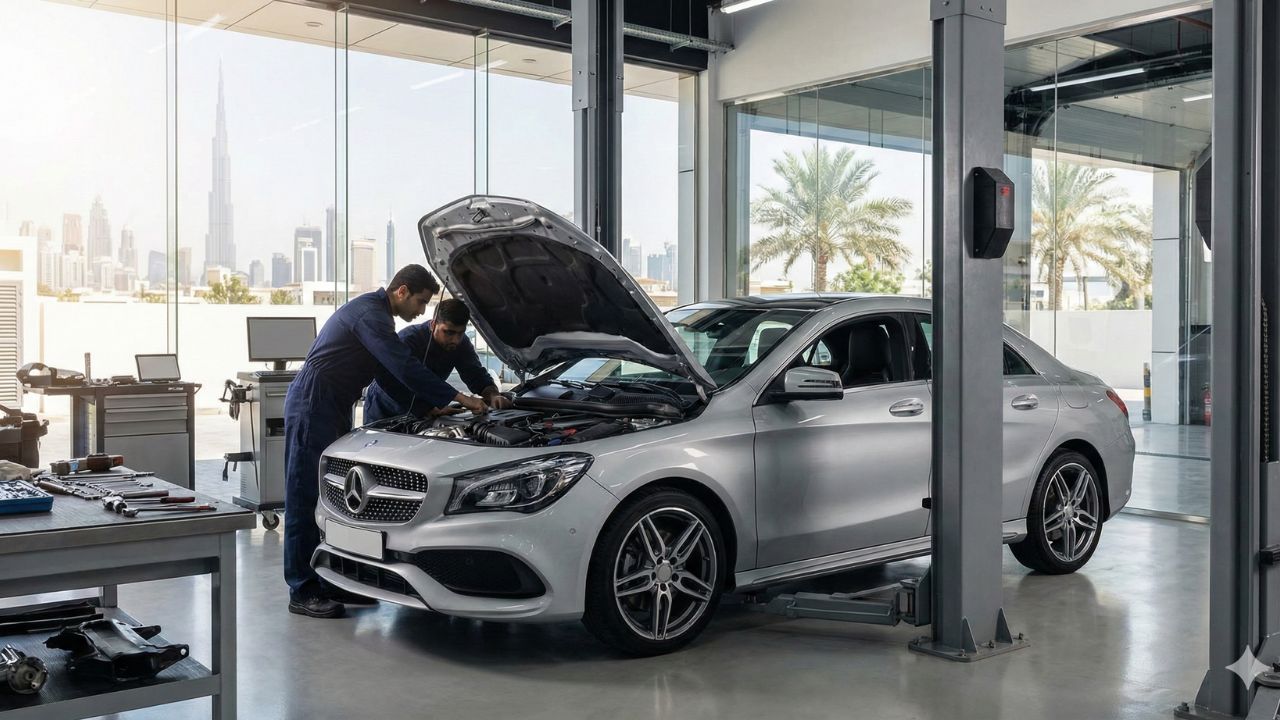
Picture this scenario: You’re navigating through the gleaming towers of Dubai Marina in your Mercedes-Benz CLA-Class, its sleek coupe-like silhouette cutting through traffic with precision. The dashboard suddenly illuminates with an amber warning symbol. Your heart sinks slightly. This isn’t just any vehicle requiring attention—this is a sophisticated piece of German engineering housing advanced technology that demands specialized understanding.
The Mercedes-Benz CLA-Class (C118), introduced in 2019 as the second generation of Mercedes’ compact four-door coupe, represents something extraordinary in automotive evolution. Unlike its predecessor, this generation sits on the completely redesigned MFA2 platform, sharing its architectural DNA with the latest A-Class while maintaining its own distinctive character. This isn’t your conventional sedan—it’s a statement vehicle that blends performance aspirations with practical luxury, all wrapped in aerodynamic styling that achieves a remarkable drag coefficient.
Dubai’s automotive landscape presents unique paradoxes. You’ll find countless repair facilities claiming expertise with luxury vehicles, yet few technicians truly understand the intricate dance between the CLA-Class’s turbocharged engines, sophisticated dual-clutch transmissions, and intelligent electrical architecture. Generic mechanics approach this vehicle as they would any Mercedes, missing the crucial differences that define the C118 generation’s specific requirements.
What distinguishes Euro Car Repair in this crowded marketplace? We’ve built our reputation exclusively around European luxury vehicles, developing deep specialization rather than spreading expertise thin across all automotive brands. Our technicians don’t just work on Mercedes-Benz models occasionally—they immerse themselves in the engineering philosophy, technical updates, and model-specific nuances that separate adequate repair from exceptional service.
The CLA-Class presents fascinating challenges. Its compact dimensions hide remarkable complexity. The turbocharged M260 four-cylinder engine, available in various power outputs depending on your model variant, demands precise maintenance protocols different from larger Mercedes powerplants. The 7-speed or 8-speed dual-clutch transmission requires specific fluid specifications and service intervals. The MBUX infotainment system integration means electrical repairs must account for complex network communications between dozens of control modules.
Throughout this comprehensive guide, we’ll explore why your Mercedes-Benz CLA-Class (C118) deserves specialized attention, how Dubai’s extreme environment accelerates specific wear patterns in this model, and why Euro Car Repair has become the trusted choice for CLA-Class owners seeking dealership-quality service without dealership complications. We’ll address the complete spectrum of services your vehicle requires, demystify common issues specific to this generation, and explain our philosophy of transparent, insurance-free service that prioritizes your vehicle’s health above administrative bureaucracy.
Your CLA-Class represents significant investment and daily reliance. It deserves technicians who recognize its unique engineering, understand its specific vulnerabilities, and possess the diagnostic equipment to communicate with its sophisticated electronic systems. Let’s explore why settling for generic repair compromises both your vehicle’s performance and your ownership experience.
Why Choose Euro Car Repair for Your Mercedes-Benz CLA-Class (C118)
Specialized CLA-Class (C118) Expertise That Goes Beyond Surface Knowledge
Walk into most repair facilities, and technicians will confidently claim they “work on all Mercedes models.” This surface-level approach fundamentally misunderstands modern automotive specialization. The CLA-Class (C118) shares virtually nothing with older Mercedes generations—it represents an entirely different engineering philosophy built on the modular MFA2 platform architecture.
Our technicians have invested hundreds of hours specifically studying the C118 generation’s unique characteristics. They understand how the longitudinally-mounted engine orientation differs from traditional Mercedes layouts. They recognize the specific torque specifications for suspension components that vary from other compact Mercedes models. They know which fault codes indicate genuine problems versus which represent temporary communication glitches in the CAN bus network.
This specialization extends to recognizing production year variations. Early 2019 models present different software calibrations than 2021 and later versions. The AMG CLA 35 and CLA 45 variants demand entirely different service approaches compared to CLA 200 or CLA 250 models. We maintain detailed technical documentation covering these distinctions, ensuring your specific vehicle receives precisely calibrated attention.
Consider transmission service as one example. The CLA-Class uses either the 7G-DCT or 8G-DCT dual-clutch transmission depending on engine variant and production year. These aren’t traditional automatic transmissions—they’re sophisticated mechatronic systems combining manual transmission efficiency with automatic convenience. Generic shops often service them like conventional automatics, using incorrect fluid specifications or improper bleeding procedures. We follow Mercedes-Benz engineering specifications exactly, understanding that these transmissions require specific fluid grades that maintain proper friction coefficients for clutch pack operation.
Our diagnostic capabilities reflect this specialization. We’ve invested in Mercedes-specific diagnostic platforms that communicate with your CLA-Class at the deepest level, accessing extended measurement values and performing component activations impossible with generic scan tools. When your dashboard displays a cryptic warning, we don’t guess—we interrogate every control module, analyze freeze-frame data, and perform guided function tests that identify root causes rather than replacing components speculatively.
Advanced Diagnostic Technology That Speaks Your CLA-Class’s Language
Modern vehicles like your CLA-Class contain more computing power than early spacecraft. The C118 generation houses approximately thirty separate control modules managing everything from engine timing to ambient lighting mood. These modules constantly communicate across multiple network protocols, sharing data and coordinating functions in microseconds.
Generic diagnostic equipment can read basic fault codes, but that’s comparable to understanding a foreign language by recognizing individual letters without comprehending words or sentences. Our Mercedes-specific diagnostic systems perform complete system scans, accessing manufacturer-level data streams that reveal subtle malfunctions invisible to basic scanners.
Take a real-world scenario we encountered recently: A CLA 250 arrived with intermittent stalling when coming to stops. Generic diagnostics showed no stored faults. Our advanced Mercedes diagnostic platform revealed a learned adaptation value in the transmission control module had drifted outside normal parameters, causing clutch engagement timing issues. We performed a transmission adaptation reset and recalibration—a procedure impossible without manufacturer-level equipment access. The vehicle returned to perfect operation.
This technological advantage extends to programming and coding requirements. When replacing components like control modules, steering angle sensors, or even simple switches, the CLA-Class often requires system initialization or component coding to function properly. We can perform these procedures in-house, avoiding the common scenario where vehicles leave repair shops with replaced components that don’t communicate correctly with the vehicle network.
Our investment in technology also includes thermal imaging cameras for detecting temperature anomalies indicating failing components, digital oscilloscopes for analyzing electrical signals in real-time, and pressure testing equipment specific to European vehicle cooling systems. These tools transform diagnosis from guesswork into precise scientific analysis.
Genuine Parts and Premium Alternatives: Quality Without Compromise
The parts debate represents one of the most misunderstood aspects of vehicle maintenance. Mercedes dealerships insist on factory parts exclusively—often at premium prices reflecting brand positioning rather than actual manufacturing costs. Meanwhile, budget repair shops gravitate toward the cheapest available components, prioritizing immediate profit over long-term vehicle health.
We’ve developed relationships with authorized Mercedes-Benz parts distributors, ensuring access to genuine OEM components when your CLA-Class demands original equipment. Simultaneously, we’ve extensively researched and tested premium aftermarket manufacturers who supply components meeting or exceeding OEM specifications at more reasonable pricing.
For critical systems—engine components, transmission parts, safety-related items like brake calipers and ABS modules—we recommend genuine Mercedes-Benz parts. Your vehicle’s engineering assumes original equipment specifications, and deviation in these areas risks performance or safety.
For routine maintenance items and wear components, we offer informed choices. Consider brake pads: The CLA-Class uses specific pad compounds designed for the vehicle’s weight distribution and braking system characteristics. We source pads from manufacturers like Brembo, Textar, or ATE—companies that actually manufacture pads for Mercedes production lines—offering identical quality at significantly reduced cost compared to Mercedes-branded packaging.
Every part we install comes with our warranty backing quality. We maintain detailed records of part sources, manufacturing dates, and installation specifications. If any component fails prematurely, we stand behind the repair completely, handling warranty claims directly without shuffling you between parts suppliers and labor disputes.
This approach extends to fluids and consumables. We use only manufacturer-approved engine oils meeting Mercedes-Benz specifications—typically Mobil 1 ESP Formula 5W-30 for most CLA-Class engines—never generic substitutes that might meet basic viscosity requirements but lack the specific additive packages Mercedes engineering demands. Transmission fluid, coolant, and brake fluid all follow identical quality standards.
Transparent Pricing Philosophy: Know Before We Begin
One of the most frustrating aspects of vehicle repair involves the dreaded phone call mid-service: “We found additional problems, and the total cost will be significantly higher than estimated.” This approach destroys trust and puts customers in impossible positions—pay unexpected costs or retrieve a partially repaired vehicle.
Euro Car Repair operates differently. Before touching any component on your Mercedes-Benz CLA-Class, we provide comprehensive written estimates detailing every procedure, part cost, labor hour requirement, and applicable tax. If diagnostic investigation reveals additional issues, we contact you immediately with detailed explanations and pricing before proceeding.
Our pricing structure reflects fair market rates significantly below dealership charges—typically 30-40% less for equivalent service quality—while maintaining substantially higher standards than budget shops operating on volume business models. We price services based on actual time requirements and true part costs, adding transparent margins rather than opaque “shop supplies” fees or hidden markups.
Consider a major service comparison: A Mercedes dealership might charge AED 3,500 for a comprehensive B-Service on your CLA-Class. Generic shops advertise AED 800, cutting corners on fluid quality and service thoroughness. We typically price this service around AED 1,800-2,200, using genuine Mercedes-approved fluids, following complete inspection protocols, and investing appropriate time in the service rather than rushing through procedures.
We’ll break down exactly what that pricing includes: the specific oil grade and quantity, genuine oil filter, air filter inspection and replacement if needed, comprehensive brake system inspection including pad thickness measurement, suspension component examination, tire pressure adjustment, and multi-point inspection covering dozens of systems. You’ll understand precisely what you’re paying for.
This transparency extends to repair decisions. If your CLA-Class needs suspension work, we’ll explain whether control arm bushings require replacement or just ball joints, providing cost breakdowns for both approaches. We’ll photograph worn components, showing you exactly why replacements are necessary rather than optional. You make informed decisions based on complete information.
Customer-First Service Model: Your CLA-Class, Your Schedule, Your Priority
Luxury vehicle ownership should enhance your life, not complicate it. We’ve designed our service model around your convenience rather than our operational efficiency. Flexible scheduling accommodates Dubai’s demanding professional landscape—we offer early morning drop-offs, evening appointments, and weekend availability.
Communication remains constant throughout your CLA-Class’s service. Upon arrival, you’ll receive a detailed service plan. As work progresses, we provide updates via your preferred method—phone calls, WhatsApp messages, or email reports. If we discover unexpected issues during inspection, we’ll send photographs and videos explaining conditions, empowering informed decision-making without pressure.
Your relationship with Euro Car Repair extends beyond individual repair transactions. We maintain comprehensive digital service records for your vehicle, tracking every procedure performed, parts installed, and inspections completed. This documentation proves invaluable for future service planning, resale value enhancement, and understanding your vehicle’s maintenance history completely.
We recognize that your time holds value. Our facility is strategically located with convenient access from major Dubai areas. For customers unable to visit during business hours, we offer pickup and delivery service throughout Dubai, collecting your CLA-Class from your location and returning it serviced and washed.
The waiting experience matters too. Our customer lounge provides comfortable seating, complimentary beverages, high-speed WiFi, and a quiet environment for working or relaxing while your vehicle receives attention. We respect that you might prefer spending service time productively rather than in sterile waiting rooms.
Why We Don’t Work With Insurance Companies: Independence Benefits You
This policy often surprises new customers, so let’s address it directly and explain why this approach actually benefits you tremendously as a Mercedes-Benz CLA-Class owner.
Insurance companies operate on fundamental business principles prioritizing cost minimization. When approving repairs, they pressure shops toward cheapest possible solutions—aftermarket crash parts instead of OEM body panels, remanufactured components instead of new, shortened labor times that rush procedures. Their approval processes create delays, adding days or weeks to repair timelines while adjusters review estimates and negotiate pricing.
By refusing insurance company partnerships, Euro Car Repair maintains complete independence in repair recommendations. We answer only to you—the vehicle owner—and to our professional standards. When your CLA-Class requires repair, we specify exactly what’s needed for proper restoration, using appropriate quality parts and investing necessary time for correct procedures.
This independence accelerates service dramatically. Without insurance approval requirements, we can begin repairs immediately upon your authorization. No waiting for adjusters, no bureaucratic delays, no compromised solutions to satisfy corporate policies. Your vehicle spends less time in the shop and returns to full operation faster.
Consider a collision repair scenario: Insurance companies often authorize paintless dent removal or blended panel painting when complete panel replacement and proper color matching would deliver superior results. They’ll approve used headlight assemblies from salvage yards rather than new OEM units. We’ll explain all options honestly, recommending the repair approach that truly restores your vehicle regardless of insurance company preferences.
For mechanical repairs, this philosophy means we’ll never suggest cutting corners to reduce claim costs. If your CLA-Class needs transmission work, we’ll rebuild or replace components properly rather than performing temporary Band-Aid repairs that satisfy insurance adjusters but leave underlying problems unresolved.
Direct payment actually simplifies your experience. You receive clear, fixed pricing upfront. No surprise “insurance didn’t cover this” bills arriving months later. No disputes over depreciation or “prevailing labor rates.” Just straightforward transactions where you pay for defined services and receive exactly what you authorized.
Many customers find that paying directly and submitting receipts to their insurance company for reimbursement provides better outcomes than insurance-direct arrangements. You maintain control over the repair quality, choose appropriate service levels for your luxury vehicle, and avoid the frustrations inherent in insurance company involvement.
Proven Track Record Serving Dubai’s CLA-Class Community
Euro Car Repair has been serving Dubai’s European luxury vehicle owners for years, building reputation through consistent service excellence rather than marketing hype. Word-of-mouth referrals comprise the majority of our new customer acquisition—existing clients trust us enough to recommend our services to friends, family, and colleagues.
Our customer retention rate exceeds 90%, meaning once CLA-Class owners experience our service quality, technical expertise, and transparent business practices, they return for all future maintenance and repair needs. This loyalty reflects satisfaction levels impossible to achieve through anything except consistent delivery of superior service.
We’ve serviced hundreds of Mercedes-Benz CLA-Class vehicles spanning all model years from the C118 generation’s 2019 introduction through current production. This experience base means we’ve encountered virtually every issue these vehicles develop, understand common failure patterns, and have developed efficient repair protocols specific to recurring problems.
Dubai’s CLA-Class community isn’t large, making reputation particularly important. Luxury vehicle owners communicate extensively through social groups, online forums, and personal networks. Negative experiences spread quickly, but so does praise for exceptional service. Our standing in this community reflects years of delivering on our commitments consistently.
Comprehensive Service Offerings for Your Mercedes-Benz CLA-Class (C118)
Engine Repair and Maintenance: The Heart of Performance
Your CLA-Class’s engine represents remarkable engineering compressed into surprisingly compact dimensions. The M260 four-cylinder turbocharged engine family powers most CLA-Class variants, delivering output ranging from 163 horsepower in base models to over 300 horsepower in AMG versions—all from just two liters of displacement. This power density comes through sophisticated technology: direct fuel injection, variable valve timing, integrated turbochargers, and intricate cooling systems managing thermal loads.
These engines demand precise maintenance schedules adapted to Dubai’s severe operating conditions. The combination of extreme ambient temperatures—frequently exceeding 50°C during summer months—and often short-distance urban driving creates harsh operational environments. Oil degrades faster when exposed to high temperatures. Cooling systems work overtime. Turbocharger bearings experience accelerated wear from heat cycling.
We’ve developed maintenance protocols specifically accounting for these factors. Engine oil service intervals get reduced from manufacturer recommendations designed for moderate climates. We use only approved 5W-30 synthetic oils meeting Mercedes-Benz 229.52 specification—these oils contain specific additive packages protecting turbocharged engines operating under extreme conditions. The oil filter receives genuine Mercedes replacement, as aftermarket filters sometimes use inferior media allowing contaminants to circulate.
The cooling system deserves particular attention in Dubai’s climate. Your CLA-Class utilizes a complex cooling arrangement with multiple circuits—the main engine coolant system, a separate turbocharger cooling circuit, and an oil cooling system. These circuits must maintain precise temperature control preventing overheating while reaching operating temperature quickly for emission control. We inspect coolant concentrations ensuring proper mix ratios, check system pressure for leaks invisible to visual inspection, and verify proper operation of electric coolant pumps that can fail silently.
Oil leaks represent common issues as engines age. The M260 engine uses a timing chain rather than belt, eliminating belt replacement requirements but creating potential oil seepage points around the chain cover. We’ve developed expertise in efficiently addressing these leaks, replacing gaskets and seals before minor seepage becomes major oil consumption requiring constant monitoring and top-ups.
Spark plug replacement follows manufacturer intervals but deserves quality attention. The CLA-Class uses specific NGK or Bosch spark plugs designed for direct injection engines operating at high cylinder pressures. We install precisely gapped plugs torqued to exact specifications—over-tightening risks thread damage in aluminum cylinder heads, while insufficient torque allows combustion gases to leak past threads.
Air filtration becomes critical in Dubai’s dusty environment. Your CLA-Class intake system pulls air through a high-efficiency filter before turbocharger compression. Contaminated filters restrict airflow, reducing power and forcing the turbo to work harder generating intake pressure. We inspect air filters at every service, replacing them more frequently than standard intervals when operating in particularly dusty conditions.
Turbocharger longevity depends heavily on proper maintenance. These precision devices spin at extraordinary speeds—over 200,000 RPM—riding on thin oil films. Clean oil maintained at correct levels prevents bearing wear. Proper shutdown procedures—allowing the engine to idle briefly before shutdown after hard driving—let turbo temperatures stabilize. We educate customers on driving habits that maximize turbocharger life.
Transmission and Gearbox Services: Smooth Power Delivery
The dual-clutch transmission in your Mercedes-Benz CLA-Class represents one of the vehicle’s most sophisticated systems, combining the efficiency of manual transmissions with automatic convenience through computer-controlled clutch actuation and lightning-fast gear changes. This technology requires specialized understanding that generic transmission shops simply don’t possess.
Most CLA-Class models use the 7G-DCT dual-clutch transmission, though some variants feature the newer 8G-DCT. Despite similar names, these represent fundamentally different transmissions requiring distinct service approaches. The 7G-DCT contains two wet-running clutches—meaning they operate immersed in specialized transmission fluid—while the 8G-DCT uses dry clutches operating in air. These architectural differences demand entirely different fluid specifications and service procedures.
Transmission fluid service intervals prove critical for dual-clutch longevity. Mercedes-Benz officially designates these transmissions as “filled for life,” but this description assumes ideal operating conditions—moderate climates, gentle driving, and relatively short ownership periods. Dubai’s reality differs dramatically. Stop-and-go traffic causes frequent clutch cycling. Extreme temperatures stress fluid additives. Extended ownership periods mean transmissions must survive well beyond original design assumptions.
We recommend transmission fluid service approximately every 60,000 kilometers or four years, whichever arrives first. This interval prevents fluid degradation that causes subtle shift quality deterioration—symptoms including delayed engagement, harsh shifting during cold starts, or slight shuddering during gear changes. By the time these symptoms become obvious, clutch pack wear has often progressed significantly.
The service procedure itself requires precision. Dual-clutch transmissions don’t have traditional drain plugs—fluid replacement requires removing the transmission pan, replacing the internal filter, and refilling with precisely measured quantities of specific Mercedes-Benz approved ATF. The system then requires electronic bleeding procedures using diagnostic equipment to purge air from the mechatronic unit and hydraulic circuits. Generic shops attempting this service often leave tiny air bubbles that cause erratic shifting.
Clutch adaptation represents another critical aspect of dual-clutch transmission maintenance. These transmissions continuously learn clutch behavior, adjusting engagement points and pressure curves as clutches gradually wear. Occasionally, adaptation values drift outside normal parameters, causing shift quality issues. We can monitor adaptation values using manufacturer-level diagnostics, resetting them when necessary and allowing the transmission to relearn proper engagement characteristics.
Transmission electrical issues can mimic mechanical failures. The mechatronic control unit—essentially a computer integrated into the transmission—contains dozens of solenoids controlling gear selection and clutch operation. Electrical connector corrosion from Dubai’s humidity, or software glitches, sometimes cause shifting problems that untrained technicians misdiagnose as requiring complete transmission replacement. Our diagnostic capabilities identify these electrical issues, often resolving problems through connector cleaning or software updates rather than expensive mechanical repairs.
We counsel customers honestly about transmission repair economics. If your CLA-Class has accumulated significant mileage and the dual-clutch unit exhibits mechanical wear—worn clutch packs, damaged synchronizers—replacement often makes more economic sense than rebuild attempts. We’ll provide cost comparisons, explain expected longevity of various approaches, and help you make informed decisions balancing repair costs against vehicle value.
Brake System Services: Confident Stopping Power
Your Mercedes-Benz CLA-Class brake system combines traditional hydraulic foundations with sophisticated electronic control systems managing ABS, stability control, and brake assist functions. The compact dimensions and relatively low weight compared to larger Mercedes models mean brake component selection balances performance with durability, requiring specific replacement parts maintaining proper system calibration.
Front brakes handle the majority of stopping force—typically around 70% during normal braking—and consequently wear faster than rear components. The CLA-Class uses solid or ventilated front rotors depending on model variant, paired with specific friction pad compounds matched to rotor metallurgy and vehicle characteristics. We measure brake pad thickness at every service, recommending replacement when pads reach approximately 3-4 millimeters remaining—this provides safety margin before reaching the wear indicators that trigger dashboard warnings.
Rotor replacement follows pad replacement in most cases. Modern brake rotors are engineered as matched systems with specific pads—mixing components from different manufacturers or generations often creates noise, vibration, or reduced stopping performance. We install rotors and pads as sets, ensuring proper break-in procedures that transfer an even layer of pad material onto rotor surfaces for optimal friction.
The rear brakes require particular attention because the CLA-Class uses an electronic parking brake system rather than mechanical cables. These systems integrate the parking brake function into the rear brake calipers through electric motors that actuate the pistons. When replacing rear brake pads, the system requires electronic retraction using diagnostic equipment—attempting to force pistons back mechanically can damage the electric motors. We have the proper tools and procedures for this operation.
Brake fluid represents often-overlooked maintenance. This hygroscopic fluid absorbs moisture from the atmosphere over time, lowering its boiling point and risking vapor lock during hard braking. Dubai’s humidity accelerates moisture absorption. Mercedes-Benz specifies DOT 4 brake fluid meeting specific low-viscosity standards for ABS operation. We recommend fluid replacement every two years regardless of mileage, completely flushing the system and installing fresh fluid throughout all brake circuits.
The brake system inspection process extends beyond measuring pad thickness. We examine brake lines for corrosion or damage, test brake pedal feel and travel, verify proper operation of the brake booster, and check brake proportioning valve function ensuring proper front-to-rear brake balance. These comprehensive inspections identify developing problems before they compromise safety.
For CLA 35 and CLA 45 AMG models, brake system demands increase substantially due to higher performance capabilities. These variants often use larger rotors, multi-piston calipers, and aggressive pad compounds. Performance brake upgrades represent popular modifications, and we can recommend and install enhanced brake systems maintaining compatibility with the vehicle’s ABS and stability control systems.
Brake squealing or grinding noises demand immediate attention. Squealing sometimes indicates wear indicators contacting rotors—thin metal tabs designed to create noise when pads reach replacement thickness. Grinding suggests metal-to-metal contact between pad backing plates and rotors, indicating severely worn pads and likely rotor damage. Either condition requires prompt service preventing damage to expensive brake components.
Air Conditioning and Climate Control: Essential Comfort in Dubai Heat
In Dubai’s brutal summer climate, air conditioning transitions from luxury feature to absolute necessity for vehicle usability. Your Mercedes-Benz CLA-Class climate control system represents sophisticated engineering managing cabin temperature, humidity, and air quality through multiple zones and automatic adjustments. When this system fails during summer, the vehicle becomes virtually undriveable within minutes.
The CLA-Class uses a modern R-134a or R-1234yf refrigerant system depending on production year—newer models transitioned to R-1234yf meeting updated environmental regulations. These systems operate at high pressures with refrigerant circulating through the compressor, condenser, expansion valve, and evaporator in continuous cycles. Each component plays critical roles in heat exchange processes.
The compressor, driven by the engine through an electromagnetic clutch, compresses refrigerant gas into high-pressure, high-temperature vapor. This represents the most expensive AC component and the most common failure point. Compressor failure often results from refrigerant loss allowing the compressor to run without proper lubrication, or from electrical clutch failure. We identify failing compressors through noise, reduced cooling capacity, or diagnostic fault codes indicating pressure sensor abnormalities.
Compressor replacement in the CLA-Class requires specific procedures beyond simply bolting in new components. The system demands evacuation, new receiver-drier installation, proper oil charging matching the compressor type, and complete system evacuation and recharging with precisely measured refrigerant quantities. Improper procedures leave moisture or air in the system, causing premature component failure.
The condenser, mounted in front of the radiator, releases heat absorbed from the cabin into the atmosphere. Dubai’s extreme ambient temperatures stress condensers heavily—they must reject heat when outside temperatures exceed cabin temperature targets. Stone impacts from road debris, corrosion from road salts, or internal restriction from contamination can compromise condenser function. We inspect condensers carefully during service, checking for damage, leaks, or blocked passages.
The evaporator, hidden deep in the dashboard, absorbs heat from cabin air passing over its cold surfaces. Water condenses on the evaporator, draining through tubes to the exterior—that puddle under your parked vehicle represents normal operation. Evaporator leaks create difficult repairs because dashboard removal is required for access. We can detect evaporator leaks using UV dye or electronic leak detectors before complete refrigerant loss occurs.
Cabin air filters protect evaporator cleanliness while filtering dust, pollen, and pollutants from intake air. Dubai’s dusty environment clogs these filters rapidly. Restricted cabin filters reduce airflow, strain the blower motor, and allow contaminants to accumulate on evaporator surfaces promoting bacterial growth. We inspect and replace cabin filters frequently, often annually or more frequently depending on operating conditions.
The climate control system’s electronic components deserve attention too. Multiple temperature sensors, pressure switches, blend door actuators, and the central climate control module manage system operation. Electrical issues sometimes mimic refrigerant problems—a failed pressure sensor might prevent compressor operation even when the refrigerant charge is correct. Our diagnostic capabilities identify electrical faults, preventing unnecessary refrigerant system repairs.
AC performance degradation happens gradually, and many owners adapt without realizing cooling capacity has diminished. We measure AC performance objectively using thermometers at dashboard vents. Proper operation should deliver vent temperatures approximately 6-8°C in recirculation mode. Higher temperatures indicate system problems requiring investigation—low refrigerant charge, restricted airflow, compressor inefficiency, or blend door issues affecting temperature mixing.
Preventive maintenance maximizes AC longevity. We recommend running the AC system briefly even during winter months, preventing compressor seal drying and ensuring lubricating oil circulates throughout the system. Regular refrigerant level checks identify small leaks before they cause compressor damage. Annual AC performance evaluations catch developing problems while repairs remain minor.
Suspension and Steering: Precision Handling and Ride Comfort
The Mercedes-Benz CLA-Class suspension design balances sporty handling characteristics with acceptable ride comfort—no simple engineering task in a compact vehicle. The MacPherson strut front suspension and multi-link rear suspension provide responsive handling while isolating occupants from road imperfections. However, Dubai’s road conditions and climate accelerate suspension component wear requiring attentive maintenance.
Speed bumps represent suspension nemeses in Dubai. The proliferation of poorly designed, excessively tall speed humps throughout residential areas subjects suspension components to repeated harsh impacts. Control arm bushings, shock absorbers, and ball joints endure forces far exceeding normal driving conditions. We regularly encounter CLA-Class vehicles with premature suspension wear directly attributable to daily speed bump traversing.
Front suspension inspection focuses on several critical components. Lower control arm bushings connect the control arms to the chassis, allowing necessary movement while maintaining proper wheel alignment geometry. These rubber bushings deteriorate from heat, oil contamination, and stress cycling. Worn bushings create clunking noises over bumps, cause imprecise steering feel, and accelerate tire wear through misalignment.
Ball joints connect control arms to steering knuckles, providing pivoting motion while supporting vehicle weight. Failed ball joints represent serious safety concerns—complete separation allows wheels to collapse under the vehicle. We measure ball joint play using specific testing procedures, replacing joints showing excessive movement before failure occurs.
Shock absorbers, or dampers in technical terminology, control suspension movement preventing excessive bouncing. The CLA-Class uses gas-charged monotube or twin-tube dampers depending on model specification. These dampers gradually lose effectiveness as internal seals wear and gas pressure decreases. Worn dampers allow excessive body motion, reduce handling precision, and accelerate wear on other suspension components. We test damper function both manually and through road test observation.
The rear suspension’s multi-link design uses numerous connection points—five separate links per side—providing precise wheel location control. This complexity means more components subject to wear. Rear suspension bushings deteriorate similar to front components, though rear wear progresses more slowly due to lower loads. We inspect all bushing and joint conditions during suspension evaluation.
Steering system maintenance in your CLA-Class focuses on the electric power steering system—there’s no hydraulic pump or fluid to service. The steering rack itself rarely requires attention, but tie rod ends connecting the rack to steering knuckles wear and require periodic replacement. Worn tie rod ends create loose steering feel and cause wandering at highway speeds.
Wheel alignment represents critical suspension maintenance often overlooked until tire wear becomes obvious. Your CLA-Class has specific alignment angles—camber, caster, and toe—engineered for the vehicle’s handling characteristics. These angles change when suspension components wear or after impact damage from potholes or curbs. We recommend alignment checks annually or whenever new tires are installed, adjusting all angles to Mercedes-Benz specifications.
Alignment becomes particularly important after suspension repairs. Replacing any component affecting suspension geometry—control arms, ball joints, tie rod ends—requires immediate alignment adjustment. Without proper alignment, new tires wear unevenly within thousands of kilometers, wasting the investment.
Dubai’s summer heat affects suspension components in surprising ways. Rubber bushings harden and crack more quickly in extreme temperatures. Shock absorber seals deteriorate faster. Even suspension spring coating can crack from thermal cycling, allowing corrosion to begin. We inspect suspension components with these climate-specific failure modes in mind.
Ride height changes sometimes indicate suspension problems. If your CLA-Class sits lower than normal or has uneven height side-to-side, this suggests broken springs or failed shock absorbers. We measure ride height against manufacturer specifications, identifying problems affecting vehicle appearance, handling, and tire wear.
Electrical System Diagnostics: Managing Complexity
Modern luxury vehicles like your Mercedes-Benz CLA-Class contain more software code than commercial aircraft, managing hundreds of functions through networked control modules. The electrical system’s complexity means diagnostic expertise becomes crucial—replacing components randomly hoping to fix electrical issues wastes money and rarely solves problems.
The battery represents the electrical system’s foundation. Your CLA-Class uses an absorbed glass mat (AGM) battery specifically designed for vehicles with start-stop systems and high electrical loads. These batteries differ fundamentally from conventional lead-acid batteries, requiring specific charging protocols and replacement procedures. When installing a new battery, we must register it with the vehicle’s electrical management system using diagnostic equipment—failure to perform this registration prevents proper charging and can damage the new battery.
Battery failures manifest in various ways. Obvious symptoms include slow cranking or complete no-start conditions. Subtle problems include electrical gremlins—random warning lights, malfunctioning accessories, or intermittent communication errors between control modules. These issues result from voltage fluctuations as the weak battery struggles to maintain system voltage during high current draw.
Dubai’s heat accelerates battery aging significantly. Extreme temperatures speed chemical reactions within batteries, causing faster degradation. A battery lasting five years in moderate climates might survive only three years in Dubai. We test battery condition during every service, measuring not just voltage but also load capacity and internal resistance indicating remaining life.
Alternator function deserves attention too. This engine-driven generator recharges the battery and powers electrical systems when the engine runs. The CLA-Class uses a computer-controlled alternator that varies output based on electrical demand and battery state of charge. These “smart alternators” require specific testing procedures different from conventional alternators. We can measure alternator output across various operating conditions, identifying failing units before complete breakdown occurs.
Electrical accessories fail occasionally. The CLA-Class contains dozens of motors, actuators, and electronic modules managing everything from seat adjustments to automatic trunk operation. When accessories malfunction, diagnostic complexity can surprise. For example, a non-functioning power window might result from a failed motor, broken regulator, faulty switch, wiring problem, or control module fault. We systematically diagnose these issues, testing components methodically rather than guessing at solutions.
The vehicle’s multiple networks—CAN bus, LIN bus, and MOST optical fiber for multimedia—communicate between control modules constantly. Network communication problems create bizarre symptoms—multiple warning lights, intermittent component operation, or complete system failures. These problems demand sophisticated diagnostic approaches using equipment that can monitor network traffic and identify communication errors.
Sensor failures represent common electrical issues. Your CLA-Class relies on dozens of sensors monitoring everything from wheel speeds to exhaust oxygen content. Failed sensors can prevent engine starting, trigger warning lights, or cause poor performance. We differentiate between actual sensor failure and wiring or connector problems that create similar symptoms.
Software updates occasionally fix electrical problems. Mercedes-Benz periodically releases updated control module programming addressing known issues or improving functionality. We maintain current software update information, applying relevant updates when they address specific problems or improve vehicle operation.
Fluid Leak Detection and Repair: Keeping Systems Sealed
Fluid leaks frustrate luxury vehicle owners because they suggest declining condition despite careful maintenance. Your Mercedes-Benz CLA-Class contains numerous fluid systems—engine oil, transmission fluid, coolant, brake fluid, power steering fluid, air conditioning refrigerant—each requiring proper sealing to function correctly. Dubai’s climate and road conditions stress sealing systems, sometimes causing leaks as vehicles age.
Engine oil leaks emerge from various sources. The timing chain cover, valve cover gasket, oil pan gasket, and front and rear crankshaft seals all represent potential leak points. Small leaks often appear as slight oil accumulation on components, visible during inspection but not severe enough to drip obviously. We identify these early leaks before they worsen, preventing oil consumption and reducing fire risks from oil contacting hot exhaust components.
Timing chain cover oil leaks deserve particular attention in the M260 engine. The complex cover design uses multiple gaskets and seals, and replacement requires careful surface preparation and precise reassembly. We’ve developed efficient procedures for this repair, minimizing labor costs while ensuring leak-free results.
Coolant leaks present serious concerns because engine overheating can cause catastrophic damage within minutes. The CLA-Class cooling system operates under pressure—approximately 1.5 bar—forcing coolant through narrow passages in the engine block and cylinder head. Leak points include radiator hoses, heater hoses, water pump, thermostat housing, and the radiator itself. Small coolant leaks sometimes appear as white residue around connections rather than obvious puddles, making detection challenging.
We pressure-test cooling systems to identify leaks invisible during static inspection. By pressurizing the system with the engine off, we can spot leaks without risks associated with running hot engines. This testing identifies marginal components likely to fail soon, allowing planned repairs rather than emergency breakdowns.
Transmission fluid leaks require immediate attention because dual-clutch transmissions contain relatively small fluid capacities—complete fluid loss can occur quickly from even moderate leaks. Leak sources include transmission seals, cooler line connections, and the transmission pan gasket. We identify leak locations precisely, performing targeted repairs rather than replacing gaskets unnecessarily.
Air conditioning refrigerant leaks create unique diagnostic challenges because the refrigerant is invisible and under pressure only when the system operates. We use electronic leak detectors or UV dye methods to locate refrigerant leaks. Small leaks might be repairable through seal replacement or component tightening; larger leaks typically require component replacement.
Preventive measures reduce leak likelihood. We inspect all fluid system components during regular service, looking for seepage patterns, corrosion, or damaged hoses. Rubber hoses deteriorate over time regardless of mileage—heat and ozone cause gradual hardening and eventual cracking. We recommend hose replacement based on age and condition rather than waiting for leaks to develop.
Additional Specialized Services for Complete Vehicle Care
Beyond major systems, your Mercedes-Benz CLA-Class requires various specialized services maintaining overall condition and functionality.
Tire service extends beyond simple replacement. Your CLA-Class uses tire pressure monitoring system (TPMS) sensors in each wheel, requiring sensor programming when replacing tires or wheels. We can clone sensor IDs or register new sensors to your vehicle’s TPMS module, ensuring the system functions properly after tire service. Proper tire selection matches your vehicle’s specifications—load rating, speed rating, and size must meet Mercedes-Benz requirements.
Sunroof maintenance prevents common leak and operating problems. The CLA-Class panoramic sunroof uses drain tubes routing water to frame areas, preventing interior leaks. These tubes can clog with debris, causing water overflow into the cabin. We clean sunroof drains during service, inspect seals for deterioration, and lubricate operating mechanisms ensuring smooth operation.
Minor body damage repair maintains your vehicle’s appearance. We handle small scratches, paint chips, and dent removal through partnership with skilled body shops specializing in European vehicles. These repairs use proper painting procedures including color matching and clear coat application maintaining factory finish quality.
Pre-purchase inspections serve buyers considering used CLA-Class vehicles. Our comprehensive inspection examines all major systems, identifies existing problems or needed maintenance, and provides detailed reports helping buyers make informed decisions. This service has prevented numerous customers from purchasing vehicles with hidden issues requiring expensive repairs.
Scheduled maintenance packages cover required service intervals comprehensively. Mercedes-Benz designates specific service types—A-Service, B-Service—required at alternating intervals. We perform these services following complete manufacturer procedures, using proper parts and fluids while inspecting all systems for developing problems. Maintenance packages provide cost predictability and ensure your vehicle receives appropriate attention throughout ownership.
Common Mercedes-Benz CLA-Class (C118) Problems We Solve
Understanding your vehicle’s specific vulnerabilities allows proactive attention preventing major failures. The CLA-Class C118 generation has developed certain characteristic issues appearing across the model range as vehicles accumulate mileage and age. We’ve encountered these problems repeatedly, developing efficient diagnostic and repair procedures.
Dual-Clutch Transmission Judder During Low-Speed Operation
Many CLA-Class owners report subtle transmission shuddering when creeping in traffic or during parking maneuvers. This manifests as vibration transmitted through the vehicle body when the transmission engages from a complete stop, particularly noticeable when the engine is cold.
This issue stems from the dual-clutch transmission’s wet clutch design. The clutches operate immersed in transmission fluid, relying on specific friction characteristics between clutch material and fluid. As the vehicle ages, contamination enters the transmission fluid—microscopic metal particles from normal wear, moisture absorption, or breakdown of fluid additives. This contamination alters friction characteristics, causing the clutches to grab unevenly during engagement.
We diagnose this problem through road testing under specific conditions and analyzing transmission adaptation values using diagnostic equipment. Treatment typically involves complete transmission fluid replacement using the exact Mercedes-Benz approved ATF specification. The fluid change must include new transmission filter installation and proper bleeding procedures. Following fluid service, we reset transmission adaptation values, forcing the system to relearn clutch engagement points with fresh fluid.
In most cases, this procedure eliminates the juddering completely. However, if the condition has existed for extended periods—allowing excessive clutch wear—some residual symptoms may persist. We counsel customers honestly about realistic expectations based on wear indicators visible in diagnostic data.
Prevention involves regular transmission fluid service despite Mercedes-Benz “lifetime fill” claims. Changing fluid every 60,000 kilometers prevents contamination buildup that causes clutch wear.
Engine Oil Consumption Concerns
Some CLA-Class models, particularly those with higher-output turbocharged engines, develop increased oil consumption as they age. Owners notice oil levels dropping between service intervals, requiring periodic top-ups to maintain proper level.
This issue relates to piston ring wear and valve stem seal deterioration. The M260 engine uses relatively low-tension piston rings optimizing fuel economy through reduced friction. These rings eventually wear, allowing small amounts of oil to enter combustion chambers where it burns. Valve stem seals prevent oil from entering cylinders through the valve guides; these seals harden over time in Dubai’s heat, losing sealing effectiveness.
Some oil consumption is considered normal—Mercedes-Benz specifies acceptable consumption rates up to one liter per 1,000 kilometers under severe operating conditions. However, consumption exceeding this suggests mechanical problems.
We diagnose excessive oil consumption through leak-down testing, which measures cylinder sealing efficiency by introducing compressed air into cylinders and measuring escape rate. This test differentiates between ring wear, valve problems, and cylinder head gasket issues. Borescope inspection allows visual examination inside cylinders, revealing carbon buildup patterns indicating oil consumption.
Addressing oil consumption depends on severity. Minor consumption might simply require more frequent oil level checks and top-ups between services. Severe consumption indicates engine wear requiring major repairs—piston ring replacement, valve stem seal replacement, or potentially complete engine rebuild. We provide honest assessments about repair costs versus vehicle value, helping customers make economically rational decisions.
Prevention centers on using correct oil specifications and maintaining proper service intervals. The Mercedes-Benz 229.52 oil specification includes specific volatility requirements minimizing oil consumption. Synthetic oils meeting this specification resist thermal breakdown better than cheaper alternatives.
Air Conditioning Performance Degradation
CLA-Class owners frequently experience gradually declining AC performance—the system still produces cold air but doesn’t maintain desired cabin temperature as effectively as when new. This becomes particularly noticeable during Dubai’s summer months when ambient temperatures peak.
Multiple factors contribute to this problem. Refrigerant slowly leaks from even perfectly sealed systems through microscopic permeation of hoses and seals. Over several years, refrigerant charge drops below optimal levels, reducing cooling capacity. Additionally, condenser fins clog with accumulated dirt, dead insects, and road debris, restricting airflow and preventing effective heat rejection.
The evaporator, hidden in the dashboard, accumulates dust and biological growth on its surfaces. This contamination insulates the evaporator, reducing heat transfer efficiency and restricting airflow. Clogged cabin air filters compound airflow restriction.
We diagnose AC performance through systematic testing. Refrigerant charge level, system pressures, and vent temperature measurements indicate system health. We inspect condenser condition visually, cleaning blocked fins carefully to restore airflow. Cabin filter replacement provides immediate improvement in many cases.
If refrigerant level is low, we identify leak sources before recharging the system. Simply adding refrigerant without finding leaks wastes money—the refrigerant will escape again within months. UV dye injection allows us to operate the system briefly, then use UV lights to spot leak locations precisely.
Complete AC system service includes refrigerant recovery, vacuum testing to verify system integrity, new receiver-drier installation, and recharge with precisely measured refrigerant quantities. This service restores cooling performance to factory specifications.
Prevention includes annual AC performance evaluation and cabin filter replacement. Running the AC system regularly, even during winter months, maintains seal lubrication and prevents stagnant refrigerant issues.
Battery Drain and Electrical System Problems
CLA-Class owners occasionally experience battery drain issues—the battery discharges when the vehicle sits unused for several days, requiring jump-starting. This frustrates owners expecting modern luxury vehicles to tolerate extended parking periods without problems.
The CLA-Class contains numerous control modules remaining partially active when parked, ready to respond to keyless entry or alarm triggers. Normally, these systems draw minimal current—around 30-50 milliamps—allowing the battery to sit for weeks without discharge. However, software glitches, failing modules, or electrical accessories not shutting down properly can increase parasitic draw, draining batteries quickly.
We diagnose parasitic draw using current meters, measuring electrical consumption with the vehicle completely shut down. By systematically removing fuses, we isolate which circuits draw excessive current, then focus testing on those specific systems. Common culprits include interior lighting not switching off completely, multimedia system components staying active, or control modules failing to enter sleep mode.
Sometimes the battery itself is the problem. Batteries gradually lose capacity with age, and Dubai’s heat accelerates this degradation. A battery that performed adequately when new might lack sufficient reserve capacity after three years to tolerate normal parasitic draw for extended periods.
We test battery condition comprehensively, measuring not just voltage but capacity, internal resistance, and cold cranking amps. These tests reveal whether the battery retains sufficient power for vehicle needs or requires replacement.
AGM battery replacement requires proper procedures. The new battery must be registered with the vehicle’s electrical system using diagnostic equipment, allowing proper charge management. Without registration, the alternator might overcharge or undercharge the battery, causing premature failure.
Prevention includes driving the vehicle regularly—weekly at minimum—and periodic battery testing. If extended parking is unavoidable, battery maintainers can keep the battery charged without overcharging.
Suspension Noise and Bushing Deterioration
CLA-Class owners often report clunking or knocking noises from the suspension when traversing speed bumps or rough roads. These noises suggest suspension component wear, particularly bushing deterioration.
Dubai’s combination of harsh road conditions—poorly designed speed bumps, pothole-riddled secondary roads—and extreme heat accelerates suspension bushing wear. These rubber isolators connect suspension components while absorbing vibration and allowing controlled movement. Heat causes rubber to harden and crack. Repeated impact loading from speed bumps tears bushings internally.
Worn bushings create noise when metal suspension components contact each other directly rather than being isolated by rubber. They also allow excessive suspension movement, affecting wheel alignment and causing imprecise handling feel.
We diagnose suspension noise through careful inspection and road testing. Sometimes noise sources are obvious—cracked bushings visible during visual inspection. Other times, diagnosis requires manipulating suspension components manually, feeling for excessive play in connections. Road testing over specific surface types helps isolate noise sources to particular suspension corners.
Control arm bushings represent the most common wear points. These bushings experience the highest loads and deteriorate predictably as vehicles accumulate mileage. Replacement involves removing complete control arms, pressing out old bushings, and installing new ones with proper alignment.
Ball joints require replacement when they develop excessive play. Unlike bushings, ball joints can separate completely if wear progresses too far, creating serious safety concerns. We measure ball joint play against manufacturer specifications, replacing joints showing excessive movement.
Shock absorbers rarely cause noise themselves but can allow suspension components to move excessively, amplifying noises from worn bushings or joints. We test shock absorber function both manually and through road test observation.
Prevention centers on avoiding harsh impacts when possible—slowing for speed bumps rather than hitting them at speed—and addressing noise promptly before wear progresses. Regular suspension inspection catches developing problems while repairs remain straightforward.
MBUX Infotainment System Glitches
The Mercedes-Benz User Experience (MBUX) infotainment system in your CLA-Class represents sophisticated technology managing navigation, entertainment, vehicle settings, and smartphone integration. Occasionally, owners experience system freezes, slow response, or features not functioning properly.
These problems typically stem from software issues rather than hardware failures. The MBUX system runs complex software managing multiple functions simultaneously. Software bugs can cause crashes or slow performance. Accumulated temporary data can consume memory, affecting response speed. Incomplete software updates sometimes create incompatibility between system modules.
We diagnose infotainment problems by checking software versions, analyzing system logs for error codes, and testing specific functions systematically. Often, simple solutions like clearing system cache or performing software resets resolve issues. If problems persist, software updates from Mercedes-Benz might address known bugs.
The navigation system requires periodic map updates maintaining routing accuracy. These updates install via USB drives or over-the-air downloads depending on your CLA-Class’s configuration. We can perform map updates ensuring navigation remains current.
Smartphone connectivity problems often relate to phone software rather than vehicle systems. We help troubleshoot these issues, verifying proper Bluetooth pairing and ensuring phone compatibility with MBUX systems.
Hardware failures occur less frequently but can affect screen responsiveness, speaker operation, or USB port functionality. We diagnose hardware issues using diagnostic equipment, replacing failed components when necessary.
Prevention includes keeping MBUX software current through available updates and maintaining proper phone compatibility. Avoiding extreme temperature exposure—like leaving the vehicle parked in direct sun for extended periods—reduces risks of screen and electronic component damage.
Brake Squealing Despite Recent Service
Some CLA-Class owners experience brake squealing, particularly noticeable during light brake applications or when backing up. This persists even after recent brake service, frustrating owners who expected new brakes to operate silently.
Brake noise stems from vibration—brake pads vibrating against rotors at frequencies generating audible sound. Multiple factors influence this vibration: pad compound characteristics, rotor surface finish, caliper hardware condition, and environmental factors like temperature and humidity.
The CLA-Class uses specific brake pad compounds balancing stopping performance, rotor wear, and noise characteristics. Aftermarket pads using different compounds might perform well but create noise. Even genuine Mercedes pads can squeal if rotor surfaces are glazed or contaminated.
We diagnose brake noise through careful inspection and testing. Rotor surface condition receives particular attention—glazed surfaces, caused by overheating or pad material transfer, require resurfacing or replacement for quiet operation. Caliper hardware including anti-rattle clips and shims must be properly installed and in good condition.
Sometimes brake noise relates to driving patterns. Gentle brake applications generate less heat, preventing proper pad material transfer to rotors. We recommend occasional firm stops from moderate speed—safely performed on empty roads—allowing brakes to heat sufficiently for proper bedding.
Chemical brake lubricants applied to pad backing plates and caliper contact points reduce noise by dampening vibration. We apply these lubricants during brake service, but they can wear away over time, allowing noise to return.
Some brake compounds generate more noise than others despite equivalent performance. When noise persists despite proper installation and rotor condition, switching to alternative pad compounds sometimes provides quieter operation.
Prevention involves using quality brake components properly installed with appropriate hardware and lubricants. Avoiding excessive heat—like riding brakes down hills—prevents rotor glazing that contributes to noise.
Coolant Temperature Fluctuations
Some CLA-Class owners notice the engine temperature gauge fluctuating more than expected, or cooling fans running frequently even during moderate driving. These symptoms suggest cooling system issues requiring attention.
The M260 engine uses precise temperature control for emission compliance and efficiency. The electronically-controlled thermostat, electric coolant pumps, and temperature sensors work together maintaining target temperatures. When components fail or coolant level drops, temperature control becomes erratic.
We diagnose cooling system problems through comprehensive testing. Coolant concentration testing verifies proper freeze protection and boiling point elevation—incorrect mixture ratios affect heat transfer efficiency. Pressure testing identifies leaks allowing coolant loss and air entry. Diagnostic equipment monitors coolant temperature sensor readings and thermostat operation.
The electric thermostat represents a common failure point. Unlike traditional mechanical thermostats, the CLA-Class uses an electronically-controlled unit that can stick open or closed. A stuck-open thermostat prevents proper engine warm-up, affecting fuel economy and cabin heating. A stuck-closed thermostat risks overheating.
Electric coolant pumps can fail electrically or mechanically. These pumps supplement the mechanically-driven water pump during specific operating conditions. Pump failure allows localized overheating in certain engine areas despite normal gauge readings.
Coolant level becomes critical in Dubai’s heat. Even minor leaks allowing slow coolant loss eventually create air pockets in the cooling system, affecting temperature control. We inspect for leaks carefully, checking common problem areas like radiator hoses, heater hoses, and the water pump.
Prevention includes regular coolant concentration testing, visual inspection for leaks, and monitoring temperature gauge behavior. Addressing minor cooling system issues promptly prevents major overheating damage.
Our Expert Technicians: The Foundation of Quality Service
Technical excellence begins with skilled technicians who understand your vehicle’s complexity and care about quality outcomes. Euro Car Repair employs mechanics specifically selected for their expertise with European luxury vehicles and passion for their craft. These aren’t generalist technicians working on any vehicle type—they’re specialists who chose this focus deliberately.
Our hiring process emphasizes demonstrated mechanical aptitude and technical education. We seek technicians with formal training from recognized automotive technical schools, preferably with European vehicle specialization. Beyond basic mechanical skills, we value problem-solving abilities and systematic diagnostic thinking essential for modern vehicle complexity.
Ongoing training represents a significant investment reflecting our commitment to expertise. Mercedes-Benz technology evolves continuously—new engine management strategies, updated transmission control algorithms, revised electrical system architectures. Our technicians participate in regular training programs keeping skills current with latest developments. This includes both formal classroom training and hands-on technical sessions with actual vehicles and components.
Certifications from industry organizations like ASE (Automotive Service Excellence) validate technical competence through rigorous testing. Our senior technicians hold multiple ASE certifications covering major automotive systems. Some technicians have completed Mercedes-Benz specific training programs through authorized channels, gaining insights into manufacturer design philosophy and service procedures.
Experience matters tremendously. While formal education provides foundation, real expertise develops through thousands of hours working on vehicles, encountering diverse problems, and learning from both successes and occasional mistakes. Our master technicians have spent decades specifically on European luxury vehicles, accumulating knowledge impossible to gain through training alone.
Diagnostic expertise separates outstanding technicians from merely competent ones. Modern vehicles contain such complexity that identifying root causes of problems demands systematic thinking, comprehensive understanding of how systems interact, and familiarity with common failure patterns. Our technicians don’t guess—they follow logical diagnostic pathways, test hypotheses methodically, and verify repairs solve problems completely.
Communication skills complement technical abilities. The best diagnostic work means nothing if technicians can’t explain findings clearly to customers. Our team excels at translating technical concepts into understandable language, helping owners comprehend their vehicle’s condition without condescending or oversimplifying. We use photographs, videos, and demonstration to show exactly what we’ve found, making abstract diagnostic results tangible.
Quality control processes ensure consistent service excellence. After completing repairs, senior technicians review work before releasing vehicles. This verification catches potential oversights—a loose connection, incomplete procedure, or missed inspection point. Final road testing confirms repairs achieved intended results before customers retrieve vehicles.
Tool and equipment expertise extends technical capabilities. Our technicians know which diagnostic procedures require specific equipment, how to interpret data streams properly, and when sophisticated testing tools provide value versus when basic procedures suffice. They maintain diagnostic equipment properly, update software regularly, and understand limitations of various testing methods.
The facility environment supports quality work. Clean, well-lit workspace with proper vehicle lifts, adequate storage for tools and parts, and comfortable temperature control allows technicians to focus on their work without environmental distractions. Proper organization means tools and equipment remain accessible but protected.
We foster continuous improvement culture. Technicians share experiences with challenging repairs, discussing diagnostic approaches and solutions. Regular team meetings cover technical topics, new procedures, or industry developments. This collaborative environment benefits everyone—less experienced technicians learn from veterans, while fresh perspectives sometimes solve problems puzzling senior staff.
Customer satisfaction drives our team. Technicians take pride in their work, understanding that quality repairs build our reputation and create long-term customer relationships. They approach each vehicle with care, treating customer property respectfully and protecting interiors while working. These details matter—customers notice when their vehicles return clean despite extensive repair work.
Dubai’s Unique Challenges for Mercedes-Benz CLA-Class (C118)
Your CLA-Class faces operating conditions in Dubai unlike anywhere else globally. Understanding these environmental stresses allows proactive maintenance preventing problems specific to this region.
Extreme Temperature Effects
Dubai’s summer temperatures regularly exceed 50°C ambient, with surface temperatures on asphalt reaching 70°C or higher. These conditions stress every vehicle system severely. Your CLA-Class’s turbocharged engine generates tremendous heat internally while attempting to reject that heat into already-scorching ambient air. The cooling system works overtime, stressing radiators, hoses, and coolant itself.
Air conditioning faces perhaps the harshest demands. The system must cool cabin air from extreme temperatures while operating compressors already heat-soaked from engine bay temperatures. Condenser efficiency drops as ambient temperature approaches desired cabin temperature—physics dictates diminishing returns as temperature differentials narrow. This explains why AC performance feels marginal during peak summer temperatures despite functioning properly by technical standards.
Electrical components age faster in extreme heat. Electronic control modules generate heat during operation that must dissipate into already-hot surroundings. Battery chemistry accelerates at high temperatures, increasing both performance and degradation rates. Plastic components—wiring insulation, connectors, hoses—harden and become brittle, cracking earlier than in moderate climates.
Engine oil degrades faster at elevated temperatures. The molecular structure of even synthetic oils breaks down gradually with heat exposure. This degradation reduces oil’s lubricating ability and increases oxidation byproducts that form sludge. We recommend shorter oil change intervals for Dubai operation—approximately 8,000 kilometers rather than the 15,000 kilometer intervals specified for moderate climates.
Cooling system maintenance becomes critical. Coolant must maintain proper concentration providing both freeze protection—less relevant in Dubai—and boiling point elevation crucial for preventing overheating. We test coolant concentration regularly, ensuring adequate protection. Radiator and condenser cleaning removes accumulated debris blocking airflow needed for heat rejection.
Interior components suffer too. Dashboard plastics crack from UV exposure and heat cycling. Leather seats dry and crack without proper conditioning. Electronic screens can develop pixel issues from extreme temperature exposure. We recommend covered parking whenever possible, significantly reducing these heat-related deterioration factors.
Sand and Dust Infiltration
Dubai’s desert environment creates constant exposure to airborne sand and dust particles. These abrasive contaminants affect multiple vehicle systems, requiring more frequent attention than typical operating environments.
Your CLA-Class air filtration system protects the engine from dust ingestion, but filters face overwhelming particle loads in Dubai conditions. A clean air filter might last 30,000 kilometers in moderate climates; in Dubai, replacement intervals drop to 10,000-15,000 kilometers. Restricted air filters reduce engine performance and force turbochargers to work harder generating boost pressure, accelerating turbo wear.
Cabin air filters face similar challenges. These filters protect occupants and prevent evaporator contamination, but clog rapidly with dust. Restricted cabin filters reduce AC performance noticeably—insufficient airflow across the evaporator means adequate cooling despite proper refrigerant charge and compressor function. We recommend cabin filter inspection and replacement much more frequently than standard intervals.
External surfaces accumulate dust constantly. This isn’t merely aesthetic—dust particles can scratch paint if wiped without proper washing techniques. Accumulated dust in crevices around badges, grilles, and trim pieces can trap moisture against metal surfaces, accelerating corrosion. Regular washing using proper techniques protects paintwork.
Dust infiltration affects seals and gaskets too. Door seals, window seals, and weatherstripping accumulate dust that acts as abrasive when these components move. Cleaning seals periodically and treating them with protectant extends life and maintains sealing effectiveness.
Brake components collect dust, both from external environment and from brake pad wear. This dust accumulation can affect brake caliper operation if sliders and hardware bind. We clean brake components thoroughly during service, lubricating slide points and inspecting for dust-related wear.
Humidity and Coastal Environment Effects
Despite desert climate, Dubai’s coastal location creates surprisingly high humidity, particularly during summer months. This humidity, combined with salt spray near beaches, accelerates corrosion on vehicle components.
Electrical connectors become vulnerable. Moisture infiltrates through connector seals, corroding metal contacts and creating resistance or open circuits. These corrosion issues cause intermittent electrical problems frustrating to diagnose—connections work initially when tested but fail under specific conditions. We apply dielectric grease to critical connectors during service, providing moisture barriers protecting contacts.
Brake components corrode readily in humid, salty environments. Exposed metal surfaces on rotors develop surface rust rapidly, though this typically cleans away with the first few brake applications. Caliper brackets and hardware experience more serious corrosion affecting operation. Seized caliper slide pins prevent proper brake pad clearance, causing dragging brakes and accelerated wear. We service brake hardware regularly, cleaning rust and applying appropriate lubricants.
Exhaust systems rust from the inside out. Combustion byproducts include water vapor that condenses inside exhaust pipes, particularly during short trips where exhaust components don’t reach full operating temperature. This moisture combines with exhaust gases forming corrosive compounds. Stainless steel exhaust components resist this better than mild steel, but corrosion eventually develops nonetheless.
Chassis components face corrosion too. Suspension components, steering racks, and chassis mounting points corrode over time despite protective coatings. This corrosion can affect functionality and complicate repair work when corroded fasteners break during disassembly.
Prevention focuses on regular washing—particularly undercarriage cleaning after beach visits—and protective coatings. We can apply rust-preventive treatments to chassis areas, providing additional protection beyond factory coatings.
Traffic Patterns and Driving Conditions
Dubai traffic presents unique challenges. The combination of aggressive highway driving on roads like Sheikh Zayed Road and congested stop-and-go traffic in areas like Deira creates wear patterns different from typical driving profiles.
High-speed highway driving stresses cooling systems and tires. Sustained speeds approaching 140-160 km/h generate tremendous heat in tires through flexing. Proper tire pressure becomes critical—underinflated tires generate excessive heat, risking failure at highway speeds. We emphasize proper tire pressure maintenance and inspection for heat-related damage.
Brake systems face demanding use. Heavy vehicles, high speeds, and sometimes sudden braking situations create significant thermal loads. Brake fade becomes possible if systems overheat—brake fluid boils, creating vapor pockets that compress rather than transmitting pressure effectively. We recommend high-quality brake fluid with elevated boiling points and regular fluid replacement.
Transmission wear accelerates in stop-and-go traffic. Your dual-clutch transmission cycles clutches constantly during traffic crawling, generating heat and wear. This explains why transmission fluid service becomes important despite relatively low mileage—the clutch cycling counts more than distance traveled. City driving requires more frequent transmission maintenance than highway driving.
Speed bumps, previously mentioned, damage suspension components through repeated harsh impacts. Unfortunately, Dubai’s residential areas contain numerous speed bumps, often poorly designed without proper approach angles. Slowing appropriately before speed bumps reduces impact forces dramatically, extending suspension component life.
Parking challenges affect vehicles too. Tight parking spaces in malls and outdoor parking in direct sun both create issues. Paint damage from door dings, mirror damage from tight spaces, and interior heat damage from sun exposure all occur regularly. We recommend parking protection behaviors and considering paint protection films or ceramic coatings.
Seasonal Considerations
Dubai’s seasons, while less extreme than temperate climates, still create maintenance considerations. Summer demands heightened attention to cooling and AC systems. Pre-summer inspections identify potential cooling system weaknesses before peak heat arrives, preventing breakdowns during the hottest months.
Winter brings somewhat more moderate temperatures and occasional dust storms. These storms deposit huge quantities of dust requiring immediate vehicle cleaning and air filter inspection. The gentler winter temperatures allow maintenance procedures like paint correction or interior detailing that would be uncomfortable in summer heat.
Ramadan affects driving patterns as traffic congestion increases dramatically near iftar times. This concentrated traffic creates more stop-and-go driving conditions, affecting fuel consumption and wear patterns. Understanding these seasonal variations helps anticipate maintenance needs.
Pricing and Value Proposition: Transparency and Fairness
Cost represents a significant consideration for luxury vehicle ownership. We understand that CLA-Class owners value their vehicles highly and want appropriate care, but also seek fair pricing that doesn’t exploit the luxury vehicle premium unnecessarily.
Our pricing philosophy centers on transparency. Every estimate breaks down labor hours required, parts costs including part numbers and specifications, and any shop supplies or fees. You’ll never encounter surprise charges or “miscellaneous” line items hiding profit padding. If additional work becomes necessary during repairs, we contact you with detailed explanations and pricing before proceeding.
Comparing our pricing to Mercedes-Benz dealerships reveals significant savings—typically 30-40% less for equivalent services. This difference stems from operational efficiency and overhead reduction rather than quality compromise. Dealerships operate elaborate facilities with extensive administrative staff, financing departments, and corporate overhead that independent shops don’t carry. Those costs get passed to customers through inflated labor rates and parts markups.
We charge AED 350-450 per labor hour depending on service complexity—sophisticated diagnostic work or specialty procedures command premium rates, while routine maintenance uses lower rates. Dealerships often charge AED 600-800 per hour, sometimes more. Over a multi-hour repair, these rate differences become substantial.
Parts pricing follows similar patterns. Dealerships mark up parts 40-60% over wholesale cost. We maintain 20-30% margins, passing savings directly to customers while maintaining adequate business sustainability. We’re transparent about this—if you source your own parts, we’ll install them with no markup, though we cannot warranty components we didn’t supply.
Consider a brake service example: Complete front brake pad and rotor replacement with genuine Mercedes components might cost AED 4,500 at a dealership. Our typical pricing ranges AED 2,800-3,200 for identical parts and superior service attention. Over multiple services annually, these savings accumulate significantly.
Package maintenance programs provide additional value. We offer annual maintenance plans covering scheduled services, inspections, and minor adjustments at discounted rates compared to paying individually. These packages help budget vehicle ownership costs while ensuring proper maintenance completion.
Value extends beyond immediate pricing though. Quality repairs performed correctly the first time eliminate repeat visits and multiply repairs. We’ve encountered numerous vehicles arriving after previous shops misdiagnosed problems, performing unnecessary repairs while underlying issues persisted. This wastes money dramatically—paying twice for the same problem repair while suffering continued vehicle unavailability.
Our diagnostic expertise prevents this waste. By identifying root causes accurately before beginning repairs, we ensure work addresses actual problems rather than symptoms. This might mean spending more time in diagnosis, but prevents the false economy of quick, incorrect repairs.
Warranty backing adds value too. We guarantee our work—if repairs fail prematurely due to workmanship or defective parts, we rectify problems at no additional cost. This warranty provides peace of mind impossible when using questionable repair facilities or attempting DIY repairs.
Long-term relationship value matters also. Customers developing ongoing relationships with Euro Car Repair benefit from continuity—technicians familiar with specific vehicles, maintenance history informing future service decisions, and loyalty rewarding customers through priority scheduling and special considerations.
We accept various payment methods accommodating customer preferences—cash, credit cards, bank transfers. Payment terms are straightforward—payment expected upon service completion unless prior arrangements exist. We don’t finance repairs directly but can recommend options for customers needing payment flexibility for major repairs.
Price shopping makes sense for significant repairs. We encourage customers to obtain multiple estimates, confident our pricing combines quality and value that withstands comparison. However, we emphasize comparing equivalent specifications—genuine versus aftermarket parts, complete versus partial procedures, experienced versus inexperienced technicians. The cheapest estimate often reflects the poorest value.
Customer Experience and Convenience: Service Excellence Beyond Repairs
Technical excellence means little if customer experience frustrates. We’ve designed service processes prioritizing convenience, communication, and respect for your time.
Scheduling appointments accommodates busy lifestyles. Online booking through our website allows 24/7 appointment scheduling without phone calls during business hours. We offer flexible timing including early morning drop-offs before work, evening appointments, and Saturday availability. Same-day service becomes possible for urgent repairs when schedule allows.
The drop-off process takes minutes. We’ve streamlined intake procedures collecting essential information quickly—contact details, vehicle symptoms, service requests, authorization limits. You’ll receive a service advisor’s direct contact information, avoiding frustrating phone trees when checking status.
Communication continues throughout service. We contact customers immediately after initial inspection, explaining findings and providing detailed estimates before beginning repairs. Progress updates arrive via preferred method—text messages for brief updates, phone calls for detailed discussions, or email for documentation. You’re never wondering about your vehicle’s status.
Digital service records provide comprehensive documentation. We photograph problem areas, document measurements like brake pad thickness or tire tread depth, and maintain detailed repair histories. These records transmit electronically, allowing easy record keeping and documentation for future reference or resale purposes.
Our facility provides comfortable waiting amenities for customers preferring to remain during service. The air-conditioned lounge offers comfortable seating, complimentary refreshments including coffee and water, high-speed WiFi for work or entertainment, and flat-screen television. The environment feels more like professional office waiting area than typical repair shop.
For customers unable to visit, pickup and delivery service eliminates inconvenience. We collect your CLA-Class from your location—home, office, wherever—perform necessary service, and return the vehicle washed and ready. This service covers major Dubai areas including Dubai Marina, Downtown Dubai, Jumeirah, Arabian Ranches, and surrounding communities. Modest service fees cover the convenience, though we waive these for major repairs.
Vehicle condition protection during service demonstrates respect for your property. We use protective seat covers, floor mats, and steering wheel covers during all service work, preventing grease or dirt contamination of interior surfaces. Exterior protection includes fender covers during engine work and careful positioning to prevent lot damage. Your vehicle returns as clean or cleaner than arrival.
Quality control inspection precedes every vehicle release. Senior technicians verify completed work meets our standards—proper torque specifications, secure connections, no leaks, appropriate fluid levels. Road testing confirms repair effectiveness and ensures no new issues developed during service.
Post-service support continues after vehicle retrieval. If questions arise about the service performed, or if any concerns develop following repairs, we address these immediately. Our technicians remain available to discuss service, explain maintenance recommendations, or troubleshoot issues.
Emergency service availability provides peace of mind. While we cannot guarantee same-day appointments for routine maintenance, we prioritize breakdown situations. If your CLA-Class becomes undriveable, we’ll work to accommodate emergency service, potentially offering after-hours assistance for serious problems.
The warranty process remains hassle-free. Should any warranty situation arise, simply contact us and schedule a return visit. We handle warranty claims internally without passing customers between parts suppliers and service departments. Our goal is resolution, not frustration.
Customer feedback receives serious attention. We encourage honest reviews and suggestions, using this input to continuously improve service quality. Complaints trigger immediate investigation and response, as service failures represent opportunities for improvement. Positive feedback gets shared with technicians, recognizing excellent work.
Frequently Asked Questions
Q1: How much does Mercedes-Benz CLA-Class (C118) repair cost in Dubai?
Repair costs vary tremendously depending on service type, parts requirements, and labor complexity. Routine maintenance like oil changes typically runs AED 600-900 using quality synthetic oils meeting Mercedes specifications. Comprehensive scheduled services range AED 1,800-2,500 depending on service type and model variant.
Major repairs command higher pricing reflecting parts costs and labor intensity. Brake system service including pads and rotors averages AED 2,500-3,500 for front axle work. Suspension repairs vary widely—replacing control arm bushings might cost AED 1,200-1,800 per side, while complete shock absorber replacement runs AED 3,000-4,500 for all four corners with quality components.
Transmission repairs represent significant expense. Dual-clutch transmission fluid service with proper procedures costs AED 1,500-2,000. Major transmission repairs requiring partial disassembly or component replacement can exceed AED 10,000-15,000, while complete transmission replacement reaches AED 20,000-30,000 depending on parts sourcing.
Engine repairs span enormous range. Minor repairs like valve cover gasket replacement might cost AED 1,500-2,200, while timing chain replacement due to wear or failure can exceed AED 5,000-7,000. Major engine rebuilds or replacement obviously command significantly higher pricing.
Our pricing consistently runs 30-40% below Mercedes-Benz dealership charges for equivalent service quality. We provide detailed written estimates before beginning work, ensuring you understand costs completely. These estimates break down labor hours, parts specifications, and itemized pricing for transparency. Additional work discovered during repairs receives approval before proceeding, preventing surprise bills.
Factors affecting costs include model variant—AMG versions often require more expensive components—production year affecting parts availability, repair complexity, and parts sourcing options. We discuss these factors openly, explaining choices between genuine Mercedes parts and quality alternatives where appropriate. Our goal remains delivering excellent value through quality work at fair pricing rather than maximizing profit through unnecessary repairs or inflated charges.
Q2: Do you use genuine Mercedes parts for Mercedes-Benz CLA-Class (C118)?
We maintain flexibility regarding parts sourcing, recommending approaches appropriate for specific repairs and customer priorities. For critical safety and performance systems, we strongly recommend genuine Mercedes-Benz OEM parts. These include engine internal components, transmission parts, ABS modules, airbag components, and structural elements. Mercedes engineering assumes original equipment specifications, and deviation in these areas risks performance, safety, or reliability.
Our relationships with authorized Mercedes-Benz parts distributors ensure access to genuine components at competitive pricing. We source parts directly from suppliers serving dealerships, obtaining identical components without dealership markup. These parts come with full Mercedes-Benz warranty backing and include proper part numbers for documentation.
For routine maintenance items and certain wear components, we offer premium aftermarket alternatives meeting or exceeding OEM specifications. Many aftermarket manufacturers actually produce components for Mercedes production lines, then market identical products under their own brands at lower prices. Brands like Bosch, Continental, Brembo, Sachs, and ATE supply both OEM and aftermarket channels with equivalent quality.
Consider brake components as example. Mercedes-branded brake pads might cost AED 600-800 per axle. Identical pads from Brembo—who manufactures for Mercedes—cost AED 400-500. The pad compound, backing plate design, and performance characteristics match exactly. We offer customers this choice transparently, explaining the equivalence.
We never install low-quality generic parts on vehicles without customer knowledge and consent. Every estimate specifies parts brands and quality levels. If you prefer all genuine Mercedes parts regardless of cost, we accommodate gladly. If budget considerations exist and quality alternatives are available, we present options honestly.
All parts we install come with our warranty. If any component fails prematurely due to defect or improper specification, we replace it at no charge including labor. This warranty covers both genuine Mercedes parts and approved aftermarket components equally, because we stand behind the quality of everything we install.
For specialized components without quality aftermarket alternatives, we source genuine Mercedes parts exclusively. Modern vehicle complexity means some components—control modules, sensors, certain electrical components—function properly only with OEM specifications. We won’t compromise vehicle operation through inappropriate parts substitution.
Fluids and consumables always meet Mercedes specifications exactly. Engine oil meets Mercedes-Benz approval standards—typically MB 229.52 for most CLA-Class engines. Transmission fluid, coolant, brake fluid, and other consumables match exact specifications even when not Mercedes-branded. These specifications exist for good reason and we never deviate regardless of cost savings.
Q3: How long does typical Mercedes-Benz CLA-Class (C118) service take?
Service duration varies considerably depending on work scope, parts availability, and schedule complexity. Basic oil change service typically completes within one hour—we drain oil, replace filter, refill with appropriate oil grade, reset service indicators, and perform courtesy multi-point inspection. You can wait comfortably or leave the vehicle briefly.
Comprehensive scheduled maintenance services require 2-3 hours. These services include oil change, filter replacements, fluid level checks, brake system inspection, suspension examination, tire condition assessment, and detailed multi-point inspection covering dozens of systems. Thoroughness takes time—rushing through procedures compromises quality.
Brake service duration depends on scope. Replacing brake pads typically takes 1.5-2 hours per axle including proper bedding procedures. Adding rotor replacement extends this to 2-3 hours per axle. Complete brake system service covering front and rear axles can span 4-6 hours when including fluid flush and detailed inspection.
Suspension repairs vary widely. Replacing shock absorbers might require 3-4 hours for all four corners. Control arm replacement can take 4-6 hours depending on specific components and whether alignment is included afterward. More extensive suspension work obviously extends duration accordingly.
Transmission service spans 2-3 hours for proper dual-clutch transmission fluid replacement including pan removal, filter replacement, proper fluid fill procedures, and electronic bleeding. This service cannot be rushed—proper procedures demand time for thorough completion.
Diagnostic time remains difficult to estimate because problem complexity varies. Simple issues might identify within 30-60 minutes. Complex intermittent problems requiring extensive testing, multiple road tests, or component substitution can demand several hours. We provide diagnostic time estimates but acknowledge uncertainty when problems resist straightforward identification.
Major repairs obviously require extended time—timing chain replacement might take 8-12 hours, engine removal for major work can span several days, and body work following collisions varies by damage extent. We provide realistic timeframes upfront, avoiding the common problem of shops promising quick completion then calling with delays.
Parts availability affects timing significantly. Common maintenance items remain in stock, allowing immediate service. Specialized components might require ordering, adding 1-3 days typically for parts arrival. Rare components for older vehicles or unusual failures occasionally demand longer waits. We check parts availability before scheduling major repairs, preventing situations where your vehicle occupies our shop waiting for parts.
We respect your time through efficient processes. Appointments receive dedicated bay assignments preventing delays from previous work running long. Multiple technicians handle different aspects of service simultaneously when appropriate—one technician performing mechanical work while another handles diagnostic tasks. This efficiency reduces your wait time without compromising quality.
For extensive repairs requiring multiple days, we provide updates on progress. You’ll know when parts arrive, when major procedures complete, and when final testing begins. This communication prevents the frustration of wondering about your vehicle’s status during extended repairs.
Q4: Why don’t you work with insurance companies?
This policy reflects our commitment to repair quality and customer service above administrative convenience. Insurance companies fundamentally prioritize cost minimization—their business models profit by limiting claim payouts. This creates inherent conflicts between proper vehicle repair and insurance company interests.
When repair shops become insurance-preferred providers, they effectively work for insurance companies rather than vehicle owners. Pressure exists to use cheaper aftermarket parts, limit labor hours, find least-expensive solutions, and sometimes compromise quality to satisfy insurance adjusters. These pressures directly conflict with proper luxury vehicle repair.
Your Mercedes-Benz CLA-Class deserves appropriate quality repairs, not cheapest possible fixes satisfying insurance algorithms. When we diagnose problems and recommend repairs, those recommendations answer only to technical requirements and your vehicle’s needs—not insurance company cost targets. This independence ensures honest repair recommendations.
Insurance approval processes create significant delays. Adjusters must review estimates, negotiate pricing, approve procedures—each step adding days or weeks to repair timelines. By avoiding insurance involvement, repairs begin immediately upon your authorization. Your vehicle spends less time awaiting bureaucratic approvals and returns to service faster.
Direct payment actually simplifies your experience. You receive fixed pricing upfront, pay for defined services, and receive exactly what you authorized. No surprise bills months later claiming “insurance didn’t cover this portion.” No disputes over depreciation or “prevailing rates.” Just straightforward transactions where you control decisions.
Many customers find that paying directly and submitting receipts to insurance companies for reimbursement provides better outcomes. You maintain control over repair quality, choose appropriate service levels for your vehicle, and avoid insurance involvement complications. Insurance companies reimburse customers regularly for covered repairs performed outside their preferred networks.
This policy particularly benefits CLA-Class owners because luxury vehicles demand quality parts and experienced technicians. Insurance companies often resist both, pressuring for cheaper alternatives. We never face these pressures—our only obligation is delivering excellent repairs to satisfied customers.
For collision repairs, insurance involvement becomes more complex. We can provide detailed repair estimates that you submit to your insurance company. If they approve our pricing and specifications, you can proceed with us while managing insurance communications directly. This approach gives you repair control while potentially receiving insurance reimbursement.
Mechanical repairs rarely involve insurance anyway unless specific coverage exists. Most insurance policies cover collision and comprehensive claims, not routine maintenance or mechanical failures from wear. Our independence matters most for these mechanical repairs where insurance involvement would be minimal regardless.
We understand some customers prefer or require insurance-direct arrangements. We respect that preference and can recommend qualified shops working within insurance networks if this remains your priority. However, we believe our independent approach delivers superior outcomes for customers valuing quality above administrative convenience.
Q5: What makes Euro Car Repair better than Mercedes dealerships for Mercedes-Benz CLA-Class (C118)?
Dealerships and independent specialists serve different purposes, and understanding these differences helps owners choose appropriate service providers for their needs.
Dealerships excel at warranty service, large-scale inventory, and brand consistency. If your CLA-Class remains under warranty, dealership service maintains warranty compliance and provides manufacturer backing for repairs. Their parts departments stock extensive inventories ensuring immediate parts availability. Multiple service advisors and large facilities handle high customer volumes efficiently.
However, dealerships operate with significant overhead costs—elaborate facilities, extensive administrative staff, corporate requirements, manufacturer obligations—that customers fund through elevated pricing. Labor rates typically run 50-80% higher than independent specialists for equivalent work. Parts markups can reach 60% over wholesale costs. These premiums don’t necessarily reflect superior expertise or quality—they cover operational costs inherent to dealership business models.
Personalized attention suffers at high-volume dealerships. Service advisors manage dozens of customers daily, limiting time for detailed discussions about your specific vehicle. Technicians work under time pressure, incentivized to complete repairs quickly rather than thoroughly. Your vehicle becomes one of many in the queue rather than receiving focused individual attention.
Euro Car Repair offers alternative advantages. Our specialization in European luxury vehicles—rather than being general repair facility—means technicians develop deep expertise with Mercedes-Benz systems and common model-specific issues. They work on Mercedes vehicles constantly, accumulating experience impossible in general shops.
Personalized service reflects our smaller scale. You communicate directly with technicians working on your vehicle rather than through service advisor intermediaries. Questions receive detailed answers from people actually performing work. This direct communication prevents information loss and miscommunication common in large operations.
Our pricing structure delivers substantial savings—typically 30-40% lower than dealerships for equivalent services—while maintaining quality through genuine parts sourcing and proper procedures. These savings accumulate significantly over years of ownership, potentially thousands of dirhams annually in reduced service costs.
Flexibility represents another advantage. We accommodate special requests, work around unusual schedules, and adapt to customer preferences. Dealerships operate rigid corporate procedures leaving little room for individual customization. We can source specialty parts, perform custom work, or adjust services matching your specific priorities.
Quality doesn’t suffer despite lower pricing. We actually invest more time in services than dealerships rushing through procedures. Oil changes include thorough inspections. Diagnostics dig deeper into problems rather than replacing components speculatively. This thoroughness prevents repeat visits and ensures problems resolve completely.
The relationship dynamic differs fundamentally. Dealerships view customers as transactions—valuable during the sale, profitable during warranty period, less prioritized afterward. We build long-term relationships with owners maintaining vehicles throughout their lifespans. Your satisfaction determines our success, creating alignment between your interests and our business objectives.
Equipment and training remain equivalent. We invest in Mercedes-specific diagnostic equipment matching dealership capabilities. Our technicians pursue ongoing training including Mercedes technical updates. The tools and knowledge match—we simply operate under different business model without corporate overhead.
For warranty work, dealerships remain necessary. Afterward, independent specialists like Euro Car Repair provide superior value without quality compromise. Many customers continue using dealerships for specific situations—complex technical updates requiring manufacturer support, or obtaining maintenance records for vehicle resale—while handling majority of service needs through independent specialists offering better pricing and attention.
Q6: Can you handle Mercedes-Benz CLA-Class (C118) warranty repairs?
Warranty work creates unique situations requiring careful understanding. If your CLA-Class remains under Mercedes-Benz factory warranty—typically 4 years from purchase for new vehicles—warranty coverage requires repairs performed at authorized Mercedes-Benz dealerships. This represents contractual requirements that independent shops cannot circumvent regardless of capability.
During warranty periods, we recommend dealership service for covered issues. Attempting warranty repairs at independent facilities risks warranty claim denials and leaves you personally responsible for repair costs. The savings from using independent shops don’t justify these risks during active warranty coverage.
However, warranty coverage limitations exist. Warranties cover manufacturing defects and component failures under normal use—they don’t cover maintenance items, wear components, or damage from accidents or abuse. Oil changes, brake service, tire replacement, and normal wear items remain your responsibility regardless of warranty status. We can handle these services without affecting warranty coverage.
Extended warranties create different considerations. Third-party extended warranties sold separately from factory coverage sometimes allow repairs at any qualified facility, sometimes require specific networks, and occasionally restrict to dealerships only. Policy terms vary dramatically. We recommend reviewing your specific extended warranty documentation understanding repair location requirements.
If your extended warranty allows independent facility repairs, we can provide detailed repair documentation for claim submission. This includes itemized estimates, parts receipts, labor records, and technical justifications. Many extended warranties reimburse customers for approved repairs, allowing choice of repair facility while maintaining coverage.
Post-warranty situations remove restrictions entirely. Once factory warranty expires, you maintain complete freedom choosing service providers. At this point, independent specialists offer significant advantages—lower costs, personalized attention, equivalent expertise—without sacrificing quality. Most CLA-Class owners transition to independent service after warranty expiration.
Pre-purchase inspections gain particular importance for used CLA-Class vehicles. Many used vehicles sell with expired or limited remaining warranty. Our comprehensive pre-purchase inspection identifies existing problems, needed maintenance, and upcoming repair requirements. This information helps negotiate purchase prices or avoid problematic vehicles entirely.
Manufacturer-specific situations occasionally benefit from dealership relationships. Technical service bulletins, software updates, or recall campaigns typically require dealership involvement. We monitor these situations and recommend dealership visits when manufacturer-level service becomes necessary.
We maintain detailed service records matching dealership documentation standards. If you later sell your CLA-Class, our comprehensive records demonstrate proper maintenance even without exclusive dealership service history. Many buyers actually prefer independent specialist records showing thorough care over dealership records sometimes indicating minimal service.
The fundamental point remains: respect warranty requirements during coverage periods, but recognize that warranty expiration doesn’t diminish vehicle quality or elevate dealership expertise above qualified independent specialists. We provide excellent CLA-Class service throughout vehicle lifespan, simply deferring to dealerships during warranty periods when contractually required.
Q7: How often should I service my Mercedes-Benz CLA-Class (C118) in Dubai?
Dubai’s extreme operating conditions demand modified service intervals beyond Mercedes-Benz standard recommendations designed for moderate climates. The combination of high temperatures, dusty environment, and varied traffic patterns accelerates wear and fluid degradation.
Engine oil service represents the most critical maintenance. Mercedes-Benz specifies 15,000-25,000 kilometer intervals depending on model year and monitoring system calculations. These intervals assume moderate climates and gentle use. Dubai reality demands more frequent service—we recommend 8,000-10,000 kilometer intervals or annually, whichever arrives first.
This reduced interval prevents oil degradation from extreme heat exposure. Even quality synthetic oils break down faster at sustained high temperatures. Turbocharged engines generate tremendous heat, stressing oil beyond normal naturally aspirated engine conditions. Frequent changes maintain proper lubrication protecting expensive engine components.
Transmission fluid service every 60,000 kilometers or four years prevents dual-clutch transmission problems. Mercedes claims “lifetime fill,” but lifetime means different things to manufacturers versus owners hoping for long-term reliability. Regular fluid changes prevent clutch wear and maintain shift quality.
Brake fluid replacement every two years regardless of mileage addresses hygroscopic moisture absorption accelerated by Dubai’s humidity. Contaminated brake fluid lowers boiling point risking brake fade during hard stops. Fresh fluid maintains proper brake performance and prevents internal brake system corrosion.
Coolant service every four years or 100,000 kilometers maintains proper freeze protection and corrosion inhibitors. While freeze protection seems irrelevant in Dubai, corrosion protection and boiling point elevation remain critical. Old coolant loses these properties, risking cooling system damage.
Air filter inspection every 10,000 kilometers addresses Dubai’s dusty conditions. Replace filters when restricted—usually every 15,000-20,000 kilometers depending on driving conditions. Dusty environments require more frequent replacement than standard 30,000+ kilometer intervals.
Cabin air filter replacement annually maintains AC performance and cabin air quality. These filters clog rapidly in dusty environments, restricting airflow and allowing contaminants into ventilation systems. Annual replacement ensures proper AC cooling capacity and prevents evaporator contamination.
Tire inspection and rotation every 10,000 kilometers promotes even wear and identifies developing problems. High temperatures accelerate tire aging regardless of tread depth. Check tire dates—tires older than six years should be replaced even if tread appears adequate, as rubber compounds degrade with age in extreme heat.
Comprehensive multi-point inspections at every service identify developing problems before failures occur. These inspections cover brake system condition, suspension wear, fluid leaks, belt condition, and dozens of other items. Early detection prevents roadside breakdowns and allows planned repairs rather than emergency situations.
Major services at 60,000 kilometer intervals address significant maintenance items—spark plugs, transmission fluid, additional filter replacements, detailed system inspections. These services require several hours but maintain vehicle reliability and performance.
Battery testing annually identifies weakening batteries before failure. Dubai’s heat shortens battery life dramatically—three year lifespan is typical versus five years in moderate climates. Replace batteries showing weakness rather than waiting for complete failure.
Beyond mileage-based schedules, symptom-based service remains important. Unusual noises, warning lights, performance changes, or handling differences deserve immediate attention regardless of service schedule. Addressing problems early prevents minor issues from escalating to major repairs.
The fundamental principle: Dubai operation constitutes “severe duty” service conditions in automotive terms. Treat your CLA-Class accordingly with shortened intervals, thorough inspections, and prompt attention to developing problems. This approach maximizes reliability, minimizes unexpected repairs, and maintains vehicle value through demonstrated proper care.
Q8: Do you offer mobile repair or pickup/delivery for Mercedes-Benz CLA-Class (C118)?
We provide pickup and delivery service throughout Dubai recognizing that owners’ time holds significant value. This service eliminates your need to visit our facility, wait during service, or arrange alternative transportation.
Our pickup service collects your CLA-Class from your specified location—home, office, parking facility—anywhere within our service areas. You provide keys and service instructions remotely if preferred, or meet briefly with our driver to discuss requirements. We transport your vehicle to our facility where technicians perform required service.
Upon completion, we deliver your vehicle returned to the original collection location or alternate destination if you’ve relocated during service. The vehicle arrives clean, washed and vacuumed, with completed service documentation and any applicable parts or recommendations explained.
Service areas include major Dubai communities: Dubai Marina, JBR, Downtown Dubai, Business Bay, Jumeirah, Arabian Ranches, Dubai Sports City, Motor City, JLT, The Greens, Emirates Hills, and surrounding areas. We can accommodate locations outside these zones for major repairs, though distance fees might apply.
Pickup and delivery fees vary based on location distance—typically AED 100-200 round trip for most areas. We waive these fees for major repairs or service packages exceeding certain values, as customer convenience becomes part of comprehensive service at that level.
Mobile repair—performing repairs at customer locations—remains impractical for most CLA-Class service. Modern vehicles demand sophisticated diagnostic equipment, specialized tools, proper lifting equipment, and controlled environment impossible to replicate in parking areas. Mobile service works for simple procedures like battery replacement or minor fixes, but comprehensive repairs require facility capabilities.
For emergency situations—complete breakdown, inability to start—we can arrange towing from your location to our facility. While we don’t operate towing services directly, we maintain relationships with reliable Dubai towing companies and can coordinate on your behalf.
The pickup/delivery service scheduling requires advance notice—preferably 24-48 hours—allowing efficient route planning. Same-day pickup becomes possible for urgent situations when schedule permits. We coordinate timing carefully, ensuring your vehicle collects at convenient times and returns when needed.
Communication continues throughout the pickup/delivery process. You’ll receive notification when we collect your vehicle, updates during service, and notification when delivery approaches. This communication prevents wondering about your vehicle’s location or service status.
Security and insurance remain our responsibility during vehicle custody. We maintain comprehensive insurance covering vehicles in our possession against damage or loss. Drivers collecting and delivering vehicles hold proper licensing and training in luxury vehicle handling. Your CLA-Class receives careful treatment throughout.
The convenience factor justifies modest pickup/delivery fees for most customers. Consider the alternative—time off work to visit a shop, waiting during service or arranging rides, fuel consumed, frustration with timing coordination. The pickup/delivery service eliminates these hassles completely, allowing productive time use while your vehicle receives attention elsewhere.
For customers unable to spare keys for extended periods, we can collect your CLA-Class, complete service same day, and return it—minimizing key separation time. We understand security concerns and work within whatever parameters maintain your comfort.
Q9: What areas of Dubai do you serve?
Euro Car Repair serves customers throughout Dubai and nearby emirates. Our central facility location provides convenient access from major areas while our pickup/delivery service extends our effective service area significantly.
Primary service areas include:
- Dubai Marina and JBR—popular residential areas with high European vehicle ownership
- Downtown Dubai including Burj Khalifa district, Business Bay, and surrounding towers
- Jumeirah areas including Jumeirah Beach Residence, Jumeirah Village, and coastal communities
- Emirates Hills, The Meadows, and The Springs—villa communities with luxury vehicle concentrations
- Arabian Ranches, Motor City, and Dubai Sports City—suburban communities
- Dubai Internet City, Dubai Media City, and Knowledge Village—business districts
- Deira and Bur Dubai—older established areas still popular with residents
- Sheikh Zayed Road corridor communities
We regularly serve customers from Sharjah and Ajman, neighboring emirates within reasonable distance. Pickup/delivery service accommodates these areas for major repairs justifying the additional travel time.
While we focus on Dubai operations, extraordinary circumstances might accommodate customers from more distant locations—Abu Dhabi, Ras Al Khaimah—particularly for specialized repairs difficult to source elsewhere. We evaluate these situations individually based on repair scope and customer needs.
Our facility enjoys convenient access from major highways including Sheikh Zayed Road, ensuring easy approach from various Dubai areas. Clear directions and mapping coordinates prevent difficulty locating us for first visits.
The service area concept becomes somewhat fluid with pickup/delivery capabilities. If you’re located within reasonable Dubai areas—typically within 30-45 minutes from our facility—we can likely accommodate pickup/delivery arrangements. Distance fees adjust based on actual travel required.
We’ve deliberately chosen not to operate multiple locations, instead focusing on one excellently-equipped facility with highly-trained technicians. Multiple location operations often dilute quality as expertise and equipment spread thin. Single-facility focus concentrates resources for superior capabilities.
For customers requiring service while traveling—if your CLA-Class needs attention while you’re across Dubai for business or visiting—we can often collect from temporary locations like hotels or offices. This flexibility recognizes Dubai’s dynamic nature where people move throughout the emirate regularly.
Remote locations or locations with severe access challenges—gated communities with strict access protocols, distant developments—might create scheduling challenges. We work around these obstacles whenever possible, though advance coordination becomes essential.
The fundamental principle: if you’re reasonably located within Dubai proper, we can serve you either through direct visit or pickup/delivery arrangement. We don’t want geography preventing access to quality CLA-Class service. Contact us with your specific location and we’ll confirm service availability immediately.
Q10: How do I know if my Mercedes-Benz CLA-Class (C118) needs immediate repair?
Recognizing symptoms requiring urgent attention versus issues tolerating delayed service prevents both unnecessary panic and dangerous neglect. Understanding your CLA-Class’s warning systems and characteristic symptoms helps make informed decisions.
Immediate attention required—do not drive:
- Red warning lights—especially oil pressure, temperature, or brake system warnings indicate serious problems risking catastrophic damage or safety
- Complete brake failure or drastically reduced braking performance represents immediate safety emergency
- Significant fluid leaks creating puddles—rapid oil, coolant, or fuel loss can cause severe damage within minutes
- Unusual smoke from engine bay, especially white coolant steam or blue oil smoke suggesting major problems
- Grinding metal noises from wheels or drivetrain indicating severe component failure
- Steering malfunction preventing proper vehicle control
- Any situation where you feel unsafe driving the vehicle
Prompt attention needed—drive carefully to service:
- Amber warning lights indicating problems requiring diagnosis but not immediate danger
- Unusual noises that are new and increasing—grinding, knocking, squealing suggesting developing problems
- Noticeable performance loss, reduced power, or rough running indicating engine or drivetrain issues
- Transmission shifting problems, slipping, or harsh engagement
- AC failure during Dubai summer when driving becomes uncomfortable quickly
- Tire warning light suggesting low pressure or TPMS malfunction
- Moderate fluid leaks creating spots but not rapid loss
- Dashboard warning messages indicating service requirements
Can wait for scheduled appointment:
- Maintenance reminder messages indicating scheduled service approaching
- Minor cosmetic issues not affecting function
- Routine wear items like brake pads with remaining life
- Small fluid seepage without active dripping
- Minor electrical gremlins that don’t affect safety systems
- Non-critical warning lights that reset and don’t return
- Performance issues that aren’t worsening
CLA-Class specific symptoms requiring attention:
- Dual-clutch transmission juddering or shuddering increasingly, suggesting clutch wear or fluid contamination
- AC performance declining to ineffective cooling in Dubai heat
- Unusual electrical behavior—multiple systems malfunctioning, suggesting network communication problems
- Engine oil consumption requiring frequent top-ups between services
- Coolant temperature fluctuations or cooling fan running constantly
- Suspension noises over bumps indicating wear that will worsen
The danger often lies in ignoring symptoms hoping they’ll disappear. Automotive problems rarely resolve themselves—they typically worsen, often causing additional damage to related components. Early attention prevents minor problems from escalating to major repairs.
Your CLA-Class contains sophisticated monitoring systems providing early warnings. The instrument cluster warning lights follow specific color coding—red demands immediate attention, amber indicates problems requiring prompt diagnosis, and white/green provide information without urgency. Learn these warnings and respond appropriately.
Trust your instincts. If something feels different—unusual sounds, strange behavior, performance changes—investigate promptly even without obvious warnings. You know your vehicle’s normal behavior, and deviations deserve attention.
For borderline situations—uncertainty whether immediate service is required—contact us describing symptoms. We can help assess urgency and recommend appropriate action. It’s far better to ask and receive reassurance than ignore problems risking safety or expensive damage.
Conclusion: Your CLA-Class Deserves Excellence
Your Mercedes-Benz CLA-Class (C118) represents significant investment in sophisticated German engineering, distinctive styling, and driving satisfaction. This vehicle deserves service matching its quality—knowledgeable technicians understanding its specific systems, diagnostic equipment communicating properly with its complex electronics, and genuine respect for the craftsmanship Mercedes-Benz invested in its creation.
Euro Car Repair has built our reputation on delivering exactly this level of service. We’ve committed ourselves exclusively to European luxury vehicles because specialization produces expertise impossible in general repair facilities. Our technicians don’t work on your CLA-Class occasionally between servicing completely different vehicle types—they focus on Mercedes-Benz and similar European brands continuously, developing deep understanding of these vehicles’ unique characteristics.
Dubai’s extreme environment demands even greater attention to proper maintenance and repair. The combination of scorching temperatures, abrasive dust, and demanding traffic patterns creates wear patterns unlike moderate climates. We’ve adapted our service recommendations specifically for Dubai conditions, ensuring your CLA-Class receives appropriate care for its operating environment rather than generic maintenance schedules designed for gentler locations.
Our transparent business practices eliminate the uncertainty and frustration often accompanying vehicle repair. You’ll always understand exactly what work your CLA-Class requires, why it’s necessary, what it will cost, and how long repairs will take. No surprises, no hidden fees, no pressure toward unnecessary service—just honest assessment and quality work focused on your vehicle’s actual needs.
The decision to avoid insurance company entanglements reflects our commitment to repair quality above administrative convenience. We work for you, answering only to your satisfaction and our professional standards. This independence ensures recommendations serve your interests rather than insurance company cost targets.
Beyond technical capability and business integrity, we value the relationship aspects of vehicle service. Your satisfaction determines our success. We want you returning for years of service, recommending us to friends and colleagues, trusting us with your valuable vehicle’s care. These outcomes only result from consistently delivering excellent service, honest communication, and demonstrable value.
Whether your CLA-Class needs routine maintenance, complex diagnostic work, or major repairs, we possess the expertise, equipment, and commitment to deliver outstanding results. Our team approaches every vehicle with professional pride and genuine enthusiasm for European automotive excellence.
Don’t compromise your Mercedes-Benz CLA-Class’s care through convenience shortcuts or budget services inadequate for luxury vehicle requirements. Contact Euro Car Repair today to schedule service, discuss your vehicle’s needs, or simply ask questions about proper CLA-Class maintenance.
Your vehicle deserves our expertise. We’re ready to demonstrate why Dubai’s knowledgeable CLA-Class owners trust us with their vehicles’ care. Experience the difference specialized service makes—schedule your appointment today and discover how vehicle service should feel.