
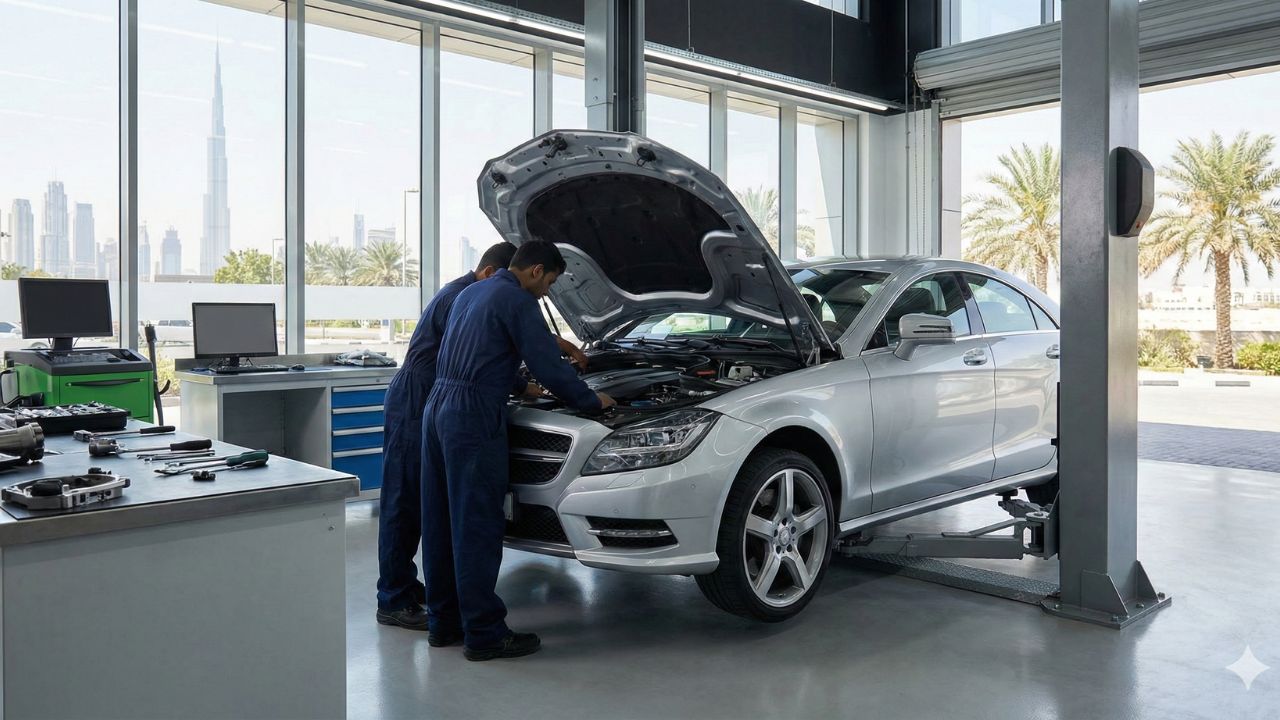
Picture this: You’re cruising down Sheikh Zayed Road in your Mercedes-Benz CLS-Class, that magnificent four-door coupe that turns heads at every intersection. The sleek C218 generation, produced between 2010 and 2018, represents everything you love about German engineering—until that subtle vibration appears, or worse, a dashboard warning light glows amber in the middle of Dubai’s scorching afternoon.
The CLS-Class isn’t just another Mercedes. It’s the car that redefined the four-door coupe segment, blending the practicality of a sedan with the emotional appeal of a coupe. This second-generation C218 brought sophisticated technology, powerful engine options, and a design language that still looks contemporary today. But here’s what most owners discover too late: this automotive masterpiece demands more than generic repair expertise.
Dubai’s environment treats the CLS-Class differently than it would in Stuttgart or London. When temperatures soar past 50°C, when sand particles infiltrate every microscopic gap, when humidity from the Arabian Gulf creates electrical gremlins—your beloved CLS needs specialists who understand these challenges intimately.
That’s where Euro Car Repair enters your story. We’ve built our reputation on one simple principle: European luxury vehicles deserve European-level expertise, without the dealership premium that makes your wallet wince. For Mercedes-Benz CLS-Class owners across Dubai, we’ve become the alternative that combines technical mastery with genuine customer care.
Why does the C218 generation require such specialized attention? Consider its complexity. The 7G-TRONIC PLUS seven-speed automatic transmission features adaptive logic that learns your driving style. The AIRMATIC air suspension adjusts ride height based on speed and road conditions. The extensive electronic systems communicate through multiple CAN bus networks. This isn’t a car you trust to someone who primarily works on basic sedans.
Throughout this comprehensive guide, you’ll discover why Euro Car Repair has become Dubai’s premier destination for CLS-Class maintenance and repair. We’ll explore the unique challenges your vehicle faces in this climate, the common issues specific to the C218 generation, and most importantly, how our approach differs fundamentally from both dealerships and general repair facilities.
Your CLS-Class represents a significant investment, both financially and emotionally. It deserves care from technicians who appreciate its engineering sophistication, who understand its quirks, and who possess the diagnostic tools specifically designed for Mercedes-Benz systems. More than that, you deserve transparency in pricing, honesty in recommendations, and service that respects your time and intelligence.
Let’s dive into what makes Euro Car Repair the best choice for keeping your Mercedes-Benz CLS-Class performing exactly as its engineers intended—even under Dubai’s demanding conditions.
Why Choose Euro Car Repair for Your CLS-Class
Specialized Mercedes-Benz CLS-Class Expertise That Goes Beyond Generic Training
When you entrust your CLS-Class to our facility, you’re not handing keys to generalists who learned Mercedes repair from YouTube videos. Our technicians have invested thousands of hours specifically studying Mercedes-Benz architecture, with particular emphasis on the unique characteristics of the C218 generation.
The CLS-Class sits in an interesting position within Mercedes’ lineup. It shares some components with the E-Class (W212) platform but incorporates unique elements that require specific knowledge. The front suspension geometry differs. The electrical architecture includes modules that don’t appear in other models. Even something as straightforward as an oil change requires understanding which engine variant sits under your hood—the M276 V6, the M157 V8, or perhaps the OM642 diesel popular in this region.
Our team maintains current certifications on Mercedes diagnostic systems, which means we access the same technical information available to dealership technicians. But here’s the crucial difference: we combine that technical access with real-world experience solving problems that actually occur in Dubai’s environment. Dealership technicians often follow rigid diagnostic protocols designed for global conditions. We adapt those protocols based on what we’ve learned from hundreds of CLS-Class vehicles that face the same extreme heat, dust infiltration, and usage patterns as yours.
Consider the AIRMATIC air suspension system. In moderate climates, these systems typically last 100,000 kilometers before needing attention. In Dubai? We’ve identified patterns of accelerated wear that appear around 60,000 kilometers, primarily affecting the front struts. Why? Because the combination of potholed roads, speed bumps, and heat cycling creates unique stress patterns. This knowledge lets us provide predictive maintenance recommendations that prevent expensive roadside failures.
Advanced Diagnostic Technology That Speaks Your CLS-Class’s Language
The C218 generation introduced sophisticated diagnostic capabilities that require equally sophisticated equipment to access. Your dashboard might display a generic warning message, but the actual fault code stored in the vehicle’s systems tells the complete story—if you have the right tools to read it.
Euro Car Repair invested heavily in Mercedes-specific diagnostic platforms. We’re not talking about generic OBD-II scanners that read basic engine codes. Our equipment communicates with every control module in your CLS-Class: engine management, transmission control, air suspension, COMAND infotainment, PARKTRONIC sensors, DISTRONIC radar cruise control, and two dozen other specialized modules.
This capability matters tremendously when diagnosing intermittent issues. Imagine your CLS occasionally refuses to start, but only after sitting in the sun for hours. A basic shop might replace the battery and wish you luck. Our diagnostic approach involves interrogating every module to identify voltage fluctuations, checking parasitic draw patterns, examining the Sleep mode behavior of electronic systems, and ultimately pinpointing whether the issue stems from a failing SAM module, a door control unit preventing proper shutdown, or perhaps the COMAND system’s persistent current draw.
We’ve solved problems that left other facilities puzzled. One CLS550 came to us after three shops unsuccessfully attempted to fix a persistent transmission fault. The vehicle would shift erratically when cold, yet perform perfectly once warmed up. Using our advanced diagnostics, we discovered the transmission’s mechatronic unit wasn’t failing—the engine coolant temperature sensor was providing incorrect readings, causing the transmission control module to use inappropriate shifting strategies. The fix? A $60 sensor rather than the $8,000 mechatronic replacement the previous shops recommended.
Genuine Parts & Quality Alternatives: The Best of Both Worlds
Here’s an uncomfortable truth about dealership parts departments: they stock genuine OEM components, which is excellent, but they mark up these parts substantially above wholesale cost. You’re essentially paying for the prestige of that three-pointed star on the packaging.
Euro Car Repair takes a different approach. We source genuine Mercedes-Benz parts directly through authorized wholesale channels, which eliminates the dealership markup. When you need a replacement part that’s genuinely OEM, you receive it—just without the inflated pricing.
However, the parts conversation becomes more nuanced when we discuss components where premium aftermarket alternatives match or exceed OEM specifications. Consider brake components. We can install genuine Mercedes brake pads and rotors, absolutely. But we can also offer premium alternatives from manufacturers like Pagid, Textar, or Brembo—companies that actually supply components to Mercedes’ production lines. These parts meet identical specifications, often come from the same factories, yet cost considerably less.
The CLS-Class uses specific brake specifications that vary by model year and engine. The CLS550 with AMG Sport Package requires different rotors than the base CLS350. We maintain this specificity in our parts sourcing, ensuring you receive components engineered for your exact configuration.
For critical systems—engine components, transmission parts, electronic modules—we default to genuine Mercedes parts. Your M276 engine’s variable valve timing solenoids? Genuine Mercedes. The 7G-TRONIC transmission’s conductor plate? Genuine Mercedes. These components are too integral to vehicle performance to compromise on quality.
Every part we install carries warranty protection. Genuine Mercedes parts come with manufacturer warranty coverage. Premium aftermarket components include manufacturer warranties that we stand behind completely. This dual approach gives you flexibility without sacrificing quality assurance.
Transparent Pricing Philosophy: No Surprises, Ever
The automotive repair industry has earned a reputation for opaque pricing and unexpected charges. We’ve built our business by doing the opposite.
Before any wrench touches your CLS-Class, you receive a detailed estimate breaking down labor costs, parts pricing, and any shop supplies needed for the job. This estimate itemizes everything. You’ll see exactly what the oil filter costs, what we charge for labor hours, and even the price of the ten liters of Mobil 1 0W-40 synthetic oil your M276 engine requires.
Our labor rates reflect our specialized expertise while remaining substantially below dealership charges. Dealerships in Dubai typically charge between 400-600 AED per labor hour for Mercedes work. Our rates sit comfortably below that range, yet we invest in the same diagnostic equipment, use identical technical procedures, and employ technicians with comparable training.
Why can we charge less? Simple: we don’t carry the overhead costs of showroom facilities, sales departments, and corporate profit margins that dealerships factor into their pricing. Our facility focuses exclusively on repair and maintenance, which creates operational efficiencies we pass directly to customers.
When we provide an estimate, that price stands firm unless we discover additional issues during the repair process. If we find something unexpected—say, oil pan corrosion while changing your oil—we contact you immediately with photos, explanation, and pricing for the additional work. You approve every dollar spent.
This transparency extends to our recommendations. If your brake pads measure 5mm remaining thickness, we’ll inform you they’re approaching the service interval but don’t require immediate replacement. We differentiate between “needs attention now” and “plan for this in the next 5,000 kilometers.” This honesty builds trust, and trust builds long-term relationships.
Customer-First Service Model: Your CLS-Class, Your Schedule
Dealership service departments operate on their timeline, not yours. Book an appointment three weeks out, drop your vehicle at 7 AM, receive a call at 4 PM announcing it’s ready. This process treats your $80,000 automobile like an appliance awaiting generic servicing.
Euro Car Repair recognizes that your CLS-Class serves as more than transportation—it’s how you navigate business meetings, family commitments, and daily life across Dubai’s sprawling geography. Our scheduling reflects this reality.
We offer flexible appointment times that accommodate your calendar rather than forcing you into rigid service windows. Need an evening drop-off? We’ll arrange it. Require Saturday service? We’re operational. Have a tight deadline for repair completion? We’ll prioritize your vehicle accordingly.
Throughout the service process, communication flows continuously. When your CLS arrives, we perform an initial inspection and contact you with findings before beginning work. As repairs progress, you receive updates via phone or WhatsApp—whatever communication method you prefer. When work completes, we walk you through everything we accomplished, showing you the old parts we replaced and explaining the testing we performed.
This personalized attention recognizes something fundamental: you’re not customer number 47 waiting for generic service. You’re a CLS-Class owner who values your vehicle and deserves service that reflects that appreciation.
Why We Don’t Work With Insurance Companies—And Why That Benefits You
This policy surprises some customers initially, so let’s address it directly and explain why it ultimately serves your interests better than insurance partnerships would.
Insurance companies insert themselves between you and quality repair work in ways that rarely benefit your vehicle. When a repair facility works with insurance, they’re essentially answering to two masters: you and your insurer. These interests don’t always align.
Insurance companies negotiate bulk pricing agreements with repair facilities, which sounds beneficial until you realize those agreements often pressure shops to use cheaper parts, reduce labor time allocations, and minimize repair costs rather than maximize repair quality. Your CLS-Class deserves better than “good enough to satisfy an insurance adjuster.”
By refusing insurance relationships, Euro Car Repair maintains complete independence in repair recommendations. When we assess damage or diagnose problems, our only consideration is what your vehicle genuinely needs—not what an insurance company wants to authorize. We specify genuine parts when necessary. We allocate appropriate labor time for proper repairs. We refuse shortcuts that compromise longevity.
This independence also eliminates service delays. Insurance approval processes can extend repair timelines by days or weeks while adjusters review estimates, request supplementary information, or dispute recommended procedures. You pay us directly, which means work begins immediately upon your approval. Your CLS returns to the road faster.
Additionally, insurance partnerships often require facilities to warranty repairs according to insurer specifications, which may differ from manufacturer recommendations. Our warranties follow Mercedes-Benz guidelines because we’re beholden only to quality standards, not insurance requirements.
Yes, you’ll pay out of pocket rather than through insurance claims. But consider what you gain: superior parts, proper repair procedures, faster service, and technicians whose loyalty belongs to your vehicle’s wellbeing rather than an insurance company’s profit margins. For many CLS-Class owners who’ve experienced both approaches, the direct payment model proves worthwhile.
Proven Track Record: Years of CLS-Class Excellence
Euro Car Repair has served Dubai’s European luxury vehicle community for years, building our reputation one satisfied customer at a time. We don’t advertise heavily or sponsor glitzy events. Our growth stems from word-of-mouth recommendations from customers who experienced our service quality firsthand.
The CLS-Class represents a significant portion of our workload, which benefits every CLS owner who comes through our doors. This volume creates knowledge accumulation. When we’ve diagnosed and repaired hundreds of CLS vehicles, we’ve encountered virtually every problem these cars develop. That pattern recognition accelerates diagnostics dramatically.
Your unusual transmission behavior? We’ve likely seen it before. Your intermittent electrical fault? Probably familiar territory. Your suspension noise that only appears over specific road surfaces? We know exactly where to look.
Our customer retention rate speaks volumes. Once CLS owners experience our service approach—the expertise, transparency, and genuine care—they rarely return to dealerships or experiment with other independent facilities. Many customers have trusted us with their CLS maintenance for 50,000+ kilometers, which demonstrates sustained satisfaction over time.
We measure success not by transaction volume but by relationship longevity. Your first visit begins what we hope becomes a years-long partnership maintaining your CLS-Class’s performance and value.
Comprehensive Service Offerings for Your CLS-Class
Engine Repair & Maintenance: The Heart of Your CLS
The C218 generation offered several powerplant options throughout its production run, each with distinct characteristics requiring specific expertise. Understanding which engine powers your particular CLS shapes every aspect of our maintenance and repair approach.
The M276 V6 engine, displacing either 3.0 or 3.5 liters depending on your model year, represents Mercedes’ first venture into direct injection V6 technology. This sophisticated powerplant produces impressive output while maintaining reasonable efficiency, but it demands particular attention to several key areas.
Carbon buildup on intake valves presents the primary long-term maintenance concern with direct injection engines. Unlike port injection systems that wash fuel across intake valves, direct injection sprays fuel directly into cylinders. This means intake valves never receive the cleaning benefit of gasoline flowing past them. Over time—typically around 60,000 kilometers in Dubai’s stop-and-go traffic—carbon deposits accumulate on valve surfaces, restricting airflow and degrading performance.
We address this through specialized walnut blasting procedures that remove carbon deposits without damaging valve surfaces. This preventive service, performed at appropriate intervals, maintains engine performance and prevents the rough idle, hesitation, and reduced power that characterize advanced carbon accumulation.
The M276 also requires attention to its variable valve timing system. The solenoids controlling camshaft positioning can develop leaks or electrical faults, triggering check engine lights and creating rough running conditions. We test these components thoroughly during major service intervals, replacing them before they fail catastrophically.
For CLS owners with the mighty M157 5.5-liter biturbo V8, different priorities emerge. This high-performance engine generates substantial heat, which accelerates oil degradation. We recommend shortened oil change intervals—every 7,500 kilometers rather than the standard 10,000—particularly for vehicles experiencing spirited driving or extended idling in traffic.
The M157’s turbochargers operate under extreme thermal and mechanical stress. We monitor their condition through boost pressure testing and wastegate operation checks during service visits. Early identification of deteriorating turbocharger performance allows planned replacement rather than catastrophic failure that potentially damages other engine components.
Diesel CLS models equipped with the OM642 V6 require entirely different expertise. This engine’s common rail fuel injection system operates at pressures exceeding 2,000 bar, demanding precise calibration and meticulous maintenance. Fuel quality becomes absolutely critical—contaminated diesel causes injector failures costing thousands of dirhams to rectify.
We’ve developed specialized cleaning procedures for OM642 diesel particulate filters, which tend to clog prematurely in Dubai’s traffic conditions. Rather than expensive filter replacement, our chemical cleaning and regeneration service often restores full function at a fraction of the cost.
Oil leaks plague older CLS models with high mileage, typically originating from valve cover gaskets, oil cooler seals, or the rear main seal. Dubai’s heat cycles accelerate gasket deterioration, causing leaks that start small but progressively worsen. Our approach involves comprehensive leak diagnosis using UV dye tracing, followed by strategic seal replacement before minor leaks become major problems.
The cooling system deserves particular attention in Dubai’s climate. Your CLS’s engine operates near 100°C under normal conditions, but add 50°C ambient temperatures and sustained highway speeds, and cooling system components work overtime. We replace coolant according to Mercedes specifications using the exact formulation required for your engine’s aluminum components. Generic coolant causes corrosion and deterioration in modern Mercedes engines—a mistake we never make.
Transmission & Gearbox Services: Seamless Power Delivery
The 7G-TRONIC PLUS transmission fitted to most CLS models represents sophisticated engineering that requires equally sophisticated maintenance. This seven-speed automatic incorporates adaptive shift logic, torque converter lockup strategies, and electronic controls that constantly adjust performance based on driving conditions.
Transmission fluid serves as the lifeblood of this complex system, yet many owners neglect fluid service because Mercedes marketed the 7G-TRONIC as “filled for life.” This designation assumes perfect operating conditions—moderate climate, smooth roads, gentle driving. Dubai provides none of these. Heat degrades transmission fluid’s lubricating and cooling properties. Stop-and-go traffic forces constant shifting that accelerates wear.
We recommend transmission fluid service every 60,000 kilometers for CLS models operating in Dubai. This service involves complete fluid exchange using Mercedes-approved ATF, along with new filter installation and pan gasket replacement. The improvement in shift quality after this service consistently amazes customers who’ve grown accustomed to gradual deterioration.
The 7G-TRONIC’s mechatronic unit—the electronic brain controlling shift execution—occasionally develops internal valve body wear or electrical connector corrosion. These failures manifest as harsh shifts, delayed engagement, or fault codes that place the transmission in limp mode. Our diagnostic approach differentiates between mechatronic issues requiring module replacement versus external problems like failing shift solenoids or damaged wiring harnesses.
Some CLS550 and CLS63 AMG models feature the MCT (Multi-Clutch Technology) transmission, essentially an automated manual transmission that replaces the torque converter with a wet clutch pack. This transmission offers lightning-fast shifts and improved efficiency but demands specific maintenance protocols. Clutch wear monitoring becomes critical, as do fluid quality inspections at abbreviated intervals.
When transmission problems develop, we carefully evaluate repair versus replacement options. Minor issues—a failing shift solenoid, a damaged output speed sensor—receive component-level repair. Major internal failures—damaged planetary gear sets, worn clutch packs—often justify remanufactured transmission installation, particularly in vehicles exceeding 150,000 kilometers. We present both options with honest cost-benefit analysis, letting you make informed decisions.
Brake System Services: Stopping Power You Can Trust
The CLS-Class’s substantial weight—often exceeding 1,900 kilograms—demands robust braking systems capable of repeated high-performance stops. Mercedes equipped these vehicles with large ventilated discs and sophisticated brake systems featuring multiple safety technologies.
Brake pad life in Dubai varies dramatically based on driving style and conditions. Gentle highway cruising might yield 40,000 kilometers from front pads, while aggressive city driving with frequent heavy braking can wear pads in 15,000 kilometers. We measure pad thickness during every service visit, providing percentage-of-life-remaining information that helps you plan replacement timing.
The CLS uses compound brake pads with wear sensors embedded in the friction material. When pads reach minimum thickness, these sensors trigger dashboard warnings. However, we recommend proactive replacement before reaching sensor activation, as continued use beyond this point damages rotors and reduces braking efficiency.
Rotor service intervals depend on pad material, driving conditions, and previous service history. Properly maintained rotors typically last two or three pad changes. However, Dubai’s dust infiltration can accelerate rotor surface deterioration, creating pulsation during braking that requires earlier replacement or resurfacing.
For CLS models equipped with PARKTRONIC and DISTRONIC systems, brake service requires additional electronic procedures. These systems constantly monitor brake pressure and actuator performance as integral components of their collision prevention algorithms. After brake repairs, we perform system recalibration ensuring all active safety features function correctly.
The electromechanical parking brake system common in later CLS models requires specific diagnostic equipment for service mode activation. Unlike traditional cable-actuated parking brakes, this system uses electric motors to actuate rear brake calipers. We can’t perform rear brake service without placing these motors in service mode through diagnostic commands—something generic shops lack equipment to accomplish.
AMG Sport Package models often feature upgraded brake systems with larger rotors and higher-performance pad compounds. These components require exact replacement specifications to maintain intended performance characteristics and avoid triggering ABS/ESP fault codes.
Air Conditioning & Climate Control: Essential Comfort in Desert Heat
In Stuttgart, air conditioning represents a comfort feature. In Dubai, it’s survival equipment. Your CLS’s climate control system doesn’t just cool the cabin—it maintains livable conditions when external temperatures could literally cook an egg on the hood.
The C218’s automatic climate control system incorporates sensors monitoring cabin temperature, exterior temperature, sun load through the windows, and even humidity levels. This data feeds the climate control module, which orchestrates compressor operation, blower speed, and air distribution to maintain your set temperature precisely.
Compressor failure represents the most expensive AC repair, typically costing several thousand dirhams for parts and labor. These failures rarely occur suddenly—instead, they announce themselves through declining cooling performance, unusual noises during compressor operation, or intermittent function. We test compressor health during service visits using pressure measurements and amp draw testing, identifying deteriorating compressors before catastrophic failure.
Refrigerant leaks plague older CLS models, particularly from corroded condenser cores or deteriorating evaporator seals. Dubai’s combination of road salt (yes, they salt roads here during rare winter rain), humidity, and temperature cycling accelerates corrosion in AC system aluminum components. Our UV dye leak detection process identifies even minor leaks before they deplete refrigerant levels to non-functional levels.
The CLS uses R134a refrigerant, which requires specific handling procedures and recovery equipment. We never simply vent refrigerant into the atmosphere—both for environmental reasons and because it’s illegal. Our AC service includes complete refrigerant recovery, system evacuation to remove moisture and contaminants, and precise recharging to manufacturer specifications.
Cabin air filters deserve replacement every 10,000 kilometers in Dubai’s dusty environment—twice the normal interval. These filters prevent sand, dust, and particulates from entering the cabin through the ventilation system. A clogged cabin filter restricts airflow, forcing the blower motor to work harder and reducing cooling efficiency. We’ve seen filters so clogged with fine desert sand they resembled solid bricks rather than filter media.
The evaporator core, buried deep within the dashboard, sometimes develops bacterial or fungal growth in Dubai’s humidity. This growth creates musty odors when activating the AC system. Our antimicrobial evaporator treatment eliminates these organisms, restoring fresh air quality to the cabin.
Suspension & Steering: Gliding Over Dubai’s Imperfect Roads
The CLS-Class offers two suspension configurations: conventional steel springs with adaptive dampers, or the AIRMATIC air suspension system. Each presents unique maintenance requirements and failure modes.
AIRMATIC air suspension transforms ride quality, automatically adjusting ride height and damping based on speed and road conditions. However, this technology introduces additional complexity and potential failure points. Air springs—essentially rubber bladders holding compressed air—deteriorate over time, particularly in extreme heat. We typically see front air springs developing leaks around 80,000 kilometers, while rear springs often last beyond 120,000 kilometers.
Failed air springs create obvious symptoms: the affected corner sags, the suspension compressor runs continuously trying to maintain pressure, and dashboard warnings illuminate. Replacement involves more than simply installing new air springs—we also inspect the compressor, check air line integrity, and verify valve block operation to ensure comprehensive system health.
The AIRMATIC system’s adaptive dampers contain electronically controlled valves that adjust damping rates based on sensor inputs and driving mode selection. Damper failure manifests as diminished ride comfort, excessive body roll, or the inability to change suspension modes. Unlike air springs which announce failures dramatically, dampers deteriorate gradually, so owners often don’t notice degradation until experiencing a properly functioning system again.
Conventional suspension models use coil springs and gas-filled dampers that maintain more consistent performance over time but sacrifice the AIRMATIC system’s adaptability. These components still wear, typically requiring replacement around 100,000 kilometers as damper seals deteriorate and spring sag develops.
Control arms, bushings, and ball joints constitute the suspension system’s foundation. Dubai’s potholed roads and aggressive speed bumps accelerate wear on these components. We inspect for torn rubber bushings, loose ball joint fit, and compromised control arm integrity during every service visit. Worn suspension components create clunking noises over bumps, imprecise steering feel, and abnormal tire wear patterns.
The CLS’s variable ratio steering system provides excellent response and feedback when properly maintained. Power steering fluid requires periodic replacement—a service many owners neglect until pump whine or heavy steering effort develops. We flush steering fluid every 60,000 kilometers using Mercedes-approved synthetic fluid, maintaining optimal hydraulic system performance.
Wheel alignment deserves particular attention after suspension work, significant pothole impacts, or whenever tire wear patterns suggest misalignment. The CLS requires precise four-wheel alignment to factory specifications, which we accomplish using laser alignment systems specifically calibrated for Mercedes geometry parameters.
Electrical System Diagnostics: Solving Complex Electronic Puzzles
Modern Mercedes vehicles incorporate more computing power than the Apollo spacecraft that reached the moon. Your CLS contains dozens of electronic control units communicating through multiple network buses, managing everything from engine performance to ambient cabin lighting.
This electrical sophistication creates diagnostic challenges when problems develop. A simple symptom—say, intermittent starting issues—could stem from dozens of potential causes spanning multiple vehicle systems. Generic repair shops often resort to parts replacement gambling: change the battery, hope the problem disappears. If not, replace the starter. Still failing? Maybe try the alternator.
Our approach inverts this costly guesswork. We use comprehensive diagnostics to identify root causes before replacing components. Starting problems might trace to a failing battery, certainly, but they could also result from parasitic current drain, corroded ground connections, faulty crankshaft position sensors, failed fuel pumps, or compromised starter motor brushes. Proper diagnosis determines the actual failure rather than generating expensive repair invoices through trial and error.
Battery replacement in the CLS requires more than connecting cables and securing hold-downs. The vehicle’s electrical system must be informed about the new battery through diagnostic programming that registers battery capacity and type in the power management system. Skip this step, and the alternator continues using charging strategies appropriate for the old battery, potentially damaging the new one.
The CLS’s extensive sensor network—measuring everything from oxygen content in exhaust gases to yaw rate during cornering—occasionally includes failing sensors that trigger dashboard warnings and degraded performance. We differentiate between genuinely failed sensors versus wiring problems, connector corrosion, or sensor signal interference from other electrical devices.
COMAND infotainment system failures create frustration disproportionate to their mechanical significance. When your navigation screen goes blank or the audio system produces no sound, your CLS still drives perfectly—but the experience suffers. We’ve developed expertise in COMAND diagnostics, addressing problems ranging from failed fiber optic connections to corrupted software requiring module replacement and reprogramming.
Fluid Leak Detection & Repair: Preventing Small Problems From Becoming Large Disasters
Oil leaks in high-mileage CLS models follow predictable patterns based on component design and thermal stress locations. Valve cover gaskets fail from heat cycling, developing seepage that progresses to dripping onto exhaust manifolds—creating burning oil smells in the cabin. Oil filter housing gaskets deteriorate from similar causes, leaking onto subframe components.
The rear main seal—positioned between engine and transmission—presents the most labor-intensive oil leak repair. Accessing this seal requires transmission removal, which explains why this repair often costs more than many owners expect. However, we’ve learned to identify early-stage rear main seal leaks through careful inspection and UV dye tracing, allowing repair planning before leak severity forces immediate expensive service.
Coolant leaks demand immediate attention in Dubai’s heat. Even minor coolant loss can lead to overheating during traffic jams or sustained highway driving when ambient temperatures exceed 45°C. The CLS’s cooling system includes multiple potential leak sources: radiator end tanks, hose connections, water pump seals, thermostat housing gaskets, and expansion tank caps.
Our leak detection process employs systematic pressure testing that stresses the cooling system beyond normal operating pressures, forcing even minor leaks to reveal themselves. We’ve identified failing components this way long before they caused roadside breakdowns or engine damage from overheating.
Additional Specialized Services: Comprehensive CLS Care
Tire replacement for the CLS involves more than mounting rubber on wheels. These vehicles incorporate Tire Pressure Monitoring Systems (TPMS) with sensors in each wheel that communicate pressure and temperature data to the dashboard display. When replacing tires, these sensors require initialization through diagnostic equipment to ensure proper system function.
The CLS’s large wheel and tire combinations—often 18-inch or 19-inch wheels wearing 245/40R18 or 255/35R19 tires—create replacement cost considerations. We source premium tire brands appropriate for your driving requirements and budget, balancing performance, longevity, and comfort.
Sunroof systems in the CLS occasionally develop drainage clogs from accumulated debris. These drains carry water from the sunroof cassette down through channels within the A-pillars to exit beneath the vehicle. When clogs occur, water backs up and leaks into the cabin—often onto rear passengers’ heads. Our sunroof service includes drainage tube cleaning and seal inspection, preventing these embarrassing and damaging leaks.
Cosmetic repairs maintain your CLS’s appearance value. We partner with specialized facilities for paint correction, scratch removal, and alloy wheel refurbishment. Deep scratches from parking mishaps or shopping cart encounters receive professional repair that preserves your vehicle’s aesthetic appeal and resale value.
Pre-purchase inspection services help prospective CLS buyers avoid expensive mistakes. We thoroughly evaluate used CLS models before purchase, identifying existing problems, deferred maintenance, and potential future issues. This comprehensive inspection includes diagnostic scanning, test driving, component condition assessment, and detailed reporting. The modest inspection cost often saves buyers tens of thousands of dirhams by revealing problems sellers conveniently forgot to mention.
Our scheduled maintenance packages bundle essential services at package pricing below individual service costs. These packages follow Mercedes’ maintenance schedule while adapting interval recommendations for Dubai’s demanding conditions.
Common Mercedes-Benz CLS-Class (C218) Problems We Solve
AIRMATIC Air Suspension Component Failures
If your CLS equipped with AIRMATIC suspension begins sagging at one corner overnight, you’ve joined thousands of owners who’ve experienced air spring failure. This problem affects CLS models universally as they age, with front air springs particularly vulnerable to heat and stress damage.
The issue develops from continuous flexing of the rubber bladder that contains compressed air supporting vehicle weight. Over time—accelerated by Dubai’s heat—the rubber develops microscopic cracks that eventually compromise air retention. Initially, the leak might be so minor the suspension compressor compensates by running more frequently. Eventually, the leak becomes severe enough that the compressor cannot maintain pressure, and the affected corner collapses.
We diagnose air spring failures through multiple methods. Visual inspection sometimes reveals obvious cracking or splitting in the rubber bladder. Soapy water applied to suspected leak areas creates bubbles confirming air escape. Our diagnostic equipment monitors suspension system pressure values and compressor duty cycle, identifying struggling systems before complete failure.
Replacement involves more than installing new air springs. We inspect the entire AIRMATIC system during this service, checking compressor health, valve block operation, and air line integrity. The compressor works significantly harder when compensating for leaking air springs, which can damage compressor components. Replacing only the failed spring while ignoring a weakened compressor often leads to compressor failure shortly after air spring replacement.
Prevention involves regular system inspections beginning around 60,000 kilometers. We check air springs for surface cracking, monitor compressor operation, and test system pressure values. Early identification of deteriorating components allows planned replacement on your schedule rather than emergency repair when the system fails before an important meeting.
Carbon Buildup on Direct Injection Engine Intake Valves
CLS350 and CLS500 models powered by the M276 direct injection V6 engine experience performance degradation around 60,000-80,000 kilometers from carbon accumulation on intake valve surfaces. This problem doesn’t occur in older port injection engines because gasoline flowing across intake valves continuously cleaned carbon deposits. Direct injection sprays fuel directly into cylinders, eliminating this cleaning action.
Symptoms develop gradually: rough idle when cold, hesitation during acceleration, reduced fuel economy, and eventually Check Engine Light illumination with misfire fault codes. Many owners assume these issues indicate serious engine problems requiring expensive repairs. The reality? Dirty valves easily cleaned through walnut blasting procedures.
Our carbon cleaning service uses crushed walnut shells propelled through intake ports to scrub carbon deposits from valve surfaces. Walnut shells are hard enough to remove carbon but soft enough to avoid damaging aluminum or valve materials. The entire procedure requires removing the intake manifold to access all cylinders, making this a labor-intensive service—but far less expensive than engine disassembly or component replacement.
Prevention involves using high-quality fuel with effective detergent packages. However, even premium fuel cannot completely prevent carbon formation in direct injection engines. We recommend preventive walnut blasting every 80,000 kilometers for engines operating primarily in city traffic, or every 100,000 kilometers for highway-driven vehicles.
Seven-Speed Transmission Harsh Shifting and Delayed Engagement
The 7G-TRONIC PLUS transmission occasionally develops harsh shift quality or delayed response when selecting Drive or Reverse. These symptoms frustrate owners who paid premium prices for smooth Mercedes performance.
Multiple causes create these problems. Degraded transmission fluid loses its friction-modifying properties, causing harsh engagement as clutch packs grab abruptly. Worn valve body components create imprecise hydraulic pressure control. Failed transmission mounts allow excessive engine movement during shifts, perceived as harsh engagement. Mechatronic unit internal wear compromises shift quality through accumulated tolerance deterioration.
Our diagnostic approach isolates the actual cause rather than assuming worst-case scenarios. We begin with transmission fluid condition analysis, examining color, smell, and metal particle content. Fresh fluid appears red and smells slightly sweet; degraded fluid turns brown and develops a burnt odor. Metal particles indicate internal component wear requiring deeper investigation.
Transmission adaptive values stored in the control module provide insight into shift compensation strategies the transmission has implemented trying to maintain quality. Excessive compensation values suggest component wear approaching service limits.
For many harsh shifting complaints, comprehensive fluid service resolves the problem completely. We perform complete fluid exchanges including filter replacement and pan gasket installation. The transmission requires approximately nine liters of Mercedes-approved ATF, which we install using proper fill procedures ensuring correct levels.
Mechanical problems—worn valve bodies, damaged clutch packs, failing torque converters—require transmission removal for internal service or replacement. We provide honest assessment of repair costs versus remanufactured transmission installation, helping you make economically sound decisions.
COMAND Infotainment System Malfunctions
The COMAND NTG4.5 system in C218 CLS models represents significant technological advancement over previous generations, but also introduces potential failure modes that frustrate owners when problems develop.
Common issues include blank screens upon starting the vehicle, audio system failures affecting radio or media playback, navigation system errors, and Bluetooth connectivity problems. These malfunctions range from minor inconveniences to serious safety concerns if the backup camera becomes unavailable.
Many COMAND problems trace to software glitches rather than hardware failures. The system runs complex operating software managing multiple functions simultaneously—navigation, audio, phone integration, vehicle settings access. Software errors can freeze the system or create specific function failures while other COMAND features operate normally.
Our diagnostic process begins with software version verification and available update identification. Mercedes periodically releases COMAND software updates addressing known bugs and improving functionality. Installing current software versions often resolves mysterious COMAND issues that resist other troubleshooting attempts.
Hardware failures require different approaches. Failed fiber optic amplifiers eliminate audio output. Corrupted navigation hard drives render map data inaccessible. Touch screen digitizer failures prevent input recognition. We identify specific failed components through systematic testing, replacing only damaged parts rather than expensive complete COMAND unit replacement.
One particularly frustrating COMAND issue involves the optical fiber network connecting various audio components. These fiber optic cables deteriorate over time, creating intermittent connection failures that manifest as random audio dropouts or complete system failures. We’ve developed expertise identifying and replacing damaged fiber optic segments, restoring system reliability.
Diesel Particulate Filter Clogging
CLS models equipped with the OM642 diesel engine include diesel particulate filters (DPF) that trap soot particles from exhaust gases, reducing harmful emissions. Under ideal conditions, these filters regenerate automatically through high-temperature combustion that burns accumulated soot into ash.
Dubai’s traffic patterns rarely provide ideal regeneration conditions. Short trips, extended idling, and stop-and-go traffic prevent exhaust temperatures from reaching levels necessary for complete regeneration. Soot accumulates progressively until the filter clogs, triggering dashboard warnings and eventually forcing the vehicle into limp mode with severely restricted performance.
Many owners first learn of DPF problems when their CLS suddenly loses power while driving, limping along at reduced speed with warning lights illuminated. This scenario often occurs in traffic—the absolute worst time for vehicle problems.
Our DPF service avoids expensive filter replacement through chemical cleaning and forced regeneration procedures. We remove the DPF, apply specialized cleaning solutions that dissolve accumulated soot, and perform forced regeneration cycles using diagnostic equipment. This process typically restores 90-95% of original filter capacity at a fraction of replacement cost.
Prevention involves operational changes and fuel additive use. We educate diesel CLS owners about driving patterns that promote natural DPF regeneration: weekly highway drives at sustained speeds above 100 kph for at least 20 minutes. These drives elevate exhaust temperatures sufficiently for regeneration to occur naturally.
Fuel additives designed for DPF-equipped diesel engines reduce soot formation and lower regeneration temperature requirements. We recommend specific additives proven effective in the Middle East’s fuel quality environment.
Electronic Parking Brake System Failures
Later C218 models feature electromechanical parking brakes replacing traditional cable-actuated systems. Electric motors integrated into rear brake calipers actuate the parking brake through diagnostic system commands rather than mechanical linkage.
This technology works beautifully when functioning properly but creates significant problems when failures occur. Common issues include parking brake refusing to release, parking brake engaging unexpectedly while driving (terrifying!), or parking brake becoming inoperable entirely.
Most electronic parking brake problems stem from rear brake caliper failures rather than control module issues. The electric actuator motors experience Dubai’s heat and occasional water intrusion from road spray or car washes. Internal motor windings corrode, mechanical components seize from corrosion, or electronic position sensors fail.
We diagnose these systems using Mercedes-specific diagnostic equipment that communicates with parking brake modules. The system stores fault codes identifying specific failures—motor current excessive (seized mechanism), position sensor implausible values (failed sensor), or communication errors (wiring problems).
Repair often requires rear caliper replacement, which involves more than traditional brake caliper installation. The new calipers require electronic configuration through diagnostic procedures that mate them to the vehicle’s parking brake system. This initialization process ensures proper operation and prevents future fault codes.
Some parking brake issues trace to failed control modules requiring replacement and programming. These modules contain software specific to your CLS’s configuration, which must be installed during module replacement. Generic shops lacking proper diagnostic equipment cannot perform these procedures—another reason specialized facilities matter for modern Mercedes repair.
Thermostat Housing Coolant Leaks
The M276 V6 engine utilizes a complex thermostat housing assembly incorporating multiple coolant passages, the thermostat itself, and temperature sensors. This housing, constructed from plastic reinforced with fiberglass, deteriorates over time from heat cycling and coolant chemical exposure.
Hairline cracks develop in the housing, creating coolant seepage that progresses to active leaking. Initially, owners notice coolant smell after driving or small puddles beneath the vehicle after parking. As cracks enlarge, coolant loss becomes severe enough to trigger low coolant warnings and create overheating risk.
The location of this thermostat housing—buried beneath intake components and against the engine block—makes leak detection challenging without systematic inspection. Coolant often drips onto lower engine components before becoming visible, making precise leak source identification difficult.
We’ve learned to recognize the symptoms of failing thermostat housings: unexplained coolant loss without visible leaks, coolant odor without obvious source, and slight temperature fluctuations during driving. When these symptoms appear, we remove intake components for direct thermostat housing inspection.
Repair requires complete housing replacement. The housing itself costs several hundred dirhams, but labor comprises the majority of repair expense due to component removal required for access. We replace not just the thermostat housing but also coolant hoses and clamps in the surrounding area, as these components deteriorate from similar thermal stress.
This repair presents an opportunity for comprehensive cooling system service. We flush the cooling system, install fresh coolant, pressure test for additional leaks, and verify proper thermostat operation. This comprehensive approach ensures cooling system reliability for years following repair.
Steering Column Electronic Lock Mechanism Failures
The CLS’s electronic steering lock system prevents vehicle theft by mechanically locking the steering column when the ignition turns off. This electromechanical device operates through signals from the Electronic Ignition Switch (EIS) module, which communicates with the key fob when you attempt starting.
When this system fails—and it does fail with surprising regularity—your CLS becomes completely inoperable. The steering lock mechanism jams in the locked position, preventing steering wheel movement even with the key present. Dashboard displays show “Steering lock malfunction” messages, and the engine won’t start.
This failure often occurs without warning, typically after parking the vehicle overnight. Owners discover the problem when attempting to drive the next morning. The car looks fine, the battery is charged, the key fob is recognized—yet the vehicle simply refuses to start.
The steering lock mechanism itself fails mechanically—internal gears strip, electric motors burn out, or mechanical components seize. These failures require steering lock module replacement, which involves steering column partial disassembly and electronic initialization of the new module.
Some steering lock problems trace to EIS module issues rather than the lock mechanism itself. Communication failures between the EIS module and steering lock create similar symptoms but require different repairs. Our diagnostic process differentiates between these failure modes, ensuring we replace the actual failed component.
This repair carries moderate urgency because a failed steering lock leaves you stranded. We prioritize these repairs, understanding that your CLS serves as essential transportation rather than optional luxury.
Our Expert Technicians: The Foundation of Service Excellence
Behind every successful CLS repair stands a technician whose knowledge extends far beyond generic automotive training. Our team comprises specialists who’ve dedicated their careers to European luxury vehicle service, with particular emphasis on Mercedes-Benz technology.
These individuals bring combined experience exceeding 75 years working exclusively on European marques. They’ve witnessed the evolution of Mercedes engineering from simple mechanical systems to today’s computer-controlled sophistication. This historical perspective provides context for understanding why systems are designed particular ways and how they’re likely to fail.
Continuous education forms a cornerstone of our technical excellence. Mercedes introduces new technologies with every model year, each requiring updated diagnostic approaches and repair techniques. Our technicians regularly attend training seminars, complete online certification courses, and study technical service bulletins detailing emerging issues and recommended solutions.
This commitment to ongoing education ensures we remain current with the latest Mercedes technologies even as the automotive industry evolves rapidly. When new diagnostic procedures become available or updated repair techniques are developed, our team learns and implements them immediately.
Certifications validate our technicians’ expertise. Multiple team members hold ASE (Automotive Service Excellence) certifications in relevant specialties. Some possess Mercedes-specific certifications obtained through technical training programs. These credentials aren’t merely wall decorations—they represent demonstrated competency in complex automotive systems.
However, certifications only tell part of the story. Real expertise develops through hands-on problem-solving experience accumulated over thousands of repair hours. Our technicians have diagnosed the obscure electrical fault that defied three other shops. They’ve solved the mysterious noise that appeared only under specific conditions. They’ve rescued CLS models from seemingly hopeless failures through methodical diagnostics and creative problem-solving.
This problem-solving ability separates truly skilled technicians from parts replacement mechanics. Anyone can replace components following instructions. Identifying which component actually failed among dozens of possibilities requires analytical thinking, systematic diagnostics, and deep system knowledge.
Our team approaches each CLS as a unique challenge rather than a routine procedure. They understand that identical symptoms don’t always share identical causes. The rough idle plaguing your CLS might stem from completely different issues than a similar complaint in another owner’s vehicle. Only comprehensive diagnosis reveals the truth.
Quality control procedures ensure work meets our internal standards before vehicles return to customers. After completing repairs, a senior technician performs verification testing confirming the original problem is resolved and no additional issues were introduced during repair. We test drive vehicles, re-scan for fault codes, and verify all systems function properly.
Customer communication represents another crucial technician skill. Technical expertise means little if we can’t explain problems and repairs in terms customers understand. Our technicians excel at translating complex automotive issues into plain language, often using analogies and visual aids to clarify situations.
When explaining why your air suspension failed, they might compare air springs to balloons constantly inflating and deflating under heavy loads—eventually, the rubber weakens and leaks develop. This explanation makes intuitive sense without requiring engineering degrees to comprehend.
The technician-customer relationship builds over time as you return for subsequent services. Your technician learns your vehicle’s history, recalls previous issues, and notices developing patterns that inform maintenance recommendations. This continuity provides service value impossible from facilities where you see different technicians each visit.
Dubai’s Unique Challenges for Mercedes-Benz CLS-Class
Dubai’s environment subjects your CLS to stresses German engineers never anticipated when designing these vehicles in moderate European climates. Understanding these unique challenges helps explain why certain components fail prematurely and why maintenance intervals require adjustment.
Extreme heat represents the most obvious environmental factor. When ambient temperatures exceed 50°C, your CLS’s cooling systems, air conditioning, and temperature-sensitive components operate at their absolute limits. Electronic components rated for 85°C maximum operating temperature face reduced margins when starting from 50°C ambient conditions.
Battery life shortens dramatically in this heat. Where a battery might last five years in temperate climates, we see battery replacement intervals around three years in Dubai. The chemical reactions within batteries accelerate at high temperatures, progressively degrading capacity until starting becomes unreliable.
Engine oil deteriorates faster under Dubai’s heat cycles. The oil experiences extreme temperature variations: cold (relatively speaking) during morning startup, then heated to operating temperature, potentially superheated in traffic jams, then cooled overnight. These cycles break down oil’s molecular structure faster than steady-state operation would.
Rubber components—hoses, seals, bushings, tires—age rapidly under intense heat and UV exposure. The rubber compounds lose plasticizers that maintain flexibility, becoming brittle and prone to cracking. This explains why we see air suspension failures, coolant hose splits, and seal leaks earlier than mileage alone would predict.
Sand and dust infiltration creates problems German test engineers rarely encounter. Dubai’s desert environment puts fine particles into the air that infiltrate every vehicle gap. These particles enter engine air intake systems, cabin ventilation, and even brake assemblies.
Air filters clog faster than standard replacement intervals anticipate. A cabin air filter might typically last 20,000 kilometers in Europe; in Dubai, we recommend replacement every 10,000 kilometers. Engine air filters similarly require more frequent service to prevent reduced performance from restricted airflow.
Brake components accumulate dust that accelerates pad and rotor wear. The abrasive dust particles act like grinding compound between pads and rotors, accelerating wear rates beyond manufacturers’ predictions. This explains why brake service intervals in Dubai often run 20-30% shorter than global averages.
Coastal humidity introduces another complication. Despite being a desert city, Dubai sits on the Arabian Gulf, which creates high humidity levels particularly during summer months. This humidity combines with temperature extremes to accelerate corrosion on metal components and create electrical problems.
Aluminum components in the cooling system and air conditioning system corrode faster in humid environments. Electrical connectors develop corrosion on contact surfaces, creating intermittent connection failures that generate mysterious electrical faults. We’ve traced numerous electrical gremlins to corroded connectors that appear fine visually but measure high resistance electrically.
The combination of humidity and extreme temperature cycles creates condensation within sealed components like headlight assemblies. Moisture enters through minor seal imperfections, then becomes trapped inside. This moisture condenses on cool surfaces, creating fogging visible from outside and potentially corroding internal reflective surfaces.
Traffic patterns in Dubai create unique mechanical stresses. The combination of highway cruising at 120+ kph followed by complete stops in congestion creates severe duty cycles. Transmission components experience extreme temperature variations. Brake systems undergo heavy thermal cycling. Suspension components absorb repeated impacts from aggressive lane changes and speed bump encounters.
The sudden acceleration and braking common in Dubai traffic stresses engine mounts, transmission mounts, and driveline components. These parts experience higher shock loads than gentle European driving would impose, accelerating wear and creating noise, vibration, and harshness issues sooner than anticipated.
Parking presents its own challenges. Outdoor parking exposes your CLS to relentless sun, heating the interior to temperatures exceeding 80°C. This heat accelerates leather deterioration, fades interior plastics, and stresses dashboard components. The repeated thermal cycling of outdoor parking followed by aggressive air conditioning use creates stress cycles components endure dozens of times daily.
Our maintenance recommendations account for all these factors. We don’t simply follow Mercedes’ global service intervals—we adapt them based on documented local conditions and accumulated experience with hundreds of Dubai-operated CLS models. Oil changes occur more frequently. Air filters receive earlier replacement. Cooling system components get proactive service before failures occur.
This localized expertise provides value you won’t find from facilities that mechanically follow manufacturer schedules without environmental consideration. We understand that Dubai isn’t Stuttgart, and we adjust our service accordingly.
Pricing & Value Proposition: Transparent, Fair, and Competitive
Automotive repair pricing creates anxiety for many vehicle owners, particularly those with luxury vehicles whose repair costs can shock the unprepared. At Euro Car Repair, we’ve built our pricing philosophy on transparency, fairness, and competitive value—ensuring you understand exactly what you’re paying for and why.
Our pricing structure begins with competitive labor rates that reflect our specialized expertise while remaining substantially below dealership charges. Where Dubai Mercedes dealerships typically command 400-600 AED per labor hour, our rates sit comfortably in the 250-350 AED range depending on service complexity. This 30-40% reduction in labor costs creates immediate savings on every repair.
Parts pricing follows similar principles. We source genuine Mercedes-Benz components through wholesale channels, eliminating dealership markup that often doubles actual component costs. When a dealership quotes 800 AED for a particular sensor, we’re supplying the identical part for 500 AED—same manufacturer, same part number, same warranty.
For components where premium aftermarket alternatives meet or exceed OEM specifications, we present both options with honest assessment of each choice’s merits. A genuine Mercedes brake rotor might cost 600 AED, while a premium Brembo rotor of identical specification runs 380 AED. You choose based on your priorities and budget.
Our estimate process ensures pricing transparency before any work begins. When you bring your CLS for service, we perform comprehensive inspection and diagnosis, then provide detailed written estimates itemizing every component and labor operation. You’ll see exactly what the oil filter costs (maybe 45 AED), what labor time we’re allocating for the service (perhaps 0.8 hours), and the total charge before agreeing to proceed.
This detailed estimation prevents the surprise invoices that plague many repair facilities. You’ll never receive a call saying “We found additional issues and your bill doubled”—because we identify issues during initial inspection and include them in the original estimate. If we discover unexpected problems during repair, work stops immediately while we contact you with explanation, photos, and pricing for the additional service.
Package pricing for common maintenance services provides additional value. Our comprehensive service packages bundle oil change, filter replacements, fluid top-offs, and multi-point inspection at rates below individual service costs. A typical major service at a dealership might run 2,500-3,000 AED; our equivalent service typically ranges 1,600-2,000 AED depending on your specific model and required fluids.
The value proposition extends beyond simple price comparison. Consider what you receive for your investment: technicians with specialized Mercedes expertise, diagnostic equipment equivalent to dealership capabilities, genuine or premium aftermarket parts, comprehensive warranties on repairs, and personalized service that treats you as a valued customer rather than transaction number 47.
Compare this to dealership experiences where you’re a number in a queue, communication happens through service advisors who may never actually see your vehicle, and pricing follows rigid corporate structures that don’t account for individual circumstances or competitive market rates.
Our no-hidden-fees policy means the estimate you receive includes all costs. No surprise “shop supplies” charges. No “environmental fees” appearing mysteriously on final invoices. No administrative surcharges. The estimate total matches the invoice total unless you approved additional work.
Payment flexibility accommodates customer preferences. We accept cash, credit cards, and bank transfers. For major repairs, we can discuss payment arrangements that ease the financial burden of unexpected large expenses. This flexibility recognizes that sometimes vehicle repairs occur at inconvenient times financially.
Long-term cost savings emerge from quality repair approaches that prioritize durable solutions over cheap quick fixes. When we recommend genuine parts for critical systems, it’s because those components will outlast budget alternatives, ultimately costing less through extended service life. When we allocate appropriate labor time for thorough repairs, it’s because rushed work often fails prematurely, forcing repeated repairs that cost more in total.
The preventive maintenance we recommend similarly reduces long-term costs. Spending 400 AED on transmission fluid service every 60,000 kilometers costs far less than the 15,000 AED transmission replacement that might become necessary if fluid service is neglected. Our maintenance recommendations emphasize cost-effective prevention rather than expensive reactive repairs.
Customer Experience & Convenience: Service Built Around Your Schedule
Euro Car Repair recognizes that your time holds value comparable to your vehicle’s worth. Our service experience design prioritizes convenience, communication, and respect for your schedule.
Scheduling appointments happens through multiple channels accommodating your preferences. Call our service line and speak directly with knowledgeable staff who can discuss your service needs, provide time estimates, and schedule appointments that fit your calendar. Prefer digital communication? WhatsApp messages or emails receive prompt responses with the same detailed information.
We offer appointment flexibility that dealerships’ rigid scheduling systems can’t match. Need an evening drop-off because daytime doesn’t work with your schedule? We’ll arrange it. Require Saturday service? We operate six days weekly. Have an urgent repair need that can’t wait for next week’s appointment? We prioritize emergency services for customers experiencing failures that impact safe vehicle operation.
Our facility provides comfortable waiting amenities for customers who prefer remaining on-site during service. Air-conditioned seating areas with WiFi access, refreshments, and entertainment options make wait time productive rather than merely tolerable. Many customers use service appointments as opportunities to catch up on emails or phone calls in our quiet environment.
For those whose schedules don’t accommodate waiting, we offer complimentary pickup and delivery service within a reasonable radius of our facility. We’ll collect your CLS from your home or office, perform required service at our facility, then return it to you—eliminating the time investment and inconvenience of vehicle drop-off and pickup. This service particularly benefits busy professionals whose daily schedules leave little room for service center visits.
Communication flows continuously throughout the service process. When your CLS arrives, we perform initial inspection and contact you with findings before beginning work. As repairs progress, you receive updates confirming we’re on schedule or explaining any delays encountered. When work completes, we call to arrange pickup or delivery and walk you through everything we accomplished.
This communication happens through your preferred channels—phone calls, WhatsApp messages, emails, or even SMS updates. We adapt to your communication preferences rather than forcing you to adapt to our systems.
Digital service records provide comprehensive vehicle history documentation. We maintain detailed records of every service we perform on your CLS, including components replaced, fluids used, and technician notes about vehicle condition. You’ll receive copies of these records after each visit, and we retain them permanently in our system. This documentation proves invaluable for warranty purposes, pre-sale vehicle history verification, or simply tracking maintenance intervals.
Warranties on repairs demonstrate confidence in our workmanship. Parts carry manufacturer warranties that we honor completely. Labor receives our own warranty covering the repair work we performed. If a component we installed fails prematurely or a problem we repaired recurs, we make it right without charging you twice.
After-service support continues beyond vehicle pickup. Questions about the repairs we performed? Call us. Concerns about vehicle behavior after service? We’ll schedule immediate follow-up inspection. Problems with components we installed? We’ll address them promptly under warranty coverage.
Emergency repair availability recognizes that vehicle failures don’t respect business hours. While we can’t guarantee immediate service for every emergency, we make reasonable efforts to accommodate urgent situations. A CLS refusing to start before an important meeting receives priority over routine maintenance that could happen anytime.
Frequently Asked Questions About CLS-Class Repair in Dubai
Q1: How much does Mercedes-Benz CLS-Class (C218) repair cost in Dubai?
Repair costs vary tremendously based on the specific issue requiring attention, your model year and configuration, and parts quality selection. Minor services like oil changes typically range 400-600 AED including genuine oil and filters. Brake pad replacement runs 1,200-2,000 AED depending on whether you’re replacing front pads only or complete front and rear service. Major repairs like AIRMATIC air suspension component replacement can cost 3,000-6,000 AED per corner including quality parts and labor. Transmission service typically costs 1,500-2,200 AED for comprehensive fluid exchange with genuine ATF and filter replacement.
Compared to dealership pricing, our charges typically run 30-40% lower for equivalent service. Dealerships command premium labor rates and mark up parts substantially above wholesale cost. We maintain competitive labor pricing and source parts efficiently, passing those savings to customers. However, we never compromise quality to achieve lower prices—we simply operate more efficiently without dealership overhead expenses.
The actual cost for your specific situation depends on precise diagnosis of your vehicle’s needs. We always provide detailed written estimates before beginning work, ensuring you understand exactly what repairs cost and why those repairs are necessary. This transparency eliminates the anxiety of unknown costs that plague many repair experiences.
Q2: Do you use genuine Mercedes parts for Mercedes-Benz CLS-Class (C218)?
We offer both genuine Mercedes-Benz OEM parts and premium aftermarket alternatives, providing choice based on your priorities and budget. For critical drivetrain components, electronic modules, and systems where exact specifications matter tremendously, we default to genuine Mercedes parts. These components require precise engineering tolerances and software integration that aftermarket manufacturers may not replicate perfectly.
However, for many components, premium aftermarket parts from reputable manufacturers meet or exceed OEM specifications. Brake systems, suspension components, and many routine maintenance items are available from tier-one suppliers who actually manufacture parts for Mercedes’ production lines. These parts carry the same specifications and quality standards, just without the Mercedes-Benz branding and associated markup.
When presenting repair estimates, we explain both options honestly. If genuine Mercedes represents the only acceptable choice for a particular component, we’ll explain why. If premium aftermarket provides equivalent quality at lower cost, we’ll present that option. The decision ultimately rests with you.
All parts we install—whether genuine Mercedes or premium aftermarket—carry comprehensive warranty coverage. Genuine parts come with manufacturer warranties that we honor completely. Aftermarket components include manufacturer warranties that we stand behind equally. If any part we install fails prematurely, we’ll replace it under warranty without additional charges to you.
Q3: How long does typical Mercedes-Benz CLS-Class (C218) service take?
Service duration varies significantly based on the specific work required. A basic oil change and inspection typically requires 45-60 minutes from vehicle arrival to completion. Brake pad replacement runs 2-3 hours depending on whether we’re servicing front axle only or complete front and rear service. Comprehensive major service including oil change, filter replacements, fluid inspections, and multi-point inspection usually takes 3-4 hours.
More complex repairs demand additional time. Air suspension component replacement might require 4-6 hours per affected corner including diagnostic time, component removal, and installation with system calibration. Transmission service with complete fluid exchange takes 2-3 hours for proper procedures. COMAND system diagnostics and software updates can consume anywhere from 1 hour for simple updates to 4+ hours for complex troubleshooting.
Some repairs extend across multiple days not because they require continuous labor but because parts ordering or specialized procedures necessitate overnight delays. We always provide realistic time estimates during the estimate process, setting appropriate expectations rather than making overly optimistic promises we can’t fulfill.
For customers needing vehicles returned quickly, we’ll prioritize scheduling and may offer extended hours completion for urgent situations. However, we never rush repairs to meet arbitrary deadlines—quality work takes appropriate time, and we refuse to compromise thoroughness for speed.
Q4: Why don’t you work with insurance companies?
Our decision to avoid insurance company relationships stems from commitment to service quality and customer advocacy. Insurance companies insert themselves between customers and repair facilities in ways that create conflicts of interest and potentially compromise repair quality.
When repair shops contract with insurance companies, they often face pressure to minimize costs through cheaper parts usage, reduced labor time allocations, and abbreviated diagnostic procedures. Insurance adjusters may question recommended repairs, deny necessary services, or insist on aftermarket parts of questionable quality. These conflicts rarely benefit vehicle owners seeking proper repairs.
By operating independently, we answer only to you. Our repair recommendations prioritize what your CLS genuinely needs rather than what insurance companies will approve. We specify appropriate parts—whether genuine Mercedes or premium aftermarket—based on quality and value rather than insurance company pricing pressures.
This independence also eliminates service delays associated with insurance approval processes. We’ve watched competitors’ customers wait days or weeks for insurance adjusters to inspect vehicles, approve estimates, or authorize additional repairs discovered during service. Your repairs begin immediately upon your approval, returning your vehicle to service without insurance bureaucracy delays.
Additionally, insurance company arrangements often require repair facilities to warranty work according to insurer specifications rather than industry standards or manufacturer recommendations. We warranty repairs properly, following Mercedes-Benz guidelines rather than insurance company requirements.
Yes, you’ll pay directly rather than filing insurance claims. But consider the benefits: superior repair quality, appropriate parts selection, faster service completion, and repairs performed in your CLS’s best interest rather than an insurance company’s financial interest. Many customers find direct payment worthwhile for these advantages.
Q5: What makes Euro Car Repair better than Mercedes dealerships for Mercedes-Benz CLS-Class (C218)?
Several factors differentiate our service from dealership experiences. First, pricing: our labor rates run 30-40% below dealership charges while our technicians possess equivalent training and experience. Parts pricing through wholesale channels eliminates dealership markup that often doubles component costs. These savings reduce total repair expenses substantially.
Second, personalized service: at dealerships, you’re a number in a service queue communicating through advisors who may never see your vehicle. We provide direct technician interaction, ensuring the person diagnosing your CLS explains findings personally rather than through intermediaries who translate imperfectly.
Third, flexibility: dealership service departments operate rigid schedules with limited appointment availability. We offer flexible scheduling including evenings and Saturdays, accommodating your calendar rather than forcing you to adapt to dealership hours.
Fourth, transparency: dealership estimates often arrive without detailed breakdown of charges, leaving customers unclear about exactly what they’re paying for. Our estimates itemize every component and labor operation, providing complete transparency about repair costs.
Fifth, independence: dealerships push manufacturer service packages and genuine parts universally, even when premium alternatives provide equal quality at lower cost. We present options objectively, letting you choose based on value rather than manufacturer profit margins.
However, dealerships provide advantages for warranty repairs and recall service that we cannot match. If your CLS remains under manufacturer warranty, dealership service may prove necessary for warranty coverage. Once warranty expires, independent facilities like ours offer superior value.
Q6: Can you handle Mercedes-Benz CLS-Class (C218) warranty repairs?
We cannot perform repairs covered under active Mercedes-Benz manufacturer warranty. Warranty work requires dealership service to maintain warranty coverage validity. Attempting warranty repairs at independent facilities will likely result in Mercedes refusing warranty coverage for those specific repairs.
However, once manufacturer warranty expires—typically after three years or 100,000 kilometers—our facility becomes an excellent alternative for all service and repair needs. We possess equivalent diagnostic equipment, technical information access, and technician expertise as dealerships, just without the premium pricing.
For CLS models beyond warranty coverage, we offer significant advantages. Extended warranty coverage purchased through third parties may have specific requirements about service provider qualifications—verify coverage details before scheduling service if you carry extended warranty coverage.
Many customers maintain dealership relationships during active warranty periods, then transition to our facility once warranty expires. This strategy maximizes warranty benefits while capturing cost savings on post-warranty service. We welcome customers at any point in their CLS ownership journey.
Q7: How often should I service my Mercedes-Benz CLS-Class (C218) in Dubai?
Dubai’s extreme conditions demand more frequent service than Mercedes’ global maintenance schedules suggest. While Mercedes officially recommends oil changes every 15,000 kilometers or annually, Dubai’s heat and traffic patterns accelerate oil degradation significantly. We recommend oil service every 10,000 kilometers for gasoline engines, or every 7,500 kilometers for the high-performance M157 V8 engine.
Transmission fluid service should occur every 60,000 kilometers despite Mercedes marketing the 7G-TRONIC as “filled for life.” This interval prevents fluid degradation that causes harsh shifting and accelerated internal wear.
Brake system inspection should happen every 10,000 kilometers given Dubai’s aggressive driving conditions and dust exposure. Actual brake component replacement intervals vary based on your driving style but typically range 20,000-40,000 kilometers for pads and 40,000-80,000 kilometers for rotors.
Air filter replacement—both engine air filter and cabin air filter—should occur every 10,000 kilometers rather than standard 20,000 kilometer intervals due to Dubai’s dust environment.
Coolant system service including fluid exchange and hose inspection deserves attention every 60,000 kilometers or four years, whichever arrives first. This interval prevents cooling system failures from degraded coolant or deteriorated hoses.
AIRMATIC air suspension inspection should begin around 60,000 kilometers and occur annually thereafter to identify deteriorating components before complete failure.
We provide personalized service schedules during each visit, tracking your specific vehicle’s maintenance history and recommending services at appropriate intervals for your driving patterns and vehicle condition.
Q8: Do you offer mobile repair or pickup/delivery for Mercedes-Benz CLS-Class (C218)?
While we don’t perform repairs at customer locations (mobile repair), we offer complimentary pickup and delivery service within reasonable distance from our facility. This service provides the convenience of mobile service without the quality compromises inherent in attempting complex repairs outside a properly equipped facility.
Our pickup/delivery process works simply: schedule service through phone, WhatsApp, or email. At the agreed time, one of our drivers collects your CLS from your home, office, or preferred location. We transport it to our facility, perform required service, then return it to you complete with invoice and service documentation.
This service covers most Dubai areas including Downtown Dubai, Dubai Marina, JBR, Business Bay, DIFC, Arabian Ranches, Motor City, Sports City, and surrounding neighborhoods. For customers located beyond our standard service radius, we evaluate pickup/delivery feasibility based on specific location and service requirements.
Major repairs requiring extended shop time work perfectly with pickup/delivery service—we collect your vehicle Monday morning, perform comprehensive repairs over several days, then deliver it back Friday afternoon. You never invest time visiting our facility, yet receive the same quality service as customers who drop vehicles personally.
For emergency situations where your CLS won’t start or isn’t safely drivable, we can often arrange towing to our facility with repair estimates provided upon arrival.
Q9: What areas of Dubai do you serve?
Euro Car Repair serves customers throughout Dubai and surrounding emirates. Our central location provides convenient access from all major Dubai neighborhoods including Downtown Dubai, Dubai Marina, JBR, Business Bay, Jumeirah, Arabian Ranches, Motor City, Sports City, Dubai Silicon Oasis, International City, and beyond.
Customers from neighboring emirates—Sharjah, Ajman, and even Abu Dhabi—also utilize our services for specialized CLS-Class repair expertise. The drive proves worthwhile when considering the cost savings compared to dealership pricing and the peace of mind from specialized expertise.
Our pickup and delivery service extends to most Dubai areas, eliminating travel requirements entirely for customers preferring this convenience. We evaluate pickup/delivery for customers in surrounding emirates based on specific service requirements and scheduling.
Accessibility from Sheikh Zayed Road provides easy facility access from anywhere in Dubai. Clear signage and ample parking simplify drop-off procedures. For first-time visitors, we provide detailed directions ensuring you find us easily.
Q10: How do I know if my Mercedes-Benz CLS-Class (C218) needs immediate repair?
Several warning signs indicate urgent repair needs requiring immediate attention. Dashboard warning lights—particularly red warning lights or messages about critical systems like “Engine malfunction: reduced power” or “Stop vehicle immediately”—demand immediate professional assessment. These warnings indicate problems potentially affecting safe vehicle operation or causing progressive damage if you continue driving.
Unusual noises deserve investigation, especially grinding sounds during braking, knocking from the engine, or clunking from suspension components. These noises often indicate worn components that may fail catastrophically if ignored. Grinding brakes suggest metal-to-metal contact requiring immediate service before brake failure occurs.
Fluid leaks create varying urgency levels depending on the fluid and leak severity. Oil leaks warrant prompt attention but typically don’t demand immediate service unless extremely severe. Coolant leaks require urgent service given Dubai’s heat—even minor coolant loss can cause overheating. Brake fluid leaks demand immediate attention as brake system integrity could be compromised.
Performance issues like significant power loss, rough running, or transmission refusing to shift properly suggest problems requiring professional diagnosis soon, if not immediately. While these issues might not prevent driving, continuing operation could worsen the underlying problem and increase ultimate repair costs.
Air suspension system failures—one corner sagging or complete vehicle lowering—require service before attempting highway driving. Operating with compromised suspension affects handling and safety.
Overheating—indicated by temperature gauge climbing into red zones or steam from beneath the hood—demands immediate engine shutdown and professional assistance. Continuing to drive an overheating engine causes catastrophic damage costing tens of thousands of dirhams to repair.
When uncertain about symptom severity, err on the side of caution and contact us for phone consultation. We can often assess urgency based on your description and advise whether immediate service is necessary or if the issue can wait for scheduled appointment. Your safety and vehicle’s wellbeing both matter tremendously—never hesitate to seek professional assessment when concerned about your CLS’s condition.
Conclusion: Your CLS-Class Deserves Specialized Excellence
The Mercedes-Benz CLS-Class represents more than mere transportation—it embodies sophisticated engineering, elegant design, and the promise of driving excellence. Maintaining this automotive achievement requires expertise matching its complexity, care proportional to its value, and service reflecting its prestige.
Euro Car Repair has built our reputation on providing exactly this level of specialized service to Dubai’s CLS-Class community. Our technicians bring decades of combined Mercedes-Benz experience, diagnostic capabilities rivaling dealership facilities, and genuine commitment to customer satisfaction that transforms routine maintenance into partnership.
We understand the unique challenges your CLS faces in Dubai’s demanding environment. We’ve solved the problems specific to the C218 generation hundreds of times. We’ve adapted maintenance schedules for local conditions through real-world experience with vehicles operating in exactly the same climate and traffic patterns as yours.
Most importantly, we’ve structured our entire service approach around your needs as a discerning vehicle owner. You deserve transparent pricing without hidden surprises. You deserve honest recommendations prioritizing your vehicle’s wellbeing over profit margins. You deserve flexibility in scheduling that respects your time constraints. You deserve expertise that solves problems correctly the first time rather than experimenting through trial and error.
The decision to bypass dealership service understandably creates hesitation for some CLS owners. We address this hesitation through demonstrated competence, transparent operations, and results that speak louder than marketing promises. Our growing roster of satisfied customers—many of whom discovered us after disappointing dealership experiences—validates our approach daily.
Your CLS-Class deserves specialized care from technicians who appreciate its engineering sophistication. It deserves parts quality matching its original construction standards. It deserves service practices that maintain rather than compromise its performance and reliability.
Euro Car Repair stands ready to provide exactly this level of service. Whether you need routine maintenance, complex diagnostics, or major repair work, our facility, expertise, and commitment to excellence ensure your CLS receives the specialized attention it demands.
Contact us today to schedule your CLS-Class service. Experience the difference that specialized expertise, transparent pricing, and genuine customer care create. Discover why Dubai’s discriminating CLS owners increasingly choose Euro Car Repair over dealerships and generic repair facilities.
Your Mercedes-Benz CLS-Class brought you driving pleasure and ownership pride. Let us help maintain both through service excellence that matches your vehicle’s engineering achievement. We look forward to serving you and becoming your trusted partner in CLS-Class maintenance for years to come.