
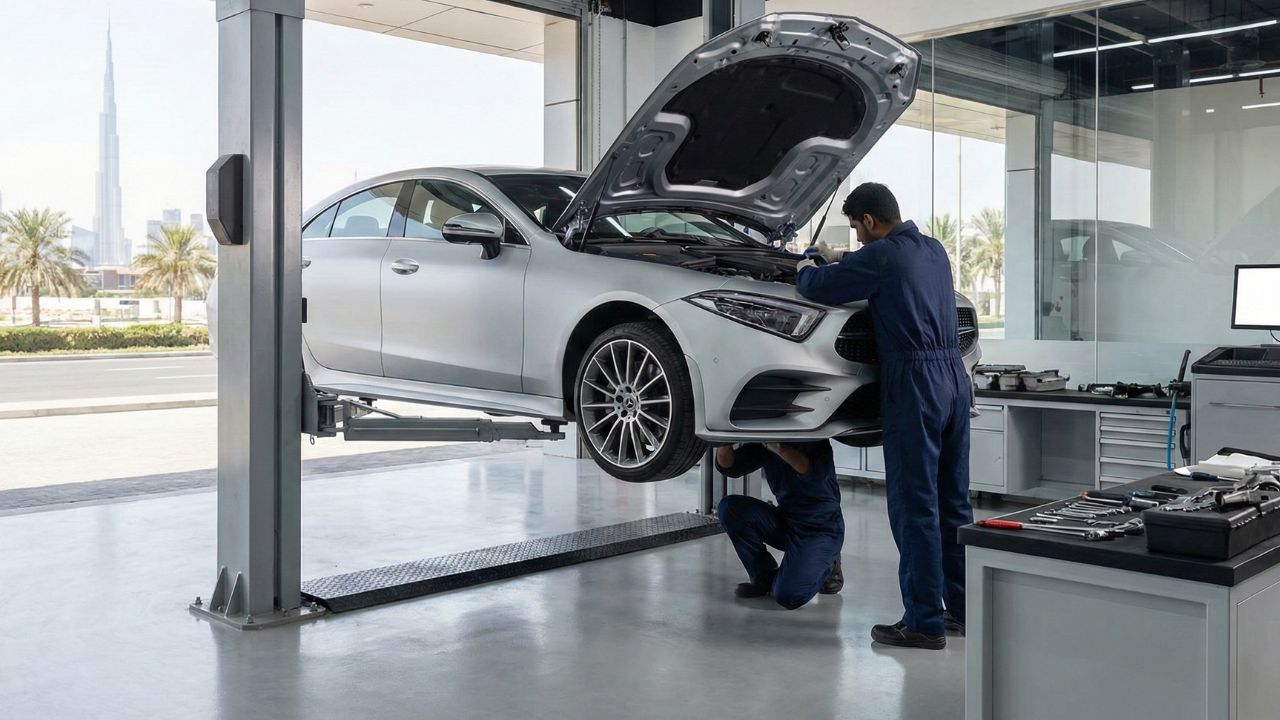
Picture this: You’re cruising down Sheikh Zayed Road in your Mercedes-Benz CLS-Class, that stunning four-door coupe that turns heads at every intersection. The sun is setting over the Dubai skyline, and suddenly, you notice something off. Maybe it’s a subtle vibration through the steering wheel, or perhaps that signature smooth ride feels slightly compromised. Your heart sinks a little because you know what comes next—finding someone who actually understands the intricate engineering marvel that is your C257.
Here’s something most CLS-Class owners discover the hard way: this isn’t just another Mercedes. The third-generation CLS-Class, internally designated as C257 and introduced in 2018, represents a quantum leap in automotive technology. It’s a vehicle that combines the elegance of a luxury sedan with the sleek proportions of a coupe, all while housing some of the most sophisticated mechanical and electronic systems Mercedes-Benz has ever engineered. When something goes wrong with this level of complexity, you can’t just take it to any garage that happens to have a Mercedes sign out front.
Dubai’s automotive repair landscape is flooded with workshops claiming expertise in luxury vehicles. Walk into any industrial area, and you’ll find dozens of establishments promising world-class service. But here’s the reality that separates mere promise from actual performance: the CLS-Class C257 requires technicians who don’t just understand Mercedes-Benz in general—they need intimate knowledge of this specific platform, its unique quirks, its particular vulnerabilities, and the specialized diagnostic protocols that make sense of its interconnected systems.
At Euro Car Repair, we’ve built our entire reputation on one fundamental principle: specialization isn’t just about having the right tools—it’s about having the right knowledge, the right experience, and the right commitment to your vehicle’s well-being. While other shops spread themselves thin across every make and model imaginable, we’ve chosen a different path. We focus exclusively on European luxury vehicles, with particular depth in Mercedes-Benz platforms, including the sophisticated C257 CLS-Class that demands our absolute best.
What makes the CLS-Class different from even other Mercedes models? Think of it this way: if the E-Class is a reliable workhorse dressed in a business suit, and the S-Class is a technological showcase wrapped in executive luxury, the CLS-Class is the artist of the family—prioritizing aesthetic perfection and driving dynamics while integrating cutting-edge technology in ways that can surprise even seasoned Mercedes technicians. The C257’s inline-six engines with EQ Boost mild-hybrid technology, its 9G-TRONIC nine-speed automatic transmission, and its AIRMATIC air suspension system all represent engineering approaches that require specific diagnostic knowledge and repair techniques.
Throughout this comprehensive guide, we’re going to walk you through exactly why Euro Car Repair has become the destination of choice for discerning CLS-Class owners across Dubai. You’ll discover what sets us apart from both dealerships and generic repair shops, understand the full spectrum of services we provide specifically tailored to your C257, learn about the unique challenges your vehicle faces in Dubai’s extreme environment, and gain insights into common issues that affect this particular model—along with how we solve them more effectively than anyone else.
Your Mercedes-Benz CLS-Class represents a significant investment, not just financially but emotionally. It’s a statement about your appreciation for design, performance, and innovation. It deserves care from people who share that appreciation and possess the technical mastery to back it up. Let’s explore why thousands of CLS-Class owners have made Euro Car Repair their trusted partner in maintaining these remarkable machines.
Why Euro Car Repair Stands Above the Rest
Our Deep-Rooted CLS-Class (C257) Specialization
When you entrust your CLS-Class to our team, you’re not getting generic European car knowledge applied to your specific vehicle. You’re receiving the benefit of years spent studying the C257 platform’s unique characteristics, from its M256 and M264 engine variants to its sophisticated 48-volt electrical architecture.
Our technicians have undergone extensive training specifically focused on the third-generation CLS-Class. This isn’t superficial familiarization—it’s comprehensive immersion into everything from the vehicle’s MRA (Modular Rear Architecture) platform characteristics to the nuances of its intelligent drive system. We understand how the C257’s weight distribution affects suspension component wear patterns. We know the specific failure modes of the EQ Boost integrated starter-generator system. We’re intimately familiar with the peculiarities of the MULTIBEAM LED headlight systems and their control modules.
This level of specialization matters more than you might initially realize. Consider the CLS-Class’s AIRMATIC air suspension system. On the surface, it might seem similar to air suspension in other Mercedes models, but the C257’s implementation includes model-specific calibrations, unique sensor arrays, and particular valve configurations. A technician who learned air suspension on an older W221 S-Class and assumes the knowledge transfers perfectly will miss critical nuances that can lead to misdiagnosis or incomplete repairs.
Our diagnostic capabilities extend beyond simply reading fault codes from the vehicle’s computer systems. We understand what those codes actually mean in the context of the CLS-Class’s specific architecture. When a C257 throws a P0016 code indicating camshaft position correlation issues, we know the common failure points specific to the M256 engine—and we know how to differentiate between a timing chain tensioner issue, a worn cam adjuster, or an oil pressure problem that manifests identically in the diagnostic system but requires completely different repair approaches.
Years of focused experience with the C257 have taught us where this model shows its age first, which components prove most vulnerable to Dubai’s harsh operating environment, and which maintenance interventions provide the greatest return on investment in terms of long-term reliability. This accumulated wisdom simply cannot be replicated by shops that see a CLS-Class once every few months between working on completely unrelated vehicles.
Technology That Sees What Others Miss
The Mercedes-Benz CLS-Class C257 contains more computing power than the spacecraft that landed on the moon. Its various control modules communicate across multiple network protocols, managing everything from engine timing to ambient lighting with microsecond precision. Diagnosing issues in this environment requires equipment that speaks the same sophisticated language.
Our workshop is equipped with factory-grade diagnostic systems specifically calibrated for Mercedes-Benz vehicles. This isn’t the generic OBD2 scanner you find at parts stores—it’s professional-grade equipment that can access every control module in your CLS-Class, read real-time data streams, perform bidirectional controls to test component functionality, and execute the specialized coding and programming procedures required after certain repairs.
But here’s where technology meets expertise in powerful ways: the most advanced diagnostic equipment in the world is only as effective as the technician interpreting its results. We’ve solved cases that left other shops baffled specifically because our team knows how to look beyond the obvious. When a CLS-Class comes in with intermittent performance issues, we don’t just read stored fault codes—we analyze freeze frame data, examine component activation patterns, monitor live data under various operating conditions, and use our depth of model-specific knowledge to identify subtle anomalies that point to root causes rather than symptoms.
One recent example perfectly illustrates this capability. A CLS450 arrived at our workshop after visiting two other repair facilities, both of which replaced components based on fault codes without resolving the underlying issue. Our technician took a different approach, using our advanced diagnostic system to monitor the entire powertrain control network while recreating the customer’s driving conditions. The data revealed a pattern suggesting not a failed component but rather a wiring harness chafing issue specific to a routing path changed in certain C257 production months. Thirty minutes of targeted repair solved a problem that had cost the owner weeks of frustration and unnecessary parts replacement.
This diagnostic depth extends to the CLS-Class’s increasingly sophisticated driver assistance systems. The C257’s array of radar sensors, cameras, and ultrasonic sensors requires specialized calibration equipment after any repairs affecting their mounting points or sightlines. We maintain the precise tools needed to properly calibrate these systems, ensuring your vehicle’s safety features function exactly as Mercedes-Benz engineered them.
Genuine Parts with Intelligent Alternatives
Quality begins with components, and the CLS-Class demands nothing less than excellence in every part that goes into its repair. We maintain direct relationships with OEM parts suppliers, ensuring access to genuine Mercedes-Benz components manufactured to the exact specifications your C257 was built with.
However, genuine doesn’t always mean dealership. Here’s something most CLS-Class owners don’t realize: many “genuine” Mercedes parts come from the same manufacturers who supply the premium aftermarket. Companies like Bosch, Brembo, Bilstein, and Continental produce both OEM parts installed at the factory and aftermarket versions sold under their own brands—often from identical production lines with identical specifications.
Our approach involves transparent conversations about parts choices. For critical engine components, complex electronic modules, or safety-critical systems, we typically recommend genuine Mercedes-Benz parts. The peace of mind and exact fitment justify the investment. For wear items like brake components, filters, or certain suspension elements, we present high-quality aftermarket alternatives that meet or exceed OEM specifications while offering better value.
Every part we install carries our quality guarantee. Whether it’s a genuine Mercedes component or a premium aftermarket alternative, we stand behind its performance and reliability. This commitment means we’re selective about our suppliers—we work only with manufacturers whose products we’ve tested and proven in real-world applications on vehicles like yours.
The parts sourcing advantage extends to availability and timing. While dealerships might quote days or weeks for certain components to arrive, our network of suppliers often enables same-day or next-day access to the parts your CLS-Class needs. This means less downtime and faster return to the road you love.
Pricing Philosophy Built on Respect
Let’s address what’s probably on your mind: cost. Mercedes-Benz CLS-Class ownership comes with certain realities, and maintenance represents one of them. But here’s where clarity and honesty matter more than anything else.
Before any work begins on your vehicle, you receive a detailed, itemized estimate. Not a vague approximation or a broad range—a specific breakdown showing labor hours, parts costs, and any additional charges. You’ll know exactly what we’re recommending, why we’re recommending it, and what it will cost. No surprises, no hidden fees, no mysterious charges appearing when you collect your vehicle.
Our pricing typically runs 30-40% below dealership rates for equivalent service quality. This isn’t because we cut corners—it’s because our overhead structure differs fundamentally from franchise dealerships with their territorial fees, corporate mandates, and standardized pricing schemes. We’re an independent workshop that can set fair prices based on actual costs rather than corporate formulas.
More importantly, we provide context for our pricing. When we recommend a service, we explain its urgency, its impact on your vehicle’s performance and reliability, and the consequences of deferring it. You’re never pressured into unnecessary work. If something can wait until your next service interval, we tell you. If there’s a more cost-effective approach that still maintains quality standards, we present it.
This transparency extends to our estimates’ accuracy. The price we quote is the price you pay, barring only one scenario: if we discover additional issues during the repair process, we contact you immediately, explain what we’ve found, provide a revised estimate, and await your approval before proceeding. Your authorization matters at every stage.
Service That Treats You Like Family
The automotive repair industry has earned a reputation for transactional relationships and impersonal service. We’ve consciously built something different—a customer experience centered on genuine care for both you and your vehicle.
When you schedule service for your CLS-Class, you’re not getting shuffled into an appointment system designed for maximum throughput. You’re receiving personalized attention that begins the moment you contact us. We listen to your concerns, ask clarifying questions to understand exactly what you’re experiencing, and schedule your appointment at a time that minimizes disruption to your routine.
Throughout the repair process, communication remains constant. You’re not left wondering what’s happening with your vehicle. We provide updates at key milestones—initial diagnosis completion, parts arrival, repair progress, and final quality checks. If we discover anything unexpected, you hear about it immediately with clear explanation and recommendations.
Our relationship with you extends beyond the immediate repair. We maintain comprehensive service records for your CLS-Class, tracking every service performed, every component replaced, and every recommendation made. This documentation becomes invaluable for understanding your vehicle’s history, planning future maintenance, and should you ever decide to sell, providing potential buyers with confidence in the vehicle’s care.
We also recognize that your time is valuable. Our workshop operates with efficiency that respects your schedule without compromising thoroughness. For routine services, we offer express options that can often complete work while you wait. For more complex repairs, we provide realistic timeframes and honor them consistently.
The Insurance Independence Advantage
Here’s where we differ dramatically from many repair shops, and it’s a difference that directly benefits you: Euro Car Repair does not work with insurance companies. This deliberate choice stems from our commitment to providing the absolute best care for your CLS-Class without external pressures or compromises.
When a repair shop works with insurance companies, they enter a relationship filled with perverse incentives. Insurance companies pressure shops to use cheaper aftermarket parts, minimize repair times, and cut costs wherever possible. They impose standardized labor rates that may not reflect the true complexity of working on sophisticated vehicles like the CLS-Class. They create approval processes that delay repairs and frustrate customers.
By remaining independent from insurance relationships, we maintain complete freedom to recommend what your vehicle actually needs. If your CLS-Class requires a genuine Mercedes component for proper repair, we recommend it without worrying whether an insurance adjuster will approve the expense. If a repair requires additional diagnostic time to identify root causes rather than just replacing components based on fault codes, we invest that time without concern about exceeding insurance-approved labor hours.
This independence also translates to speed. Without insurance approval processes, we can begin work immediately upon your authorization. No waiting days for adjusters to review estimates. No back-and-forth negotiations about coverage. Just straightforward repair work that starts when you need it and proceeds at the pace your vehicle’s needs dictate.
For CLS-Class owners specifically, this matters enormously. Your vehicle’s sophisticated systems don’t respond well to cost-cutting measures. Using substandard parts or rushing repairs to meet insurance company expectations creates long-term reliability issues that cost far more to address than doing things right the first time.
We recognize this approach means you pay directly for our services rather than filing insurance claims. However, most of our CLS-Class owners find that the combination of our fair pricing, quality workmanship, and absence of insurance-company compromises creates better overall value than navigating the insurance repair process.
A Reputation Earned Through Excellence
We don’t need to tell you we’re excellent—our customers’ continued trust demonstrates it more convincingly than any marketing claim ever could. The majority of our CLS-Class service work comes from repeat customers and referrals, the kind of organic growth that only happens when you consistently exceed expectations.
Many of our CLS-Class customers have been with us for years, following us from previous vehicles through their current C257. They stay because they’ve experienced the difference between merely adequate service and true expertise, between shops that view their vehicle as a transaction and a team that treats it as the precision instrument it is.
This reputation extends throughout Dubai’s luxury car community. CLS-Class owners talk to each other—at social gatherings, business meetings, car enthusiast events. When someone asks where to service their Mercedes, our name emerges consistently because satisfied customers become vocal advocates.
We’ve earned this position through unwavering consistency. Every CLS-Class receives the same meticulous attention whether it’s a 2018 CLS450 with 80,000 kilometers or a 2023 CLS53 AMG with barely 5,000 on the odometer. We don’t have good days and bad days—we have standards that remain constant regardless of circumstances.
Comprehensive Services Tailored to Your CLS-Class
Engine Performance and Reliability Services
The heart of your Mercedes-Benz CLS-Class beats with remarkable sophistication. Whether your C257 features the M256 inline-six with EQ Boost mild-hybrid technology or the M264 turbocharged four-cylinder, you’re operating an engine that represents the cutting edge of internal combustion development—and that advancement comes with specific service requirements.
The M256 engine, found in the CLS450 and CLS53 AMG variants, integrates a 48-volt electrical system that powers an integrated starter-generator positioned between the engine and transmission. This clever device provides multiple functions: starting the engine, recovering energy during deceleration, providing electrical boost during acceleration, and enabling the engine to shut off completely at stops. When this system develops issues—and specific failure modes do occur as these vehicles accumulate mileage—diagnosis requires understanding both its mechanical integration and its complex electrical control strategies.
Our engine services for the CLS-Class begin with comprehensive diagnostic assessment. We don’t just look for obvious problems; we evaluate the engine’s overall health through multiple lenses. Compression testing reveals the condition of pistons, rings, and valves. Oil analysis identifies wear patterns and contamination before they cause damage. Scope diagnostics allow us to literally look inside the engine through spark plug ports or other access points, identifying carbon buildup or mechanical issues invisible to external inspection.
Oil leaks plague Mercedes engines as they age, and the C257 platform shows particular vulnerability at certain gasket locations. The valve cover gaskets, timing cover seals, and oil pan gaskets all develop leaks with predictable frequency. We’ve refined our repair techniques specifically for the CLS-Class’s engine bay layout, which differs from other Mercedes models in ways that affect access and procedure. What might be a four-hour job on an E-Class can take substantially longer on a CLS-Class due to packaging constraints—and we factor these realities into our estimates so you’re never surprised.
Cooling system maintenance receives particular attention in Dubai’s climate. Your CLS-Class’s engine operates within tight temperature parameters, and the Gulf heat stresses every component of the cooling system. We replace coolant on schedules adjusted for local conditions—more frequently than Mercedes’ global recommendations because those recommendations assume European climates. We inspect water pumps, thermostats, and radiators for the subtle signs of impending failure that allow us to address issues before they strand you.
The turbocharging systems in CLS-Class engines—whether the twin-turbos in the M256 or the single turbo in the M264—require specific attention as mileage accumulates. Turbochargers operate under tremendous stress, spinning at speeds exceeding 100,000 RPM while managing exhaust gases at extreme temperatures. Oil quality and change intervals directly impact turbocharger longevity. We’ve seen too many expensive turbo failures that could have been prevented with better oil service, so we emphasize this aspect of engine care with every CLS-Class owner.
Preventive maintenance represents the smartest investment you can make in your CLS-Class’s engine. Regular oil changes with the correct specification synthetic oil, timely spark plug replacement, attention to air filtration in Dubai’s dusty environment, and periodic fuel system cleaning all contribute to long-term reliability that avoids the catastrophic failures requiring tens of thousands of dirhams to repair.
Transmission and Drivetrain Excellence
Your CLS-Class’s 9G-TRONIC nine-speed automatic transmission represents one of the smoothest, most refined gearboxes ever installed in a production vehicle. This transmission’s ability to shift almost imperceptibly while maintaining optimal engine speed for both performance and efficiency is genuinely remarkable—until something goes wrong, at which point its complexity becomes intimidatingly apparent.
The 9G-TRONIC requires specific service approaches that differ from older Mercedes transmissions. Its electronic control module continuously adapts shift strategies based on driving style, learning your patterns and adjusting accordingly. This adaptive behavior means that even minor transmission issues can manifest in ways that seem unrelated to the actual problem. A failing conductor plate might present as harsh shifts only under specific conditions, while a software calibration issue could create symptoms that mimic mechanical failure.
Our transmission services begin with comprehensive fluid analysis. Transmission fluid in the 9G-TRONIC serves multiple crucial functions: lubricating moving parts, providing hydraulic pressure for clutch and brake band operation, cooling internal components, and even conducting electrical signals to the conductor plate. As this fluid ages or becomes contaminated, all these functions degrade. We evaluate fluid condition visually and, when warranted, send samples for laboratory analysis that reveals precisely what’s happening inside the transmission.
Fluid service for the CLS-Class transmission follows intervals appropriate for Dubai’s demanding conditions. While Mercedes may advertise “lifetime” transmission fluid in some markets, this claim assumes ideal operating conditions that don’t exist in the Middle East. Heat, stop-and-go traffic, and the accumulated stress of aggressive driving all accelerate fluid degradation. We typically recommend transmission fluid service every 60,000-80,000 kilometers for CLS-Class vehicles operated primarily in Dubai—more frequently if the vehicle sees particularly harsh use.
When transmission problems do develop, the repair vs. replacement decision requires careful analysis. Modern transmissions like the 9G-TRONIC contain numerous individual components that can fail independently. A malfunctioning solenoid, a worn clutch pack, or a damaged valve body can all be repaired for fractions of what complete transmission replacement costs. However, internal damage sometimes progresses to the point where replacement becomes the only economical option.
Our diagnostic capabilities allow us to pinpoint specific failure modes within the transmission. Using specialized equipment, we can monitor solenoid operation, measure clutch pack engagement, evaluate torque converter lock-up characteristics, and assess the electronic control systems. This precision diagnosis ensures you pay only for the repairs your transmission actually needs, not for shotgun approaches that replace components unnecessarily.
The CLS-Class’s rear-wheel-drive configuration (or all-wheel-drive in the 4MATIC variants) includes additional drivetrain components requiring periodic attention. Differential fluid service, driveshaft support bearing inspection, and CV joint evaluation all form part of comprehensive drivetrain maintenance that ensures power reaches the wheels smoothly and reliably.
Brake System Mastery for Safety and Performance
Every time you press the brake pedal in your CLS-Class, you’re activating one of the most sophisticated braking systems available in any production vehicle. The C257’s brakes integrate multiple technologies: large ventilated disc brakes at all four corners, electronic brake force distribution, brake assist, adaptive brake lights, and hill start assist all working in concert to provide confident, controlled stopping power.
The CLS450 comes equipped with substantial brake components—360mm front discs and 320mm rear discs on most variants, with even larger rotors available on AMG-line packages. These substantial brakes handle the significant weight and performance potential of the vehicle, but they also generate tremendous heat that accelerates wear, particularly in Dubai’s traffic conditions where frequent braking is unavoidable.
Our brake services for the CLS-Class start with comprehensive inspection of all brake system components. We measure rotor thickness and check for heat-related warping. We inspect brake pads for remaining material and evaluate their wear patterns, which can reveal suspension alignment issues or caliper problems. We examine brake hoses for deterioration, test brake fluid condition, and evaluate the electronic brake systems through diagnostic protocols.
Brake pad replacement timing depends heavily on driving patterns. Aggressive driving wears pads quickly, while highway cruising extends their life. Dubai’s mix of gridlock traffic and high-speed motorways creates a unique wear profile. We typically see CLS-Class front brake pads requiring replacement around 30,000-40,000 kilometers, with rear pads lasting somewhat longer due to the brake system’s front bias.
When we replace brake pads, we don’t just swap the friction material. We clean and lubricate caliper slides to ensure even pad wear. We inspect calipers for leaks or binding. We evaluate rotor condition and recommend replacement when thickness measurements or surface condition warrant it. We test the electronic parking brake system, which integrates with the rear brake calipers in a configuration requiring specific service procedures.
Brake fluid represents a critical yet often overlooked aspect of brake system maintenance. This hygroscopic fluid absorbs moisture over time, lowering its boiling point and reducing its effectiveness under the extreme temperatures modern brakes generate. We recommend brake fluid replacement every two years for the CLS-Class, regardless of mileage. In Dubai’s humidity, this interval becomes even more critical as moisture accumulation accelerates.
Performance upgrade options exist for CLS-Class owners who desire enhanced braking capability. Upgraded brake pads offering better high-temperature performance, slotted or cross-drilled rotors for improved heat dissipation, and stainless steel brake lines for firmer pedal feel all represent potential enhancements we can discuss based on your driving preferences and requirements.
Climate Control Mastery for Dubai Conditions
In Dubai, your CLS-Class’s air conditioning system isn’t a luxury feature—it’s essential equipment that directly impacts your comfort and safety. The C257’s THERMOTRONIC automatic climate control system maintains cabin temperature with precision, but this capability depends on every component functioning optimally.
The AC system in your CLS-Class operates through a complex refrigeration cycle. The compressor, driven by the engine, pressurizes refrigerant gas. This high-pressure gas flows to the condenser mounted ahead of the radiator, where it releases heat and condenses into liquid. The liquid refrigerant then passes through an expansion valve into the evaporator inside the dashboard, where it evaporates, absorbing heat from the cabin air in the process. The cycle repeats continuously while the AC operates.
Dubai’s extreme temperatures stress this system mercilessly. Running the AC constantly puts enormous load on the compressor. The condenser works overtime trying to reject heat when ambient temperatures exceed 45 degrees Celsius. The evaporator battles humidity that accelerates bacterial growth and creates drainage issues.
Our AC services for the CLS-Class address these challenges comprehensively. We begin with performance testing, measuring actual vent temperatures and comparing them to specifications. Inadequate cooling triggers diagnostic procedures to identify the failure point. Is refrigerant charge low, suggesting a leak? Is the compressor failing to build pressure? Is the evaporator clogged or the expansion valve malfunctioning?
AC compressor replacement represents one of the more common repairs we perform on CLS-Class vehicles in Dubai. These compressors simply work harder here than in temperate climates, accumulating wear at accelerated rates. When a compressor fails, proper replacement involves more than just bolting in a new unit. The entire system requires evacuation and flushing to remove contamination. The expansion valve typically requires replacement. Fresh refrigerant and compressor oil must be added to precise specifications. The system must be leak-tested and its performance verified.
Evaporator issues manifest differently than compressor problems. A restricted or failing evaporator typically produces adequate cooling initially that deteriorates as ice forms on the evaporator core. You might notice decreased airflow, musty odors, or water pooling under the dashboard. Evaporator replacement represents a significant repair because accessing this component requires substantial dashboard disassembly—but neglecting evaporator problems leads to complete AC failure and potential water damage to interior components.
Cabin air filtration deserves special attention in Dubai’s environment. Your CLS-Class’s cabin air filter prevents dust, pollen, and particulates from entering the climate control system. In the Gulf’s dusty conditions, these filters clog far more quickly than Mercedes’ standard replacement intervals suggest. We recommend cabin air filter replacement every 10,000-15,000 kilometers for vehicles operated primarily in Dubai, sometimes more frequently if you drive in particularly dusty areas or during sandstorm season.
Beyond repairs, we offer preventive measures that extend AC system life. Annual refrigerant pressure checks identify developing leaks before they cause complete charge loss. Evaporator cleaning and sanitization treatments eliminate bacterial growth that causes odors. Condenser cleaning removes the dust and debris accumulation that reduces cooling efficiency.
Suspension and Steering Precision
The CLS-Class’s AIRMATIC air suspension system delivers the seemingly contradictory combination of luxurious ride comfort and engaging driving dynamics. This adaptive suspension continuously adjusts damping rates and ride height based on speed, road conditions, and selected drive mode. When everything works perfectly, the result is magical—but complexity brings vulnerability.
AIRMATIC suspension relies on air springs at each corner of the vehicle, with electronically controlled dampers and a central air compressor feeding the system. Ride height sensors at each wheel monitor vehicle position, while accelerometers detect body motion. The suspension control module processes all this data hundreds of times per second, commanding the dampers and air springs to optimize ride quality.
Air suspension components wear differently than conventional coil springs and shocks. The air springs themselves—essentially reinforced rubber bags—develop leaks as the rubber ages and cracks. The compressor works constantly to maintain system pressure, accumulating wear that eventually leads to failure. The electronic level valves that control air distribution can stick or malfunction. The air lines connecting components can chafe through or develop connector leaks.
Our suspension diagnostics for the CLS-Class employ both physical inspection and electronic analysis. We examine air springs for cracks or leaks. We listen to the compressor for abnormal noise indicating impending failure. We measure actual vs. commanded ride height at each corner. We use diagnostic equipment to monitor system pressure, valve operation, and damper response.
When air suspension components fail, replacement typically involves complete corner assemblies rather than attempting to repair individual air spring components. The labor involved in replacement makes it economically sensible to replace the complete assembly with fresh components rather than risking near-term failure of repaired units. We typically recommend replacing air springs in pairs—both fronts or both rears—to maintain consistent ride characteristics.
The conventional aspects of your CLS-Class’s suspension also require periodic attention. Control arm bushings, ball joints, and sway bar links all experience wear, particularly in vehicles subjected to aggressive driving or rough road conditions. These components’ gradual deterioration often goes unnoticed until inspection or until wear progresses to the point of creating noise or affecting handling.
Steering in the CLS-Class employs speed-sensitive power assist that provides light steering at low speeds for easy parking while firming up at highway speeds for stability and precision. The electric power steering system is generally reliable but can develop issues with steering angle sensors, steering rack wear, or control module malfunctions that require specific diagnostic approaches.
Wheel alignment represents a critical but often overlooked aspect of suspension maintenance. Your CLS-Class’s suspension geometry affects tire wear, handling balance, and steering feel. Dubai’s rough roads, aggressive speed bumps, and pothole-riddled side streets all conspire to knock alignment out of specification. We recommend alignment checks annually and always after any suspension work or impact with road hazards.
Electrical System Expertise
If you think of your CLS-Class as a computer on wheels, you’re not far off. The C257 contains dozens of electronic control modules managing every aspect of vehicle operation. This distributed computing architecture enables the sophisticated features you enjoy—but it also creates diagnostic challenges when electrical issues arise.
The 48-volt electrical system in CLS450 and CLS53 models adds another layer of complexity. This mild-hybrid system operates alongside the conventional 12-volt electrical system, creating dual voltage architecture that requires specific diagnostic knowledge and safety precautions during service.
Battery health affects more than just starting reliability in modern Mercedes vehicles. The CLS-Class’s battery monitoring system continuously tracks battery condition, adjusting charging strategies and electrical system operation accordingly. A weak or failing battery triggers a cascade of seemingly unrelated electrical issues: warning lights, transmission shift problems, suspension malfunctions, and accessory failures.
When we replace a battery in your CLS-Class, the procedure involves more than simply swapping units. The new battery must be registered to the vehicle’s electrical system through diagnostic software, informing the control modules of the fresh battery’s characteristics. This registration ensures optimal charging strategies and prevents premature battery failure due to incorrect charging profiles.
Electrical diagnostics require systematic approaches rather than random parts replacement. When your CLS-Class develops electrical issues, we begin by documenting all fault codes stored in the various control modules. We then investigate whether these faults represent actual failures or symptoms of other problems. A dozen fault codes across multiple systems might point to a single failed module or wiring issue rather than a dozen separate problems.
Sensor failures represent common electrical issues in the CLS-Class. Oxygen sensors, mass airflow sensors, throttle position sensors, wheel speed sensors, steering angle sensors—the list goes on. Each sensor provides critical data to control systems, and sensor failures can affect everything from engine performance to stability control operation. Our diagnostic equipment allows us to test sensor outputs, compare readings to specifications, and verify that control modules properly interpret sensor data.
Water intrusion causes substantial electrical problems in vehicles, and the CLS-Class shows particular vulnerability in certain areas. Sunroof drains that clog can allow water into the cabin, potentially reaching control modules mounted under seats or in footwells. We inspect these drainage systems during service and clear blockages before they cause expensive damage.
Fluid Leak Detection and Resolution
Oil leaks might seem like minor annoyances, but in the CLS-Class’s sophisticated engine, they can indicate significant problems or lead to serious damage if neglected. The M256 and M264 engines use specific gasket materials and sealing designs that develop predictable leak patterns as vehicles age.
Our leak detection process begins with thorough inspection to locate the leak source precisely. Oil tends to migrate across engine surfaces, making it appear to leak from areas downstream of the actual failure point. We clean suspected areas, add UV dye to the oil if necessary, and operate the engine to identify exactly where oil escapes.
Valve cover gasket leaks represent the most common oil leak on CLS-Class engines. These gaskets seal the valve covers to the cylinder head, containing oil that lubricates the camshafts and valve train. As gaskets age, they harden and lose their sealing ability. The repair requires removing the valve covers, thoroughly cleaning the sealing surfaces, and installing new gaskets with proper torque specifications.
Timing cover leaks prove more complex. The timing cover seals the front of the engine where the timing chain and various seals reside. Accessing this area requires significant disassembly, often including removal of the cooling fan, pulleys, and various accessories. When we identify timing cover leaks, we typically replace all seals in the area since the labor investment makes it economical to address all potential leak points simultaneously.
Coolant leaks require immediate attention because they can lead to engine overheating and catastrophic damage. Your CLS-Class’s cooling system operates under pressure, and even small leaks can rapidly worsen. We pressure-test cooling systems to identify leak points, examining water pumps, radiators, hoses, and the numerous plastic connections used throughout the system.
Transmission fluid leaks most commonly develop at the transmission pan gasket or at the output shaft seals where the driveshaft connects. These leaks warrant prompt repair because low transmission fluid levels can cause expensive transmission damage within remarkably short periods.
Specialized Services for Complete Care
Beyond major systems, your CLS-Class requires various specialized services that maintain its appearance, functionality, and value.
Tire service for the CLS-Class involves more than mounting and balancing. Your vehicle’s tire pressure monitoring system requires proper servicing when tires are replaced. Each tire contains a sensor that transmits pressure and temperature data to the vehicle’s control modules. These sensors require activation and programming when new tires are installed, a procedure requiring specific equipment.
The CLS-Class’s large diameter wheels—19-inch as standard with 20-inch available—and performance-oriented tire profiles create handling and comfort benefits but also make tires vulnerable to damage from Dubai’s aggressive curbs and occasional road hazards. We inspect tires regularly for damage, measure tread depth, and recommend replacement when safety margins diminish.
Sunroof issues affect many CLS-Class vehicles as they accumulate mileage. The panoramic sunroof system incorporates multiple motors, rails, and control modules. Proper lubrication of the rails and regular cleaning of the drainage channels prevents most common problems. When mechanical issues do develop, our experience with the C257’s specific sunroof design enables effective repair.
Paint and bodywork services address the inevitable minor damage that accumulates during normal use. Door dings, parking lot scrapes, and curb rash on wheels can all be repaired to restore your CLS-Class’s pristine appearance. We work with specialized paint and body facilities that understand the importance of proper color matching and finish quality on luxury vehicles.
Pre-purchase inspection services provide invaluable protection when considering a used CLS-Class. Our comprehensive inspections evaluate mechanical condition, identify prior damage or repair issues, verify service history accuracy, and test all systems. This objective assessment can save you from expensive problems or provide negotiating leverage on price.
Scheduled maintenance packages bundle services at intervals appropriate for your driving patterns and Dubai’s conditions. These packages ensure your CLS-Class receives consistent, comprehensive care that maximizes reliability and preserves value. From oil changes to major services, we track everything and remind you when upcoming service intervals approach.
Common CLS-Class (C257) Issues We Solve Daily
EQ Boost System Complications
The integrated starter-generator system that provides the CLS450 and CLS53 with their mild-hybrid capabilities represents genuinely innovative engineering—but it also introduces failure modes unique to this technology. The ISG unit sits between the engine and transmission, spinning constantly during vehicle operation and managing both mechanical and electrical functions.
When the ISG develops issues, symptoms can vary dramatically. Some owners experience rough starts or complete starting failure. Others notice vibrations during the auto-start-stop function or hear unusual noises during engine shutdown. Still others discover the problem only through dashboard warning lights indicating hybrid system malfunctions.
Our diagnostic approach systematically evaluates the 48-volt electrical system, the ISG unit itself, the power electronics controlling the system, and the software calibrations managing integration with the engine and transmission. We’ve successfully diagnosed cases where other facilities replaced costly components unnecessarily because they lacked specific knowledge of how this system operates.
Prevention centers on maintaining electrical system health. Ensuring the 12-volt and 48-volt batteries remain in excellent condition, protecting electrical connections from corrosion, and updating software when Mercedes releases improved calibrations all contribute to EQ Boost system longevity.
AIRMATIC Suspension Deterioration
Air suspension components have finite lifespans, and the CLS-Class’s AIRMATIC system proves no exception. We typically see air spring leaks beginning around the 80,000-100,000 kilometer range, though harsh use or unfortunate circumstances can accelerate deterioration.
The first sign usually appears as the vehicle sitting lower on one corner after being parked overnight. The suspension compressor works harder to maintain ride height, running more frequently than normal. Eventually, warning lights illuminate and the suspension defaults to a non-adjustable height.
Early intervention saves money. Catching air spring leaks before the compressor wears out from overwork means addressing one component rather than multiple expensive parts. We recommend proactive replacement of air springs showing early signs of deterioration rather than waiting for complete failure.
Transmission Adaptation Issues
The 9G-TRONIC transmission’s sophisticated adaptive logic occasionally gets confused, particularly after battery replacement or if the vehicle has been driven in unusual patterns. Symptoms include harsh shifts, delayed engagement, or shift points that seem wrong for the driving situation.
Most transmission adaptation issues respond to electronic reset procedures and relearning cycles. We clear the transmission’s adaptation values, perform prescribed relearning drives, and verify that the transmission reestablishes proper shift patterns. This corrects problems that owners sometimes fear indicate expensive mechanical failures.
True mechanical transmission issues do occur but less frequently than adaptation-related symptoms. When we diagnose actual mechanical problems—failing clutch packs, worn valve bodies, or malfunctioning solenoids—we provide detailed explanations and comprehensive repair options.
Turbocharger Failure Progression
Both the M256’s twin-turbo configuration and the M264’s single turbo will eventually require replacement as vehicles accumulate high mileage, though proper maintenance dramatically extends turbocharger life. Early warning signs include blue smoke from the exhaust, indicating oil consumption through worn turbo seals, or excessive turbo noise suggesting bearing wear.
We’ve prevented numerous expensive turbo failures through proactive intervention. Oil analysis revealing elevated metal content indicates bearing wear before noise develops. Addressing oil quality issues or cooling system problems that accelerate turbo deterioration can add years to turbocharger life.
When turbocharger replacement becomes necessary, we address related components simultaneously. Oil feed and return lines often require replacement. The intercooler may need cleaning. Spark plugs that showed oil fouling get replaced. This comprehensive approach ensures reliability after major repairs.
Fuel System Complications in Dubai’s Climate
The high-pressure direct injection fuel systems in CLS-Class engines operate at pressures exceeding 2000 bar, creating performance and efficiency benefits but also vulnerability to fuel quality issues. Dubai’s extreme heat can affect fuel system components, and occasional fuel quality variations stress these sophisticated systems.
Carbon buildup on intake valves represents a particular challenge in direct injection engines. Unlike port fuel injection where gasoline washes across intake valves, direct injection introduces fuel directly into the combustion chamber, allowing carbon deposits to accumulate on valve surfaces. Over time, this buildup restricts airflow and degrades performance.
We address carbon buildup through several approaches. Chemical cleaning treatments can reduce deposits. In severe cases, walnut shell blasting—a process using crushed walnut shells propelled against valve surfaces—removes stubborn carbon without damaging components. Preventive measures include periodic fuel system cleaning treatments and occasional high-speed driving to raise combustion temperatures.
High-pressure fuel pumps show occasional failures in CLS-Class engines. Symptoms include rough running, misfires under load, or complete starting failure. Diagnosis involves monitoring fuel pressure during various operating conditions, comparing measured pressures to specifications, and evaluating electrical operation of the pump control systems.
Electrical Gremlins and Module Communication Issues
Modern vehicles’ networked control modules occasionally experience communication problems, particularly as vehicles age and electrical connections accumulate corrosion or water intrusion. The CLS-Class’s sophisticated architecture includes multiple communication networks—CAN bus, FlexRay, and LIN—all of which must function perfectly for seamless operation.
Intermittent electrical issues prove most challenging to diagnose. A module that malfunctions sporadically, a connector that works when ambient temperature is moderate but fails when hot, or a control unit that loses communication only under specific conditions all require patience and systematic diagnostic approaches.
Our experience with the C257 platform helps us recognize patterns. We know which modules are vulnerable to water damage, which connectors commonly corrode, and which software bugs Mercedes has addressed through updates. This knowledge accelerates diagnosis and ensures effective repairs.
Brake System Wear Patterns
The CLS-Class’s substantial weight and performance capability create specific brake wear patterns we’ve learned to anticipate. Front brakes naturally wear faster than rears, but the degree of this front bias varies based on driving style. Aggressive drivers might see front pad life half that of rear pads, while conservative drivers achieve more balanced wear.
Rotor replacement timing depends on both thickness and condition. Rotors that measure within specification for thickness might still require replacement if they’ve developed heat-related warping causing pulsation during braking. We machine rotors when possible but recommend replacement when thickness approaches minimum specifications or when surface condition warrants it.
The electronic parking brake system integrated into the rear calipers requires specific service procedures. When replacing rear brake pads, we must electrically retract the parking brake motors before compressing the caliper pistons. This procedure requires diagnostic equipment communicating with the parking brake control module.
Climate Control Blend Door Failures
The THERMOTRONIC climate control system uses electronically controlled blend doors to mix heated and cooled air, achieving precise temperature control. These blend door motors occasionally fail, creating symptoms ranging from inability to achieve desired cabin temperature to clicking noises from behind the dashboard.
Diagnosis involves using diagnostic equipment to command blend door positions while monitoring actual movement. We can identify specific motors that fail to respond or move to incorrect positions. Replacement requires substantial dashboard disassembly but restores full climate control functionality.
Prevention centers on periodic climate control system exercise. Running the AC and heat regularly, cycling through all vent positions, and avoiding neglecting climate control system operation all help maintain blend door motor health.
Our Expert Technicians: The Difference Makers
Behind every perfectly repaired CLS-Class stands a technician whose knowledge, experience, and dedication transform complex problems into elegant solutions. Our team doesn’t just fix cars—they understand these vehicles at levels that separate competent mechanical work from true expertise.
Each technician working on CLS-Class vehicles has completed extensive training specific to Mercedes-Benz systems. This isn’t generic automotive education but focused instruction on the particular engineering approaches, diagnostic strategies, and repair procedures that Mercedes employs. They understand how Mercedes’ engineers think, how the various systems integrate, and where the vehicles show vulnerability.
But formal training represents only the foundation. Real expertise develops through hands-on experience, through encountering problems that textbooks don’t cover, through learning the subtle clues that point experienced technicians toward solutions that leave others baffled. Our team has accumulated this battle-tested knowledge through years working specifically with European luxury vehicles.
The diagnostic process separates exceptional technicians from average ones more than any other aspect of their work. Anyone can replace components based on fault codes or follow rote procedures. True diagnostic mastery involves understanding the underlying engineering well enough to trace symptoms to root causes, to recognize when fault codes mislead rather than inform, to trust experience when data seems contradictory.
Our technicians approach each CLS-Class as an individual rather than just another example of a model. They consider the vehicle’s history, its mileage and age, how the owner describes driving it, what prior repairs have addressed. They factor Dubai’s unique environment into their diagnostic thinking. They maintain healthy skepticism about obvious answers that might obscure deeper issues.
Continuous education keeps our team current with evolving technology. Mercedes constantly updates their vehicles, introducing new features, revising control strategies, and addressing issues through software updates. We invest in ongoing training that ensures our technicians remain proficient with the latest developments while maintaining their expertise with older systems still operating in customer vehicles.
Communication represents an undervalued but critical skill in our technicians’ repertoire. Technical expertise means little if technicians can’t explain issues clearly to customers, helping owners understand what’s wrong, why it happened, what repair involves, and how to prevent recurrence. Our team excels at translating complex technical reality into accessible explanations that inform without overwhelming.
Quality control processes ensure consistent excellence across every repair. Work doesn’t conclude when components are installed—it concludes when verification procedures confirm proper function, when the vehicle has been road tested to validate the repair, when diagnostic systems show no remaining issues. We don’t release vehicles until we’re confident they’ll perform perfectly.
Our technicians take personal pride in their work. They view each CLS-Class as a machine deserving respect, care, and their absolute best effort. This attitude isn’t about marketing—it’s genuine appreciation for sophisticated engineering combined with commitment to customer satisfaction that drives excellence at every stage.
Navigating Dubai’s Unique Challenges
Dubai presents operating conditions that test your CLS-Class in ways that Mercedes’ German engineers never anticipated. Understanding these environmental challenges and adjusting maintenance accordingly separates vehicles that remain reliable for years from those plagued by premature failures.
Summer temperatures regularly exceeding 45 degrees Celsius stress every fluid, seal, and component in your vehicle. Engine oil operates at higher temperatures, breaking down more quickly. Coolant works harder to reject heat. Rubber seals and gaskets harden and crack from sustained heat exposure. Your AC system runs constantly under maximum load. These realities necessitate more aggressive maintenance intervals than Mercedes’ global recommendations suggest.
We’ve adapted our service schedules specifically for Gulf conditions. Oil changes occur more frequently because thermal stress accelerates lubricant degradation. Coolant replacement happens on shortened intervals because the extreme heat ages antifreeze more rapidly. We scrutinize cooling system components more carefully because even minor deficiencies can lead to overheating in ambient temperatures that leave no margin for error.
Dubai’s dusty environment affects your CLS-Class’s air filtration systems dramatically. The engine air filter prevents sand and dust from entering the combustion chambers where they’d cause rapid cylinder wear. The cabin air filter stops particulates from entering the climate control system and passenger compartment. Both filters clog far faster here than in cleaner environments.
We’ve established replacement intervals for both filters that reflect Dubai’s reality. Engine air filters typically need replacement every 15,000 kilometers or annually, whichever comes first. Cabin air filters often require changing every 10,000-15,000 kilometers. During sandstorm season or if you frequently drive in particularly dusty areas like construction zones or desert roads, even these aggressive intervals might prove insufficient.
The coastal humidity in areas like Dubai Marina, JBR, and the Palm creates corrosion concerns that inland desert areas avoid. Salt-laden air attacks electrical connections, brake components, and any exposed metal surfaces. CLS-Class vehicles garaged near the coast require more frequent inspection of brake components and electrical connections to catch corrosion before it causes failures.
Traffic patterns affect vehicle wear in ways many owners don’t consider. Sheikh Zayed Road’s high-speed cruising alternates with gridlock conditions, creating a particularly stressful duty cycle. Your CLS-Class’s transmission shifts constantly in heavy traffic. Brakes endure repeated heating cycles. The engine operates at less efficient temperatures during extended idling. This combination accelerates wear beyond what pure mileage would suggest.
Parking challenges introduce their own issues. Indoor parking protects your CLS-Class from sun exposure that ages interior materials and stresses paint. However, most outdoor parking lots in Dubai mean your vehicle bakes in direct sunlight, with interior temperatures sometimes exceeding 70 degrees. This heat stress accelerates deterioration of dashboard materials, leather seats, and various trim components. It also loads the AC system with extraordinary cooling demands every time you start the vehicle.
We provide specific guidance for surviving Dubai’s environment. Park indoors whenever possible. Use sunshades to reduce interior temperatures when outdoor parking is unavoidable. Wash your vehicle regularly to remove corrosive salt and accumulated dust. Consider paint protection film and ceramic coatings to preserve your CLS-Class’s finish against environmental assault. Run your AC on fresh air mode periodically to prevent drainage systems from stagnating.
Seasonal considerations also factor into our service recommendations. The intense summer months from June through September create maximum stress. We recommend comprehensive inspections before summer arrives, ensuring cooling systems, AC components, and all fluids are fresh and capable of handling the upcoming challenge. Post-summer inspections identify damage sustained during the hot months before cooler weather arrives and repair urgency diminishes.
Transparent Pricing and Exceptional Value
Discussing money feels awkward, but transparency requires addressing what many consider the most important aspect of automotive service: what it costs. We approach pricing with the same honesty that characterizes every aspect of our operation.
Our estimate process begins with comprehensive diagnostic evaluation. We don’t guess at problems or provide vague price ranges hoping the actual figure lands somewhere in the middle. We identify exactly what’s wrong, determine precisely what repairs require, source accurate parts pricing, and calculate specific labor hours. This diligence means your estimate reflects reality rather than wishful thinking.
Every estimate arrives itemized in detail. You’ll see individual line items for each component requiring replacement, separate labor charges for different procedures, and clear identification of any fluids, supplies, or miscellaneous charges. This transparency allows you to understand exactly where your money goes and make informed decisions about which repairs to authorize immediately versus which might be deferred.
Comparison with dealership pricing reveals substantial savings. Dealerships operate under franchise structures requiring territory fees, corporate overhead allocations, and standardized pricing schemes that inflate costs. Our independent structure eliminates these burdens, allowing us to charge fair prices based on actual costs rather than corporate mandates.
Typical savings range from 30-40% below dealership prices for equivalent service quality. A major service that costs 3,000 dirhams at a dealership might run 2,000 dirhams at our facility—same genuine parts, same quality workmanship, same expertise, just without the franchise overhead built into pricing.
But value extends beyond simple cost comparison. We invest time in accurate diagnosis that prevents unnecessary repairs. We communicate clearly throughout the process, avoiding surprises. We stand behind our work with comprehensive warranties. We build relationships that provide ongoing value through personalized service and attention to your vehicle’s specific needs and history.
Package maintenance programs bundle routine services at favorable pricing while ensuring your CLS-Class receives comprehensive care at appropriate intervals. These packages remove the guesswork from maintenance planning, providing scheduled service that prevents problems rather than just reacting to failures.
Payment flexibility accommodates various preferences. We accept all major credit cards, provide financing options for larger repairs, and work with you when unexpected repair needs strain budgets. Our goal is getting your CLS-Class properly repaired, and we’re willing to discuss payment arrangements that make necessary service accessible.
The long-term cost savings from quality repairs done right the first time exceeds the apparent savings from cut-rate service that creates future problems. Using genuine or premium aftermarket parts prevents premature failures that cheap components cause. Proper diagnostic work addresses root causes rather than symptoms that recur after superficial repairs. Thorough procedures ensure repairs last rather than requiring rework.
Hidden fees don’t exist in our pricing structure. The estimate we provide is the price you pay, period. If circumstances change during repair—we discover additional issues, for instance—we contact you immediately, explain the situation, provide a revised estimate, and await your authorization before proceeding. You’re never surprised by charges you didn’t approve.
Customer Experience: Where Service Becomes Partnership
The moment you contact Euro Car Repair, you experience service designed around your needs rather than our convenience. Scheduling happens when it works for you, not when we have gaps in our calendar. We listen to your concerns without interrupting or dismissing them. We ask clarifying questions that help us understand exactly what you’re experiencing.
Appointment flexibility accommodates demanding schedules. Early morning drop-offs, evening pickup options, weekend service availability—we work around your life rather than expecting your life to work around our hours. For routine services that can be completed quickly, we often offer while-you-wait options with comfortable seating, refreshments, and WiFi so you’re not inconvenienced.
Our waiting area provides more than just a place to sit. Comfortable seating, climate control that actually works, quality refreshments, and reliable internet connectivity make waiting bearable when you choose to stay. However, we also recognize your time is valuable and provide alternative options.
Pickup and delivery service transforms vehicle maintenance from an interruption into a seamless background process. We’ll collect your CLS-Class from your home or office, transport it to our facility for service, and return it when repairs are complete. You never leave your location, never rearrange your schedule, never interrupt your day. The service happens invisibly while you focus on more important matters.
Communication throughout the repair process keeps you informed without overwhelming you with unnecessary details. When we complete initial diagnosis, you receive a call explaining what we found, what repairs we recommend, and what the work will cost. If questions arise during repairs, we reach out immediately rather than proceeding on assumptions. When work is complete, we contact you to discuss what was done and when the vehicle is ready for collection.
Digital service records provide comprehensive documentation of every service performed on your CLS-Class. These records remain accessible whenever you need them—for warranty claims, when selling the vehicle, or simply to understand its service history. We track everything: dates, mileage, services performed, parts replaced, recommendations made, future service needs.
Our warranty on repairs demonstrates confidence in our work. Parts and labor receive guarantee periods appropriate to the service performed. Should any issue arise with work we’ve completed, we address it without argument or additional charges. This warranty isn’t fine-print-riddled coverage that disappears under scrutiny—it’s straightforward protection backed by our commitment to customer satisfaction.
After-service support extends beyond the immediate repair. If you have questions about how to maintain something we’ve repaired, we’re available. If you’re concerned about a noise or behavior after service, we’ll inspect it without charging diagnostic fees. We view our relationship as ongoing partnership rather than transactional interaction.
Emergency repair availability provides peace of mind when breakdowns occur. While we encourage scheduled maintenance to prevent emergencies, we recognize that unexpected failures happen. When you need urgent assistance, we prioritize getting you back on the road rather than scheduling you weeks out according to normal appointment procedures.
Frequently Asked Questions
Q1: How much does Mercedes-Benz CLS-Class (C257) repair typically cost in Dubai?
The honest answer frustrates many people because it’s genuinely variable: it depends entirely on what needs repair. An oil change might cost 400-600 dirhams depending on oil type and filter requirements. Brake pad replacement typically runs 1,200-2,000 dirhams depending on whether just pads are needed or rotors require replacement too. Major repairs like transmission service, suspension component replacement, or engine work can range from 3,000 dirhams to well over 10,000 for significant repairs.
What we can tell you definitively is that our pricing runs approximately 30-40% below Mercedes dealership rates for equivalent service quality. Where a dealership might charge 250 dirhams per hour for labor, we charge considerably less. Where they mark up parts by 40-50% over cost, our margins are more reasonable. This doesn’t mean cheap—it means fair value for expert service.
The factors affecting repair costs include the specific issue requiring attention, whether genuine Mercedes parts are necessary or quality aftermarket alternatives are acceptable, the labor intensity of the repair (some jobs require extensive disassembly simply to access failed components), and whether additional issues discovered during work warrant immediate attention. We provide detailed estimates before beginning work, so you’ll know exact costs before authorizing repairs.
Q2: Do you use genuine Mercedes-Benz parts for CLS-Class repairs?
We source genuine Mercedes-Benz OEM parts for any repair where they represent the best option. Complex electronic modules, safety-critical components, and items where exact specifications matter receive genuine parts without question. However, we also recognize that many “genuine” Mercedes parts come from the same manufacturers producing premium aftermarket alternatives.
Here’s what most people don’t understand: Companies like Bosch, Brembo, Bilstein, and Continental manufacture both the OEM parts installed at Mercedes factories and aftermarket parts sold under their own brands. Often these parts come from identical production lines with identical specifications. The primary difference is the packaging and the price—genuine Mercedes packaging costs significantly more than the identical part in aftermarket packaging.
For each repair, we discuss parts options transparently. We explain when genuine parts are truly necessary, when premium aftermarket alternatives offer equivalent quality and performance at better value, and what the price differences involve. The choice remains yours, though we provide recommendations based on our experience with what works best long-term.
Every part we install, whether genuine or premium aftermarket, carries our warranty. We stand behind the quality and performance of components we use, which means we’re extremely selective about our suppliers. We work only with manufacturers and distributors whose products we’ve tested and proven in real-world applications.
Q3: How long does typical Mercedes-Benz CLS-Class service take?
Service duration varies dramatically based on what work is being performed. A basic oil change and inspection might take 45 minutes to an hour. Brake pad replacement typically requires 2-3 hours. More complex services extend accordingly—transmission service might take 3-4 hours, while major repairs like engine work, suspension replacement, or dashboard-intensive repairs can require a full day or multiple days.
Several factors influence timing beyond the mechanical work itself. Parts availability matters—if we need to order components, the repair extends to include delivery time. Diagnostic complexity affects duration when we’re troubleshooting issues rather than performing scheduled maintenance. Unexpected complications discovered during work can add time, though we always contact you for authorization before extending service beyond the original estimate.
We provide realistic timeframes when scheduling service, factoring in our shop’s current workload and the specific requirements of your CLS-Class’s service needs. We don’t overpromise aggressive completion times we can’t meet reliably. We’d rather exceed expectations by finishing early than disappoint you by running late.
For customers needing expedited service, we often accommodate rush requests when possible. While we can’t always compress complex repairs into unrealistic timeframes without compromising quality, we do our best to work around urgent scheduling needs when they arise.
Q4: Why don’t you work with insurance companies?
This question deserves thorough explanation because our insurance independence directly benefits you, even though it might seem inconvenient initially.
Insurance companies prioritize minimizing their costs, which creates pressure on repair shops to cut corners. They push for cheaper aftermarket parts of questionable quality, demand labor rates below what proper repair requires, and impose approval processes that delay work while adjusting estimates downward. Shops accepting insurance work often find themselves choosing between proper repairs and insurance company approval.
We’ve chosen a different path. By not working with insurance companies, we maintain complete independence in recommending what your CLS-Class actually needs. If genuine Mercedes parts represent the best choice, we recommend them without worrying whether an insurance adjuster will approve the expense. If proper diagnosis requires additional time to identify root causes rather than just replacing components based on fault codes, we invest that time without concern about exceeding insurance-approved hours.
This independence also translates to speed. Without insurance approval processes, we begin work immediately upon your authorization. No waiting days for adjusters to review estimates. No back-and-forth negotiations about coverage. Just straightforward repair that starts when needed and proceeds at the pace proper workmanship requires.
For CLS-Class owners specifically, this matters enormously. Your vehicle’s sophisticated systems don’t respond well to cost-cutting measures. Using substandard parts or rushing repairs to meet insurance company expectations creates reliability issues that cost far more to address later than doing things properly the first time.
We recognize this approach means you pay directly for our services. However, our fair pricing combined with quality workmanship and absence of insurance-company compromises typically creates better overall value than navigating the insurance repair process, even accounting for your deductible.
Q5: What makes Euro Car Repair better than Mercedes dealerships for CLS-Class service?
Dealerships offer certain advantages—access to proprietary technical information, factory training for technicians, comprehensive parts inventory. However, we match or exceed these advantages while providing additional benefits dealerships can’t offer.
Our technicians’ experience specifically with the C257 CLS-Class equals or surpasses dealership technicians. Many dealership mechanics work on whatever vehicles arrive—one day a C-Class, the next an AMG GT, the day after a Sprinter van. Our focus on European luxury vehicles means our team develops deep expertise with specific platforms like the CLS-Class rather than surface familiarity across Mercedes’ entire lineup.
Pricing represents our most obvious advantage. Dealership franchise structures impose territory fees, corporate overhead, and standardized pricing schemes that inflate costs significantly. Our typical 30-40% savings below dealership rates reflects elimination of these burdens while maintaining equivalent service quality.
Personalized attention distinguishes our service experience from dealership conveyor-belt approaches. Dealerships process high volumes, which creates efficiency but reduces individual attention. When you bring your CLS-Class to us, you’re not customer number 47 today—you’re a valued client whose vehicle receives focused care from technicians who remember its history and particular needs.
Flexibility in scheduling, service approaches, and parts choices all exceed what dealerships typically offer. We work around your schedule rather than fitting you into rigid appointment slots. We discuss repair options and alternatives rather than following predetermined service procedures. We help you prioritize repairs according to your needs rather than pushing packaged services you might not require immediately.
The absence of sales pressure creates a more comfortable experience. Dealership service departments often push additional services, extended warranties, and accessory sales. Our revenue comes exclusively from repair and maintenance work we actually perform, eliminating incentive to recommend unnecessary services.
Q6: Can you handle Mercedes-Benz CLS-Class warranty repairs?
Active Mercedes-Benz factory warranty requires service at authorized dealerships to maintain coverage. We cannot perform warranty repairs while factory warranty remains in effect without potentially voiding that coverage. If your CLS-Class remains under original warranty, we recommend using dealership service to protect your warranty benefits.
However, once factory warranty expires, we become an excellent alternative offering the same or better service quality at substantially lower cost. We often see CLS-Class owners who faithfully used dealership service during warranty coverage switching to our facility once that warranty expires and they’re no longer obligated to use dealer service.
Extended warranties purchased separately from the factory warranty vary in their service location requirements. Some extended warranty contracts allow service at independent facilities, while others mandate dealer service. We recommend reviewing your specific extended warranty terms to understand service location restrictions.
For vehicles outside warranty coverage, we provide the same diagnostic and repair capabilities dealerships offer, often with advantages in personal attention, pricing, and scheduling flexibility. The post-warranty period is actually when our value proposition becomes strongest—you maintain the service quality your CLS-Class demands while significantly reducing maintenance costs.
Q7: How often should I service my Mercedes-Benz CLS-Class in Dubai’s climate?
Dubai’s extreme environment demands more aggressive maintenance schedules than Mercedes’ global recommendations assume. We’ve developed service intervals specifically calibrated for Gulf conditions based on years of experience with what actually works here versus what theoretical schedules suggest.
Oil changes should occur every 10,000 kilometers or annually, whichever comes first. Mercedes might advertise 15,000-kilometer or even longer intervals in some markets, but Dubai’s heat accelerates oil degradation. The few hundred dirhams spent on more frequent oil changes prevents the tens of thousands in engine damage that inadequate lubrication causes.
Air filters—both engine and cabin—require replacement every 10,000-15,000 kilometers in Dubai’s dusty environment. Standard Mercedes intervals assume cleaner conditions that simply don’t exist here. Clogged air filters reduce engine performance, decrease fuel efficiency, and in the cabin filter’s case, compromise air conditioning effectiveness.
Brake fluid replacement should occur every two years regardless of mileage. This hygroscopic fluid absorbs moisture rapidly in Dubai’s humidity, lowering its boiling point and reducing braking effectiveness under the extreme temperatures modern brakes generate.
Coolant replacement follows three-year intervals rather than the longer periods sometimes suggested. The extreme heat stresses coolant, breaking down its anti-corrosion additives and reducing its effectiveness at managing engine temperatures.
Transmission fluid service, despite Mercedes sometimes advertising “lifetime” fluid, should occur every 60,000-80,000 kilometers for vehicles operated primarily in Dubai. Heat, stop-and-go traffic, and accumulated stress all degrade transmission fluid faster than ideal conditions would.
Major services at 40,000, 80,000, and 120,000 kilometer intervals involve comprehensive inspection and replacement of numerous components according to predetermined schedules. These services maintain your CLS-Class’s reliability and catch developing issues before they cause breakdowns.
Q8: Do you offer mobile repair or pickup/delivery service for the CLS-Class?
We provide pickup and delivery service throughout Dubai, transforming vehicle maintenance from a scheduling nightmare into a seamless background process. Simply schedule your service, and we’ll collect your CLS-Class from your home or office at the appointed time. We transport it to our facility, perform the authorized service, and return it when work is complete.
This service eliminates the traditional automotive service hassles. You don’t rearrange your schedule around shop hours. You don’t spend time in waiting rooms or arranging alternate transportation. Your day proceeds normally while your vehicle receives expert care.
The areas we serve include all major Dubai locations: Downtown Dubai, Business Bay, Dubai Marina, JBR, Dubai Silicon Oasis, Jumeirah, Al Barsha, Motor City, Arabian Ranches, and surrounding areas. If you’re located elsewhere in Dubai, contact us—we often accommodate special arrangements for customers outside our standard service radius.
Mobile repair for minor services is occasionally possible, though most CLS-Class service requires our workshop’s specialized equipment and facilities. We can discuss whether mobile service makes sense for your specific needs, though pickup/delivery typically provides better results for anything beyond the most basic services.
Q9: What areas of Dubai do you serve?
Our facility is strategically located to serve customers throughout Dubai efficiently. While we’re physically located in a specific area, our pickup and delivery service extends our effective service radius to cover all of Dubai’s major residential and commercial areas.
We regularly serve customers in Downtown Dubai, Dubai Marina, Jumeirah Lakes Towers, Business Bay, Dubai Silicon Oasis, Arabian Ranches, Motor City, Jumeirah, Al Barsha, Sheikh Zayed Road corridor, and throughout Deira and Bur Dubai. Basically, if you’re in Dubai, we can accommodate your service needs.
For customers who prefer dropping vehicles off directly rather than using pickup service, our facility is easily accessible from major roads and offers convenient parking. Our location was chosen specifically for accessibility while maintaining the professional workshop environment your CLS-Class demands.
Customers in outlying areas like Dubai Investment Park, Dubai South, or the outer reaches of development sometimes ask whether we serve their locations. While we prefer focusing on Dubai proper for logistical efficiency, we’re often willing to accommodate special arrangements for customers in these areas. Contact us to discuss your specific location—we’re flexible when possible.
Q10: How do I know if my Mercedes-Benz CLS-Class needs immediate repair versus something that can wait?
Certain symptoms demand immediate attention to prevent further damage or ensure safety. Others, while warranting repair, can wait for convenient scheduling without risk of catastrophic failure.
Immediate attention is required for: engine overheating (pull over immediately and shut off the engine to prevent catastrophic damage), complete loss of brakes (obviously a safety emergency), transmission that won’t engage gears or slips dangerously, severe fluid leaks that leave puddles (especially coolant or brake fluid), warning lights indicating serious malfunctions like low oil pressure or brake system failure, unusual noises suggesting imminent mechanical failure, and any safety system malfunction affecting vehicle control.
Schedule service soon but not necessarily emergently for: minor fluid leaks that aren’t actively worsening, unusual noises that remain consistent rather than progressively worsening, check engine lights without accompanying performance issues, air conditioning that’s operating poorly but not completely failed, and minor electrical issues that don’t affect critical systems.
Can wait for scheduled maintenance: worn brake pads that still have adequate material remaining, tires showing wear but still above minimum tread depth, minor cosmetic issues, routine scheduled services approaching their interval, and minor convenience feature malfunctions.
When in doubt, contact us. Describe the symptoms you’re experiencing, and we’ll help you understand urgency. We’d rather you call about something minor that can wait than ignore something serious that worsens into expensive damage or safety hazards. We’re here to help, and that begins with honest assessment of what requires immediate attention versus what can be scheduled conveniently.
Your CLS-Class Deserves Expert Care—We Deliver It
Your Mercedes-Benz CLS-Class represents more than transportation. It’s a statement about your appreciation for engineering excellence, design sophistication, and driving dynamics that few vehicles deliver. This remarkable machine deserves care from people who understand and respect what makes it special.
Euro Car Repair has built our reputation on exactly this understanding. We’re not a generic repair shop that happens to work on Mercedes occasionally. We’re specialists who’ve invested years developing the expertise, acquiring the equipment, and building the relationships with parts suppliers that enable us to maintain vehicles like your CLS-Class at the highest possible standard.
Our team approaches every CLS-Class with the knowledge that this vehicle’s owner chose it specifically for its unique combination of elegance and performance. We recognize the trust involved in allowing us to service something that matters to you. We honor that trust through meticulous work, transparent communication, fair pricing, and absolute commitment to your satisfaction.
The difference between adequate service and excellent service often comes down to details—the technician who takes extra time to properly diagnose root causes rather than replacing components based on fault codes, the advisor who explains options clearly without pressure, the quality control that ensures everything functions perfectly before your vehicle leaves our care. These details accumulate into experiences that separate merely satisfactory from genuinely excellent.
Dubai’s demanding environment places unique stresses on your CLS-Class. The extreme heat, abrasive dust, coastal humidity, and challenging traffic conditions all accelerate wear and create maintenance requirements beyond what European operating conditions would demand. We’ve calibrated our service approaches specifically for these realities, ensuring your vehicle receives care appropriate for where it actually operates rather than generic schedules designed for average conditions that don’t exist here.
When issues develop—and even meticulously maintained vehicles eventually require repair—you deserve diagnosis from technicians who’ve seen the same problems dozens of times before, who know the CLS-Class’s vulnerabilities, who can trace symptoms to causes efficiently and accurately. You deserve repairs performed with proper procedures, quality parts, and verification that ensures long-term reliability rather than just temporary fixes.
Our independence from insurance company relationships means we maintain complete focus on what your vehicle needs rather than what external entities will authorize. This freedom enables us to recommend genuine parts when they’re truly necessary, invest diagnostic time to solve problems correctly, and perform repairs to the exacting standards your CLS-Class demands.
Whether you need routine maintenance to keep your vehicle performing perfectly, diagnostic services to identify troubling symptoms, or complex repairs to restore full functionality, Euro Car Repair stands ready to deliver the expertise your CLS-Class requires. We’ve built our business on the simple principle that exceptional work creates satisfied customers who return repeatedly and recommend us enthusiastically to others.
Contact us today to schedule service for your Mercedes-Benz CLS-Class. Experience the difference that specialized knowledge, modern equipment, transparent communication, and genuine commitment to excellence creates. Your vehicle deserves nothing less than the absolute best care available—and we’re here to provide exactly that.
Euro Car Repair: Where European luxury vehicles receive the expert attention they deserve, where customers become partners in maintaining automotive excellence, and where your CLS-Class finds the care it needs to deliver the performance and reliability you expect for years to come.