
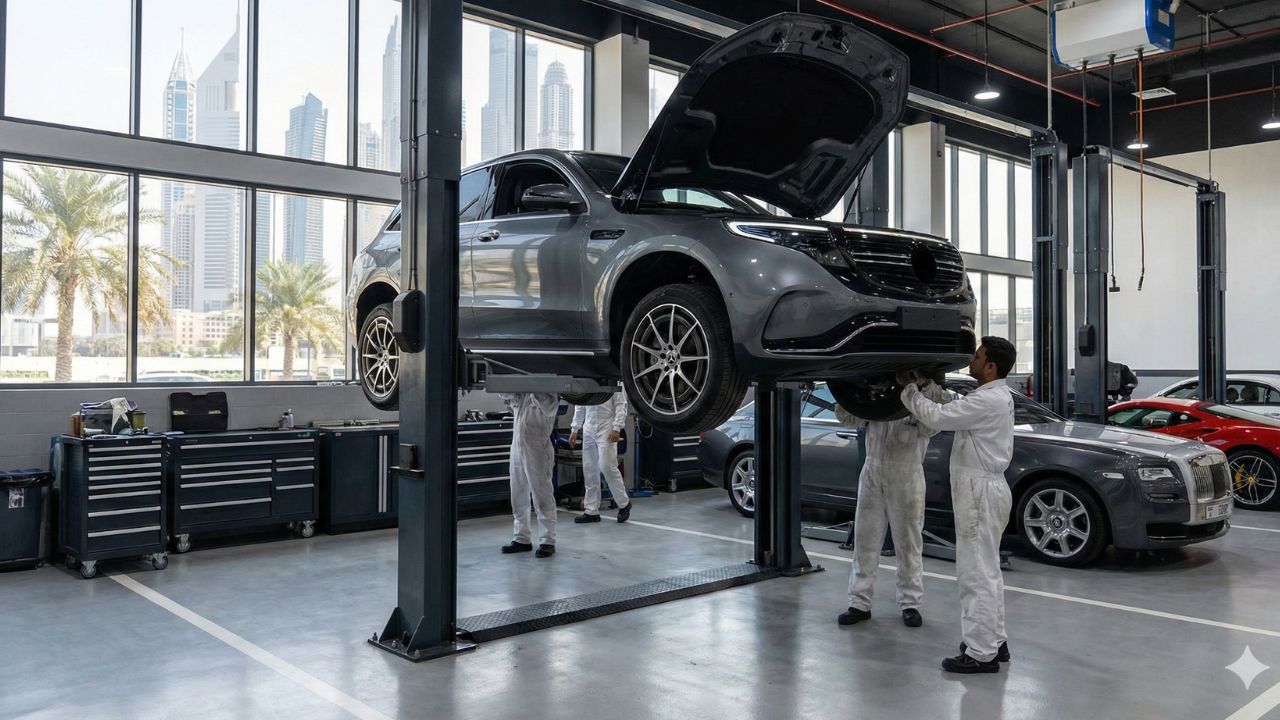
Picture this: You’re cruising down Sheikh Zayed Road in your Mercedes-Benz EQC, the smooth electric powertrain delivering whisper-quiet performance that makes Dubai traffic almost enjoyable. Then suddenly, an unfamiliar warning light illuminates your digital dashboard. Your heart sinks. This isn’t just any vehicle—it’s Mercedes-Benz’s groundbreaking first fully electric SUV, the N293 generation EQC, a sophisticated machine that represents the German manufacturer’s bold leap into sustainable luxury mobility.
Where do you turn when this technological marvel needs attention?
The Mercedes-Benz EQC (N293), produced from 2019 to 2023, stands as a testament to Stuttgart’s engineering prowess. Built on a modified GLC platform and packed with dual electric motors producing 402 horsepower, this electric luxury SUV requires knowledge that goes far beyond conventional automotive repair. We’re talking about high-voltage battery systems, regenerative braking computers, thermal management networks, and software-dependent components that would leave traditional mechanics scratching their heads.
Dubai’s landscape of automotive repair shops ranges from corner garages to gleaming dealerships, yet finding someone who truly understands your EQC’s intricate electric architecture presents a genuine challenge. The N293 generation isn’t simply a Mercedes with batteries instead of an engine—it’s a completely reimagined vehicle platform where every system communicates through complex digital networks, where cooling strategies differ fundamentally from combustion engines, and where diagnostic procedures require specialized equipment that most facilities simply don’t possess.
This is precisely where Euro Car Repair enters your story.
For years, we’ve dedicated ourselves exclusively to European luxury vehicles, developing deep expertise in brands like Mercedes-Benz, BMW, Audi, Range Rover, and other premium marques. But the EQC demanded we elevate our game even further. Our technicians invested countless hours mastering the unique characteristics of Mercedes-Benz’s electric vehicle architecture, understanding how the N293’s 80 kWh battery pack integrates with its dual asynchronous motors, learning the nuances of its liquid cooling system, and becoming fluent in the diagnostic language of electric mobility.
Dubai presents extraordinary challenges for any vehicle, but electric vehicles face their own distinct set of obstacles. When temperatures soar beyond 50°C during summer months, your EQC’s battery thermal management system works overtime. The coastal humidity that permeates areas like JBR and Dubai Marina can affect sensitive electrical connections. Fine desert sand finds its way into cooling air intakes designed in Germany for entirely different climatic conditions. These aren’t theoretical concerns—they’re daily realities that impact your vehicle’s performance, efficiency, and longevity.
Throughout this comprehensive guide, we’ll explore why Euro Car Repair has become Dubai’s trusted destination for Mercedes-Benz EQC (N293) owners who refuse to compromise on service quality. You’ll discover our specialized approach to electric vehicle maintenance, learn about common issues specific to this model, understand why we deliberately choose not to work with insurance companies (a decision that directly benefits you), and gain insights into keeping your electric Mercedes performing exactly as its engineers intended.
Your EQC represents a significant investment in automotive excellence and environmental consciousness. It deserves care from professionals who appreciate its technological sophistication and understand the unique demands of Dubai’s environment. Let’s explore why discerning EQC owners consistently choose Euro Car Repair when their electric luxury SUV needs expert attention.
Why Choose Euro Car Repair for Your Mercedes-Benz EQC (N293)
Specialized Mercedes-Benz EQC Expertise That Makes the Difference
The Mercedes-Benz EQC (N293) isn’t just another vehicle in our workshop—it’s a specialty we’ve deliberately cultivated through rigorous training and hands-on experience. Our technicians have pursued certification programs specifically focused on electric vehicle systems, going well beyond basic automotive repair credentials. They’ve studied the EQC’s unique architecture, understanding how its Electric Drive System (EDS) coordinates power delivery between front and rear axles, how the Battery Management System (BMS) monitors each of the 384 individual cells within the battery pack, and how the vehicle’s multiple computers communicate through CAN bus networks.
When you bring your EQC to our facility, you’re not explaining electric vehicle basics to mechanics learning on your vehicle. Our team already knows that the N293 generation uses a water-cooled battery system with its own dedicated cooling circuit, separate from the cabin climate control. They understand why the EQC’s regenerative braking system requires periodic brake component service despite reduced wear from friction braking. They’re familiar with the specific software updates Mercedes-Benz has released to optimize battery performance and address early production quirks.
This depth of knowledge translates into accurate diagnostics on the first attempt. We’ve encountered EQC owners who visited multiple facilities before finding us, each previous shop offering vague explanations or recommending expensive part replacements based on guesswork rather than proper diagnosis. Electric vehicles demand precision—there’s no room for trial-and-error approaches when dealing with high-voltage systems and integrated computer networks.
Our experience with the N293 generation specifically spans dozens of vehicles and hundreds of service appointments. We’ve tracked patterns in how these vehicles respond to Dubai’s climate, identified which components tend to require attention at specific mileage intervals, and developed maintenance protocols that prevent problems before they emerge. This accumulated wisdom simply cannot be matched by facilities that occasionally encounter an EQC among their predominantly combustion-engine workload.
Advanced Diagnostic Technology for Electric Vehicle Complexity
The Mercedes-Benz EQC’s onboard diagnostic system operates at a completely different level than conventional vehicles. While a traditional Mercedes might have fifteen to twenty individual control modules, your EQC contains over forty separate computers managing everything from battery cell balancing to ambient lighting preferences. Accessing and interpreting data from these systems requires diagnostic equipment specifically designed for electric vehicle architecture.
Our workshop utilizes professional-grade diagnostic platforms that communicate directly with Mercedes-Benz’s engineering databases. This isn’t generic scan tool technology—it’s manufacturer-level equipment capable of performing guided diagnostics, initiating component actuations for testing purposes, and even programming new control modules when necessary. When your EQC displays a fault code, we don’t just read a number and look it up in a basic database. We access the complete fault memory, review freeze-frame data showing exact vehicle conditions when the fault occurred, and trace the problem to its root cause rather than simply addressing symptoms.
Consider a scenario we encountered recently: an EQC arrived with reduced power output and a vague warning about the propulsion system. A basic diagnostic scan showed multiple fault codes related to the rear electric motor. However, our deeper analysis revealed that the actual problem originated in a coolant temperature sensor providing incorrect readings to the Battery Management System. The system was limiting power to prevent perceived overheating that wasn’t actually occurring. Replacing the motor, as another facility had recommended, would have wasted thousands of dirhams without solving anything.
This diagnostic precision extends to preventive analysis as well. During routine service appointments, we review your EQC’s system health data, checking battery cell voltage balance, monitoring charging system performance, verifying proper operation of thermal management components, and identifying developing issues before they cause breakdowns. It’s analogous to having a comprehensive health checkup rather than waiting until symptoms appear.
Genuine Parts and Premium Quality Alternatives
The parts debate takes on new significance with electric vehicles. Your EQC’s components must meet exact specifications not just for physical fit, but for electrical compatibility, thermal performance, and software integration. We source Original Equipment Manufacturer (OEM) parts directly from Mercedes-Benz’s supply chain, ensuring every component meets the precise standards your vehicle requires.
However, we also recognize that OEM pricing doesn’t always align with reasonable value expectations. For certain applications, we offer premium aftermarket alternatives that meet or exceed original specifications while providing cost savings. These aren’t bargain-basement substitutes—they’re components from respected manufacturers who supply parts to multiple automotive brands. We’ll always explain the difference between OEM and quality aftermarket options, providing honest guidance about where you can save money without compromising your vehicle’s performance or reliability.
Every part we install carries warranty protection. OEM components come with Mercedes-Benz’s standard warranty terms, while our selected aftermarket parts include manufacturer warranties that we stand behind completely. If any part fails prematurely, we’ll replace it without question. This commitment to quality extends beyond individual components to encompass our entire repair philosophy.
For EQC-specific items like high-voltage cables, battery cooling system components, or electric motor parts, we insist on OEM specification due to the critical nature of these systems. There’s simply no acceptable compromise when dealing with components that operate at 400 volts or manage thermal loads across your battery pack. Your safety and your vehicle’s reliability take absolute precedence over cost considerations in these areas.
Transparent Pricing Philosophy That Respects Your Investment
Nothing erodes trust faster than unexpected charges appearing on a final invoice. Our pricing approach starts with thorough communication before any wrench turns. When you bring your EQC to our facility, we perform a comprehensive diagnostic assessment and then prepare a detailed estimate covering every aspect of recommended service. You’ll see line-item breakdowns for labor hours, parts costs, and any additional services we suggest.
This estimate isn’t a rough approximation—it’s a firm quote. If we discover additional issues during repair work, we contact you immediately to discuss options before proceeding. You’ll never receive a surprise invoice for work you didn’t authorize. This transparency extends to explaining why certain services cost what they do. Electric vehicle expertise commands fair compensation because of the specialized knowledge and equipment required. However, you’ll find our rates substantially lower than Mercedes-Benz dealership pricing—typically thirty to forty percent less for equivalent service quality.
We’re not competing on rock-bottom pricing because quality work carries inherent costs. The technician servicing your EQC invested years developing expertise. The diagnostic equipment accessing your vehicle’s systems represents significant capital investment. The OEM parts ensuring proper repair meet exacting standards. But we’ve structured our business model to eliminate the overhead bloat that drives dealership prices skyward, passing those savings directly to you.
Customer-First Service Model That Values Relationships
Your EQC isn’t just another job number in our system—it’s your daily companion, your investment, your choice of how to move through the world. We treat it accordingly. From your first contact with our team, you’ll experience personalized attention focused on understanding your specific concerns and circumstances. Maybe you’ve noticed a subtle change in how the regenerative braking feels. Perhaps you’re concerned about reduced range compared to when the vehicle was new. Or you simply want to ensure your EQC receives proper maintenance to preserve its value and performance.
Whatever brings you to our facility, we listen carefully and respond thoughtfully. Throughout the service process, we maintain open communication. You’ll receive updates on diagnostic findings, explanations of recommended repairs, and realistic timelines for completion. If we encounter unexpected delays, we inform you immediately rather than leaving you wondering. After service completion, we review everything we’ve done, explaining what we found, what we repaired, and what you should monitor going forward.
This relationship-focused approach extends beyond individual service appointments. We maintain detailed service records for every vehicle we service, tracking maintenance history, noting specific issues or patterns, and scheduling proactive reminders when upcoming service intervals approach. Many of our EQC customers have been with us since purchasing their vehicles new, trusting us with every service need from basic inspections to complex repairs.
Why We Don’t Work With Insurance Companies—And Why That Benefits You
Our decision to operate completely independently from insurance companies isn’t about convenience—it’s a deliberate choice that directly benefits every customer. When repair facilities work with insurance providers, they face constant pressure to minimize costs, often at the expense of repair quality. Insurers may demand use of aftermarket parts that don’t meet OEM specifications, push for repair procedures that take shortcuts, or simply deny coverage for services that your vehicle genuinely needs.
By refusing insurance involvement, we maintain complete independence in our repair recommendations. When your EQC needs a specific component replaced, we recommend the right part for the job, not the cheapest option that an adjuster will approve. We follow proper repair procedures without cutting corners to meet insurance-imposed labor hour limits. Our loyalty lies entirely with you and your vehicle, not with third-party companies focused on minimizing their payout.
This approach also dramatically accelerates the repair process. You’ve likely experienced the frustration of waiting days or weeks for insurance approval on repairs, your vehicle sitting idle while adjusters review estimates and negotiate details. Without insurance involvement, we proceed directly from diagnostic assessment to repair execution, getting your EQC back on the road quickly.
The direct payment model creates additional advantages. You’re not trapped in payment disputes between repair facilities and insurance companies. You’re not dealing with deductibles, co-pays, or coverage questions. You simply pay for the service your vehicle receives, receiving exactly what you’ve authorized without insurance company interference.
For many EQC owners, the premium you’re saving by not filing claims more than offsets direct payment for routine maintenance and minor repairs. Reserve your insurance coverage for genuinely catastrophic situations while handling regular service needs directly—you’ll often find this approach more economical in the long term while ensuring your vehicle receives optimal care.
Proven Track Record Serving Dubai’s Electric Mercedes Community
Reputation isn’t built overnight, especially in Dubai’s discerning automotive market. Our facility has earned trust through consistent delivery of exceptional service, accurate diagnostics, and repairs that solve problems permanently rather than temporarily. EQC owners throughout Dubai have discovered us through recommendations from friends, colleagues, and family members who experienced our expertise firsthand.
This word-of-mouth reputation matters immensely in the luxury vehicle community. When someone invests in a Mercedes-Benz EQC, they’re typically well-informed, detail-oriented, and uncompromising about service quality. These aren’t customers who accept mediocrity or tolerate excuses. They expect—and deserve—excellence. The fact that discerning EQC owners consistently choose us and recommend us to others speaks volumes about the service quality we deliver.
Our customer retention rate exceeds ninety percent, meaning once EQC owners experience our service, they rarely go elsewhere for future needs. This loyalty stems from tangible results: accurate diagnostics that solve problems efficiently, transparent pricing without surprises, expertise that instills confidence, and genuine care about every vehicle we service. We’ve built relationships with customers that span years, servicing their vehicles through warranty periods and well beyond, becoming their trusted partner in maintaining their electric Mercedes investment.
Comprehensive Service Offerings for Your Mercedes-Benz EQC (N293)
Electric Motor and Drive System Services
The Mercedes-Benz EQC (N293) employs dual asynchronous electric motors—one driving the front axle, one powering the rear—creating an all-wheel drive system that responds instantly to changing traction conditions. Unlike conventional motors with brushes, bearings, and mechanical complexity requiring regular maintenance, these electric motors are relatively maintenance-free under normal circumstances. However, “relatively” doesn’t mean “never,” and certain conditions can affect motor performance or longevity.
We provide comprehensive electric motor diagnostics using specialized testing equipment that evaluates winding resistance, insulation integrity, and bearing condition without disassembly. This non-invasive testing identifies developing problems before they cause catastrophic failure. Should motor repair or replacement become necessary, we follow Mercedes-Benz’s exact procedures for high-voltage system isolation, ensuring absolute safety throughout the process.
The power electronics controlling these motors—inverters that convert battery DC power to the AC current the motors require—represent another critical service area. These sophisticated units generate substantial heat during operation and rely on liquid cooling to maintain optimal temperatures. We service the inverter cooling system, verify proper operation of cooling pumps and heat exchangers, and test inverter function across the full power range.
Your EQC’s drive system also includes multiple reduction gearboxes that translate the motors’ high-speed rotation into usable wheel speed. While these units operate in sealed housings filled with lifetime lubricant, we verify seal integrity and check for any fluid leakage that could indicate developing problems. Early detection of seal deterioration prevents catastrophic gearbox failure that would require extremely expensive replacement.
The sophisticated torque vectoring system controlling power distribution between front and rear axles depends on accurate sensor data and precise computer control. We test all wheel speed sensors, yaw rate sensors, and steering angle sensors that feed information to the drive control system, ensuring your EQC delivers the confident, balanced handling Mercedes-Benz engineered into this platform.
Battery System Health and Thermal Management
Your EQC’s 80 kWh lithium-ion battery pack represents the heart of the vehicle, a carefully engineered assembly of 384 individual cells arranged in modules and monitored continuously by the Battery Management System. While you can’t perform traditional battery maintenance like checking fluid levels or cleaning terminals, comprehensive diagnostic assessment reveals vital information about battery health, capacity, and charging performance.
We evaluate individual cell voltage balance, identifying any cells drifting from the pack average—a potential indicator of developing problems. We review charging cycle history, examining how your battery has been charged over its lifetime and whether charging patterns might be affecting longevity. We test the battery cooling system’s effectiveness, verifying that coolant flows properly through channels surrounding the battery modules and that temperature sensors provide accurate readings.
Dubai’s extreme heat makes battery thermal management absolutely critical. The EQC’s liquid cooling system maintains optimal battery temperature during charging, driving, and even when parked in scorching temperatures. This system includes a dedicated coolant circuit with its own electric pump, heat exchanger, and temperature control valve. We service this cooling system at appropriate intervals, replacing coolant according to Mercedes-Benz specifications and verifying leak-free operation throughout the circuit.
The battery pack’s mounting system and underbody protection also require periodic inspection. While Mercedes-Benz designed robust protection, Dubai’s occasional rough roads and parking obstacles can potentially damage the battery tray or cooling lines. We perform thorough underbody inspections, checking for any damage to protective covers, coolant lines, or high-voltage cables that could develop into serious problems.
Battery performance naturally degrades over time and charge cycles—this is physics, not a defect. However, we can help maximize your battery’s longevity through proper charging guidance and thermal management maintenance. We’ll discuss optimal charging strategies for Dubai’s climate, explain how to minimize battery stress during the brutal summer months, and recommend service intervals that keep your thermal management system operating at peak efficiency.
Regenerative Braking and Friction Brake Services
The EQC’s regenerative braking system recovers energy during deceleration, feeding electricity back into the battery while simultaneously slowing the vehicle. This brilliant system reduces reliance on traditional friction brakes, extending brake component life substantially. However, this very efficiency creates a unique maintenance requirement: brake components can corrode from insufficient use.
In Dubai’s humid coastal environment, brake rotors that aren’t regularly scrubbed by brake pad contact can develop surface rust and corrosion. Even though your brake pads might have plenty of material remaining, the rotors may require service due to corrosion pitting or uneven surfaces. We evaluate brake components specifically in the context of electric vehicle operation, checking for corrosion issues alongside traditional wear assessment.
Your EQC’s brake system also includes a sophisticated hydraulic backup providing maximum stopping power when regenerative braking alone isn’t sufficient. This hydraulic system requires periodic brake fluid service—moisture absorption degrades fluid performance over time, and high humidity accelerates this process. We flush and replace brake fluid according to Mercedes-Benz’s specifications, using DOT 4 Low Viscosity fluid specifically formulated for vehicles equipped with electronic brake systems.
The brake-by-wire system coordinating regenerative and friction braking relies on multiple pressure sensors, electronic control valves, and a high-pressure accumulator. We test all these components, verifying smooth transition between regenerative and friction braking across different deceleration rates. Any inconsistency in brake pedal feel or braking performance deserves immediate investigation—brake system integrity isn’t an area for compromise.
We also service the electronic parking brake system, testing motor function and mechanism operation. These electrically-actuated parking brakes can develop problems from infrequent use or environmental exposure, requiring periodic service to ensure reliable operation. Proper maintenance prevents the frustrating situation of a parking brake that won’t release or fails to hold the vehicle securely.
Climate Control System Services
Dubai’s climate makes air conditioning not a luxury but an absolute necessity, and the EQC’s electric climate control system differs fundamentally from conventional automotive AC. Without engine waste heat to warm the cabin, your EQC uses an electric heating system. Conversely, the AC compressor runs on electric power rather than being driven by an engine belt. These differences create unique service requirements and diagnostic considerations.
The electric AC compressor draws significant power from the battery, directly impacting your driving range. We verify compressor efficiency, checking for refrigerant leaks, testing compressor motor current draw, and ensuring the system delivers maximum cooling with minimum power consumption. Any decline in AC performance should prompt immediate attention—struggling to cool the cabin in 50-degree heat isn’t just uncomfortable, it’s potentially dangerous.
Your EQC’s AC system uses R1234yf refrigerant, a more environmentally friendly alternative to older R134a. This refrigerant requires specific handling equipment and expertise—it’s not interchangeable with traditional refrigerants, and improper service can damage system components. We maintain proper equipment for R1234yf service, ensuring accurate refrigerant recovery, system evacuation, and recharge to exact specifications.
The climate control system’s electric heating elements and heat pump components (if equipped) require periodic testing to verify proper operation. These components work overtime during Dubai’s brief winter months, and any malfunction affects cabin comfort significantly. We test heating system operation across all temperature settings, verify proper operation of temperature blend doors and airflow distribution, and ensure the system maintains your selected cabin temperature efficiently.
Cabin air filters deserve attention in Dubai’s dusty environment. These filters trap dust, sand, and particulates before they enter the passenger compartment, but they quickly become saturated in our conditions. We recommend more frequent cabin filter replacement than Mercedes-Benz’s standard interval—typically every six months rather than annually. This simple service maintains air quality and prevents the musty odors that can develop when filters become saturated with captured particles.
Suspension and Steering System Maintenance
The Mercedes-Benz EQC rides on a sophisticated multi-link suspension system engineered to balance comfort with precise handling. The battery pack’s substantial weight—approximately 650 kilograms—places significant demands on suspension components, potentially accelerating wear compared to lighter vehicles. We inspect all suspension bushings, control arms, ball joints, and mounting points for wear or deterioration.
Dubai’s road conditions, from Sheikh Zayed Road’s expansion joints to occasional potholes on secondary routes, subject suspension components to constant stress. We’ve observed that EQC suspension bushings tend to show wear patterns at specific mileage intervals, typically around 60,000 to 80,000 kilometers depending on driving conditions. Replacing these components before they fail completely prevents the cascading damage that occurs when a failed bushing allows excessive component movement.
The EQC’s electric power steering system provides effortless maneuverability while maintaining road feel that inspires confidence. This system requires minimal maintenance, but we verify proper operation of the steering assist motor, check for any fluid leaks in the hydraulic portion of the system (yes, electric power steering can still incorporate hydraulic components), and test steering angle sensor calibration.
Wheel alignment becomes critical on a vehicle where battery efficiency directly affects driving range. Improper alignment creates rolling resistance that forces the motors to work harder, consuming more energy and reducing the distance you can travel on a full charge. We perform precise four-wheel alignment using laser measuring systems, setting all angles exactly to Mercedes-Benz specifications. After any suspension component replacement or following encounters with serious road obstacles, alignment verification is essential.
The air suspension system, if your EQC is equipped with this option, requires additional specialized service. Air springs can develop leaks, the compressor may need service, and the electronic control system managing ride height demands periodic diagnostic assessment. We service all these components, maintaining your air suspension’s ability to adapt ride height and damping characteristics to current driving conditions.
Electrical System Diagnostics and Repairs
Beyond the high-voltage systems powering your EQC’s motors, a conventional 12-volt electrical system manages everything from the infotainment screen to the power windows. This auxiliary battery requires periodic replacement just like any conventional vehicle battery, though the replacement procedure demands specific steps to properly initialize the new battery in the vehicle’s electrical management system.
We encounter numerous electrical concerns with the N293 generation EQC—not because Mercedes-Benz built an unreliable vehicle, but because modern luxury vehicles pack so many electrical features that occasional gremlins are almost inevitable. From malfunctioning door lock actuators to erratic behavior from the MBUX infotainment system, we diagnose and repair electrical issues across every system.
Dubai’s humidity creates particular challenges for electrical connections and control modules. We’ve seen corrosion develop in connector pins, particularly in areas where water can potentially accumulate. Regular inspection of susceptible connections, application of dielectric grease to prevent moisture intrusion, and proactive replacement of corroding components prevents mysterious electrical problems from developing.
The multiple cameras, radar sensors, and ultrasonic sensors enabling your EQC’s advanced driver assistance features require periodic calibration and cleaning. Dubai’s dust accumulation can obscure sensor lenses, while minor collisions or even parking mishaps might disrupt sensor alignment. We test all safety system sensors, verify proper operation of features like active brake assist and lane keeping assistance, and perform necessary calibration procedures when component replacement or vehicle repairs affect sensor alignment.
Comprehensive Inspection and Preventive Services
The foundation of reliable vehicle operation isn’t reactive repairs—it’s proactive maintenance that prevents problems from developing. We offer comprehensive inspection services tailored specifically to the EQC’s unique characteristics. These inspections go far beyond basic visual checks, incorporating diagnostic system analysis, road testing under various conditions, and detailed examination of all major vehicle systems.
Our multi-point inspection process examines battery health indicators, electric motor performance parameters, brake system condition, suspension component integrity, tire wear patterns, fluid levels and condition, underbody protection, cooling system operation, and electrical system function. You’ll receive a detailed report documenting current vehicle condition, identifying any developing concerns, and recommending appropriate service intervals for upcoming maintenance needs.
For EQC owners who purchased their vehicles new, we provide service scheduling that aligns with Mercedes-Benz’s recommended maintenance intervals while adapting these recommendations to Dubai’s specific environmental demands. For those who acquired pre-owned EQCs, we establish a maintenance baseline and develop a service plan addressing any deferred maintenance while setting up proper ongoing care.
Pre-purchase inspections for prospective EQC buyers represent another crucial service we provide. The electric vehicle market remains relatively new, and purchasing a used EQC carries unique risks compared to conventional vehicles. Our comprehensive pre-purchase inspection evaluates battery health and capacity, tests all electric drive components, assesses accident history through detailed body inspection, verifies that all software updates have been applied, and provides an honest assessment of the vehicle’s current condition and likely future service needs. This service has saved numerous prospective buyers from purchasing problematic vehicles, providing peace of mind worth far more than the inspection cost.
Common Mercedes-Benz EQC (N293) Problems We Solve
Reduced Battery Range and Charging Issues
Perhaps the most common concern we encounter from EQC owners centers on battery range that seems to have declined from when the vehicle was new. Understanding battery degradation requires separating normal behavior from actual problems. All lithium-ion batteries experience gradual capacity loss over time and charge cycles—this is unavoidable physics. However, the rate of degradation varies dramatically based on charging habits, operating temperatures, and usage patterns.
We’ve identified that EQC battery packs typically retain ninety percent or more of original capacity through the first 100,000 kilometers when properly maintained. If your range has declined more significantly, we investigate several potential causes. Battery cell imbalance can reduce usable capacity, where some cells charge faster or discharge quicker than others. The Battery Management System may require recalibration following certain service procedures. Or, cooling system problems might be causing the BMS to limit charging capacity as a protective measure.
Charging problems present another frequent service topic. Some EQC owners report slower charging speeds than expected, particularly when using public charging infrastructure. We’ve found that charging speed depends on multiple factors: battery state of charge when charging begins, current battery temperature, the charging station’s actual output capability versus its advertised rating, and even ambient temperature affecting thermal management during charging.
When charging problems occur at home, potential culprits include inadequate electrical service to the charging location, damaged charging cables, or problems with the vehicle’s onboard charging system. We test the complete charging circuit, verify proper operation of the onboard charger, examine charging port contacts for damage or corrosion, and ensure the charging system communicates correctly with both AC and DC charging equipment.
Climate Control System Malfunctions
Dubai’s extreme temperatures place enormous demands on the EQC’s climate control system, and we regularly service vehicles where AC performance has deteriorated. The symptoms vary: insufficient cooling capacity, intermittent cold air, strange odors from the vents, or complete system failure. Each symptom points toward different potential causes requiring distinct diagnostic approaches.
Refrigerant leaks represent the most common AC problem. The EQC’s AC system operates at higher pressures than conventional automotive systems, and even minor leaks can quickly deplete refrigerant charge. We use electronic leak detection equipment to locate even pinhole-sized leaks in condensers, evaporators, or connecting lines. Once identified, proper repair might involve replacing the leaking component or, for minor leaks in accessible locations, specialized sealing procedures.
The electric AC compressor can develop internal problems, particularly after extended operation in extreme heat. We’ve encountered compressors with worn internal components, failing motor windings, or seized bearings. Compressor replacement requires complete system evacuation, compressor swap following exact procedures to prevent contamination, and thorough system recharge with precise refrigerant quantities.
Evaporator core problems present particular challenges because accessing the evaporator requires substantial dashboard disassembly. We’ve seen evaporator leaks where refrigerant escapes into the cabin air handler, and blocked evaporator drain tubes causing water accumulation and musty odors. These repairs demand significant labor investment, but proper execution restores full climate control functionality.
Suspension Noise and Handling Changes
EQC owners occasionally report various suspension noises—clunks over bumps, squeaks during low-speed maneuvering, or rattles from the undercarriage. These noises frequently stem from worn suspension bushings, particularly in the rear multi-link suspension where the battery pack’s weight concentrates significant forces. We inspect all suspension attachment points, testing for excessive movement and checking bushing condition.
Control arm bushings deserve particular attention on the N293 generation. We’ve observed accelerated wear in the rear lower control arm bushings on vehicles frequently driven over imperfect road surfaces. These bushings deteriorate from constant flexing under load, eventually allowing excess movement that creates noise and affects handling precision. Replacement restores quiet operation and proper suspension geometry.
Steering knuckle issues occasionally develop, manifesting as unusual tire wear or pulling to one side despite proper alignment settings. The steering knuckle connects the wheel hub to the suspension components, and any play or damage in this assembly affects everything downstream. We’ve replaced steering knuckles on several EQCs where wear or damage couldn’t be corrected through adjustment alone.
Air suspension problems, when equipped, typically involve air spring leaks or compressor failures. Air springs can develop cracks in the rubber membrane, slowly leaking air and causing the vehicle to sag, particularly after sitting overnight. The air suspension compressor works frequently in Dubai’s climate to maintain ride height, potentially leading to premature wear. We stock common air suspension components and can diagnose whether sagging results from leaking springs, failing height sensors, or control module issues.
Brake System Problems Despite Low Mileage
The irony of regenerative braking creates unexpected brake system problems on relatively low-mileage EQCs. Where conventional vehicles regularly exercise brake components, the EQC’s regenerative system handles most deceleration duty, leaving friction brakes largely inactive. In Dubai’s humid environment, this inactivity allows corrosion to develop on brake rotors and accumulate on brake pad surfaces.
We’ve serviced EQCs with only 30,000 kilometers showing severe rotor corrosion requiring replacement—not from wear, but from oxidation. The rotors develop pitting and uneven surfaces that cause vibration during the occasions when friction braking is needed. Brake pads can develop glazing or corrosion spots that reduce braking effectiveness and create noise during brake application.
The solution involves more frequent brake component inspection than traditional service intervals suggest. We recommend annual brake system inspection regardless of mileage, with special attention to rotor condition and pad surface quality. Sometimes simply using the friction brakes more frequently—selecting lower regenerative braking levels occasionally to exercise the brake components—helps prevent corrosion accumulation.
Brake fluid degradation proceeds on a time basis rather than mileage, making regular fluid service essential even on low-mileage vehicles. Moisture absorption into brake fluid lowers its boiling point, potentially causing brake fade under heavy use and corroding internal brake system components. We replace brake fluid every two years regardless of mileage, following Mercedes-Benz specifications for proper fluid type and system bleeding procedures.
Electrical Gremlins and Software Glitches
Modern vehicles are essentially computers on wheels, and the EQC contains over forty individual control modules managing various functions. Occasionally, software glitches create unusual behavior: infotainment system freezes, erratic gauge readings, warning lights without corresponding problems, or features that intermittently stop functioning.
Many electrical gremlins resolve through software updates that Mercedes-Benz releases to address known issues. We maintain current update packages for the N293 generation, applying software patches that resolve documented problems and improve system operation. These updates might address battery management algorithms, charging system optimization, or driver assistance feature calibration.
However, some electrical problems stem from actual hardware faults requiring physical repair. Corroded connectors in humid areas can create intermittent electrical contact, causing modules to malfunction randomly. We’ve replaced connector assemblies affected by moisture intrusion, restoring reliable electrical communication between components.
The 12-volt auxiliary battery powers all conventional electrical accessories and supports the high-voltage system during initialization. A failing auxiliary battery creates bizarre symptoms throughout the vehicle because marginally adequate voltage confuses sensitive electronic modules. We test auxiliary battery condition regularly, replacing batteries proactively before they fail completely and potentially strand you.
MBUX Infotainment System Issues
The Mercedes-Benz User Experience (MBUX) infotainment system provides sophisticated functionality when operating correctly, but we regularly address various MBUX-related concerns. Touchscreen responsiveness sometimes deteriorates, display quality degrades, navigation functions malfunction, or the system fails to boot properly at vehicle startup.
Software-related MBUX problems often resolve through system updates or initialization procedures. We can reset the MBUX system to factory defaults and reinstall current software, frequently resolving glitchy behavior. However, persistent problems might indicate failing hardware components—the display assembly itself, the MBUX control unit, or connecting wiring harnesses.
Connectivity problems with smartphone integration represent another frequent service topic. Mercedes me connect features might fail to communicate with your phone, Android Auto or Apple CarPlay functions might operate intermittently, or Bluetooth audio streaming might disconnect randomly. These issues sometimes result from smartphone software conflicts, but can also indicate problems with the vehicle’s wireless communication modules requiring replacement or software updates.
Door Lock and Keyless Entry Malfunctions
Keyless entry convenience becomes frustration when the system malfunctions, and we’ve serviced numerous EQCs with various keyless entry problems. Door handles might not present when you approach the vehicle, locks might not respond to key fob commands, or the vehicle might fail to recognize the key fob is inside the cabin when attempting to start.
These problems stem from various causes requiring different solutions. Door lock actuators can fail, preventing the handle presentation mechanism from operating. Key fob batteries weaken, reducing signal range to the point where the vehicle doesn’t detect the fob’s presence. Control modules managing keyless entry can develop software glitches or actual hardware failures requiring replacement.
We’ve also encountered antenna amplifier failures affecting keyless entry operation. The EQC uses multiple antennas throughout the vehicle to detect key fob location, and these antennas connect to amplifier modules that can fail. Diagnosing keyless entry problems requires systematic testing of each component in the system, identifying the specific failure point rather than replacing parts randomly.
Coolant Leaks and Thermal Management Problems
The EQC’s cooling system is actually multiple interconnected systems: battery cooling, power electronics cooling, cabin heating, and climate control. Various fluids circulate through different circuits, each with its own pumps, valves, and heat exchangers. Coolant leaks can develop in any of these circuits, requiring careful diagnosis to identify the leak source and affected circuit.
Battery cooling system leaks are particularly concerning because coolant loss affects thermal management crucial for battery longevity and performance. We use pressure testing equipment to locate coolant leaks in the battery cooling circuit, identifying whether the leak originates in a coolant line, heat exchanger, or pump assembly. Some leaks only occur under specific temperature or pressure conditions, requiring thorough testing procedures.
The electric coolant pumps managing fluid circulation can fail, either from motor burnout or internal seal deterioration. Pump failure reduces cooling effectiveness, potentially causing the vehicle to limit power output or display warning messages about overheating. We replace failed coolant pumps with OEM components, ensuring proper operation across all operating conditions.
Coolant quality degrades over time, losing its corrosion inhibitors and potentially becoming acidic enough to damage cooling system components. We test coolant condition and replace it at appropriate intervals, using Mercedes-Benz approved coolant that meets specific requirements for electric vehicle cooling systems. Proper coolant maintenance prevents expensive cooling system component failures from preventable deterioration.
Our Expert Technicians: The Heart of Everything We Do
Technical expertise doesn’t develop overnight, and our team represents years of accumulated knowledge, training, and hands-on experience with European luxury vehicles. Every technician servicing your Mercedes-Benz EQC has completed extensive training specifically focused on electric vehicle systems, going far beyond basic automotive repair credentials.
The path to becoming a qualified EV technician starts with comprehensive safety training. High-voltage systems demand respect and proper procedures—there’s no room for shortcuts or assumptions when working with components operating at 400 volts. Our technicians undergo rigorous safety certification, learning proper procedures for high-voltage system isolation, testing while energized, and emergency response protocols should something go wrong.
Beyond safety fundamentals, EV-specific technical training covers battery technology, electric motor theory, power electronics operation, thermal management strategies, and the sophisticated computer networks managing modern electric vehicles. This isn’t knowledge you pick up casually—it requires dedicated study, practical application, and continuous updating as technology evolves.
Mercedes-Benz regularly updates training programs to address new developments and documented service issues. Our technicians participate in these programs, staying current with the latest service procedures, diagnostic techniques, and repair strategies specific to the N293 generation EQC. This ongoing education ensures we’re applying current best practices rather than outdated procedures that might not address recent service bulletins or updated repair methods.
However, formal training represents only the foundation. True expertise develops through hands-on experience solving real problems on actual vehicles. Our team has collectively serviced dozens of EQCs, encountering and resolving the full spectrum of issues these vehicles develop. This accumulated experience creates pattern recognition that formal training can’t replicate—the ability to hear an unusual noise and immediately suspect a specific component, to recognize symptoms pointing toward a particular fault before diagnostic testing confirms it, or to identify unusual wear patterns indicating underlying problems requiring attention.
Problem-solving ability separates competent technicians from exceptional ones. When confronted with an unusual issue or a problem that doesn’t match typical diagnostic patterns, our team draws on deep technical knowledge to develop systematic diagnostic strategies. They understand how different vehicle systems interact, how a fault in one system might create symptoms in seemingly unrelated areas, and how to trace problems methodically to their root causes.
Communication skills matter tremendously in service relationships. The best diagnostic abilities mean nothing if technicians can’t explain findings clearly to customers who lack technical backgrounds. Our team excels at translating complex technical concepts into understandable terms, explaining what’s wrong, why it occurred, what repair entails, and what you should expect afterward. This communication builds trust and helps you make informed decisions about your vehicle’s service.
Quality control processes ensure consistent excellence across every repair. Each completed job undergoes verification testing before we return your vehicle, confirming that the repair solved the original problem and didn’t create new issues. Road testing verifies that your EQC performs as intended, diagnostic scans confirm no fault codes remain active, and visual inspection ensures proper installation of all components.
Dubai’s Unique Challenges for the Mercedes-Benz EQC (N293)
Dubai’s environment creates operating conditions that Mercedes-Benz engineers in Germany likely never anticipated when developing the EQC. Understanding these challenges helps you appreciate why specialized local expertise matters for maintaining your electric Mercedes.
Summer temperatures regularly exceeding 50 degrees Celsius place extraordinary demands on battery thermal management. Your EQC’s cooling system works continuously to maintain optimal battery temperature, even when parked. This constant operation increases wear on cooling system components and can reveal any weaknesses in thermal management design. We’ve seen cooling system components fail prematurely compared to vehicles operated in temperate climates, requiring more frequent inspection and potentially earlier replacement.
The battery cells themselves tolerate heat poorly. While the cooling system prevents dangerous temperatures, chronic exposure to elevated temperatures accelerates the electrochemical degradation process that gradually reduces battery capacity. Nothing you can do will completely prevent this degradation in Dubai’s climate, but proper thermal management maintenance minimizes the rate of capacity loss.
Fine desert sand presents another insidious challenge. This ultra-fine particulate penetrates into areas you’d never expect, accumulating in cooling system air intakes, infiltrating door seals and window channels, and coating electronic connectors with abrasive grit. We pay particular attention to cleaning cooling system air paths during service, ensuring unrestricted airflow through heat exchangers. Sand accumulation in these areas reduces cooling effectiveness, potentially causing overheating issues.
Humidity from Dubai’s coastal location creates problems for electrical systems throughout your EQC. Connector terminals can corrode, particularly in areas where moisture can accumulate. Control modules located in potentially wet areas can experience moisture intrusion leading to electrical faults. We’ve developed inspection protocols specifically targeting electrical connections susceptible to humidity-related corrosion, applying protective measures before problems develop.
Traffic patterns in Dubai create unique wear characteristics. The frequent stop-and-go traffic on Sheikh Zayed Road during peak hours taxes brake components, suspension elements, and tire wear patterns differently than highway driving. Even though regenerative braking handles most deceleration duty, constant acceleration and braking cycles affect battery charge/discharge patterns and place demands on the electric drive system.
Parking conditions significantly impact long-term vehicle health. EQCs parked outdoors face direct sun exposure that heats the entire vehicle, forcing climate control systems to work harder when you restart. Paint and plastic trim components fade faster from UV exposure. Interior components degrade more quickly in extreme heat. We always recommend covered or underground parking when possible, dramatically reducing these environmental stresses.
Seasonal service recommendations help you adapt to Dubai’s limited seasonal variation. While we don’t experience the dramatic temperature swings of northern climates, we do see patterns in service needs. Summer demands particular attention to cooling system operation and air conditioning performance. The brief winter period provides opportunity for services that might be less urgent during punishing summer heat.
Pricing and Value Proposition: Transparency Matters
Discussing pricing requires balancing transparency with the reality that every repair situation differs. We can’t provide exact prices without diagnosing your specific vehicle, but we can explain our pricing structure and how it compares to alternatives.
Our service rates typically run thirty to forty percent lower than Mercedes-Benz dealership pricing for equivalent work. This isn’t because we cut corners—it’s because our business model eliminates the overhead costs that drive dealership prices upward. We’re not supporting elaborate showrooms, extensive administrative staff, or manufacturer-imposed facility requirements. These savings flow directly to you through more competitive pricing.
However, we’re not the cheapest option you’ll find. Corner garages with minimal overhead might quote lower prices, but they lack the specialized equipment, training, and expertise that EQC service demands. When dealing with electric vehicle systems, expertise isn’t optional—it’s essential. The true measure of value isn’t the lowest price but rather the optimal balance of quality, expertise, and cost.
Our estimate process begins with thorough diagnosis. Unlike shops that quote prices based on your description of symptoms, we perform systematic diagnostic procedures to identify exactly what’s wrong. This diagnosis carries a fee, but it’s credited toward repair costs if you proceed with service. The alternative—quoting repair costs based on guesswork—leads to either missed problems or unnecessary work.
Once diagnosis is complete, we prepare detailed estimates breaking down all anticipated costs: labor hours for specific tasks, parts with exact part numbers and prices, any additional services we recommend, and total projected cost. This estimate represents a firm quote, not an approximate range. If we discover additional issues during repair work, we contact you for authorization before proceeding.
Package maintenance programs offer cost savings for EQC owners committed to proper ongoing service. These packages bundle multiple services at reduced combined pricing compared to purchasing each service individually. Pre-paying for scheduled maintenance over a set period (typically one or two years) provides budget predictability while ensuring your vehicle receives appropriate care at correct intervals.
Our no-hidden-fees policy means the estimate you approve equals the invoice you pay. We don’t add shop supplies fees, environmental charges, or other nickel-and-dime additions that inflate final costs. Labor rates, parts prices, and any applicable taxes are clearly stated upfront. This transparency builds trust and eliminates the invoice shock that many customers experience elsewhere.
Payment flexibility matters, particularly for unexpected repairs requiring substantial investment. We accept all major payment methods including credit cards, bank transfers, and cash. For significant repairs, we can discuss payment arrangements that spread costs over time rather than requiring full payment immediately.
Long-term cost analysis often reveals that quality repairs cost less than cheap fixes. A properly diagnosed and correctly repaired problem stays fixed, while cut-rate repairs frequently fail prematurely, requiring the job to be done again—and often costing more in total than doing it right initially. Our approach prioritizes permanent solutions over temporary patches, saving you money over the long term through reduced repeat repairs.
Customer Experience and Convenience: Service Beyond the Repair
Service quality extends far beyond technical competence into the entire experience of working with a repair facility. We’ve designed our processes to respect your time, reduce inconvenience, and provide peace of mind throughout the service journey.
Scheduling begins with your convenience. We offer flexible appointment times including early morning drop-off, evening pickup, and weekend service availability. We understand that your schedule doesn’t revolve around automotive service, so we adapt to your needs rather than forcing you into limited time slots.
The intake process focuses on understanding your concerns thoroughly. We ask detailed questions about symptoms you’ve experienced, when problems occur, any patterns you’ve noticed, and your service history. This conversation helps our technicians begin the diagnostic process with maximum context, improving diagnostic efficiency.
If you choose to wait during service, our facility provides comfortable accommodations. Climate-controlled waiting areas with comfortable seating, complimentary beverages, and Wi-Fi connectivity make the wait more pleasant. However, most customers prefer our alternative: leave your vehicle with us and continue with your day.
Our pickup and delivery service extends throughout Dubai, covering all major residential and business areas. We’ll collect your EQC from your location, transport it to our facility for service, and return it when work is complete. This eliminates the inconvenience of arranging transportation to and from our shop, saving you time and hassle.
Progress updates keep you informed throughout the repair process. Once diagnosis is complete, we contact you with findings and recommendations before beginning any work. During multi-day repairs, we provide status updates so you’re never wondering what’s happening with your vehicle. If we encounter unexpected complications or delays, you’ll know immediately rather than discovering problems when calling to check on completion.
Digital service records provide comprehensive documentation of all work performed on your EQC. You’ll receive detailed invoices listing every service performed, parts installed, and diagnostic findings. These records prove invaluable for warranty claims, resale value documentation, or simply tracking your vehicle’s service history.
Repair warranties protect your investment in service work. Parts carry manufacturer warranties, while our labor warranty guarantees workmanship quality. If any problem develops related to service we’ve performed, we’ll make it right without additional charges—it’s that simple.
After-service support continues beyond the completed repair. If you have questions about the service performed, need clarification about recommendations we made, or experience any concerns following service, we’re available to assist. We’d rather address questions promptly than have you worry unnecessarily about your vehicle.
Emergency repair availability recognizes that breakdowns don’t follow convenient schedules. While we can’t provide 24/7 service, we do offer expanded availability for urgent situations where your EQC is immobilized or experiencing problems making it unsafe to drive. Contact us directly and we’ll work to accommodate emergency service needs as quickly as possible.
Frequently Asked Questions About Mercedes-Benz EQC (N293) Repair in Dubai
Q1: How much does Mercedes-Benz EQC repair cost in Dubai?
Repair costs vary enormously depending on what service your EQC requires, so providing a single answer proves impossible. However, understanding the factors influencing cost helps you anticipate potential expenses. Routine maintenance like brake fluid service might cost a few hundred dirhams, while major component replacements like battery pack replacement (extremely rare) could reach tens of thousands of dirhams.
Service type represents the primary cost determinant. Regular maintenance—fluid replacements, filter changes, inspections—costs relatively little compared to component repairs or replacements. Diagnostic services typically range from 300 to 500 dirhams depending on complexity, though this fee is usually credited toward repair costs.
Parts costs vary dramatically between OEM and aftermarket sources. Genuine Mercedes-Benz components command premium pricing but guarantee exact specifications and compatibility. Quality aftermarket alternatives can save thirty to fifty percent on certain components while maintaining acceptable quality standards. However, for critical systems like high-voltage components or battery-related parts, we recommend only OEM specifications.
Compared to dealership pricing, our repair costs typically run thirty to forty percent lower for equivalent work. A service that might cost 3,000 dirhams at a dealership often runs 1,800 to 2,100 dirhams at our facility. These savings stem from lower overhead costs rather than reduced quality—you receive the same expertise and parts quality while paying substantially less.
Labor rates reflect the specialized expertise required for electric vehicle service. While our rates remain competitive with general automotive shops, they acknowledge that EV technician certification and training represent significant investment. You’re paying for knowledge that prevents expensive mistakes and ensures repairs are performed correctly the first time.
Q2: Do you use genuine Mercedes parts for Mercedes-Benz EQC repairs?
We offer both genuine Mercedes-Benz OEM parts and carefully selected premium aftermarket alternatives, always explaining the differences and letting you choose based on your priorities. For certain components, particularly those involved in high-voltage systems or battery management, we insist on OEM specification because no acceptable alternatives exist.
Genuine Mercedes-Benz parts guarantee exact specifications matching what the factory installed originally. They carry Mercedes-Benz’s warranty backing and undergo quality control processes ensuring consistent manufacturing standards. When we install OEM parts, you receive the same warranty terms Mercedes-Benz provides through their dealership network.
Premium aftermarket parts come from reputable manufacturers who often supply components to multiple automotive brands. These parts meet or exceed OEM specifications while typically costing thirty to fifty percent less. For applications like brake components, suspension parts, or certain electrical components, quality aftermarket options provide excellent value without compromising reliability or safety.
We source parts from established suppliers with proven track records, not random internet vendors selling questionable products at rock-bottom prices. Every aftermarket part we install carries manufacturer warranty protection that we honor completely. If any aftermarket part fails prematurely, we replace it under warranty without question or hassle.
The decision between OEM and aftermarket often depends on your vehicle’s age, your budget constraints, and how long you plan to keep the vehicle. For newer EQCs still under warranty or customers planning long-term ownership, OEM parts often represent the better choice. For older vehicles where cost considerations weigh more heavily, quality aftermarket alternatives can provide perfectly acceptable solutions.
Q3: How long does typical Mercedes-Benz EQC service take?
Service duration varies enormously based on what work your EQC requires. Simple maintenance like tire rotation might take thirty minutes, while complex repairs involving major component replacement could span multiple days. Understanding typical timeframes helps you plan accordingly.
Routine maintenance services—oil change equivalent service, fluid checks, tire rotation, visual inspections—typically require one to two hours. We can often complete these services while you wait if you prefer. However, scheduling appointments rather than walking in ensures we can accommodate your timeline without delays.
Brake service duration depends on complexity. Pad replacement on a single axle takes approximately two hours, while complete brake system service including rotor replacement and fluid flush might require four to five hours. If we discover additional problems during brake inspection, timelines extend accordingly.
Climate control system repairs vary dramatically. Recharging the AC system with refrigerant might take ninety minutes, while replacing an evaporator core requires eight to ten hours due to extensive dashboard disassembly. We provide realistic time estimates once we diagnose exactly what service your climate control system needs.
Battery system diagnostics typically require two to three hours for comprehensive evaluation. Actually repairing battery-related problems depends entirely on what we find—software updates might take an hour, while cooling system repairs could span most of a day.
Electrical problem diagnosis is perhaps the most variable service timeframe. Simple issues might reveal themselves quickly, while intermittent problems or complex electrical faults can require extensive testing and investigation. We provide time estimates once initial diagnosis points us toward the problem area, but electrical diagnostics sometimes takes longer than initially anticipated as we methodically track down elusive faults.
For major repairs requiring parts ordering, total turnaround time includes parts delivery. Common components typically arrive within one to two business days from our suppliers. Unusual or specialized components might require ordering directly from Mercedes-Benz, potentially extending delivery times to a week or more for rare parts.
Q4: Why don’t you work with insurance companies?
Our decision to operate independently from insurance companies stems from a fundamental commitment to prioritizing your vehicle’s needs over insurance company cost controls. This policy benefits you in multiple concrete ways that might not be immediately obvious.
Insurance companies exert constant pressure on repair facilities to minimize costs. They may require use of aftermarket parts that don’t meet OEM specifications, limit allowable labor hours below what proper repairs require, or deny coverage for services that vehicles genuinely need. Repair facilities dependent on insurance work face difficult choices between following proper procedures and meeting insurer demands.
By refusing insurance involvement, we maintain complete independence in our repair recommendations. When your EQC needs a specific component replaced, we recommend the right part for the job based solely on technical requirements, not on what an insurance adjuster will approve. We follow proper repair procedures without cutting corners to meet insurance-imposed labor hour limits.
The repair approval process with insurance companies creates massive delays. You’re likely familiar with the frustration: waiting days for an adjuster to inspect damage, additional delays while the adjuster negotiates with the repair facility, more waiting if the insurer requires supplemental estimates or disputes repair necessity. Your vehicle sits idle throughout this bureaucratic process.
Without insurance involvement, we move directly from diagnostic assessment to repair execution. Once you approve our estimate, work begins immediately. We’ve completed many repairs in the time it would take just to receive initial insurance approval elsewhere. This speed gets you back on the road quickly without endless waiting.
The direct payment model creates financial transparency that insurance involvement obscures. You know exactly what service costs and why. You’re not navigating deductibles, co-pays, depreciation adjustments, or coverage disputes. You simply pay for the service your vehicle receives.
Many EQC owners find that premium savings from not filing claims more than offset direct payment for routine maintenance and minor repairs. Reserve your insurance coverage for genuinely catastrophic situations—total loss accidents, major collision damage, theft. Handle regular service needs and moderate repairs directly, often spending less in the long run while ensuring your vehicle receives optimal care.
Q5: What makes Euro Car Repair better than Mercedes dealerships for EQC service?
Comparing our facility to Mercedes-Benz dealerships requires acknowledging that dealerships offer certain advantages we cannot match. They have direct manufacturer support, immediate parts access, and warranty repair authorization. However, for out-of-warranty EQCs or customers prioritizing value and personalized service, we offer compelling advantages.
Cost savings represent the most obvious difference. Our pricing typically runs thirty to forty percent below dealership rates for equivalent service. This isn’t because we’re cutting corners—it’s because we’ve eliminated the overhead costs that drive dealership pricing upward. You receive equivalent expertise and parts quality while paying substantially less.
Personalized attention distinguishes our service approach from the volume-oriented dealership model. Your EQC isn’t just another service number in a queue of dozens processed daily. We take time to understand your specific concerns, provide detailed explanations of findings, and develop relationships that extend beyond individual service appointments. Many of our customers remain with us for years, appreciating this personal touch that large dealerships struggle to provide.
Flexibility in service approach allows us to tailor recommendations to your specific situation. Dealerships often follow rigid service menus dictated by manufacturer guidelines, sometimes recommending services your particular vehicle doesn’t truly need. We evaluate each EQC individually, recommending only services that your specific vehicle requires based on its actual condition and usage patterns.
Technical expertise on electric vehicles matches or exceeds dealership capability. Our technicians focus specifically on European luxury vehicles, developing deep expertise in fewer brands rather than spreading knowledge across every vehicle manufacturer Mercedes-Benz competes with. This focused specialization creates exceptional familiarity with EQC-specific issues and solutions.
Service speed often surpasses dealership timelines. Large dealerships face scheduling constraints from high service volume, sometimes requiring days or weeks before they can accommodate appointments. We maintain capacity for more flexible scheduling, often accommodating service needs within days rather than weeks.
Independence from manufacturer pressures allows honest recommendations free from corporate influence. Dealerships face manufacturer pressure to sell specific services, promote particular products, or maintain certain performance metrics. We answer only to you, providing recommendations based solely on your vehicle’s needs and your preferences.
Q6: Can you handle Mercedes-Benz EQC warranty repairs?
Warranty repair authorization represents one area where dealerships maintain exclusive capability. Mercedes-Benz warranty coverage requires repairs be performed at authorized dealership service centers. We cannot perform warranty-covered repairs or submit warranty claims on your behalf.
However, understanding warranty limitations helps clarify when our services become relevant. New vehicle warranty coverage typically extends three years or 100,000 kilometers, whichever occurs first. Battery pack warranty extends further—typically eight years or 160,000 kilometers with capacity retention guarantees. Once these warranty periods expire, dealership authorization becomes unnecessary.
Many EQC owners discover us after warranty expiration, when dealership service costs suddenly seem less justifiable. Throughout the warranty period, you’re wise to utilize dealer service for covered repairs. Once warranty expires, the calculation changes dramatically—paying dealership premium pricing makes little sense when equivalent expertise exists at substantially lower cost.
We can perform non-warranty service even on newer EQCs still under warranty. Routine maintenance, tire service, cosmetic repairs, or services not covered by warranty don’t require dealership authorization. Many owners utilize dealerships only for warranty-covered issues while handling other service needs with us, optimizing both warranty protection and service costs.
Pre-purchase inspection services prove particularly valuable for used EQC shopping. We’ll thoroughly evaluate any EQC you’re considering, identifying existing problems, assessing remaining warranty coverage, and providing honest assessment of the vehicle’s condition. This service prevents expensive surprises after purchase, potentially saving far more than the inspection cost.
Post-warranty maintenance becomes our specialty. Once your EQC exits warranty coverage, we provide comprehensive service addressing all maintenance and repair needs at pricing substantially below dealership rates. Many customers transition to us specifically at warranty expiration, appreciating the cost savings while maintaining service quality.
Q7: How often should I service my Mercedes-Benz EQC in Dubai?
Service intervals depend on multiple factors including your driving patterns, operating conditions, and whether you prioritize preventive maintenance or reactive repairs. Dubai’s harsh environment demands more frequent attention than Mercedes-Benz’s standard service intervals designed for temperate climates.
Annual comprehensive inspections represent our minimum recommendation regardless of mileage. These inspections evaluate all major systems, identify developing problems before they cause breakdowns, and ensure your EQC remains in optimal condition. Even if you drive minimal annual mileage, time-based deterioration affects various components requiring periodic attention.
Every six months, we recommend basic service including tire rotation, brake inspection, fluid level verification, and visual underbody inspection. This frequency might seem excessive compared to standard schedules, but Dubai’s conditions accelerate wear patterns justifying more frequent attention.
Climate control system service before summer proves essential in Dubai’s climate. Annual AC system inspection, refrigerant pressure verification, and performance testing ensure your air conditioning will handle punishing summer temperatures when you need it most. Discovering AC problems in May beats suffering through a 50-degree July day with failed climate control.
Brake system inspection every 10,000 to 15,000 kilometers addresses the unique challenges regenerative braking creates. We check for corrosion development on rotors and pads, verify proper brake fluid condition, and ensure the brake system delivers full performance when friction braking is required.
Battery system health assessment annually provides valuable insight into your EQC’s most expensive component. We review battery capacity retention, check cell balance, verify cooling system operation, and identify any developing issues affecting battery longevity or performance.
Coolant system service every 30,000 kilometers or two years maintains optimal thermal management. This includes testing coolant condition, verifying proper antifreeze concentration, checking for leaks, and ensuring all cooling system components operate properly.
Cabin air filter replacement every six months keeps air quality optimal and prevents musty odors. Dubai’s dusty environment quickly saturates these filters, reducing climate control effectiveness and potentially causing unpleasant smells from accumulated debris.
These recommendations represent general guidelines. Your specific EQC might require more or less frequent service depending on usage patterns, storage conditions, and driving style. We develop customized maintenance schedules for each customer based on their vehicle’s actual needs rather than rigidly applying generic intervals.
Q8: Do you offer mobile repair or pickup/delivery for Mercedes-Benz EQC?
We provide pickup and delivery service throughout Dubai, eliminating the inconvenience of arranging transportation to and from our facility. This service proves particularly valuable for working professionals who can’t spare time to drop off and collect vehicles during business hours.
Our service coverage extends to all major Dubai areas: Downtown Dubai, Dubai Marina, JBR, Palm Jumeirah, Arabian Ranches, Dubai Hills Estate, Jumeirah, Business Bay, DIFC, and most other residential and commercial districts. If you’re located in Dubai, we can almost certainly accommodate pickup and delivery service.
The process works simply: schedule your service appointment, we collect your EQC from your specified location (home, office, wherever convenient), transport it to our facility for service, and return it when work is complete. You’ll receive updates throughout the service process, and final payment can be processed remotely if you prefer.
Pickup and delivery service carries a modest fee covering transportation costs and the technician’s time. This fee varies based on distance from our facility, but most customers find it well worth the convenience of not disrupting their schedules to handle vehicle service logistics.
For emergency situations where your EQC is immobilized, we can arrange towing service from your location to our facility. While we don’t operate our own tow trucks, we work with reliable towing services and can coordinate the entire process on your behalf.
Mobile repair service—performing work at your location rather than in our facility—is limited to services that don’t require specialized equipment or controlled environment. We cannot perform complex diagnostics, major repairs, or services requiring lifts and dedicated equipment at off-site locations. However, for simple services like battery replacement or minor troubleshooting, we can sometimes accommodate mobile service requests.
Q9: What areas of Dubai do you serve?
Our facility serves customers throughout Dubai, though practical considerations make some areas more convenient than others. For service requiring your vehicle to visit our workshop, location becomes less relevant thanks to our pickup and delivery service.
We regularly serve customers from all major Dubai areas: Sheikh Zayed Road corridor, Dubai Marina and JBR, Palm Jumeirah, Downtown Dubai and Business Bay, Jumeirah neighborhoods, Arabian Ranches and Springs, Dubai Hills Estate, Motor City, Discovery Gardens, International City, Deira and Bur Dubai, and most other residential and commercial districts.
Emergency service availability extends throughout Dubai, though response times vary based on current shop workload and your distance from our facility. We’ll always be honest about realistic timelines rather than making promises we can’t keep.
Our pickup and delivery service range covers essentially all of Dubai, with fees varying based on distance from our workshop. Areas farther from our facility incur slightly higher transportation costs, but most customers find the convenience worth this modest additional expense.
If you’re located in adjacent emirates like Sharjah or Ajman, we can still potentially serve you, though pickup/delivery costs and logistics become more complex. Contact us to discuss your specific situation—we’ll work to accommodate your needs if practically possible.
Q10: How do I know if my Mercedes-Benz EQC needs immediate repair?
Certain warning signs demand immediate attention, potentially indicating safety concerns or problems that worsen rapidly if ignored. Understanding these red flags helps you distinguish between issues requiring urgent service and concerns that can wait for scheduled appointments.
Any dashboard warning lights related to the high-voltage system, battery malfunction, or electric drive system require immediate investigation. These warnings might indicate serious problems affecting drivability or safety. Don’t ignore them hoping they’ll resolve spontaneously—they won’t.
Unusual noises from the drive system—grinding, clicking, or whining sounds that didn’t previously exist—deserve prompt attention. While electric motors operate quietly under normal circumstances, abnormal sounds can indicate bearing wear, gear problems, or component failures developing.
Sudden reduction in battery range beyond normal variation suggests investigating battery system health. While range naturally varies based on driving conditions and climate control usage, dramatic declines (twenty percent or more) indicate potential problems requiring diagnosis.
Brake performance changes demand immediate attention. If your brake pedal feels different—longer travel, softer feel, or requiring more pressure—the brake system needs inspection before you continue driving. Brake safety isn’t an area for compromise or delay.
Unusual vibrations, pulling to one side, or steering problems indicate suspension or steering system issues requiring prompt service. These symptoms affect vehicle control and could indicate safety concerns justifying immediate inspection.
Coolant leaks visible under your parked EQC—puddles or wetness beneath the vehicle—require investigation even if the vehicle seems to operate normally. Coolant loss affects thermal management critical for battery and drive system health.
Complete loss of electric drive power obviously requires immediate service. If your EQC won’t move under its own power, don’t continue attempting to drive—arrange towing service and diagnostic assessment.
Climate control system failure, while not strictly a safety concern, becomes urgent in Dubai’s summer temperatures. If your AC stops working during extreme heat, the vehicle becomes essentially unusable until repaired.
When doubt exists about whether a problem requires immediate attention, contact us for guidance. We can often assess urgency based on your description of symptoms, helping you make informed decisions about whether to schedule routine service or arrange emergency attention.
Conclusion: Your EQC Deserves Expert Care
The Mercedes-Benz EQC (N293) represents automotive evolution—a sophisticated electric luxury SUV that combines environmental consciousness with genuine Mercedes-Benz refinement. This technological achievement demands service expertise that matches its engineering sophistication. Generic repair shops simply cannot provide the specialized knowledge, diagnostic equipment, and experience that electric vehicle service requires.
Euro Car Repair has built our reputation on delivering exactly this specialized expertise. Our technicians understand the EQC’s unique characteristics, from its dual-motor all-wheel drive system to its complex thermal management architecture. We’ve invested in the diagnostic technology necessary to properly service electric vehicles, not basic scan tools that barely scratch the surface of EV diagnostics. We’ve accumulated hands-on experience with dozens of EQCs, encountering and solving the full spectrum of issues these vehicles develop.
Dubai’s extreme environment places unique demands on your electric Mercedes. The punishing heat, pervasive dust, coastal humidity, and challenging traffic patterns create operating conditions far removed from the temperate German climate where the EQC was engineered. We understand these local challenges intimately, adapting service recommendations and maintenance schedules to address Dubai’s specific demands.
Our commitment to transparent pricing, quality parts, and customer-focused service creates relationships that extend far beyond individual repair transactions. We’re not interested in maximizing revenue from a single service appointment—we’re building long-term partnerships with EQC owners who value expertise, honesty, and consistent excellence. Many of our customers have trusted us with their vehicles for years, appreciating the personalized attention and technical competence we deliver.
The decision to avoid insurance company entanglements might seem unusual, but it directly benefits you through faster service, better parts quality, and repair recommendations driven solely by your vehicle’s needs rather than insurer cost pressures. You’ll appreciate the streamlined process and superior results this independence provides.
Whether your EQC needs routine maintenance, complex diagnostics, or major repair work, you can trust our team to deliver exceptional service. We’ll explain findings clearly, recommend appropriate solutions, provide transparent pricing, and execute repairs with meticulous attention to quality. Your satisfaction and your vehicle’s optimal performance drive every decision we make.
Don’t trust your Mercedes-Benz EQC to facilities lacking proper electric vehicle expertise. Contact Euro Car Repair today to experience the difference that specialized knowledge and genuine care make. Schedule your service appointment and discover why discerning EQC owners throughout Dubai consistently choose us for all their vehicle service needs.
Your EQC represents a significant investment in automotive excellence. Protect that investment with service from professionals who understand and appreciate this remarkable vehicle. We’re ready to serve you with the expertise your electric Mercedes deserves.