
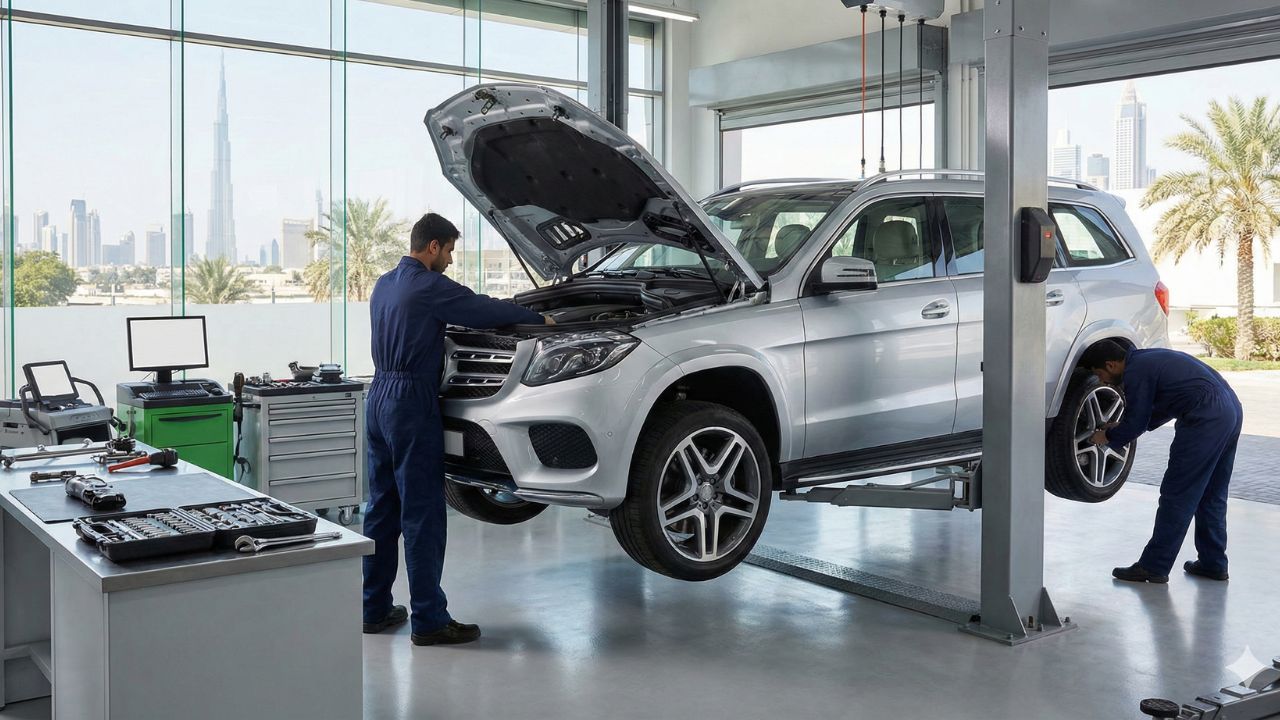
Picture this: You’re cruising down Sheikh Zayed Road in your Mercedes-Benz GLS-Class, that magnificent beast of German engineering that cost you a small fortune. The seven-seater luxury SUV that makes every school run feel like a VIP transport mission. Then suddenly, an unfamiliar sound emerges from under the hood. Your heart sinks. Who do you trust with your prized possession in a city where repair shops outnumber shawarma stands?
Your Mercedes-Benz GLS-Class X166 isn’t just another SUV collecting sand in Dubai’s sprawling parking lots. Manufactured between 2012 and 2019, this second-generation luxury cruiser represents Mercedes-Benz’s ambitious answer to the growing appetite for spacious, technologically advanced family vehicles. With its powerful engine options ranging from the diesel-sipping OM642 V6 to the thunderous M157 V8, and featuring the sophisticated AIRMATIC suspension system that makes Dubai’s occasionally questionable road surfaces feel like butter, this vehicle demands respect and specialized knowledge.
Euro Car Repair understands something fundamental that many generic workshops miss: the X166 generation GLS-Class isn’t just another Mercedes. It’s a complex symphony of interlocking systems where the air suspension communicates with the transmission controller, where the engine management system monitors seventy-three different parameters simultaneously, and where a seemingly simple brake pad replacement requires proper electronic handbrake retraction procedures that only factory-level diagnostic equipment can perform correctly.
Dubai’s automotive repair landscape resembles a maze. Dealerships quote astronomical prices that make your wallet weep. Generic repair shops promise cheap fixes but treat your GLS-Class like it’s a basic sedan. Insurance-approved facilities push standardized solutions that ignore your vehicle’s individual quirks. Meanwhile, your Mercedes sits there, waiting for someone who actually understands that the X166’s 7G-TRONIC PLUS transmission requires specific adaptation procedures after fluid services, or that its pre-safe system integration means any airbag-related work affects six other vehicle systems.
That’s where we step in.
Euro Car Repair has built its reputation on a simple philosophy: European luxury vehicles deserve European-level expertise without European-level pricing drama. We’ve spent years mastering the peculiarities of the GLS-Class X166, understanding why its alternator bearings fail prematurely in Dubai’s heat, knowing exactly which batch of air suspension compressors from which production months tend to develop leaks, and recognizing the telltale signs of the infamous timing chain tensioner issue before it becomes catastrophic.
What makes the X166 different from other Mercedes models? Everything. While the C-Class and E-Class share certain platform characteristics, the GLS-Class sits on the completely different MRA platform’s predecessor. Its weight distribution, suspension geometry, cooling requirements, and electrical architecture are unique. The three-row seating configuration creates specific air conditioning challenges. The larger displacement engines generate heat patterns that affect component longevity differently. Even the transmission calibration for the heavier vehicle mass means wear patterns emerge in places that lighter Mercedes models never experience.
This article will walk you through exactly why Euro Car Repair has become the go-to destination for discerning GLS-Class X166 owners across Dubai, from the Marina’s glittering towers to the family villas of Arabian Ranches. You’ll discover our specialized approach, understand our comprehensive service offerings, learn about common X166 issues we solve daily, and see why our decision to remain independent from insurance companies actually saves you money and headaches.
Your GLS-Class deserves better than guesswork. It deserves expertise. Let’s explore what that really means.
Why Euro Car Repair Stands Apart for GLS-Class X166 Service
Specialized Mercedes-Benz GLS-Class X166 Expertise
Walk into most repair facilities in Dubai, and you’ll find mechanics who can change oil and replace brake pads on virtually anything with wheels. That’s fine for basic vehicles. Your GLS-Class X166 isn’t basic.
Our technicians have undergone extensive training specifically focused on the X166 platform. This isn’t generic Mercedes training—it’s generation-specific knowledge that covers the unique quirks of the 2012-2019 production run. We understand that early 2013 models had different engine management software than late 2018 models. We know that the mid-cycle refresh in 2016 changed more than just the exterior styling—it altered the entire infotainment electrical architecture, requiring completely different diagnostic approaches for multimedia issues.
One of our senior technicians spent three years working exclusively on GLS and GL-Class vehicles before joining Euro Car Repair. That’s thousands of hours hands-on with your exact vehicle type. He can identify a failing air suspension compressor by sound alone, distinguish between a transmission valve body issue and a torque converter problem through driving characteristics, and predict which sensors will fail next based on the vehicle’s production date and known batch issues.
This depth of knowledge matters enormously. When a customer recently brought in their 2015 GLS 500 with intermittent transmission shifting delays, generic shops had already replaced the transmission fluid twice and recommended a complete transmission rebuild. Our technician immediately suspected the conductor plate—a known weak point in this specific year and engine combination. Twenty minutes of diagnostic work and a conductor plate replacement later, the vehicle shifted perfectly. The customer saved approximately 25,000 dirhams compared to the unnecessary transmission overhaul.
We maintain a comprehensive database of every X166 we service, tracking patterns and issues specific to Dubai’s operating environment. This institutional knowledge allows us to predict problems before they become catastrophic, recommend preventive maintenance timing based on real-world local data rather than generalized manufacturer recommendations, and source parts proactively for common failures.
Advanced Diagnostic Technology for Complex Systems
The Mercedes-Benz GLS-Class X166 generates more data than a small weather station. Every drive, the vehicle’s forty-seven control modules monitor, log, and analyze hundreds of parameters. When something goes wrong, the right diagnostic equipment doesn’t just tell you there’s a problem—it tells you why, when, how often, and what other systems might be affected.
Euro Car Repair utilizes factory-level diagnostic equipment that communicates with your GLS-Class in its native language. We’re not using generic OBD-II scanners that can read basic fault codes but miss ninety percent of the vehicle’s actual diagnostic capabilities. Our Mercedes XENTRY diagnostic system accesses the same depth of information that dealership technicians see, allowing us to perform guided fault finding, component activation testing, adaptation procedures, and software updates.
This technology advantage reveals problems that other shops literally cannot see. Consider the air suspension system—a generic scan tool might display “Air Suspension Fault” and leave you guessing. Our system shows us the exact pressure readings in each air spring, the compressor duty cycle percentage, leak rates measured in millibars per minute, and historical data showing when the problem started developing. We can watch in real-time as the system attempts to level the vehicle, identifying whether you have a mechanical leak, a failing compressor, a malfunctioning valve block, or simply a calibration issue from a recent battery replacement.
Recently, a customer complained about reduced fuel economy in their GLS 350d. Three other shops had performed various repairs without improvement. Our diagnostic session revealed that the engine was running in a permanent “limp mode” that wasn’t triggering any dashboard warnings. The root cause? A corroded connector on the mass airflow sensor that was causing intermittent signal dropouts. The engine computer had learned to ignore the faulty sensor and was running on enriched baseline parameters. Total repair time: thirty minutes. Customer’s fuel economy: restored to normal. This is what proper diagnostic technology accomplishes.
Genuine Parts and Intelligent Alternatives
The parts debate in Mercedes-Benz repair circles generates more heat than a Dubai afternoon in July. Dealerships insist on only genuine Mercedes parts at premium prices. Budget shops use whatever fits at rock-bottom costs. We take the intelligent middle path that prioritizes your vehicle’s longevity and your financial reality.
For critical safety systems and high-precision components, we source genuine Mercedes-Benz OEM parts exclusively. Brake components, airbag modules, electronic control units, engine management sensors—these aren’t areas where we compromise. Your GLS-Class’s ABS system wasn’t designed to work with generic brake components, and we won’t risk your family’s safety to save a few hundred dirhams.
However, for wear items and non-critical components, we offer premium aftermarket alternatives that meet or exceed OEM specifications at substantially lower costs. A genuine Mercedes air filter costs four times what a Mahle or Mann filter costs, yet the aftermarket versions are manufactured in the same German facilities with identical specifications. Same with cabin filters, spark plugs from NGK or Bosch, brake discs from Brembo, and numerous other components where the OEM part is simply a branded version of a quality aftermarket manufacturer’s product.
We explain these options transparently. When we prepare your estimate, you’ll see both OEM and quality aftermarket pricing where applicable. We share our professional recommendation based on the component’s criticality, your vehicle’s usage pattern, and your budget. A GLS-Class that primarily handles school runs and grocery shopping doesn’t need the same brake specifications as one that regularly tows boats or makes desert trips to Hatta.
Every part we install, whether OEM or aftermarket, comes with our comprehensive warranty. We stand behind our recommendations because we’ve tested these components in Dubai’s brutal environment. We know which brands hold up and which don’t.
Transparent Pricing That Respects Your Intelligence
You’re not calling us to discuss the weather. You want to know: “How much will this cost?” We respect that directness.
Our pricing philosophy starts with comprehensive diagnostics before any repair recommendations. We charge a reasonable diagnostic fee that gets credited toward your repair if you proceed with us. This diagnostic session produces a detailed estimate that breaks down labor hours, parts costs, and any additional services we recommend. You’ll never see vague line items like “additional repairs as needed” or surprise charges appearing after we’ve started work.
On average, our service costs run forty to sixty percent lower than dealership pricing for identical work. That’s not because we’re cutting corners—it’s because we’re not subsidizing massive showroom overhead, corporate profit margins, and commissioned service advisors. A major service on your GLS 500 that would cost 4,500 dirhams at a dealership typically runs between 2,500 and 3,000 dirhams at our facility, using the same OEM parts and following identical service procedures.
We provide itemized estimates that you can actually understand. If we recommend replacing your air suspension compressor, the estimate shows the part cost, labor time at our hourly rate, any additional consumables needed, and the total. If you want to see comparable dealership pricing, we’ll show you the manufacturer’s labor time guides and typical dealer markups.
Price transparency extends to our policies on additional findings during repairs. If we discover additional issues while working on your vehicle, we stop, photograph the problem, and contact you before proceeding. You’ll receive pictures on your phone showing exactly what we’ve found and why we’re recommending additional work. No surprises when you pick up your vehicle.
Customer-First Service That Treats Your Time as Valuable
Your GLS-Class is your mobile command center, your family transport, your business meeting venue on wheels. Being without it isn’t just inconvenient—it disrupts your entire life.
Euro Car Repair designs our service process around your schedule, not ours. We offer early morning drop-offs before your workday starts, evening appointments after business hours, and weekend service for those who can’t afford weekday downtime. Schedule permitting, we can even collect your vehicle from your location and return it after service completion, allowing you to maintain your daily routine uninterrupted.
During longer repairs, we maintain communication throughout the process. You’re not left wondering whether your vehicle is still sitting untouched in our workshop bay. Our service updates include progress photos, explanation of work completed, and realistic timeframes for remaining tasks. If we encounter delays—a parts shipment running late or an additional issue requiring attention—you’ll know immediately, not when you arrive to collect your vehicle.
Our waiting area isn’t an afterthought. Comfortable seating, climate control that actually works, complimentary beverages, and reliable WiFi make shorter service appointments almost pleasant. We understand that watching mechanics work on your expensive SUV isn’t everyone’s idea of entertainment, so we’ve created a space where you can actually be productive while waiting.
After your service, we don’t just hand you keys and invoice. We walk you through the work performed, show you any replaced parts when relevant, explain any additional observations we made during service, and provide recommendations for future maintenance timing. Your GLS-Class receives a digital service record in our system, allowing us to track maintenance history even if you’ve lost your paperwork.
The Insurance Independence Advantage
This section surprises many customers initially, but understanding our position clarifies why independence benefits you enormously.
Euro Car Repair deliberately chooses not to partner with insurance companies. This isn’t stubbornness—it’s strategic positioning that keeps your vehicle’s best interests central to every decision.
Insurance company partnerships sound convenient until you understand their implications. Insurance-approved facilities operate under strict limitations regarding parts sourcing, labor time allowances, and repair methodologies. An insurance company might approve only aftermarket crash parts when your vehicle deserves OEM components. They might limit labor time for complex repairs, pressuring technicians to rush work that demands patience and precision. They might deny repairs that aren’t strictly necessary for basic vehicle operation but are important for maintaining your GLS-Class’s sophisticated systems.
By remaining insurance-independent, we make recommendations based solely on what your vehicle actually needs. If your air suspension requires replacement, we’re not constrained by insurance company preferences for cheaper coil spring conversions that fundamentally alter your vehicle’s character and resale value. If your transmission needs specific adaptation procedures after repair, we perform them properly rather than skipping steps to meet insurance time limitations.
This independence accelerates your repair timeline dramatically. Insurance claim processing adds days or weeks to simple repairs. Waiting for adjuster visits, obtaining multiple estimates, seeking approvals for additional repairs discovered during teardown—these bureaucratic steps delay your vehicle’s return. Without insurance involvement, we diagnose, estimate, receive your approval, and begin repairs immediately.
The financial reality often surprises customers. Many repairs cost less than typical insurance deductibles anyway, making claims financially pointless while adding all that processing hassle. Even for larger repairs, paying directly often costs comparable to or less than deductible amounts when you factor in our competitive pricing versus insurance-approved facility rates.
Insurance claims also affect your policy premiums and claims history. Minor repairs claimed through insurance can impact your rates for years, ultimately costing far more than paying directly for the repair. We help customers make informed decisions about when insurance claims make financial sense and when direct payment serves them better.
Proven Track Record in Dubai’s GLS-Class Community
Trust isn’t demanded—it’s earned through consistent excellence over time.
Euro Car Repair has served Dubai’s luxury vehicle community for years, building relationships with customers who return repeatedly and refer their friends, family, and colleagues. Our customer retention rate exceeds eighty percent, meaning most clients who try our service once become regular customers for all their vehicle’s needs.
Word-of-mouth recommendation drives most of our new business. In tight-knit communities like Dubai’s European vehicle owner circles, reputation spreads quickly—both positive and negative. GLS-Class owners particularly form an informal network, sharing experiences about service providers, warning each other about poor experiences, and recommending trusted facilities.
We’ve earned that trust by delivering consistent quality, standing behind our work unconditionally, and treating every vehicle as if it were our own family’s transportation. When rare problems arise—and in automotive repair, even perfect work occasionally encounters unexpected issues—we address them immediately without excuse-making or finger-pointing.
Our approach builds long-term relationships rather than transactional interactions. We remember your vehicle’s history, anticipate upcoming maintenance needs, and proactively notify you about recalls or known issues affecting your specific production year. Many customers have been with us through multiple vehicle ownership cycles, trusting us with everything from routine oil changes to major engine rebuilds.
Comprehensive Service Excellence for Every GLS-Class X166 Need
Engine Repair and Maintenance: The Heart of Your GLS-Class
The powerplant under your GLS-Class’s hood represents decades of Mercedes-Benz engineering evolution. Whether you’re running the efficient OM642 3.0-liter diesel V6, the powerful M276 3.0-liter twin-turbo petrol V6, or the thunderous M157 5.5-liter twin-turbo V8, your engine demands specialized understanding.
Dubai’s extreme operating environment stresses engines in ways that German engineers could hardly imagine when designing these power units. Sustained operation at elevated ambient temperatures above forty-five degrees Celsius forces cooling systems to work at maximum capacity for extended periods. Short-trip urban driving patterns prevent engines from reaching optimal operating temperatures consistently, promoting condensation accumulation in the crankcase and carbon buildup on intake valves. Sand infiltration, despite sophisticated air filtration, gradually accumulates in intake systems and affects airflow characteristics.
Our engine services begin with comprehensive diagnostics that establish baseline performance parameters. We measure compression across all cylinders, analyze combustion patterns through exhaust gas composition, evaluate timing chain condition through acoustic analysis and scope inspection, and verify proper turbocharger operation across the entire boost pressure range. This diagnostic foundation ensures we’re addressing actual problems rather than symptoms.
Oil leak repair represents one of our most common engine services for X166 models. The valve cover gaskets on both diesel and petrol engines develop leaks over time, particularly on vehicles experiencing Dubai’s thermal cycling between scorching daytime temperatures and air-conditioned night parking. We replace these gaskets using OEM components, properly cleaning sealing surfaces and torquing fasteners to exact specifications. The oil filter housing on diesel engines commonly develops seepage around the O-ring seals—a thirty-minute repair that prevents the mess of oil-soaked engine bay components and potential exhaust system smoke.
Cooling system maintenance takes heightened importance in Dubai’s climate. Your GLS-Class’s cooling system operates under extreme stress, cycling coolant through the massive radiator assembly at rates that quickly degrade hoses, accelerate water pump bearing wear, and stress thermostat components. We recommend complete coolant system inspection every year regardless of mileage, checking for pressure system integrity, verifying proper thermostat operation, and examining all hoses for the telltale signs of imminent failure—surface cracking, unusual softness, or internal deterioration visible through translucent hose walls.
The timing chain assembly on V6 and V8 engines requires particular attention. Mercedes-Benz extended the timing chain service intervals based on European operating conditions, but Dubai’s extreme heat accelerates chain stretch and guide wear. We recommend timing chain inspection around 100,000 kilometers rather than waiting for the ominous rattling that signals imminent failure. Preventive timing chain service costs a fraction of the engine rebuild required after a failed chain damages valves and pistons.
Turbocharger maintenance on forced-induction engines prevents the costly failures that strand vehicles and empty wallets. We verify proper oil supply to turbocharger bearings, check for shaft play indicating bearing wear, inspect wastegate operation, and clean the intake system of the oil residue that accumulates from crankcase ventilation system vapors. Regular maintenance extends turbocharger life well beyond the premature failures that plague neglected vehicles.
Transmission and Gearbox Services: Ensuring Smooth Power Delivery
The 7G-TRONIC PLUS automatic transmission in your GLS-Class X166 represents sophisticated engineering that seamlessly manages power delivery across seven forward gears. This isn’t your grandfather’s three-speed automatic—it’s a complex electrohydraulic system where transmission fluid serves as both lubricant and hydraulic control medium.
Transmission health starts with proper fluid maintenance. Mercedes-Benz officially claims “lifetime” transmission fluid in many markets, yet our experience serving Dubai vehicles tells a different story. Heat degrades transmission fluid’s properties over time, and Dubai generates heat enthusiastically. We recommend transmission fluid service every 60,000 kilometers for diesel engines and 50,000 kilometers for higher-output petrol engines, particularly if your driving involves trailer towing or extensive urban traffic crawling.
Our transmission service isn’t a simple drain-and-fill operation. The 7G-TRONIC transmission holds approximately nine liters of fluid, but a simple drain only removes about forty percent. We perform a complete fluid exchange using specialized equipment that simultaneously removes old fluid while introducing fresh fluid, ensuring complete system renewal. After fluid replacement, the transmission requires electronic adaptation procedures through the diagnostic system, teaching the transmission computer about the fresh fluid’s characteristics and resetting adaptation values that compensated for degraded fluid properties.
Transmission problems manifest in various ways, and correct diagnosis requires experienced interpretation. Delayed engagement when shifting from park to drive or reverse often indicates either low fluid level, worn clutch packs, or failing valve body solenoids. Harsh shifts during gear changes suggest adaptation issues, damaged torque converter clutch, or failing pressure regulation. Slipping between gears typically points to worn clutch packs or severe fluid degradation. Unusual noises during shifts often originate from worn torque converter components or failing transmission mount bushings.
The conductor plate—the electronic control module residing inside the transmission oil pan—deserves special mention as a known trouble spot on X166 models. This component manages solenoid operation and monitors transmission sensors, and its position bathed in transmission fluid makes it vulnerable to contamination from worn clutch material and fluid breakdown products. Conductor plate failure produces symptoms ranging from complete loss of gear engagement to erratic shifting patterns. We maintain ready stock of conductor plates for common engine combinations, minimizing your vehicle’s downtime.
Transmission mount condition affects both shifting quality and drivetrain vibration. The massive V6 and V8 engines generate substantial torque that stressed mounts must control. Worn transmission mounts allow excessive drivetrain movement, producing clunking sounds during throttle application and creating harsh shift quality through misalignment. We inspect mounts during every transmission service, recommending replacement at the first signs of deterioration rather than waiting for complete failure.
Brake System Services: Critical Safety Components
Your GLS-Class X166 tips the scales at over 2,400 kilograms when fully loaded with passengers and cargo. Bringing that mass to controlled stops repeatedly requires robust brake components operating at peak efficiency.
The X166 utilizes a sophisticated braking system featuring ventilated disc rotors at all four corners, with particularly massive front rotors measuring approximately 360 millimeters in diameter. The brake calipers—four-piston fixed units at the front and single-piston floating units at the rear—clamp brake pads against these rotors with enormous force, converting your vehicle’s kinetic energy into heat that must be effectively dissipated.
Dubai’s driving patterns stress brake systems uniquely. Extended highway cruising at elevated speeds means high-energy stops when traffic suddenly slows. Urban traffic crawling involves constant brake application, maintaining friction material at elevated temperatures for extended periods. Desert driving introduces fine sand particles that accelerate rotor surface wear and create brake dust that accumulates in caliper mechanisms.
We recommend brake inspection every major service interval, but certain symptoms demand immediate attention. Pulsating brake pedal during stops indicates rotor surface irregularities—either uneven pad deposits or actual rotor thickness variation. Squealing or grinding noises signal pad material depletion. Pulling to one side during braking suggests uneven pad wear or caliper mechanical problems. Soft or spongy brake pedal feel indicates air in the hydraulic system or possible fluid leakage.
Brake pad replacement timing depends heavily on driving patterns. Aggressive drivers in urban traffic may need pad replacement every 25,000 kilometers, while highway-cruising drivers might achieve 50,000 kilometers or more. We measure pad thickness during inspections, recommending replacement when any pad reaches three millimeters—before the backing plate contacts the rotor and causes expensive damage.
Rotor replacement accompanies brake pad changes when rotors reach minimum thickness specifications or develop surface damage. Your X166’s rotors are designed for one or two pad replacements before requiring replacement themselves. We machine rotors only when surface irregularities are minor and remaining material thickness exceeds minimum specifications with adequate margin.
The electronic parking brake system requires specialized procedures during pad replacement. Unlike mechanical parking brakes, the electronic system uses the rear brake calipers with electric motor actuation. Retracting these calipers for pad replacement requires diagnostic system commands—attempting mechanical retraction damages expensive caliper motors. We perform these procedures correctly, preserving your parking brake system functionality.
Brake fluid service prevents the deterioration that compromises braking performance and damages components. Brake fluid absorbs atmospheric moisture over time, lowering its boiling point and introducing corrosion potential into the hydraulic system. We recommend brake fluid replacement every two years regardless of mileage, flushing the entire system with fresh DOT 4 fluid meeting Mercedes-Benz specifications.
Air Conditioning and Climate Control: Essential Comfort in Dubai’s Heat
If you’re reading this in Dubai, you already understand—functional air conditioning isn’t luxury, it’s survival equipment.
Your GLS-Class features a sophisticated three-zone automatic climate control system capable of maintaining different temperature targets for driver, front passenger, and rear occupants. This system moves an astonishing amount of air through precisely controlled ducts, filtered through high-efficiency cabin filters, and chilled by a powerful air conditioning compressor driven by the engine.
The AC compressor in your X166 works harder than compressors in virtually any other climate worldwide. Where European vehicles might cycle compressor operation on and off, Dubai vehicles often run compressors continuously throughout the six-month summer season. This constant operation stresses compressor bearings, wears clutch components, and demands impeccable system maintenance.
Common AC issues begin with reduced cooling efficiency. Your system might blow cold air initially but struggle to maintain temperature during extended driving. This typically indicates either low refrigerant charge from minor system leaks or contaminated cabin filters restricting airflow. We diagnose cooling issues systematically, starting with refrigerant pressure measurements, leak detection testing, cabin filter inspection, and evaporator temperature verification.
The AC compressor itself represents the system’s most expensive component and most common failure point. Compressor failure announces itself through unusual noises—grinding, squealing, or rattling from the engine bay with AC operation. Complete cooling loss often indicates catastrophic compressor failure, where internal components have broken and contaminated the entire system. When this occurs, we recommend complete system flushing, receiver-drier replacement, and expansion valve replacement alongside compressor installation, preventing new compressor damage from circulating debris.
Evaporator replacement ranks among the most labor-intensive AC repairs because this component hides deep within the dashboard assembly. The evaporator—the cold radiator-like component that actually chills air—can develop leaks or clogging over time. Symptoms include reduced cooling capacity, persistent musty odors, or visible moisture dripping from unexpected dashboard locations. Evaporator replacement requires extensive dashboard disassembly, making it a multi-day repair that we schedule carefully to minimize your inconvenience.
Refrigerant specifications matter significantly. Your GLS-Class uses R134a refrigerant, and proper system charging requires specific amounts measured precisely. Overcharging reduces cooling efficiency and stresses compressor operation. Undercharging similarly reduces performance while allowing compressor damage through insufficient lubrication. We charge systems by weight rather than gauge pressure alone, ensuring optimal operation.
Cabin air filter replacement represents the simplest yet most impactful AC maintenance. These filters trap Dubai’s dust, sand, and airborne pollutants before they enter the cabin. Clogged filters reduce airflow dramatically, forcing the blower motor to work harder while delivering less air volume. We recommend cabin filter replacement every major service, more frequently for vehicles parking outdoors or driving in dusty conditions regularly.
The climate control system’s electronic components require occasional attention. Blend door motors that regulate hot and cold air mixing can fail, producing symptoms like one side blowing hot while the other blows cold. Blower motor resistors regulate fan speed, and their failure produces symptoms like high fan speeds working while low speeds don’t. Temperature sensors throughout the system feed data to the climate control computer, and failed sensors produce erratic temperature regulation. Our diagnostic equipment communicates with the climate control system, identifying electronic component failures precisely.
Suspension and Steering: Maintaining Ride Quality and Control
The AIRMATIC air suspension system in your GLS-Class X166 represents Mercedes-Benz engineering at its sophisticated peak. This system replaces conventional coil springs with air springs at each corner, adjusting ride height electronically and adapting suspension stiffness to driving conditions.
Air suspension provides tangible benefits. Automatic load leveling maintains consistent ride height regardless of passenger and cargo loading. Adjustable ride height facilitates easier entry and exit while providing enhanced ground clearance for off-road driving. Comfort-oriented tuning delivers the cloud-like ride quality that Mercedes luxury SUVs are famous for achieving.
However, air suspension complexity introduces maintenance considerations that conventional suspension doesn’t face. The system relies on multiple components working harmoniously—air springs themselves, the central compressor generating air pressure, electronic control valves directing air to individual corners, height sensors monitoring ride position, and the control module coordinating everything.
Air spring leaks represent the most common air suspension problem we address. The rubber air spring bladders develop cracks over time, accelerated by Dubai’s intense UV exposure and ozone concentration. Symptoms begin subtly—the vehicle sits slightly lower after parking overnight, requiring time for the compressor to restore proper height. As leaks worsen, you might hear the compressor running frequently, attempting to maintain system pressure. Eventually, one corner drops significantly, and the dashboard displays suspension fault warnings.
We replace air springs using OEM components exclusively because aftermarket alternatives simply don’t deliver comparable longevity in Dubai’s environment. Each air spring replacement includes new mounting hardware, and we thoroughly inspect associated components while the suspension is disassembled.
The air suspension compressor works tremendously hard in Dubai, cycling frequently to maintain system pressure against minor leaks that all air suspension systems develop over time. Compressor failure symptoms include loud operation, inability to raise the vehicle, or complete system failure messages. We stock replacement compressors and can typically complete this repair same-day, minimizing your inconvenience.
Conventional suspension components still exist on your air-suspended GLS-Class, and these wear according to typical patterns. Upper and lower control arm bushings deteriorate from age and use, producing symptoms including imprecise steering feel and unusual tire wear patterns. Shock absorbers—yes, your air suspension still uses shock absorbers within the air spring assemblies—can fail, reducing ride quality dramatically. Sway bar links and bushings wear, creating clunking noises over bumps.
Steering system maintenance ensures precise control of your substantial vehicle. The power steering system uses electrohydraulic assistance, combining electric motor efficiency with hydraulic power feel. Steering fluid leaks commonly develop at high-pressure hose connections and power steering pump seals. Regular fluid inspection and timely leak repair prevent the catastrophic steering failures that leave you wrestling an unresponsive steering wheel.
Wheel alignment deserves particular attention on the GLS-Class. Proper alignment ensures even tire wear, stable highway tracking, and precise steering response. Dubai’s occasionally harsh road surfaces and aggressive speed bump installations knock alignments out of specification regularly. We recommend annual alignment inspection, or immediately following any impact that your wheels experience.
Electrical System Diagnostics: Solving Modern Vehicle Complexity
Modern Mercedes-Benz vehicles qualify as rolling computers, and your GLS-Class X166 exemplifies this technological density. Forty-seven separate control modules monitor everything from engine performance to seat position memory, all communicating across high-speed data networks wiring throughout the vehicle.
Electrical problems manifest in bewildering variety. Intermittent warning lights, erratic system behavior, features suddenly failing, battery draining overnight, modules refusing to communicate with diagnostic equipment—these symptoms require systematic diagnostic approaches that generic shops simply can’t execute effectively.
Battery maintenance forms the foundation of electrical system health. Your GLS-Class uses a substantial battery to support its electrical demands, but even quality batteries deteriorate in Dubai’s heat. Heat accelerates internal chemical reactions that degrade battery capacity, typically reducing battery life to three years maximum regardless of battery quality. We test batteries comprehensively, measuring not just voltage but actual cranking amperage and reserve capacity. Weak batteries cause cascading problems throughout vehicle electrical systems, producing symptoms that mislead inexperienced diagnosticians into expensive module replacements when a simple battery replacement would resolve everything.
Battery replacement on modern Mercedes requires proper procedures beyond merely connecting cables. The vehicle’s power management system must be informed about the new battery through diagnostic system registration procedures, allowing the charging system to optimize parameters for battery health and longevity. Skipping this step results in improper charging that reduces new battery life.
Sensor failures produce diagnostic challenges because modern vehicles rely on dozens of sensors feeding data to various control modules. Failed sensors might trigger immediate warning lights, or they might cause subtle performance issues without obvious indications. A failed oxygen sensor might reduce fuel economy without triggering fault codes. A deteriorating coolant temperature sensor might produce cold-start issues that disappear when the engine warms.
Module failures require accurate diagnosis to avoid expensive misdiagnosis. Control modules are expensive—often 2,000 to 5,000 dirhams or more—making incorrect replacement painful financially. We verify actual module failure through comprehensive testing, checking power supply, ground connections, data network communication, and internal module self-test results before recommending replacement. Often, apparent module failures are actually wiring problems or failed sensors providing incorrect information.
Fluid Leak Detection and Repair: Preventing Messy Problems
Nothing damages parking surfaces or reduces resale value quite like fluid leaks marking your vehicle’s territory.
Oil leaks commonly develop on X166 models at several predictable locations. Valve cover gaskets leak as previously mentioned, creating messy engine bay conditions. Oil filter housing O-rings deteriorate, producing leaks that run down the front of the engine. Oil cooler connections on diesel engines develop seepage. The rear main crankshaft seal occasionally leaks on higher-mileage vehicles, producing oil drops visible on the ground but difficult to source without careful inspection.
We diagnose leaks through systematic inspection, often using fluorescent dye tracer added to suspect systems and ultraviolet light inspection to pinpoint exact leak sources. This diagnostic precision prevents the wasteful approach of replacing multiple components hoping to solve the leak.
Coolant leaks demand immediate attention because low coolant levels risk catastrophic engine overheating. Common coolant leak sources include radiator end tank failures, deteriorated coolant hoses, water pump weep hole seepage, and heater core leaks inside the dashboard. We pressure test cooling systems to locate elusive leaks that only occur at operating temperature and pressure.
Transmission fluid leaks typically originate from output shaft seals, transmission pan gaskets, or cooler line connections. These leaks often appear minor initially but worsen progressively. Low transmission fluid causes shifting problems and eventual transmission damage, making timely leak repair essential.
Power steering fluid leaks commonly develop at high-pressure hose connections and pump seals. These leaks might seem minor but can empty the system surprisingly quickly, leading to difficult steering and potential pump damage from running dry.
Additional Specialized Services: Comprehensive Care
Tire replacement on your GLS-Class involves more than mounting rubber on wheels. The Tire Pressure Monitoring System (TPMS) requires proper programming when installing new tires or wheels. Each TPMS sensor has a unique identifier that the vehicle’s TPMS control module must learn. Without proper programming procedures, your tire pressure warnings will malfunction.
We also perform paint correction and scratch repair services for the inevitable cosmetic damage that Dubai’s environment inflicts. Parking lot encounters, sand-blasting from desert drives, and general wear all mark your vehicle’s finish. Our refinishing capabilities range from minor scratch buffing to complete panel repainting matching your vehicle’s factory color exactly.
Pre-purchase inspection services protect buyers from expensive surprises. Considering a used GLS-Class? Our comprehensive inspection evaluates mechanical condition, identifies existing problems, assesses maintenance history, and provides honest assessment of the vehicle’s true condition. This small investment potentially saves tens of thousands of dirhams by revealing problems before purchase.
Scheduled maintenance packages offer convenient bundling of services at your vehicle’s specific mileage intervals. We follow Mercedes-Benz recommended service schedules adapted for Dubai’s severe operating environment, ensuring your GLS-Class receives all necessary maintenance without wasteful additional services.
Common GLS-Class X166 Problems We Solve Daily
Air Suspension Failures: The Achilles Heel
Air suspension issues top the list of common GLS-Class X166 problems, particularly on vehicles exceeding 80,000 kilometers. The air spring bladders simply weren’t designed for continuous operation in temperatures regularly exceeding forty-five degrees Celsius while exposed to intense UV radiation and ozone levels present in Dubai’s atmosphere.
Typical failure progression follows a predictable pattern. Initially, owners notice the vehicle sits slightly lower on one corner after overnight parking. The compressor runs briefly at startup, restoring proper height. Over weeks, this settling becomes more pronounced, and compressor run time increases. Eventually, the affected corner drops significantly, dashboard warnings illuminate, and the suspension system disables itself, defaulting to a rigid emergency mode that drives terribly.
We’ve identified that rear air springs fail more frequently than fronts on the X166, likely because rear springs support variable loads while fronts maintain relatively consistent loading. The driver’s side rear spring commonly fails first, followed by passenger’s side rear, then fronts. This pattern suggests load-dependent wear rates.
Our air spring replacement addresses not just the failed component but the system holistically. We replace springs in axle pairs rather than individually, preventing the asymmetric wear that occurs when one new spring partners with an aged spring experiencing different spring rates. We thoroughly inspect the compressor, checking for signs of overwork from compensating for leaks. We verify valve block operation, ensuring proper air distribution. We examine all air lines for deterioration or damage.
Prevention strategies include parking in covered locations when possible, reducing UV exposure that deteriorates rubber components. Maintaining proper ride height settings rather than constantly raising the suspension for easier entry accelerates wear. Addressing suspension faults promptly prevents compressor damage from excessive cycling.
Transmission Conductor Plate Failures
The transmission conductor plate represents a peculiar vulnerability in an otherwise robust drivetrain. This electronic module lives inside the transmission oil pan, bathed in transmission fluid, where it manages solenoid operation and monitors sensors.
Symptoms of conductor plate failure vary dramatically, creating diagnostic challenges for inexperienced technicians. Some vehicles lose all forward gears while reverse functions normally. Others experience erratic shifting where the transmission seemingly selects gears randomly. Some produce limp mode restrictions limiting maximum speed. The confounding aspect? These symptoms might appear intermittently, functioning normally when cold, failing when hot, or vice versa.
The 2013-2015 model years show higher conductor plate failure rates than later production, suggesting either a component specification change or manufacturing batch issues during those years. We maintain ready inventory of conductor plates for these problematic years, recognizing that replacement often provides the most cost-effective solution compared to extensive diagnostic time attempting to verify internal component condition.
Interestingly, conductor plate replacement often resolves transmission problems that owners have tolerated for months, believing harsh shifting or delayed engagement represented normal transmission aging. The corrected operation after replacement demonstrates how significantly degraded conductor plates affect transmission behavior even before producing obvious fault conditions.
Thermostat Stuck Closed: Overheating Drama
Engine thermostats in the V6 and V8 engines occasionally stick in the closed position, preventing coolant circulation through the radiator. This failure produces dramatic overheating that can occur suddenly during driving, creating potentially dangerous situations when coolant temperatures spike into the red zone.
The stuck thermostat creates a perplexing symptom pattern. The engine might run normally around town, where airflow and modest engine loads generate manageable heat. Then, during highway driving or in heavy traffic, temperatures suddenly climb as the trapped coolant in the engine block reaches its heat capacity limit without benefit of radiator cooling.
We diagnose thermostat issues through systematic testing. We monitor coolant temperature sensor readings while feeling radiator hose temperatures. If the thermostat functions properly, the radiator inlet hose should warm quickly as the thermostat opens. A stuck-closed thermostat keeps the radiator inlet hose cold while engine temperatures climb. We can also command thermostat operation through diagnostic equipment on electrically-controlled thermostats, watching for proper response.
Thermostat replacement prevents the engine damage that results from sustained overheating—warped cylinder heads, blown head gaskets, and damaged head bolts representing far more expensive repairs than a simple preventive thermostat replacement.
Turbocharger Failures on High-Mileage Diesels
The OM642 diesel V6 engine’s twin turbochargers generally deliver reliable service, but higher-mileage examples occasionally develop turbo problems that require replacement.
Turbocharger bearing failure announces itself through characteristic whining or whistling noises that increase with engine speed. These bearings depend entirely on engine oil supply for lubrication and cooling—any oil supply restriction or contaminated oil accelerates bearing wear. Visible blue smoke from the exhaust during acceleration often indicates turbocharger seal failure allowing oil into the exhaust stream.
We diagnose turbo condition through physical inspection and boost pressure testing. Removing the intake ducting allows us to manually check turbocharger shaft for excessive play indicating bearing wear. We measure boost pressure during test drives, comparing actual readings against specification. Underboost conditions might indicate failed wastegate control or boost leak somewhere in the intake system.
Turbocharger replacement requires careful preparation. We thoroughly flush the intake system, removing oil residue accumulated from the failed turbo’s blow-by. We replace the engine oil and filter, ensuring the new turbocharger receives clean lubrication. We carefully inspect all intake and exhaust connections, replacing deteriorated gaskets and securing all clamps properly.
Prevention starts with religious oil service adherence. The high-speed turbocharger bearings simply cannot tolerate degraded oil or extended service intervals. We recommend oil service every 10,000 kilometers maximum on diesel engines, more frequently under severe duty cycles.
Electrical Gremlins from Corroded Connections
Dubai’s humidity, despite the perception of desert dryness, wreaks havoc on electrical connections. Coastal areas particularly suffer from salt-laden air that corrodes exposed electrical components.
Common electrical problems trace to corroded ground connections. Modern vehicles rely on numerous ground points where electrical circuits complete their return path to battery negative. Corroded grounds produce bewildering symptoms—modules failing intermittently, warning lights appearing randomly, systems functioning erratically. These symptoms frustrate owners and challenge diagnosticians because they seem random and illogical.
We address electrical problems systematically, verifying power supply and ground integrity before condemning expensive modules. Often, simply cleaning corroded connections and applying protective coatings resolves problems that seemed to require component replacement.
Battery terminal corrosion deserves mention specifically. Even minor corrosion at battery terminals increases electrical resistance, reducing available voltage to vehicle systems. Sensitive modules operate marginally, producing strange faults. We clean battery terminals to bare metal, apply protective coating, and verify proper connection torque.
Brake System Vibration from Warped Rotors
Brake pedal pulsation during stops frustrates many GLS-Class owners, typically resulting from rotor thickness variation—commonly called rotor warping though rotors rarely actually warp.
This problem develops through repeated hard stops that heat rotors excessively. If the driver immediately stops and applies the parking brake, clamping hot pads against even hotter rotor surfaces, uneven material transfer from pads to rotors creates thickness variations that produce pulsation during subsequent braking.
We address this through proper rotor machining or replacement. Machining works when rotors retain adequate thickness above minimum specifications and surface irregularities are minor. Severe warping or rotors near minimum thickness require replacement.
Prevention involves proper brake system bedding after pad replacement and avoiding parking brake application immediately after hard stops. Allowing rotors to cool naturally prevents the pad material transfer that initiates pulsation problems.
Oil Consumption on High-Mileage Engines
Some GLS-Class owners report increased oil consumption as vehicles approach 150,000 kilometers, particularly on the M276 V6 engine.
This consumption typically results from worn piston rings allowing combustion pressure to force oil past the rings into the combustion chambers. Valve stem seal deterioration similarly allows oil to leak past valve guides into cylinders.
Diagnosing oil consumption requires systematic monitoring. We establish baseline consumption by noting oil level, driving a specific distance, then rechecking level. Consumption exceeding one liter per 2,000 kilometers suggests significant wear requiring attention.
Minor consumption might require only monitoring and periodic oil level checks between services. Severe consumption needs engine internal work—ring replacement or complete rebuild depending on wear extent. We perform compression and leak-down testing to assess cylinder condition before recommending repair approaches.
Prevention centers on regular oil service with quality oil meeting Mercedes specifications. Extended oil change intervals accelerate engine wear, promoting consumption problems.
Failed Multifunction Display Screens
The instrument cluster and COMAND infotainment screen occasionally fail on X166 models, typically showing symptoms like flickering display, partial display sections not functioning, or complete screen failure.
These failures often result from ribbon cable connections between circuit boards and displays deteriorating from heat cycling. The electronics behind the dashboard experience significant temperature variations from ambient heat and air conditioning operation.
Screen replacement requires careful disassembly and coding procedures. These modules contain vehicle-specific data that must be transferred or coded into replacement units, requiring factory-level diagnostic equipment capability.
Our Expert Technicians: The Human Element
Technology and tools only accomplish what skilled hands direct them to achieve. Our technician team brings the crucial human expertise that transforms sophisticated equipment into effective repairs.
Each Euro Car Repair technician undergoes rigorous initial evaluation before joining our team. We don’t hire merely based on certificates hanging on walls—we test actual diagnostic ability, problem-solving approaches, and hands-on mechanical skills. A technician might hold impressive certifications yet lack the practical experience that distinguishes competent mechanics from truly exceptional technicians.
Our senior technicians average over fifteen years’ experience specifically on European luxury vehicles. That experience translates into pattern recognition that shortcuts diagnostic time. An experienced technician hears an unusual noise and immediately suspects specific components based on that sound’s character. They feel brake pedal feedback during test drives and instinctively recognize whether they’re experiencing rotor issues, pad problems, or hydraulic concerns.
Continuous training keeps our team current with evolving technology. Mercedes-Benz releases updated repair procedures, technical service bulletins addressing known issues, and software updates requiring specific installation procedures. We maintain access to manufacturer training resources, technical hotlines for challenging problems, and peer networks of experienced specialists.
Our diagnostic approach emphasizes methodical problem-solving over parts-throwing guesswork. We teach technicians to think through systems logically: power supply verified before condemning modules; mechanical condition confirmed before assuming electronic failures; simple explanations eliminated before pursuing complex theories. This disciplined approach saves customers money while improving first-time repair success rates.
Quality control procedures verify work before vehicles return to customers. A different technician than the one performing repairs conducts final inspection, test-driving the vehicle, verifying repair completion, checking for any issues created during repair work, and ensuring cleanliness standards meet our expectations.
Customer communication represents a crucial technician skill we actively develop. Technical expertise means nothing if technicians can’t explain problems and solutions in accessible language that customers understand. We train technicians to describe issues clearly, explain repair necessity, present options when multiple solutions exist, and answer questions patiently.
Dubai’s Unique Challenges for Your GLS-Class X166
Dubai’s operating environment presents challenges that German engineers designing your Mercedes in Stuttgart could barely imagine.
Heat represents the most obvious environmental factor. Summer ambient temperatures regularly exceeding forty-five degrees Celsius stress every vehicle system. Engine cooling systems work continuously at maximum capacity. Air conditioning runs constantly. Rubber components deteriorate rapidly from accelerated chemical aging. Battery life shortens dramatically. Fluids degrade faster.
The particular challenge for your GLS-Class? Its mass and powerful engines generate tremendous heat even without environmental contributions. The combination creates cooling system demands that push design limits regularly. We recommend more frequent coolant system inspection and maintenance compared to cooler climates.
Sand and dust infiltration creates problems that European vehicles simply don’t face. Fine desert sand penetrates surprisingly effectively despite sophisticated filtration systems. Sand accumulates in intake systems, reducing airflow and power output. It contaminates lubrication systems despite filtration, accelerating wear. It clogs condenser and radiator fins, reducing cooling efficiency.
Air filter replacement timing becomes critical in Dubai. Where European recommendations might suggest 30,000-kilometer intervals, Dubai driving might require replacement every 15,000 kilometers or even more frequently for vehicles regularly driving in dusty conditions. We inspect air filters at every service, replacing them whenever restriction becomes evident.
Humidity surprises many residents who perceive Dubai as desert-dry. Coastal proximity creates substantial humidity, particularly overnight when temperatures drop. This humidity affects electrical systems, promoting corrosion at connection points. It affects brake components, creating surface rust on rotors overnight that produces initial braking noise and requires several stops to clean.
Parking environments significantly affect maintenance needs. Outdoor parking exposes vehicles to intense UV radiation that deteriorates paint, rubber seals, and interior materials. Indoor parking in covered garages dramatically reduces UV exposure but introduces different challenges—condensation from rapid temperature changes, potential coolant system stress from frequent hot-to-cold cycling.
Traffic patterns in Dubai create unique wear patterns. Long highway commutes along Sheikh Zayed Road keep engines operating at elevated speeds for extended periods, promoting different wear patterns than stop-and-go urban driving. Beach road driving in areas like JBR exposes undercarriages to salt-laden coastal air.
We adapt maintenance recommendations to your specific usage patterns. A GLS-Class making twice-daily school runs primarily in urban traffic needs different service attention than one covering 100 kilometers daily on highway commutes. We ask about your driving patterns, parking environment, and typical usage to customize maintenance recommendations appropriately.
Seasonal considerations affect service timing recommendations. Summer places maximum stress on cooling and air conditioning systems—scheduling cooling system inspection before summer begins prevents hot-season breakdowns. Winter (what passes for winter in Dubai) creates ideal conditions for addressing longer-duration repairs, as comfortable temperatures make waiting for service completion more pleasant.
Pricing and Value: Investment in Vehicle Longevity
Discussing pricing requires honesty: quality repair work costs money. Quality parts, skilled technicians, sophisticated equipment, and proper procedures cannot coexist with rock-bottom pricing.
However, quality work need not equal dealership pricing excess.
Our pricing structure balances fair compensation for expertise with reasonable rates that customers can accept without financial strain. Technician labor rates approximately forty percent below dealership rates while maintaining comparable expertise levels. Parts sourcing through quality aftermarket and OEM suppliers rather than dealer markups reduces component costs substantially.
When we prepare estimates, you receive itemized breakdowns showing labor hours at specified rates, parts costs from identified sources, and any additional necessary items like fluids or consumables. This transparency allows you to understand exactly what you’re paying for and why.
Compare our approach to common dealership practices. Dealerships often quote service packages rather than itemized repairs, bundling necessary work with recommended services, making it difficult to distinguish critical repairs from optional maintenance. We present necessary repairs separately from recommended services, empowering you to prioritize work according to budget and urgency.
A typical major service on a GLS 500—including oil and filter change, air filter, cabin filter, spark plugs, and comprehensive inspection—costs approximately 2,500 dirhams at our facility compared to 4,200 dirhams at a dealership, using identical OEM parts and following identical procedures. That’s nearly 1,700 dirhams savings while receiving equivalent or superior service attention.
Package deals for regular maintenance provide additional value. We offer service packages covering scheduled maintenance through specific mileage intervals, bundling multiple services at reduced combined pricing compared to purchasing services individually. These packages facilitate proper maintenance budgeting while ensuring your GLS-Class receives consistent care.
Value extends beyond immediate pricing to long-term ownership costs. Proper maintenance prevents expensive failures. A 300-dirham coolant service prevents a 15,000-dirham engine rebuild from overheating damage. A 1,500-dirham transmission service prevents a 25,000-dirham transmission replacement. Prevention always costs less than correction.
We guarantee our work comprehensively. Parts carry warranties from manufacturers that we honor fully. Our labor carries our own warranty covering workmanship, typically twelve months or 20,000 kilometers. If something we’ve repaired fails within warranty period, we fix it at no additional charge—no questions, no excuses.
Payment flexibility accommodates varying customer needs. We accept cash, credit cards, bank transfers, and checks. For major unexpected repairs creating financial burden, we can discuss payment arrangements allowing manageable installments rather than demanding full immediate payment.
The intangible value of relationship-based service cannot be easily quantified but benefits customers substantially. We maintain comprehensive service histories in our computer system, proactively tracking upcoming maintenance needs, remembering your vehicle’s quirks and previous repairs, and anticipating problems before they become emergencies.
Customer Experience: Service That Respects You
Great repair work delivered through terrible customer experience still creates unhappy customers. We recognize that how we treat customers matters as much as how we treat vehicles.
Scheduling begins with convenient options. Call us directly during business hours and speak with knowledgeable staff who can discuss your concerns, recommend appropriate service timing, and schedule appointments that fit your schedule. Our online booking system allows 24/7 appointment scheduling for customers preferring digital interactions.
When you arrive for service, you’re greeted by name. Our service advisors review your concerns, discuss any additional services we recommend based on vehicle mileage and condition, and establish clear expectations about repair timeline and costs. No pressure tactics, no upselling unnecessary services—just honest assessment and recommendations.
For longer repairs requiring several hours or days, we offer multiple convenience options. Our comfortable waiting area provides climate-controlled comfort, WiFi connectivity, refreshments, and a quiet environment where you can work or relax. Alternatively, we provide pickup and delivery service within our service area, collecting your vehicle from your location and returning it after service completion.
Communication throughout repairs keeps you informed. For scheduled maintenance completed within expected timeframes, you’ll receive notification when your vehicle is ready. For repairs encountering unexpected issues or requiring additional work approval, you’ll receive phone calls explaining findings, discussing options, and obtaining authorization before proceeding.
Progress photos help customers understand repairs visually. When we identify problems, we photograph them before repair. When repairs are completed, we photograph the new components installed. These images accompany our digital service invoices, providing permanent records of work performed.
After service completion, we review completed work, discuss any observations made during service, and answer questions about your vehicle’s condition. We recommend future maintenance timing based on actual vehicle condition rather than arbitrary schedules. We provide honest assessment about repair urgency—what needs immediate attention versus what can wait until your next service.
Digital service records maintain comprehensive maintenance history accessible whenever needed. Lost your service paperwork? No problem—we have complete records showing every service we’ve performed, dates, mileage, and parts used. This record-keeping benefits you during warranty claims, pre-sale inspections, and insurance matters.
Our after-service support extends beyond the initial repair. Questions about vehicle behavior? Concerns about recent repairs? Call us. We make ourselves available to address concerns, provide additional explanation, or schedule follow-up inspections if necessary.
Emergency repairs receive priority attention. Vehicle suddenly stops running? Warning lights illuminating? Unusual noises appearing? Call us. We’ll assess urgency, provide initial troubleshooting guidance over phone, and if necessary, arrange towing to our facility for immediate diagnostic attention.
Frequently Asked Questions About GLS-Class X166 Service
How much does Mercedes-Benz GLS-Class X166 repair cost in Dubai?
Repair costs vary enormously based on what actually needs fixing, making blanket pricing statements meaningless. A basic oil service costs approximately 400-600 dirhams. Major services including multiple filters and spark plugs run 2,000-3,000 dirhams. Brake pad replacement costs roughly 1,500-2,500 dirhams depending on pad quality selected. Air suspension spring replacement ranges 3,000-4,000 dirhams per corner including parts and labor. Transmission conductor plate replacement costs approximately 2,500-3,500 dirhams. Engine repair costs vary wildly from a 500-dirham valve cover gasket replacement to 15,000+ dirhams for major internal work.
Generally, our pricing runs forty to sixty percent below dealership rates for identical work using equivalent parts quality. We provide detailed written estimates before beginning any work, ensuring you know exactly what repairs will cost before committing. Factors affecting cost include parts quality selected (OEM versus premium aftermarket), labor complexity, additional repairs discovered during work, and your vehicle’s specific configuration. We never surprise customers with unexpected charges—any additional work discovered during repairs receives your approval before proceeding.
Do you use genuine Mercedes parts for Mercedes-Benz GLS-Class X166?
Our parts philosophy balances quality with value intelligently. For critical safety systems—brakes, airbags, suspension components, electronic control modules—we use genuine Mercedes-Benz OEM parts exclusively. Your safety and vehicle reliability aren’t areas where we compromise quality for cost savings.
For wear items and non-critical components, we offer choices between OEM parts and premium aftermarket alternatives meeting or exceeding OEM specifications. Many aftermarket parts are manufactured by the same suppliers that produce OEM parts, simply without Mercedes packaging and associated markup. Brands like Bosch, Continental, Mahle, Mann, Brembo, Bilstein, and others manufacture components for Mercedes while simultaneously offering identical products through aftermarket channels at substantially lower costs.
We explain these options transparently in our estimates. You’ll see both OEM and quality aftermarket pricing where applicable, along with our professional recommendation based on the component’s function and your vehicle’s usage. A daily-driver GLS-Class primarily handling urban driving might benefit from cost-effective premium aftermarket components, while an enthusiast maintaining a cherished vehicle might prefer all-OEM parts regardless of cost premium.
Every part we install carries comprehensive warranty coverage—manufacturer warranties on parts themselves and our labor warranty covering installation. We stand behind our parts recommendations because we’ve extensively tested these components in Dubai’s demanding environment.
How long does typical Mercedes-Benz GLS-Class X166 service take?
Service duration depends entirely on what services you’re having performed. Basic oil and filter service typically requires forty-five minutes to one hour including vehicle inspection. Major services involving multiple filters, spark plugs, and comprehensive inspection might take two to three hours. Brake pad replacement usually requires two to three hours for front and rear. Air suspension spring replacement takes three to four hours per corner. Transmission services require three to four hours including fluid exchange and adaptation procedures.
More complex repairs extend timeframes significantly. Transmission conductor plate replacement requires approximately eight hours including transmission pan removal, component replacement, and extensive testing. Engine internal repairs might need several days depending on problem complexity. Air conditioning evaporator replacement requires two to three days due to extensive dashboard disassembly.
Parts availability affects timeline substantially. Common wear items we maintain in stock allow immediate repair. Specialized components might require ordering, adding one to three days for parts delivery. We’re always honest about realistic timeframes, never making promises we can’t keep just to secure your business.
We schedule appointments strategically to manage workflow efficiently. Book early morning appointments, and same-day service completion becomes likely for routine maintenance. Drop your vehicle the evening before, and we’ll complete work next morning, allowing afternoon pickup. For major repairs, we discuss timeline expectations upfront and maintain communication throughout the process.
Why don’t you work with insurance companies?
Our decision to remain insurance-independent directly benefits customers through better service quality, faster repairs, and greater flexibility. Insurance company partnerships sound convenient initially but create problematic constraints affecting your vehicle’s repair quality.
Insurance-approved facilities operate under strict limitations. Insurance companies often mandate cheap aftermarket crash parts when OEM components would better maintain your vehicle’s value. They impose rigid labor time limits that pressure technicians to rush complex repairs demanding patience and precision. They frequently deny repairs that aren’t strictly necessary for basic operation but are important for maintaining your GLS-Class’s sophisticated systems properly.
Our independence means recommendations based solely on what your vehicle actually needs. If your air suspension requires replacement, we’re not pressured toward cheaper coil spring conversions that fundamentally alter your vehicle’s character. If your transmission needs specific adaptation procedures after repair, we perform them properly rather than skipping steps to meet insurance time restrictions.
Insurance claim processing dramatically slows repairs. Waiting for adjusters, obtaining multiple estimates, seeking approvals for additional discovered repairs—these bureaucratic steps add days or weeks to simple fixes. Without insurance involvement, we diagnose, estimate, receive your approval, and begin repairs immediately.
Financial reality often surprises customers. Many repairs cost less than typical insurance deductibles anyway. Even for larger repairs, paying directly often costs comparable to deductible amounts when you factor in our competitive pricing versus insurance-approved facility rates. Insurance claims also affect your premiums and claims history, potentially costing more long-term than paying directly for repairs.
What makes Euro Car Repair better than Mercedes dealerships for Mercedes-Benz GLS-Class X166?
Dealerships excel at certain services—warranty repairs, software updates requiring manufacturer authorization, and accessing technical support for unusual problems. However, for post-warranty repair and maintenance, independent specialists like Euro Car Repair offer substantial advantages.
Pricing represents the most obvious difference—our rates run forty to sixty percent below dealership pricing for identical work using equivalent parts. Dealerships carry massive overhead—elaborate showrooms, commissioned sales staff, corporate profit margin expectations—that customers ultimately fund through inflated service pricing.
Personalized attention distinguishes independent service from dealership volume operations. You’re not service ticket number 2,847 lost in a massive facility servicing hundreds of vehicles daily. We know your name, remember your vehicle’s history, and provide individualized attention impossible in high-volume dealership environments.
Flexibility benefits customers significantly. Need evening appointments? Weekend service? Pickup and delivery? Dealerships typically operate rigid schedules. We adapt to customer needs rather than forcing customers to adapt to our convenience.
Expertise focus matters. Dealership technicians work on every Mercedes model from compact sedans to commercial vans. Our specialists focus specifically on European luxury vehicles, developing deep expertise on your GLS-Class X166 through concentrated experience rather than diluted general Mercedes knowledge.
Can you handle Mercedes-Benz GLS-Class X166 warranty repairs?
Active manufacturer warranty repairs must be performed at authorized Mercedes-Benz dealerships to maintain warranty coverage. Attempting warranty repairs at independent facilities risks warranty claim denial, leaving you financially responsible for repairs that should have been covered.
However, once your manufacturer warranty expires—typically three years or 100,000 kilometers for Mercedes—choosing between dealerships and independent specialists becomes purely preference-based. Independent facilities can perform identical repairs using equivalent parts quality at substantially lower costs.
We also handle repairs on used GLS-Class vehicles where original warranty has expired but aftermarket warranty coverage exists. Many aftermarket warranty companies approve repairs at independent facilities, recognizing that quality independent shops deliver equivalent service at lower costs benefiting the warranty company financially.
Our service especially benefits post-warranty owners seeking dealership-quality expertise without dealership pricing burden. The technical knowledge, diagnostic equipment, and repair capabilities needed for your GLS-Class don’t suddenly vanish when warranty expires—they’re available at our facility without the premium pricing dealerships charge.
How often should I service my Mercedes-Benz GLS-Class X166 in Dubai?
Dubai’s severe operating environment demands more frequent service than standard manufacturer recommendations based on European conditions. Heat, dust, humidity, and traffic patterns accelerate wear and fluid degradation.
Oil service intervals depend on engine type and usage patterns. Diesel engines should receive oil changes every 10,000 kilometers maximum, more frequently under severe duty cycles like constant urban traffic or trailer towing. Petrol engines tolerate 12,000-15,000 kilometer intervals for highway driving, but urban stop-and-go traffic warrants 10,000 kilometer changes. Using quality synthetic oil meeting Mercedes specifications is non-negotiable—saving money on cheap oil costs far more in accelerated engine wear.
Comprehensive service including filters, spark plugs (petrol engines), and detailed inspection should occur annually or every 20,000 kilometers, whichever comes first. This service identifies developing problems before they become failures, maintaining your vehicle’s reliability and safety.
Transmission fluid service should occur every 50,000-60,000 kilometers despite “lifetime fluid” claims. Dubai’s heat degrades transmission fluid properties over time, and fresh fluid dramatically extends transmission life.
Brake fluid replacement every two years prevents moisture contamination that lowers boiling points and promotes internal corrosion.
Air conditioning service benefits from annual inspection before summer, ensuring reliable cooling when you need it most. Refrigerant levels, compressor operation, and airflow should all be verified.
Tire rotation and alignment inspection should occur every 10,000 kilometers, promoting even wear and extending tire life.
Do you offer mobile repair or pickup/delivery for Mercedes-Benz GLS-Class X166?
We provide convenient pickup and delivery service within our Dubai service area, eliminating your need to arrange transportation to and from our facility. Schedule your service appointment, and we’ll coordinate vehicle pickup at your location—whether home, office, or elsewhere. After service completion, we’ll return your vehicle to the same location or alternate location you specify.
This service particularly benefits customers with demanding schedules who cannot spare time for service facility visits. You continue your daily routine uninterrupted while we handle your vehicle’s service needs.
Mobile on-site repairs remain limited to very basic services. Complex repairs require our facility’s equipment, tools, and diagnostic technology. However, for emergency situations where your vehicle won’t start or is unsafe to drive, we can arrange towing to our facility for proper diagnosis and repair.
Our pickup/delivery service operates Monday through Saturday, scheduled in advance to ensure efficient routing. Rush service can sometimes be accommodated depending on current workload and geographic convenience.
What areas of Dubai do you serve?
Euro Car Repair serves customers throughout Dubai from our centrally-located facility. We regularly service vehicles from all major areas including Dubai Marina, JBR, Business Bay, Downtown Dubai, Arabian Ranches, Jumeirah, Umm Suqeim, Al Barsha, Motor City, Sports City, Dubai Silicon Oasis, and everywhere in between.
Our pickup and delivery service covers Dubai extensively, though some outlying areas might incur nominal travel charges depending on distance. We’ll quote any potential travel fees transparently when scheduling service.
Proximity to major road networks allows convenient access—whether you’re commuting from coastal areas along Jumeirah Beach Road, business districts near Sheikh Zayed Road, or residential communities throughout Dubai’s sprawling landscape.
Many customers discover us through word-of-mouth recommendations from their neighborhoods, particularly in areas like Arabian Ranches, Dubai Marina, and Springs where GLS-Class ownership is common and residents actively share service provider recommendations.
How do I know if my Mercedes-Benz GLS-Class X166 needs immediate repair?
Certain warning signs demand immediate attention to prevent safety issues or catastrophic damage. Engine overheating indicators—temperature gauge in the red zone, steam from under hood, temperature warning lights—require immediate engine shutdown and professional assistance. Continued operation risks catastrophic engine damage from thermal stress.
Brake system warnings demand immediate response. Grinding noises during braking indicate complete pad wear and rotor damage in progress. Soft or spongy brake pedal suggests hydraulic system problems. Warning lights for brake system or ABS failures need prompt investigation.
Transmission problems like complete loss of gear engagement, harsh shifting with sudden lurching, burning smells, or slipping between gears warrant immediate service before transmission damage becomes catastrophic.
Suspension failures, particularly air suspension faults, should be addressed promptly. While not immediately dangerous, driving on failed suspension damages other components and affects vehicle control.
Unusual noises require evaluation. Grinding, squealing, knocking, or rattling sounds often indicate component failure progression. Identifying and repairing problems early prevents more extensive damage.
Fluid leaks deserve attention based on leak severity. Major leaks creating puddles require immediate service. Minor seepage can usually wait for convenient service scheduling, though leaks always worsen over time.
Warning lights should never be ignored. While not all warning lights indicate emergency situations, they all indicate problems requiring professional diagnosis. Ignoring warnings allows minor issues to become major failures.
Conclusion: Your GLS-Class Deserves Specialized Excellence
Your Mercedes-Benz GLS-Class X166 represents a significant investment in luxury, capability, and German engineering excellence. This sophisticated vehicle deserves more than generic repair shop treatment—it demands specialized knowledge, proper diagnostic equipment, quality parts, and skilled technicians who understand its complexities.
Euro Car Repair built our reputation on delivering exactly that specialized excellence. Our technicians bring years of focused experience specifically on your vehicle generation. Our diagnostic equipment provides factory-level capabilities identifying problems other shops literally cannot see. Our parts philosophy balances quality with value intelligently. Our pricing respects your budget without compromising repair quality. Our customer service approach treats you as a valued individual rather than anonymous transaction number.
The decision to remain independent from insurance companies demonstrates our commitment to your vehicle’s best interests above bureaucratic convenience. We recommend repairs based on what your GLS-Class actually needs, use quality components that maintain reliability and value, and complete repairs correctly the first time rather than rushing to meet insurance limitations.
Dubai’s demanding environment makes proper maintenance more critical, not less. Heat, dust, humidity, and challenging driving conditions stress your vehicle’s systems constantly. Regular maintenance performed by knowledgeable specialists prevents the expensive failures that transform reliable transportation into financial headaches and inconvenient breakdowns.
We invite you to experience the Euro Car Repair difference. Whether you need routine maintenance, diagnostic services for concerning symptoms, or major repairs, we’ll provide the specialized expertise your GLS-Class X166 deserves. Our technicians will treat your vehicle with the same care they’d apply to their own family’s transportation. Our service advisors will communicate clearly, honestly, and transparently throughout your service experience.
Contact Euro Car Repair today to schedule your service appointment. Discover why discerning GLS-Class owners across Dubai trust us with their prestigious vehicles. Experience service excellence that honors both your vehicle’s sophisticated engineering and your expectations for professional, quality-focused automotive care.
Your three-pointed star deserves nothing less than specialists who truly understand it. We’re ready to prove we’re exactly those specialists.