
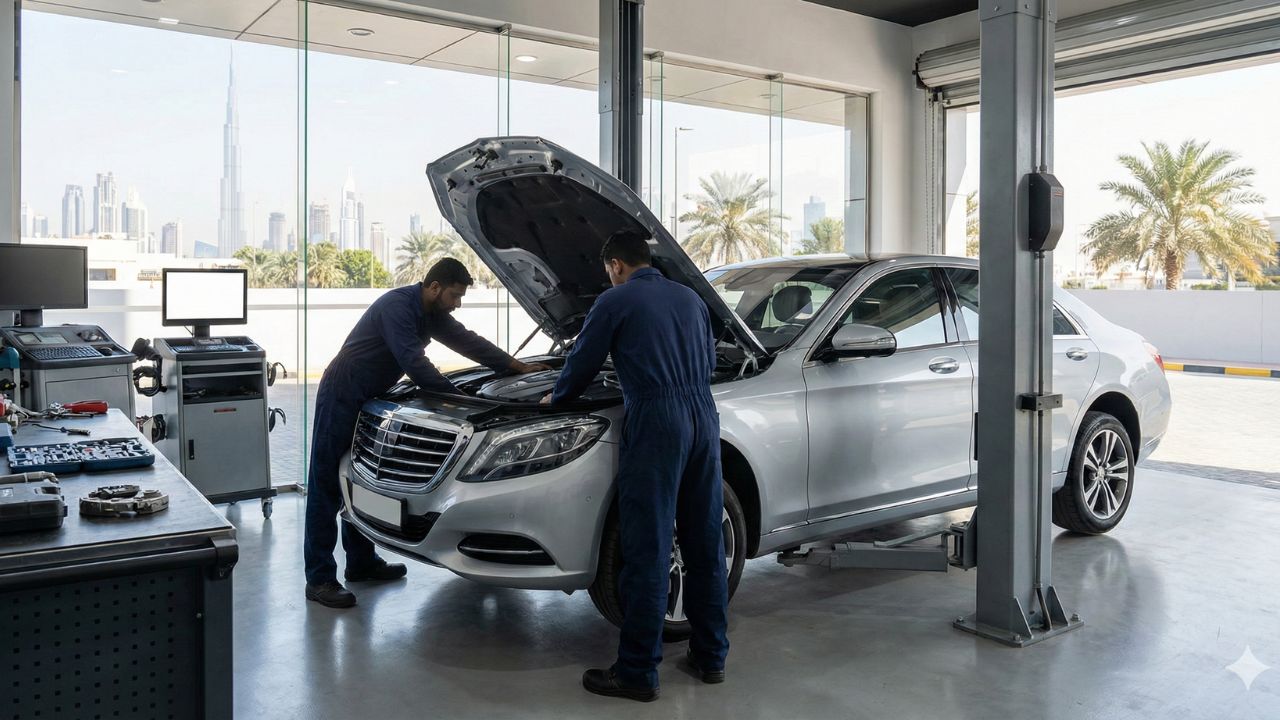
Picture this: You’re gliding down Sheikh Zayed Road in your Mercedes-Benz S-Class W222, that magnificent flagship sedan that represents the pinnacle of automotive engineering from 2013 to 2020. The cabin is whisper-quiet, the air conditioning battles Dubai’s relentless 50°C heat effortlessly, and every sensor, every computer module, every precisely calibrated system works in perfect harmony. Then, without warning, an unfamiliar dashboard warning illuminates. Your heart sinks slightly because you know this isn’t just any car—this is a W222 S-Class, a technological masterpiece with more computing power than the spacecraft that landed on the moon, and it demands expertise that goes far beyond what standard repair facilities can offer.
The W222 generation transformed what luxury sedans could achieve. Mercedes-Benz didn’t just build a car; they orchestrated a symphony of innovation. This generation introduced Magic Body Control, the first suspension system to actually scan the road ahead and prepare for imperfections before the wheels encounter them. It brought us curved OLED displays, massaging seats with six different programs, and climate control so sophisticated it can differentiate between your preferences and your passenger’s down to individual air vents. But here’s the reality that every W222 owner discovers eventually: exceptional engineering requires exceptional maintenance.
Dubai presents a unique paradox for luxury vehicle owners. This city attracts the world’s finest automobiles, yet its environment tests every component relentlessly. The combination of extreme temperatures that make asphalt soft enough to leave footprints, sand particles fine enough to infiltrate sealed systems, and humidity that accelerates corrosion creates challenges engineers in Stuttgart never fully anticipated during development. Your W222 S-Class wasn’t designed in a climate laboratory that replicated parking outdoors in Jumeirah during August, idling in Business Bay traffic for forty minutes, then being pushed to 140 km/h on the E11 highway.
This is precisely where Euro Car Repair enters your story. We’ve built our reputation on understanding not just Mercedes-Benz vehicles generally, but specifically what makes the W222 S-Class tick, click, purr, and occasionally protest. Located in Dubai and serving exclusively this emirate, we’ve become the destination for discerning S-Class owners who refuse to compromise on quality yet appreciate transparent pricing and personalized service that dealerships simply cannot match.
What distinguishes us isn’t just our specialized equipment or our technicians’ training—though both are exceptional. It’s our philosophy about the relationship between car and owner. We believe your W222 represents a significant investment that deserves protection through expert care, honest communication, and repairs executed to standards that honor Mercedes-Benz’s engineering excellence. We also operate with complete independence from insurance companies, a decision we’ll explore in detail because it fundamentally benefits you in ways that might surprise you.
The W222 S-Class occupies a special position in Mercedes-Benz history. It arrived during a period when the company recommitted to making the S-Class the absolute benchmark, investing development resources that smaller manufacturers spend on entire model ranges. The result was a vehicle that advanced automotive technology by measurable leaps. But advancement brings complexity, and complexity demands specialization. Generic repair shops see wiring harnesses; we see the data highways connecting forty-five electronic control units. They see suspension components; we understand AIRMATIC air suspension with continuously variable damping that adjusts 1,000 times per second.
Throughout this comprehensive guide, we’ll explore every dimension of Mercedes-Benz S-Class W222 repair in Dubai. You’ll discover why choosing the right repair facility impacts not just your immediate repair needs but your vehicle’s longevity, resale value, and your peace of mind. We’ll demystify common issues specific to this generation, explain our approach to diagnostics and repairs, and provide the transparent information you deserve when making decisions about your vehicle’s care.
Whether your W222 is a 2014 model approaching its tenth year or a 2020 final-year example still feeling relatively new, whether it’s the S400 with its efficient V6, the muscular S500, the commanding S63 AMG, or even the extraordinary S65 with its twin-turbo V12, we possess the expertise to maintain it properly. Let’s begin this journey into understanding what exceptional S-Class repair truly means.
Why Choose Euro Car Repair for Your W222 S-Class
Specialized Mercedes-Benz S-Class W222 Expertise That Makes the Difference
The W222 S-Class isn’t just another Mercedes-Benz—it’s an entirely different category of vehicle engineering. When our technicians approach your S-Class, they’re not seeing “just another German luxury sedan.” They’re recognizing seven years of Mercedes-Benz’s flagship development, encompassing innovations that trickled down to other models only years later. This depth of understanding separates competent mechanics from true specialists.
Our team has invested thousands of hours specifically with W222 architecture. We understand that the 7G-TRONIC PLUS transmission in your S-Class requires different diagnostic approaches than the 9G-TRONIC that came later. We know that the M276 V6 engine, while generally reliable, develops specific oil consumption patterns that owners should monitor. We’ve seen how the M278 V8’s direct injection system responds to Dubai’s fuel quality. This isn’t generic knowledge—this is model-specific expertise built through dedicated focus.
Consider the AIRMATIC air suspension system in your W222. Standard repair facilities might understand air suspension conceptually, but do they know that your S-Class uses a specific strut design with integrated damping that can’t simply be replaced with generic components? Do they understand the calibration requirements after suspension repairs, or that the system’s self-leveling algorithm needs recalibration through Mercedes-Benz proprietary software? We do, because we’ve made it our business to master these systems completely.
The electrical architecture deserves special mention. Your W222 contains somewhere between 50 and 70 million lines of computer code, depending on which features you specified. That’s more code than modern commercial aircraft. The vehicle’s Controller Area Network (CAN) buses communicate at speeds reaching 500 kilobits per second, coordinating everything from throttle response to how aggressively your massage seat kneads your lower back. When electrical gremlins appear—and in Dubai’s humidity, they sometimes do—identifying the root cause requires sophisticated diagnostic protocols that we’ve refined specifically for W222 systems.
Advanced Diagnostic Technology: Seeing What Others Miss
Here’s something most S-Class owners discover the hard way: not all diagnostic equipment is created equal. Your dashboard might display a vague warning like “Vehicle System Malfunction,” but that’s merely the tip of an informational iceberg. The real diagnostic data lives dozens of layers deeper in your vehicle’s computer systems, accessible only through proper equipment paired with interpretive expertise.
We’ve invested in Star Diagnosis equipment, Mercedes-Benz’s proprietary diagnostic system that communicates with your W222 at the same depth as dealership tools. But equipment alone doesn’t solve mysteries—it’s the technician’s ability to interpret what the data reveals. When we connect to your S-Class, we’re not just reading generic OBD-II codes that any auto parts store scanner can access. We’re diving into manufacturer-specific data streams, viewing real-time sensor values, examining freeze-frame data that captures exact conditions when faults occurred, and analyzing adaptation values that reveal how various systems have adjusted over time.
Let me share an example of diagnostic depth in action. An S-Class owner came to us after visiting three different repair facilities, each unable to solve an intermittent starting issue. The car would sometimes crank without starting, then work perfectly for weeks. Generic diagnostics revealed nothing. When we connected our Mercedes-specific equipment, we discovered that the crankshaft position sensor was providing signals within acceptable parameters—but barely. Under Dubai’s extreme engine bay temperatures, that sensor was occasionally drifting just outside its operating window, causing start failures that left no fault codes because they self-corrected as temperatures stabilized. That’s the diagnostic depth that solves real problems.
We also employ thermal imaging cameras that reveal hot spots indicating electrical resistance issues, borescopes for internal engine inspection without disassembly, and oscilloscopes for analyzing electrical signals at the microsecond level. This technology stack, combined with technicians trained to interpret the results, means we can identify problems that other facilities simply cannot see.
Genuine Parts and Quality Alternatives: The Right Component for Your Investment
The parts debate creates genuine confusion for S-Class owners. Dealerships insist only genuine Mercedes-Benz parts will suffice, while budget repair shops push whatever fits mechanically. The truth, as usual, inhabits more nuanced territory. Your W222 deserves quality components, but “quality” and “OEM stamped” aren’t always synonymous, especially when we’re discussing service items.
We source genuine Mercedes-Benz OEM parts for critical systems where engineering specifications demand exact matches. Your engine’s turbocharger, transmission control modules, safety systems like airbags—these receive only manufacturer-specified components. There’s no reasonable argument for compromise in these areas. However, for many service items and wear components, premium aftermarket manufacturers produce parts that meet or exceed OEM specifications at substantially reduced costs.
Consider brake components. We can install genuine Mercedes-Benz brake pads, or we can fit Pagid or Textar pads—often the very same manufacturers who supply Mercedes-Benz, just without the star logo and the corresponding markup. Both options carry warranties; both meet performance specifications; one costs significantly less. We present both options transparently, explain the differences honestly, and let you make informed decisions based on your priorities and budget.
Our parts sourcing relationships give you advantages beyond just options. We maintain partnerships with suppliers across Europe and the UAE, ensuring we can usually source needed components within 24-48 hours rather than the week-plus waits that sometimes plague dealership repairs. For urgent repairs, we’ve been known to expedite specific components to get your S-Class back on the road faster than standard supply chains allow.
Every part we install, whether OEM or premium aftermarket, comes with warranty coverage. We stand behind our work and the components we choose. If a part fails prematurely—a rare occurrence, but it happens—we replace it without finger-pointing or complicated warranty claim processes.
Transparent Pricing Philosophy: Knowing Before You Commit
Few things frustrate vehicle owners more than repair estimate uncertainty. You drop off your S-Class, receive a vague “we’ll let you know” response, then get a phone call days later with a number that makes you question whether they’re repairing your car or purchasing a new one. We fundamentally reject that approach.
Our estimate process begins with comprehensive diagnosis. We don’t guess; we identify. Once we understand exactly what your W222 needs, we prepare a detailed, itemized estimate that breaks down labor costs, parts costs, and any additional supplies or services required. You receive this estimate before any repair work begins. Not a range, not a ballpark—a specific number based on actual assessment.
Here’s where we differ from many competitors: we explain our pricing. Why does that repair cost what it does? How much is labor versus parts? What would happen if you delayed this repair—is it safety-critical, or can it wait? We believe informed customers make better decisions, and better decisions lead to better outcomes and stronger trust.
Compared to dealership pricing, our services typically cost 30-45% less for equivalent quality work. That’s not because we cut corners—it’s because our overhead structure differs. We don’t have the massive showroom expenses, the corporate profit margins, or the sales teams that dealerships support. Our business model focuses exclusively on repair excellence, and our pricing reflects that efficiency.
We also never discover “additional problems” mid-repair that weren’t in the original estimate without contacting you first. If diagnostic work reveals issues we didn’t initially identify, we pause, contact you with updated information and pricing, and proceed only with your explicit approval. Your authorization matters to us because your trust matters more than any single repair invoice.
Customer-First Service Model: You’re Not Just a Ticket Number
Dealership service departments often treat vehicle repairs as transactional episodes. Vehicle arrives, work gets assigned to whoever’s available, repairs happen, vehicle departs. Next. There’s an efficiency to that approach, but it sacrifices the relationship element that transforms service from obligation to partnership.
We intentionally operate differently. When you bring your W222 to Euro Car Repair, you’re beginning a relationship, not completing a transaction. We assign a service advisor who becomes your primary point of contact throughout your ownership experience. This person learns your vehicle’s history, understands your usage patterns, recognizes your priorities regarding performance versus economy, and communicates with you in the style you prefer—detailed technical explanations or accessible summaries.
During repairs, we maintain communication transparency. If your service requires three days, you’re not wondering what’s happening for seventy-two hours. We provide progress updates, explain any challenges we encounter, and keep you informed about timing. If we’re waiting for a part delivery or if diagnosis takes longer than anticipated, you know about it.
We also recognize that your W222 isn’t just transportation—it represents a certain lifestyle expectation. Being without it creates inconvenience. That’s why we offer flexible scheduling options, including early morning drop-offs and evening pickups when our standard hours don’t align with your schedule. For major services, we can arrange pickup directly from your location in Dubai and return your S-Class once completed, saving you the complications of arranging transportation.
Our waiting area provides comfortable accommodation if you prefer to stay during service. We’ve equipped it with high-speed Wi-Fi, refreshments, and comfortable seating because we understand that your time holds value. Some customers use these hours productively for work; others appreciate the chance to slow down with complimentary coffee and magazines.
Why We Don’t Work With Insurance: The Freedom That Benefits You
This might seem counterintuitive at first. Why would a repair facility refuse to work with insurance companies? Doesn’t that limit customer options? The answer reveals fundamental differences in priorities, and understanding those differences helps explain why our approach ultimately serves your interests better.
Insurance companies optimize for their bottom line, not your vehicle’s optimal care. When repairs go through insurance, adjusters who’ve never seen your specific W222 make decisions about which repairs are “necessary” and which are “optional.” They negotiate parts prices by pressuring repair facilities to use cheaper alternatives. They set labor rate caps that may not reflect the specialized expertise your S-Class actually requires. The result is a system that consistently pushes repair quality toward adequacy rather than excellence.
By operating outside the insurance system, we maintain complete independence in our recommendations. If your S-Class needs a particular repair, we recommend it based purely on what’s best for your vehicle and your safety—not based on what an insurance adjuster might approve. We’re not negotiating repair scope to fit insurance authorization; we’re determining proper repair scope based on proper assessment.
This independence also accelerates your repair timeline dramatically. Insurance claims require estimating, submission, review, negotiation, approval—processes that can consume days or even weeks. During that time, your S-Class sits waiting. Without insurance involvement, we diagnose, estimate, receive your approval, and begin repairs immediately. For many services, the time you save by avoiding insurance bureaucracy exceeds the actual repair duration.
There’s also pricing transparency to consider. Insurance-involved repairs often include inflated initial estimates that get negotiated downward. The final cost might seem reasonable, but the process involves theatrical pricing games. We provide honest, accurate pricing from the start because we’re dealing directly with you, not playing negotiation theater with insurance adjusters.
For collision repairs or major accident damage where insurance coverage is essential, we’re happy to provide detailed estimates you can submit to your insurance company for reimbursement. You’ll pay us directly, then handle reimbursement yourself. This approach gives you more control over the repair process while still accessing your insurance coverage.
Proven Track Record: Years of W222 S-Class Excellence
Reputation in the automotive repair industry isn’t built through advertising—it’s earned through consistent excellence over time. We’ve been serving Dubai’s European luxury vehicle community for years, and within that community, W222 S-Class owners represent a significant and loyal segment of our customer base.
Our repeat customer rate exceeds 85%, meaning the vast majority of clients who discover us return for subsequent services and recommend us to fellow enthusiasts. That statistic matters because it reflects satisfaction that extends beyond single repair experiences. People return because they trust us, because we’ve earned their confidence through quality work, honest communication, and fair pricing.
Word-of-mouth referrals drive more than half our new business. In Dubai’s luxury vehicle community, owners talk. They share experiences at social gatherings, in online forums, and through personal networks. When someone asks “where should I take my S-Class for service,” our name appears consistently in those conversations. We’re proud of that reputation and work daily to maintain it.
We’ve also built relationships with local W222 owner groups and luxury vehicle communities. Many members specifically seek us out based on recommendations from other enthusiasts who’ve experienced our service firsthand. This community trust represents the most valuable endorsement possible—the kind that no amount of advertising can create artificially.
Comprehensive Service Offerings for Your W222 S-Class
Engine Repair and Maintenance: Protecting Your S-Class’s Heart
The powerplants available in W222 S-Class models range from efficiently sophisticated to brutally powerful. The M276 3.0-liter V6 with direct injection and twin turbocharging delivers smooth, capable performance with reasonable fuel economy. The M278 4.7-liter V8, also twin-turbocharged, provides the muscle that S-Class buyers traditionally expected. And for those who selected AMG variants, the M157 5.5-liter V8 or the extraordinary M279 6.0-liter V12 represent engineering without compromise.
Each engine variant has characteristics we’ve come to understand intimately through repeated service experiences. The M276 V6, while generally reliable, can develop oil consumption issues as mileage accumulates, particularly if oil change intervals are extended beyond Mercedes-Benz specifications. We monitor this closely during service, checking consumption rates and investigating if they exceed normal parameters. The direct injection system in these engines also means carbon buildup on intake valves becomes concern after 80,000-100,000 kilometers—a maintenance item many owners don’t anticipate until driveability issues appear.
The V8 engines bring different considerations. Their twin-turbocharger systems operate under extreme conditions, particularly in Dubai’s heat. Turbocharger oil feed lines must maintain perfect sealing; even minor oil starvation can damage turbocharger bearings, leading to expensive failures. We’ve developed specific inspection protocols for these systems during routine maintenance, catching early warning signs before catastrophic failure occurs.
Oil leak diagnosis and repair represents a common service need for higher-mileage W222 models. These engines use numerous gaskets and seals, and Dubai’s temperature extremes accelerate seal deterioration. We see valve cover gaskets weep oil, timing cover seals develop minor leaks, and oil filter housing o-rings begin seeping. While these leaks often start as minor annoyances, they can progress to significant oil consumption and create fire hazards if oil contacts hot exhaust components.
Our engine maintenance approach emphasizes prevention. We recommend oil changes using Mercedes-Benz specified 229.5 synthetic oil every 10,000 kilometers or annually in Dubai conditions—more frequently than some manufacturers suggest because extreme heat degrades oil properties faster. We inspect cooling systems meticulously because engine overheating in Dubai traffic can occur rapidly, potentially causing serious damage before warning systems alert drivers.
The cooling system itself deserves particular attention on W222 models. These engines run sophisticated thermal management systems with multiple temperature sensors, electric cooling fans with variable speeds, and precisely controlled thermostats. A failing water pump—particularly the electric auxiliary pumps used in some configurations—can create overheating situations that damage cylinder heads or head gaskets. We monitor cooling system operation during every service, checking pump function, fan operation, and coolant condition.
Transmission and Gearbox Services: Maintaining Seamless Shifts
The 7G-TRONIC PLUS seven-speed automatic transmission fitted to most W222 S-Class models represents mature, well-developed technology. It shifts smoothly, adapts to driving styles, and generally provides hundreds of thousands of kilometers of reliable service—assuming it receives proper maintenance, which many owners unfortunately neglect.
Transmission fluid in modern automatics isn’t truly “lifetime” despite some manufacturer claims. The fluid degrades through heat cycles, accumulates wear particles from clutch pack engagement, and gradually loses its friction-modifying properties. In Dubai’s climate, this degradation accelerates. We recommend transmission fluid and filter service every 60,000 kilometers, a schedule that prevents the gradual shift quality deterioration many owners accept as normal aging.
When transmission issues develop, symptoms often appear subtle initially. Slightly delayed engagement when shifting from Park to Drive. Occasionally firm shifts during specific gear changes. A barely perceptible shudder at low speeds. Many owners dismiss these signs, assuming they’re normal characteristics. They’re not—they’re early warnings that transmission health is declining and intervention could prevent expensive repairs.
Our diagnostic approach to transmission concerns starts with fluid analysis. Transmission fluid color, smell, and contamination level tell us enormous amounts about internal condition. Fresh fluid appears bright red and smells slightly sweet. Degraded fluid darkens to brown or black, smells burned, and contains visible metallic particles that indicate internal wear. Severe contamination often means internal damage requires rebuilding or replacement.
We also use Mercedes-Benz diagnostic software to monitor transmission adaptation values. The transmission’s computer continuously adjusts shift parameters to compensate for wear, maintaining consistent shift feel as components age. By examining these adaptation values, we can determine whether the transmission is compensating within normal ranges or struggling with excessive wear. This diagnostic insight often reveals problems before drivers notice symptoms, enabling preventive intervention.
For W222 models experiencing transmission failure beyond repair through fluid service and adaptation reset, we can source remanufactured transmissions that come with warranties matching or exceeding original equipment. These units are completely disassembled, inspected, rebuilt with new wear components, and tested to original specifications. They provide dependable service at costs substantially below new transmission replacement while maintaining quality standards appropriate for your S-Class.
Brake System Services: Stopping Power That Matches Performance
The braking systems on W222 S-Class models reflect Mercedes-Benz’s understanding that a vehicle this large and potentially powerful needs exceptional stopping capability. Standard models feature generously sized ventilated disc brakes with sophisticated ABS, brake assist, and electronic brake force distribution. AMG variants take this further with high-performance brake packages featuring even larger discs, performance pad compounds, and painted calipers.
Despite their capabilities, brake systems remain fundamentally wear-based. Brake pads compress against rotors thousands of times daily, converting kinetic energy to heat and friction. This process gradually wears pad material and, over time, affects rotor surface quality. In Dubai’s traffic conditions—frequent acceleration followed by heavy braking, often while carrying vehicle-cooling air conditioning loads—brake systems work harder than in temperate climates with flowing traffic.
We monitor brake pad thickness during every service visit. W222 models typically use electronic brake wear sensors that alert drivers when pads reach minimum thickness, but we prefer catching wear before sensors trigger. Replacing pads before they reach absolute minimums prevents damage to rotors, which are considerably more expensive than pads. We’ve seen countless vehicles arrive with warning lights active, only to discover that owners have driven additional weeks or months after the warning appeared, grinding pad backing plates against rotors and necessitating complete brake component replacement.
Rotor condition matters as much as pad thickness. Rotors develop surface imperfections through normal use—glazing from excessive heat, mild warping from uneven cooling, minor scoring from pad material. These conditions create vibrations during braking, reduce stopping effectiveness, and accelerate pad wear. We measure rotor thickness and inspect surface quality during brake service, recommending resurfacing or replacement when conditions warrant.
The brake fluid in your W222 is hygroscopic, meaning it absorbs moisture from the atmosphere over time. This moisture contamination lowers brake fluid’s boiling point, potentially creating brake fade during hard stops where heat buildup boils contaminated fluid, creating vapor bubbles that compress rather than transmitting hydraulic pressure. We recommend complete brake fluid exchange every two years, a schedule that maintains system integrity and prevents internal corrosion within brake components.
For performance-oriented owners who occasionally push their S-Class harder—trackdays, spirited drives through Hatta, or simply enjoying the capabilities of an AMG variant—we can install upgraded brake pads formulated for higher temperature resistance and more aggressive initial bite. These performance compounds may produce slightly more brake dust and minor squealing during initial application when cold, but they provide superior fade resistance and confidence-inspiring stopping power.
Air Conditioning and Climate Control: Essential Comfort in Dubai’s Heat
In Dubai, air conditioning transitions from luxury to necessity. When temperatures outside reach 50°C, your W222’s climate control system isn’t just providing comfort—it’s making the vehicle inhabitable. The multi-zone automatic climate control system in your S-Class represents sophisticated engineering, precisely controlling temperature, airflow, and distribution to create an optimal cabin environment.
The system’s complexity extends beyond simple refrigeration. Your W222 uses dual evaporators, multiple temperature sensors, cabin air quality sensors that detect pollutants and automatically recirculate air, and even humidity sensors that optimize comfort beyond simple temperature control. When functioning properly, the system maintains such stable conditions that occupants barely notice it operating—they simply remain comfortable.
Dubai’s environment challenges air conditioning systems severely. The extreme temperature differential between outside air and desired cabin temperature forces the system to work at maximum capacity frequently. Compressors cycle constantly during summer months. Condenser fans run continuously. Refrigerant pressures reach upper operational limits. These demands accelerate wear on components designed for less extreme duty cycles.
Compressor failure represents the most significant air conditioning expense. The compressor, driven by your engine through an electromagnetic clutch, pressurizes refrigerant and circulates it through the system. W222 models use variable displacement compressors that adjust output based on cooling demand, improving efficiency but adding mechanical complexity. When compressors fail—usually through bearing wear or internal seal deterioration—replacement becomes necessary. We use OEM-quality compressors that include updated revisions addressing known weaknesses in earlier units.
Refrigerant leaks create another common concern. Your W222 uses R134a refrigerant in a sealed system that should theoretically never need recharging. If refrigerant levels drop, a leak exists somewhere—in hose connections, at the condenser, through evaporator corrosion, or from seal deterioration at the compressor shaft. We use electronic leak detectors and UV dye to locate leaks precisely, enabling proper repair rather than simply recharging the system repeatedly.
The cabin air filters in your S-Class deserve more attention than most owners provide. These filters trap dust, pollen, sand, and pollutants before air enters the cabin, protecting not just your respiratory comfort but also the evaporator core from contamination. In Dubai’s dusty environment, these filters load with particles rapidly. We recommend replacement every 10,000 kilometers, more frequently than standard service schedules suggest, because loaded filters restrict airflow, reduce cooling effectiveness, and can create musty odors as trapped organic material decomposes on the filter media.
For vehicles experiencing persistent air conditioning issues—weak cooling, intermittent operation, unusual noises from the system—we perform complete system diagnostics using manifold gauges to check refrigerant pressures, thermal imaging to observe temperature distributions, and Mercedes-Benz diagnostic software to monitor blend door positions, sensor readings, and system self-test results. This comprehensive approach identifies root causes rather than treating symptoms.
Suspension and Steering: Maintaining the Magic Carpet Ride
The AIRMATIC air suspension system available on most W222 S-Class models represents one of Mercedes-Benz’s signature technologies. Unlike conventional coil spring suspension, AIRMATIC uses air springs at each corner, electronically controlled dampers, and a sophisticated control system that continuously adjusts suspension characteristics based on road conditions, vehicle speed, driving style, and selected comfort modes.
This system provides the legendary “magic carpet ride” that S-Class owners expect—smooth, isolated, controlled. The suspension seems to float over road imperfections while maintaining precise body control during cornering. It’s an extraordinary achievement that requires numerous components working in perfect harmony. When those components begin failing, the degradation often occurs gradually enough that owners adapt without realizing their suspension isn’t performing to original specifications.
Air strut leaks represent the most common AIRMATIC concern. Each air spring contains a tough but flexible rubber bladder that holds pressurized air supporting vehicle weight. Over time, especially in Dubai’s heat and UV exposure, these bladders can develop small leaks. Initially, the compressor compensates by running more frequently to maintain pressure. Eventually, leaks overwhelm the compressor’s capacity, and the vehicle begins displaying warning messages or sagging at one corner.
We’ve developed specific diagnostic procedures for AIRMATIC concerns. When a vehicle arrives with suspension complaints, we perform static leak tests using soapy water to identify leaking struts, check compressor function and output pressure, examine valve block operation, and use Mercedes-Benz diagnostic tools to analyze system self-leveling data and fault codes. This thorough assessment determines whether simple repairs—replacing a leaking strut or cleaning a stuck valve—can restore function or whether more extensive service is needed.
The adaptive damping system, controlled electronically through various drive modes (Comfort, Sport, Sport+, Individual), uses dampers that can adjust firmness in milliseconds. These dampers contain electromagnetically controlled valves that regulate hydraulic fluid flow, changing damping characteristics. While generally reliable, these dampers can develop electronic faults or internal wear. Failed dampers often manifest as excessive body motion during cornering, nose dive during braking, or loss of the characteristic S-Class ride comfort.
Steering system maintenance on W222 models centers on the speed-sensitive power steering, which provides light effort at parking speeds and increases resistance as velocity rises. The system uses an electric motor rather than traditional hydraulic assist, eliminating the maintenance concerns of hydraulic steering but introducing electronic complexity. Steering concerns typically relate to alignment issues affecting tire wear and straight-line stability, or to worn suspension bushings allowing play that creates imprecise steering feel.
We perform four-wheel alignment using manufacturer-specific specifications for your W222. Proper alignment ensures even tire wear, maximizes tire life, and maintains the stable, confidence-inspiring steering feel Mercedes-Benz engineered into your S-Class. In Dubai, where inadvertent pothole strikes and speed bump contacts happen frequently, alignment can drift from specifications gradually. We recommend annual alignment checks even without obvious symptoms.
Electrical System Diagnostics: Mastering Complexity
If there’s one system that separates specialized S-Class repair facilities from general shops, it’s electrical diagnostics. Your W222 contains dozens of electronic control modules managing everything from engine performance to seat position memory, each communicating across multiple data networks. When electrical gremlins appear, systematic diagnosis using proper equipment and expertise becomes essential.
Battery health takes on particular importance in vehicles this electronically complex. W222 models use AGM (Absorbed Glass Mat) batteries specifically designed for vehicles with start-stop systems and high electrical demands. These batteries aren’t interchangeable with conventional flooded batteries—using incorrect battery types can cause charging system faults and electronic malfunctions. When battery replacement becomes necessary, we install proper AGM batteries and perform the required coding through Mercedes-Benz diagnostic systems, informing the vehicle’s electrical management system about the new battery so charging parameters adjust appropriately.
Dubai’s heat accelerates battery aging dramatically. Batteries that might last five or six years in temperate climates often fail within three years here. We test battery health during every service using electronic load testers that measure cold cranking amps and reserve capacity, providing objective data about remaining battery life. This testing often reveals batteries that appear to work fine but are approaching failure, allowing replacement before the inevitable morning when your S-Class refuses to start.
Sensor failures create another common electrical concern. Your W222 uses dozens of sensors monitoring everything imaginable—oxygen sensors for emission control, mass airflow sensors for fuel delivery calculation, wheel speed sensors for ABS and stability control, radar sensors for adaptive cruise control, cameras for parking assistance and lane keeping. When sensors fail or provide implausible data, the vehicle’s computers generate fault codes that may trigger warning messages or limit functionality.
Sensor diagnosis requires understanding not just which sensor is reporting problems, but why it’s failing. Is the sensor itself defective, or is it reporting accurately that another problem exists? Is the issue related to sensor wiring, connections, or computer module problems? We analyze sensor data streams in real-time, compare readings against expected values, and trace electrical circuits when necessary to determine root causes.
The multiplexing systems that coordinate communications between electronic modules occasionally experience faults that manifest mysteriously—intermittent warning messages, features that stop working randomly, or odd behaviors that seem impossible to replicate consistently. These concerns require patience, systematic testing, and deep understanding of how W222 systems communicate. We’ve resolved issues that stumped other facilities by understanding the relationship between seemingly unrelated systems connected through shared data buses.
Fluid Leak Detection and Repair: Keeping Everything Sealed
Fluid leaks frustrate owners because they create mess, waste expensive fluids, and indicate problems requiring attention. W222 S-Class models, particularly as mileage accumulates, can develop various leak concerns. Identifying leak sources definitively, then repairing them properly, prevents minor nuisances from becoming major failures.
Engine oil leaks often start at valve cover gaskets, which seal the top of the engine. W222 engines position these gaskets where heat concentration is significant, accelerating rubber deterioration. As gaskets age, they compress and lose elasticity, allowing oil to seep past. Initially, this creates minor oil smell from small amounts burning on hot engine surfaces. Over time, leaks worsen, potentially dripping oil onto garage floors and creating fire hazards.
Oil filter housing seals represent another common leak source. W222 models use cartridge-style oil filters mounted in housings that seal with o-rings. These o-rings experience pressure cycles and temperature extremes during every drive. When they harden and lose sealing ability, oil leaks from the housing—often onto exhaust manifolds where it burns, creating blue smoke and oil smell from the engine compartment. Replacing these o-rings during oil changes before leaks develop represents simple preventive maintenance.
Coolant leaks require urgent attention because they can lead to engine overheating and catastrophic damage. We see coolant leaks from aged radiator hoses, deteriorating water pump seals, and occasionally from heater core leaks that allow coolant into the cabin. Identifying coolant leak sources sometimes requires pressure testing the cooling system with specialized equipment that maintains pressure while we inspect every connection, hose, and component for escaping coolant.
Transmission fluid leaks often appear at output shaft seals or from cooler line connections. Automatic transmissions operate at significant hydraulic pressures, and seal degradation creates leaks that can drip onto hot exhaust components. Beyond the mess and smell, transmission fluid leaks reduce fluid levels, potentially causing transmission damage from inadequate lubrication and cooling. We address transmission leaks by replacing failed seals and inspecting why seals failed—sometimes, excessive transmission wear creates internal pressure that accelerates seal failure, indicating deeper problems.
We use fluorescent dye and UV lights to identify challenging leaks. By adding dye to suspect fluid systems, driving the vehicle, then inspecting with UV light, we can trace leak paths back to their sources even when leaks are intermittent or too minor to locate through visual inspection alone. This technology has solved countless mystery leaks that owners lived with for months because other facilities couldn’t identify the source.
Additional Specialized Services: Complete Care for Your S-Class
Tire service for W222 models requires attention to several factors beyond simple tire mounting. Your S-Class uses a Tire Pressure Monitoring System (TPMS) with sensors mounted inside each wheel that transmit pressure and temperature data wirelessly to the vehicle’s computer. When installing new tires or replacing TPMS sensors, we must program sensor IDs into the vehicle using Mercedes-Benz diagnostic equipment. Failing to perform this programming leaves you without functional tire pressure monitoring—a safety system that’s also legally required to operate properly.
We recommend tire rotation every 8,000-10,000 kilometers to ensure even wear. The weight distribution and power delivery of your S-Class can create uneven wear patterns if tires aren’t rotated regularly. We also perform vibration diagnosis when customers report steering wheel shake or body vibration at highway speeds. These symptoms often relate to tire balance, but they can also indicate bent wheels from pothole impacts, or suspension components problems.
Sunroof systems on W222 models provide expansive glass areas that create bright, airy cabin environments. The panoramic sunroofs available on many models span nearly the entire roof, using multiple glass panels and complex mechanisms. When sunroof drains clog—a common issue in dusty environments—water collects and can overflow into the cabin, soaking headliners, carpets, and electronic modules. We clean sunroof drain tubes preventively during routine maintenance, avoiding expensive water damage repairs.
Paint scratch repair requires careful attention on vehicles this prestigious. Minor parking lot scratches, stone chips, and clearcoat damage affect not just appearance but also resale value. We can perform minor paint correction and touch-up work for small imperfections, or coordinate professional paint shop services for damage requiring panel repainting.
Pre-purchase inspection services help prospective buyers evaluate used W222 S-Class vehicles thoroughly before purchase. We perform comprehensive inspections covering all major systems, identifying existing problems, signs of previous damage or poor repairs, and predicting likely future maintenance needs. This service has saved our customers thousands of dirhams by revealing issues sellers failed to disclose, enabling informed negotiations or avoiding problematic vehicles entirely.
Scheduled maintenance packages provide comprehensive service at predictable costs. Rather than paying separately for each service, our packages bundle recommended maintenance appropriate for your vehicle’s mileage and age into single annual or semi-annual services. These packages ensure nothing gets overlooked while offering cost savings compared to individual service purchases.
Common Mercedes-Benz S-Class W222 Problems We Solve
AIRMATIC Suspension Failures: Maintaining the Legendary Ride
The AIRMATIC air suspension system, while providing exceptional ride quality, represents the most common significant repair concern for higher-mileage W222 models. The system’s complexity—air compressor, valve block, air struts, sensors, control modules, air lines—means multiple potential failure points exist.
Owners typically first notice AIRMATIC problems through warning messages or the vehicle sitting lower than normal, especially after extended parking. The compressor may run excessively, attempting to maintain air pressure against leaking components. In some cases, the vehicle displays “AIRMATIC Visit Workshop” messages and enters a fail-safe mode that limits functionality.
Air strut leaks develop gradually. The rubber air springs endure constant pressure cycles and exposure to road debris, chemicals, and Dubai’s UV intensity. Small cracks eventually appear, allowing air to escape slowly. Many owners don’t realize their suspension has degraded until comparing their ride quality to a properly functioning S-Class—the difference is remarkable.
We diagnose AIRMATIC concerns through systematic testing. Visual inspection reveals obvious strut damage or leaking connections. We perform lift tests, raising the vehicle and observing which corners lose height, indicating problematic struts. Diagnostic software shows us real-time air spring pressure, compressor activity, and valve block function. This comprehensive approach determines whether simple repairs can restore function or whether multiple components require replacement.
Replacement involves installing new struts with updated internal design revisions that address weaknesses in earlier production units. We also inspect and often replace air line connections that become brittle and leak. The valve block, which controls airflow to individual struts, occasionally requires replacement when internal solenoids stick or fail. After repairs, we perform complete system calibration and leveling, ensuring your S-Class sits at proper height in all modes.
Oil Consumption in M276 V6 Engines: Monitoring and Managing
The M276 3.0-liter V6 engine, while generally reliable and efficient, has developed a reputation for oil consumption issues in some vehicles. Not every M276 consumes excessive oil, but enough do that it warrants discussion for W222 S-Class owners with this engine.
The issue typically manifests as lower oil level between changes, sometimes requiring owners to add oil mid-interval. Mercedes-Benz considers oil consumption up to one liter per 1,000 kilometers within specifications, but many owners rightfully find this consumption rate excessive and concerning.
The root cause relates to piston ring design and cylinder wall bore quality in some production runs. Under certain operating conditions—particularly low engine speeds under load, common in city driving—combustion blow-by can allow oil past piston rings into the combustion chamber where it burns. The problem often worsens as engines age and rings wear.
We monitor oil consumption in M276 engines during every service. If consumption exceeds reasonable rates, we investigate potential causes. Sometimes, accumulated carbon deposits contribute to excessive consumption, and performing induction system cleaning reduces consumption by restoring proper ring sealing. In other cases, using specific oil viscosity grades minimizes consumption by providing better film strength and sealing.
For engines with severe consumption issues, repair ultimately requires internal engine work—replacing piston rings and potentially honing cylinders. This represents major service, but it permanently resolves the issue rather than managing it through frequent oil additions. We help owners evaluate whether their specific consumption rate justifies internal repairs or whether simply monitoring levels and adding oil as needed makes more economic sense given their vehicle’s age and mileage.
Transmission Jerky Shifting and Shuddering: Restoring Smooth Operation
Many W222 owners eventually experience transmission behavior changes—shifts that feel slightly rougher than new, occasional shuddering at low speeds, or delayed responses when accelerating from stops. These symptoms often develop so gradually that owners assume they’re normal aging characteristics. They’re not, and often, relatively simple intervention restores proper transmission function.
The 7G-TRONIC PLUS transmission uses sophisticated electronic control and adaptation strategies. As clutch packs wear microscopically during normal use, the transmission computer adjusts application pressure and timing to maintain consistent shift feel. These adaptations work well until wear exceeds the computer’s ability to compensate. At that point, symptoms appear.
Degraded transmission fluid accelerates these issues. As fluid loses its friction-modifying additives and accumulates wear particles, it no longer provides ideal operating characteristics. Shifts become harsher because fluid can’t modulate clutch engagement smoothly. Torque converter lockup shudder develops because contaminated fluid can’t properly dampen torsional vibrations.
We address these concerns through comprehensive transmission service that includes complete fluid replacement with genuine Mercedes-Benz specification fluid, new filter installation, and adaptation reset. The adaptation reset clears learned values from the transmission computer, forcing it to relearn shift characteristics with fresh fluid. In many cases, transmission feel improves dramatically—owners report their transmissions feeling nearly new again.
For transmissions with more significant internal wear, fluid service provides temporary improvement but symptoms eventually return. At that point, we discuss options including transmission rebuilding or remanufactured replacement. The decision depends on symptom severity, vehicle value, and owner’s long-term plans.
Electrical System Issues: Solving Electronic Mysteries
W222 electrical concerns manifest in bewildering variety. Warning messages appear without obvious causes. Features stop working intermittently. Dashboard displays freeze or glitch. Solving these issues requires systematic diagnostic approaches and deep understanding of interconnected systems.
Battery and alternator problems create the foundation for many electrical gremlins. When battery voltage drops below optimal levels or alternator charging becomes inconsistent, electronic modules begin behaving erratically. Sensors provide implausible readings. Computers generate spurious fault codes. The vehicle enters various limp modes or disables features as protective measures.
We always begin electrical diagnostics with comprehensive battery and charging system testing. Even batteries that seem functional can fail to provide stable voltage under load, creating electrical instability throughout the vehicle. Replacing marginal batteries and ensuring proper charging system operation resolves surprising numbers of mysterious electrical complaints.
Water intrusion creates another common electrical failure cause. Dubai receives infrequent but occasionally intense rainfall. Clogged sunroof drains or compromised door seals allow water into areas housing electronic modules. Even small amounts of moisture can corrode connection pins, create short circuits, or damage sensitive electronics. We inspect for water intrusion signs when diagnosing electrical issues—corrosion on connectors, water stains on carpets, musty odors indicating moisture accumulation.
Module failures require replacement with properly coded units. Unlike simple sensors, control modules contain software programmed specifically for your vehicle’s configuration. Installing modules without proper coding leaves features non-functional. We use Mercedes-Benz diagnostic tools to code replacement modules correctly, ensuring complete functionality restoration.
Climate Control Not Cooling Properly: Restoring Comfort
Given Dubai’s climate, air conditioning problems quickly transition from inconvenient to intolerable. When your W222’s climate control system fails to maintain comfortable cabin temperatures despite running at maximum settings, several potential causes exist.
Refrigerant leaks represent the most common culprit. The air conditioning system operates as a sealed circuit under pressure. Leaks from any component—condenser, evaporator, hoses, compressor seals—allow refrigerant to escape. As refrigerant levels drop, cooling capacity diminishes proportionally. Eventually, insufficient refrigerant remains for the system to produce any cold air.
We use electronic leak detectors to identify refrigerant escapes. These sensitive instruments detect trace refrigerant molecules, pinpointing leak locations that may not be visually obvious. Once we identify the leaking component, we replace it, evacuate the system to remove air and moisture, then recharge with proper refrigerant quantity and test for proper operation.
Condenser damage from road debris creates another failure mode. The condenser, mounted ahead of the radiator, receives direct airflow—and direct rock and debris impacts. Punctures or bent cooling fins reduce condenser efficiency, limiting the system’s heat rejection ability. In Dubai’s ambient temperatures, damaged condensers can’t reject enough heat for the system to produce adequately cold air in the cabin.
Failed compressors prevent refrigerant circulation. When compressor bearings wear or internal components fail, the unit stops pumping refrigerant through the system. This represents significant repair expense, but it’s essential for restoring climate control function. We install quality replacement compressors, replace the receiver-drier to remove moisture, flush the system to clear contaminants, then recharge and test.
Brake Vibration and Noise: Restoring Smooth Stopping
Vibration through the steering wheel or brake pedal during braking indicates warped brake rotors or uneven pad deposits. While concerning, these symptoms typically don’t indicate safety problems—brakes still function, just without the smooth confidence inspiring feel Mercedes-Benz engineered into your S-Class.
Rotor warping develops through uneven heating and cooling cycles. Hard stops heat rotors significantly. If one section cools faster than others—from puddle water contact, for instance—differential thermal expansion creates microscopic thickness variations. These variations create the pulsation felt during braking as pads encounter areas of different thickness.
Pad deposits create similar symptoms through different mechanisms. Brake pad material can transfer onto rotor surfaces unevenly, creating high spots that cause pulsation. This often happens after hard mountain driving or track use followed by immediate parking with hot brakes.
We address brake vibration by measuring rotor thickness variations and inspecting surface conditions. Rotors within thickness specifications but showing minor warping can sometimes be resurfaced, removing the uneven surface and restoring smooth operation. Rotors beyond minimum thickness or with significant warping require replacement. We always replace pads simultaneously because used pads won’t seat properly on new or refinished rotor surfaces.
Brake noise—squealing, grinding, or groaning sounds—indicates different concerns. Squealing often relates to pad vibration or dust accumulation. We clean brake components, apply appropriate lubricants to pad backing plates and caliper slide pins, and install noise-dampening shims if not already present. Grinding indicates pads worn to backing plates, requiring immediate replacement to prevent rotor damage. Groaning sometimes relates to caliper binding, requiring caliper service or replacement.
Diesel Particulate Filter Issues (Diesel Models): Maintaining Emissions
Diesel W222 S-Class models sold in markets outside North America use diesel particulate filters (DPF) to trap soot emissions. These systems work effectively but require specific operating conditions for proper function. In Dubai’s traffic, where diesel S-Class models spend significant time idling or at low speeds, DPF problems occasionally develop.
The DPF traps soot particles during normal operation, then periodically initiates regeneration cycles where extremely high temperatures burn accumulated soot. Regeneration requires sustained highway speeds with moderate engine load—conditions that allow exhaust temperatures to reach 600°C or higher. Urban driving with frequent stops prevents proper regeneration, allowing soot accumulation that eventually restricts exhaust flow and triggers warning messages.
When DPF reaches critical soot loading, the vehicle enters limp mode limiting performance and displaying warnings that service is urgently needed. Ignoring these warnings can result in DPF damage requiring expensive replacement rather than simple cleaning.
We address DPF issues through forced regeneration using diagnostic software, or through professional DPF cleaning if soot loading exceeds levels where regeneration can succeed. We also educate owners about driving patterns that facilitate proper DPF function—regular highway drives of at least 30 minutes allow the system to regenerate naturally, preventing problems.
Door Lock and Trunk Mechanism Failures: Electrical and Mechanical Issues
W222 models use sophisticated door latching mechanisms with electronic actuation and soft-close features. These systems provide exceptional convenience—doors pull themselves fully closed from partially latched positions, providing that satisfying Mercedes-Benz vault-like closure sound. However, these mechanisms contain motors, sensors, and complex mechanical linkages that occasionally require service.
Common symptoms include doors that won’t lock or unlock electronically, soft-close features that stop working, or trunk mechanisms that fail to latch properly. Sometimes issues relate to individual door latch assemblies that develop motor failures or mechanical binding. Other times, central locking system failures affect multiple doors simultaneously.
We diagnose door mechanism problems by accessing each door’s latch assembly, testing motor function directly, and checking mechanical operation. Diagnostic software reveals fault codes that often identify specific problematic components. In some cases, cleaning and lubricating mechanisms restores proper function. Other times, latch assembly replacement becomes necessary.
Trunk closure problems often relate to the sophisticated mechanism that includes soft-close motors, electronic latches, and the power trunk opener/closer. These systems endure significant loads and eventual component wear. We’ve developed expertise with W222 trunk mechanisms through repeated repairs, knowing which components fail commonly and how to restore proper function efficiently.
Our Expert Technicians: The Team Behind Your S-Class Care
The most sophisticated diagnostic equipment proves useless without skilled technicians interpreting its data and applying expertise. Our team represents our greatest asset—experienced, trained professionals who view automotive repair as craftsmanship requiring constant learning and dedication to excellence.
Every technician working on your W222 has undergone specialized training in European luxury vehicle systems. This isn’t generic automotive repair training—it’s focused education covering Mercedes-Benz’s specific engineering philosophies, diagnostic procedures, and repair methodologies. Several team members have completed Mercedes-Benz technical training programs, earning certifications that demonstrate mastery of these complex vehicles.
Experience matters tremendously in automotive diagnosis. Book knowledge provides foundation, but pattern recognition developed through years of hands-on experience enables technicians to identify problems faster and more accurately. Our senior technicians collectively possess decades of European luxury vehicle experience, having diagnosed and repaired thousands of vehicles across various brands and models. This breadth of experience means they’ve encountered unusual problems that textbooks never mention—the kind of experience that solves challenging issues other facilities can’t diagnose.
We maintain continuous education programs keeping our technicians current with evolving automotive technology. Mercedes-Benz introduces new systems, revises existing designs, and issues technical service bulletins addressing newly discovered problems or improved repair procedures. Staying current requires ongoing learning, and we invest in training resources that many independent facilities consider too expensive. This investment pays dividends in diagnostic accuracy and repair quality.
Problem-solving ability distinguishes exceptional technicians from merely competent ones. Not every diagnosis follows linear paths. Sometimes initial diagnostic results point in misleading directions. Sometimes multiple small problems interact to create symptoms that seem unrelated to any individual issue. Exceptional technicians approach these challenges systematically, developing hypotheses, testing them methodically, and adjusting their diagnostic approach based on results. This analytical thinking—combined with intuition developed through experience—resolves problems that appear unsolvable.
Customer communication represents another critical technician skill. Technical expertise means nothing if technicians can’t explain problems clearly to customers lacking automotive backgrounds. Our technicians excel at translating technical concepts into accessible language, explaining what’s wrong, why it happened, how we’ll fix it, and what owners can do to prevent recurrence. This communication builds trust and helps customers make informed decisions about their vehicles’ care.
Quality control processes ensure consistency across all our work. Every repair undergoes secondary inspection before vehicles return to customers. This fresh-eyes review catches occasional oversights, ensures nothing was missed, and verifies that repairs meet our standards. We’d rather spend extra minutes reviewing our own work than have customers return with problems that should have been prevented.
Our team’s passion for these vehicles extends beyond professional duty. Many of our technicians are genuine automotive enthusiasts who chose this career because they love working with sophisticated machines. This passion translates into care and attention beyond what’s required—taking extra time to get repairs perfect, researching unusual problems after hours, and genuinely caring about the vehicles entrusted to us.
Dubai’s Unique Challenges for Mercedes-Benz S-Class W222
Dubai’s environment presents extraordinary challenges for automotive longevity. The combination of temperature extremes, airborne dust, coastal humidity, and intense UV radiation creates conditions that accelerate wear on virtually every vehicle system. Understanding these challenges and adapting maintenance accordingly protects your W222 investment.
The temperature extremes start with summer highs frequently reaching 50°C. Engine bay temperatures under these conditions exceed 70°C even when vehicles are parked. These temperatures accelerate lubricant degradation, stress cooling systems, affect rubber components, and challenge air conditioning systems operating at maximum capacity for months continuously. Your W222’s thermal management systems work overtime in Dubai summers—cooling fans run constantly, oil temperatures stay elevated, and heat soak after parking delays subsequent cool-down.
These temperature stresses require more frequent maintenance than manufacturers specify for temperate climates. Engine oil degrades faster in extreme heat, losing viscosity and protective properties more rapidly. We recommend more frequent oil changes for Dubai—every 10,000 kilometers rather than factory 15,000-kilometer intervals. This adjustment accounts for the harsher operating environment your engine endures daily.
Sand and dust infiltration challenges every filtration system. Despite W222’s sophisticated cabin air filtration and engine intake designs, Dubai’s airborne particles inevitably penetrate over time. Cabin air filters load with dust rapidly, restricting airflow and reducing climate control effectiveness. Engine air filters accumulate fine particles that, if allowed to reach intake systems, accelerate internal wear. We inspect filters at every service, replacing them more frequently than standard schedules suggest.
The dust also affects external components. It accumulates in wheel wells, around suspension components, and in door jambs where it retains moisture and accelerates corrosion. Regular washing, particularly of undercarriage areas, helps combat this accumulation. We recommend periodic underbody cleaning to remove dust and salt deposits that promote rust formation.
Coastal humidity creates corrosion concerns despite Dubai’s overall dry climate. Saline moisture from the Arabian Gulf affects vehicles parked near coastal areas—particularly in communities like JBR, Marina, and Palm Jumeirah. This moisture accelerates corrosion on exposed metal surfaces, electrical connections, and brake components. Vehicles garaged have significantly reduced exposure compared to those parked outdoors long-term, but even garaged vehicles aren’t immune.
Electrical systems suffer particularly from humidity exposure. Moisture infiltration into connectors creates corrosion on contact pins, increasing electrical resistance and eventually preventing proper circuit function. We apply dielectric grease to critical electrical connections during service, providing additional moisture protection that extends connection lifespan.
Traffic patterns affect maintenance needs through their impact on driving cycles. Dubai traffic often involves extended low-speed operation followed by brief highway bursts—the exact pattern that prevents diesel particulate filters from regenerating properly, accelerates brake wear through frequent stops, and stresses transmissions constantly shifting between gears. These conditions increase maintenance frequency compared to regions with smoother traffic flow.
The intense UV radiation degrades rubber components, plastics, and paint finishes faster than in temperate regions. Weatherstrip seals around doors and windows harden and crack, potentially allowing wind noise and water intrusion. Plastic trim pieces fade and become brittle. Paint oxidation occurs more rapidly despite modern clearcoat technology. Regular washing, waxing, and parking in covered areas when possible minimizes UV damage.
We’ve adapted our service recommendations specifically for Dubai conditions. Beyond more frequent oil changes and filter replacements, we recommend annual cooling system service inspections, regular brake fluid exchanges to combat moisture absorption, and periodic electrical system inspections checking for corrosion. These preventive measures, while requiring modest investment, prevent expensive failures and extend your W222’s service life significantly.
Seasonal service timing matters in Dubai. We recommend comprehensive pre-summer inspections in April or May, checking air conditioning performance, cooling system integrity, and battery health before extreme heat arrives. Post-summer inspections in October allow us to assess systems after months of maximum stress, addressing issues before they worsen during the more moderate months.
Pricing and Value Proposition: Transparency That Builds Trust
Discussing pricing for luxury vehicle repair requires balancing multiple factors—service quality, parts costs, labor complexity, and fair profit margins. We’ve developed our pricing philosophy around transparency and value, ensuring customers understand what they’re paying for and why our prices represent investment in quality rather than mere expense.
Our estimate process begins with accurate diagnosis. We never provide “ballpark” figures based on symptoms described over phone calls. Instead, we ask you to bring your W222 for comprehensive assessment. We connect diagnostic equipment, test drive if necessary, perform visual inspections, and determine exactly what’s needed. Only then do we prepare detailed estimates breaking down labor costs, parts prices, and additional supplies required.
This detailed estimation serves multiple purposes. First, it eliminates surprise costs—you know the total before authorizing work. Second, it allows informed decisions—if multiple repairs are needed, you can prioritize based on urgency and budget. Third, it provides cost comparison data—you can evaluate our pricing against alternatives, making informed choices about where to service your vehicle.
Compared to dealership pricing, our services typically cost 30-45% less for equivalent quality work. This isn’t achieved through reduced quality—we use equal-quality parts and employ equally skilled technicians. The difference relates to overhead structure. Dealerships maintain expensive showrooms, large administrative staffs, and corporate profit requirements that inflate service costs. Our facility focuses exclusively on repair excellence without those overhead burdens, allowing competitive pricing while maintaining quality.
For major repairs—transmission replacement, engine work, suspension overhauls—the savings become particularly significant. A transmission service at a dealership might cost AED 3,000; we provide equivalent service for AED 1,800-2,000. An AIRMATIC strut replacement quoted at AED 4,500 per corner at dealerships costs AED 2,800-3,200 through our facility. These aren’t minor differences—over your ownership experience, choosing qualified independent service saves thousands of dirhams.
Value extends beyond just pricing, though. Our technicians typically spend more time with each vehicle than dealership schedules permit. This additional attention catches problems early, ensuring nothing gets overlooked. We also provide more flexible service options—scheduling that accommodates your needs rather than rigid appointment slots, willingness to explain technical details, and relationship-focused service that views you as a valued customer rather than a service ticket number.
Package maintenance programs provide additional value. Rather than pricing each service item separately, packages bundle recommended maintenance appropriate for your mileage and age into comprehensive services at reduced costs. A typical 40,000-kilometer service package might include oil change, filter replacements, brake inspection, fluid level checks, and multi-point inspection for a single price that saves 15-20% compared to purchasing services individually.
We never pressure customers toward unnecessary services. If your W222 doesn’t need something yet, we tell you honestly. We might recommend monitoring a developing issue or suggest scheduling future service when it becomes necessary, but we don’t exaggerate urgency to generate revenue. This honesty builds long-term trust worth more than short-term profits from unnecessary repairs.
Payment flexibility accommodates different customer preferences. We accept cash, credit cards, and bank transfers. For major unexpected repairs, we can discuss payment arrangements that ease financial burden—we’d rather work with good customers facing temporary constraints than insist on full immediate payment.
The long-term cost advantages of quality repairs deserve emphasis. Cheap repairs using inferior parts require more frequent replacement, ultimately costing more over time. Quality repairs using proper parts and expert workmanship last longer, reducing total ownership costs. When you calculate repair costs across your entire ownership period, quality service proves more economical than budget alternatives.
Customer Experience and Convenience: Service Excellence Beyond Technical Work
Technical expertise forms the foundation of quality automotive service, but customer experience determines whether that expertise translates into satisfaction. We’ve designed every aspect of our service process around convenience, communication, and respect for your time and investment.
Scheduling begins with simplicity. Contact us via phone, WhatsApp, or email—whichever method you prefer. We’ll discuss your vehicle’s needs, symptoms you’re experiencing, and service scheduling. We offer appointment times throughout the day, including early morning drop-offs for customers who want service completed while they’re at work, and evening pickups for those with schedule constraints.
When you arrive, a dedicated service advisor greets you personally. This isn’t an impersonal counter transaction—it’s a conversation about your vehicle. We ask questions about symptoms, driving patterns, previous service history, and your concerns. This information helps our technicians diagnose accurately and ensures we address your priorities.
We provide accurate service timing estimates. If your service requires four hours, we tell you four hours—not “probably done by end of day” vagueness. This accuracy allows you to plan your day confidently. If complications arise extending repair time, we contact you immediately with updated timing and explanations.
Our waiting area provides comfortable accommodation if you prefer staying during service. We’ve equipped it with high-speed Wi-Fi, comfortable seating, coffee, refreshments, and a television. Some customers use this time productively for work; others appreciate the chance to relax away from office demands. Either way, the environment makes waiting pleasant rather than frustrating.
For longer repairs, pickup and delivery service eliminates transportation hassles. We can collect your W222 from your location anywhere in Dubai, perform necessary service at our facility, then return it to you completed. This convenience proves particularly valuable for customers with busy schedules who can’t afford time spent arranging transportation and waiting at repair facilities.
Throughout service, we maintain communication. If diagnosis reveals issues we didn’t initially anticipate, we contact you before proceeding. We explain what we’ve found, why it matters, what repair options exist, and what we recommend. You make informed decisions with complete information rather than facing unexpected invoices for unauthorized work.
Digital service records provide convenient documentation. We maintain detailed records of all service performed on your W222, accessible through our system. This documentation helps with warranty claims, resale value verification, and maintenance planning. You’ll always know exactly what service your vehicle has received and when.
After service completion, we perform quality control inspections and test drives ensuring everything functions properly. We don’t return vehicles until we’re confident repairs meet our standards. This extra attention prevents the frustrating experience of taking your car home only to discover problems that should have been caught before delivery.
We provide warranties on repairs because we stand behind our work. Parts come with manufacturer warranties; our labor carries guarantees appropriate to the service performed. If something fails prematurely—rare but possible—we address it without hassle or excuses.
Post-service support continues beyond pickup. If you have questions about your service, notice anything unusual, or want clarification about recommendations we made, contact us. We’re here to support your ownership experience, not just process repair transactions. Many customers develop long-term relationships with their service advisors, creating continuity that improves service quality over time.
Emergency repair availability accommodates urgent needs. While we can’t always provide immediate service for non-emergency requests, we prioritize safety-critical issues requiring urgent attention. If your W222 develops serious problems requiring immediate service—cooling system failures, brake concerns, or safety system malfunctions—contact us. We’ll make accommodations to address urgent needs promptly.
Frequently Asked Questions About W222 S-Class Repair
Q1: How much does Mercedes-Benz S-Class W222 repair cost in Dubai?
Repair costs vary dramatically based on service complexity, required parts, and labor intensity. Simple oil changes might cost AED 400-600 depending on oil quantity and filter prices. Brake pad replacement ranges from AED 800-1,500 per axle depending on whether you choose OEM or premium aftermarket pads. Major services like transmission rebuilding or AIRMATIC suspension replacement can reach AED 8,000-15,000.
The most accurate approach involves obtaining specific estimates for your actual needs rather than relying on general ranges. Every W222 has unique requirements based on mileage, maintenance history, driving conditions, and specific issues present. What one vehicle needs for proper function might differ substantially from another’s requirements.
Compared to dealership pricing, independent specialized facilities like ours typically charge 30-45% less for equivalent quality work. This savings results from lower overhead costs, not reduced quality. We use equal-grade parts, employ equally skilled technicians, and maintain equivalent quality standards—just without dealership price premiums.
Factors affecting your specific repair costs include parts availability (rare components cost more), labor complexity (some repairs require extensive disassembly accessing hidden components), diagnostic time required (intermittent electrical issues sometimes need extended diagnosis), and your choice between OEM versus quality aftermarket components where options exist. We explain these factors transparently during estimation, helping you understand pricing rationale rather than just accepting numbers without context.
Q2: Do you use genuine Mercedes parts for Mercedes-Benz S-Class W222?
We offer both genuine Mercedes-Benz OEM parts and premium aftermarket alternatives, explaining differences honestly so you make informed decisions. For critical systems—engine internals, transmission components, safety systems, electronic control modules—we strongly recommend genuine OEM parts. These components require exact specifications matching Mercedes-Benz engineering, and aftermarket alternatives may not meet those standards.
For many service items and wear components, premium aftermarket manufacturers produce parts meeting or exceeding OEM specifications. Brake pads, filters, belts, hoses, and similar items often come from the same factories supplying Mercedes-Benz, just without the star logo and corresponding markup. We source these premium aftermarket components from reputable manufacturers like Bosch, Mann, Lemförder, and others known for quality matching original equipment.
The decision between OEM and quality aftermarket involves balancing cost savings against peace of mind. OEM parts guarantee compatibility and performance, but they cost significantly more. Quality aftermarket parts provide equivalent function at reduced prices but may not carry the Mercedes-Benz pedigree some owners prefer. We present both options with transparent pricing and honest recommendations based on what we’d choose for our own vehicles.
Every part we install, whether OEM or aftermarket, comes with appropriate warranty coverage. OEM parts carry manufacturer warranties; aftermarket components include supplier warranties and our installation guarantee. This warranty protection means you’re not assuming risk when choosing quality aftermarket components—if problems develop, we address them.
Our parts sourcing relationships ensure relatively quick availability. We maintain stock of common service items for immediate installation. For less common components, we can usually source parts within 24-48 hours through our European and UAE supplier networks. This responsiveness keeps your vehicle off the road for minimal time compared to dealership parts departments that sometimes require week-plus waits.
Q3: How long does typical Mercedes-Benz S-Class W222 service take?
Service duration varies considerably based on complexity. Basic oil changes require approximately one hour including vehicle inspection and fluid level checks. Brake pad replacement takes 2-3 hours for both axles. Transmission service spans 3-4 hours for complete fluid exchange and filter replacement. Major repairs like AIRMATIC suspension replacement might require full day or multiple days depending on parts availability and whether we’re replacing multiple corners.
Several factors affect service timing beyond just repair complexity. Diagnosis time for intermittent or vague symptoms can extend service duration—we won’t rush diagnosis risking incorrect repairs. Parts availability impacts timing if we need to source specific components not in our inventory. Some repairs require test drives afterward to verify proper function, adding time but ensuring quality.
We provide realistic timing estimates upfront, erring toward slightly longer estimates rather than optimistic predictions we can’t meet. This approach manages expectations appropriately—if we estimate four hours and complete work in three, you’re pleasantly surprised rather than frustrated by delays. If complications extend timing beyond estimates, we contact you immediately with updated information.
Compare our timing to dealership service schedules. Dealerships often require vehicles for entire days even for relatively simple service because their scheduling systems prioritize throughput over individual vehicle attention. They may not begin working on your W222 until afternoon despite morning drop-off. We typically begin service shortly after arrival and work continuously until completion, reducing total time your vehicle spends at our facility.
For major repairs requiring extended time, we discuss loaner arrangements or alternative transportation options. We understand that being without your S-Class creates inconvenience, particularly if it’s your primary vehicle. Where possible, we accommodate urgent timing needs—sometimes working extended hours to complete service faster than standard scheduling would allow.
Q4: Why don’t you work with insurance companies?
Our decision to operate outside insurance systems reflects fundamental priorities benefiting our customers despite seeming counterintuitive initially. Insurance companies introduce conflicts of interest that compromise repair quality. When facilities accept insurance work, adjusters who haven’t seen your vehicle make decisions about repair scope, parts quality, and labor rates. These adjusters optimize for insurance company profits, not your vehicle’s optimal care.
Insurance repairs pressure facilities toward cheapest solutions. Adjusters negotiate parts prices downward, often requiring aftermarket components of questionable quality. They set labor rate caps below what specialized luxury vehicle repair actually costs, forcing facilities to either rush work or absorb losses. They question repair necessity, denying authorization for repairs that technicians know your W222 needs. These pressures create conflicts between providing quality service and getting paid adequately.
By operating outside insurance systems, we maintain complete independence. Our recommendations stem purely from what your vehicle needs and what’s best for your safety and satisfaction—not from what insurance adjusters might approve. We’re not negotiating repair scope to fit insurance guidelines; we’re determining proper scope based on proper assessment.
This independence also accelerates service dramatically. Insurance claims require estimate submission, adjuster review, negotiation, approval—processes consuming days or weeks. Your S-Class sits waiting for authorization while bureaucratic wheels turn slowly. Without insurance involvement, we diagnose, estimate, receive your approval, and begin repairs immediately. The time saved by avoiding insurance bureaucracy often exceeds actual repair duration.
There’s pricing clarity to consider. Insurance-involved repairs often include inflated initial estimates that get negotiated downward through claims processes. The final approved amount might seem reasonable, but the process involved unnecessary pricing theater. We provide honest, accurate pricing from the start because we’re dealing directly with you rather than playing negotiation games with adjusters.
For situations where you want to claim repairs through insurance coverage—particularly collision damage or comprehensive claims—we provide detailed estimates you can submit for reimbursement. You pay us directly, then handle reimbursement yourself. This approach gives you control over repair process while still accessing insurance benefits.
Q5: What makes Euro Car Repair better than Mercedes dealerships for Mercedes-Benz S-Class W222?
Several meaningful differences distinguish specialized independent facilities from dealership service departments. First, personalized attention—you’re a valued customer here, not a service ticket number. Our service advisors develop relationships with customers, learning their vehicles, understanding their priorities, and communicating in styles matching individual preferences. Dealership service departments process high volumes, making personalized attention difficult despite good intentions.
Second, cost savings without quality compromise. Our pricing runs 30-45% below dealership rates for equivalent work. This isn’t achieved through cheaper parts or less skilled technicians—we use quality components and employ experts. The difference relates to overhead. We don’t have showroom expenses, corporate profit margins, or sales team costs inflating service pricing.
Third, flexibility in scheduling and service. We accommodate unusual timing requests, offer pickup/delivery service, and adjust our processes to your needs. Dealerships operate on rigid schedules dictated by corporate policies and service throughput targets. They have less flexibility adapting to individual customer situations.
Fourth, independence in recommendations. Dealerships face corporate pressures promoting specific services, campaigns, and add-ons that may not align with what your W222 actually needs. We have no corporate mandates—our recommendations stem purely from what benefits your vehicle and situation. This independence means you receive honest advice uninfluenced by sales targets or promotional requirements.
Fifth, specialized focus. While dealerships service all Mercedes models, we specialize in European luxury vehicles with particular expertise in S-Class models. This focused specialization means deeper knowledge and more refined skills with your specific vehicle generation. We’re not generalists maintaining familiarity with fifty different models—we’re specialists with deep expertise in vehicles like your W222.
The combination of personalized service, cost advantages, flexibility, independence, and specialized expertise creates value that dealerships struggle to match despite their advantages in brand affiliation and OEM parts access.
Q6: Can you handle Mercedes-Benz S-Class W222 warranty repairs?
Mercedes-Benz new vehicle warranties require service at authorized dealerships for warranty coverage to remain valid. If your W222 is still within original manufacturer warranty period, you should maintain warranty compliance by using dealership service for covered repairs. This protects your warranty rights and ensures any manufacturing defects get addressed through proper channels.
However, warranty limitations are often misunderstood. Warranties don’t require dealership service for all maintenance—only for repairs of defects covered by warranty. You can legally service your vehicle anywhere for routine maintenance like oil changes, brake service, and general upkeep without voiding warranty. The Magnuson-Moss Warranty Act protects consumer rights to choose service providers for maintenance not covered under warranty.
Once your W222 exits warranty coverage—typically after four years—dealership service requirement disappears entirely. At that point, you’re free to service your vehicle wherever you choose without any coverage concerns. Most W222 models in Dubai have exited original warranty, making independent specialized service the smart economic choice.
Extended warranties, if you purchased them, have varying requirements. Some extended coverage programs require authorized service; others allow independent facilities if certain conditions are met. We recommend reviewing your specific extended warranty terms to understand service requirements and limitations.
For post-warranty vehicles, our service advantages become especially compelling. You’re no longer bound to dealership pricing and can access equivalent quality service at substantially reduced costs. Over remaining ownership years, this pricing difference accumulates to thousands of dirhams in savings—money better spent on actual repairs and maintenance than on dealership price premiums.
Q7: How often should I service my Mercedes-Benz S-Class W222 in Dubai?
Dubai’s harsh operating environment requires more frequent service than Mercedes-Benz’s global maintenance schedules suggest. While Mercedes recommends service intervals based on temperate climate assumptions, we’ve adapted recommendations specifically for Dubai conditions accounting for extreme heat, dusty environment, and typical local driving patterns.
Oil changes should occur every 10,000 kilometers or annually, whichever comes first. This interval is more frequent than the 15,000-kilometer factory recommendation because Dubai’s heat degrades oil properties faster. The extreme temperatures your engine endures daily—especially during summer months—breaks down oil additives and reduces lubricating effectiveness more quickly than in moderate climates.
Cabin air filters need replacement every 10,000 kilometers given dust exposure. These filters trap airborne particles before they enter your cabin, and Dubai’s dusty environment loads them rapidly. Clogged filters restrict airflow, reduce climate control effectiveness, and can create musty odors from trapped organic material decomposing on filter media.
Engine air filter inspection should occur at every service, with replacement when visual inspection shows significant dust loading—typically every 15,000-20,000 kilometers depending on driving conditions. Vehicles frequently driven in desert areas or during sandstorms need more frequent replacement.
Brake fluid exchange should occur every two years regardless of mileage. Brake fluid is hygroscopic, absorbing atmospheric moisture over time. This moisture lowers boiling points, potentially creating brake fade, and causes internal brake system corrosion.
Transmission service is recommended every 60,000 kilometers despite some “lifetime fluid” claims. Modern transmission fluids degrade through heat cycles and accumulate wear particles. Fresh fluid and filter replacement maintains optimal transmission function and longevity.
Coolant system inspection annually, with fluid exchange every three years or 100,000 kilometers. Cooling systems work harder in Dubai’s climate, making regular inspection essential for preventing overheating failures.
Battery testing should occur at every service visit. Dubai’s heat shortens battery life dramatically—batteries that might last five years in temperate climates often fail within three years here. Regular testing provides advance warning before unexpected failure.
These intervals represent general guidance. Your specific vehicle might need more or less frequent service based on mileage accumulation, driving patterns, and how well maintenance has been performed historically. We adjust recommendations based on your individual circumstances rather than applying one-size-fits-all schedules.
Q8: Do you offer mobile repair or pickup/delivery for Mercedes-Benz S-Class W222?
We provide pickup and delivery service throughout Dubai, eliminating transportation hassles when your W222 needs service. We understand that arranging transportation to repair facilities and waiting during service creates inconvenience—particularly for busy professionals or families managing multiple vehicles.
Our pickup service works simply. Schedule service at your convenience, and we’ll collect your W222 from your specified location—home, office, wherever proves most convenient. We transport your vehicle to our facility, perform necessary service, then return it to you completed. This door-to-door convenience saves your time and eliminates the juggling required coordinating rides or managing temporary transportation.
Delivery service coverage spans all Dubai areas—Downtown, Marina, JBR, Business Bay, Arabian Ranches, Dubai Hills, Palm Jumeirah, and beyond. Wherever you’re located within Dubai, we accommodate pickup and delivery requests. The service is complimentary for major repairs and available for modest fees for routine service, making it accessible for various service types.
While we don’t provide mobile on-site repairs for most services—modern vehicles like your W222 require sophisticated equipment and controlled environments for proper service—we can handle certain emergency situations mobile. For instance, if your S-Class won’t start due to battery failure, we can provide mobile battery replacement in some circumstances. However, comprehensive service requires facility capabilities.
The pickup/delivery service particularly benefits customers facing extended repair times. If your W222 needs multiple-day service for major repairs, you’re not managing transportation complications throughout that period. We handle collection when you’re ready and return when complete—simple, convenient, stress-free.
To arrange pickup/delivery, simply mention your preference when scheduling service. We’ll coordinate timing that suits your schedule and provide any necessary details about key transfer and vehicle access.
Q9: What areas of Dubai do you serve?
We serve all Dubai areas without restriction. Whether you’re located in established communities like Jumeirah and Arabian Ranches, newer developments like Dubai Hills and Damac Hills, high-rise areas like Marina and JBR, business districts like DIFC and Business Bay, or outlying areas like Arabian Ranches and Motor City—we accommodate service requests from throughout the emirate.
Our central location provides reasonable access from most Dubai areas. Travel times vary depending on traffic conditions, but we’re generally accessible within 30-45 minutes from most residential and business districts. This accessibility means bringing your W222 for service doesn’t consume excessive time even if you’re staying while work completes.
Our pickup and delivery service extends to all Dubai areas, making physical location less relevant. Even if you’re located in areas requiring longer transport times, we’ll accommodate pickup and delivery requests, bringing our expertise to your doorstep effectively.
We focus exclusively on Dubai rather than spreading throughout the UAE because this focus allows us to provide superior service quality and responsiveness. We know Dubai’s unique automotive challenges intimately—the specific traffic patterns, environmental conditions, and customer needs that characterize vehicle ownership here. This localized expertise translates to better service for Dubai-based owners.
If you’re located in adjacent emirates like Sharjah or Ajman and prefer our specialized service, we can sometimes accommodate pickup from these areas for major service work. Contact us to discuss specific situations—we’re flexible when circumstances warrant.
Q10: How do I know if my Mercedes-Benz S-Class W222 needs immediate repair?
Certain warning signs indicate urgent repair needs requiring prompt attention rather than scheduling service at convenience. Understanding these signals helps you avoid situations where delayed service causes more extensive damage or creates safety hazards.
Dashboard warning lights, particularly red ones, require immediate attention. Red warnings indicate serious issues—engine overheating, critical oil pressure loss, brake system malfunctions, or other failures requiring immediate service. Yellow/amber warnings suggest less urgent but still important issues needing attention relatively soon. Never ignore dashboard warnings assuming they’ll resolve themselves.
Unusual noises, especially sudden changes, warrant investigation. Grinding noises from brakes indicate pads worn to backing plates, creating rotor damage and reducing stopping effectiveness. Knocking from the engine might signal serious internal problems. Whining from transmission suggests internal wear. High-pitched squealing from engine accessory belts indicates impending belt failure. These noises don’t typically improve without intervention—they’re symptoms requiring diagnosis.
Fluid leaks leaving puddles under your parked S-Class need prompt attention. Small drips might not constitute emergencies, but significant leaks—especially engine oil or coolant—can lead to rapid damage if levels drop critically. Note leak color and location, then have us inspect to determine source and urgency.
Performance changes like rough idling, hesitation during acceleration, unusual vibrations, or difficulty starting suggest developing problems. While these might not require immediate towing to repair facilities, they warrant scheduling diagnosis relatively soon before minor issues become major failures.
Brake pedal feel changes—increased pedal travel, pedal sinking to floor, or reduced braking effectiveness—represent safety-critical issues requiring immediate service. Don’t drive vehicles with compromised braking further than absolutely necessary to reach service.
Overheating warnings require immediate action. If your temperature gauge rises into red zones or coolant temperature warnings appear, stop driving immediately. Continued operation with overheating engines causes catastrophic damage within minutes. Find safe place to stop, shut down engine, and arrange towing rather than risk severe engine damage.
Steering changes or unusual pulling require prompt diagnosis. These symptoms might indicate suspension damage, alignment problems, or tire issues. While often not immediately dangerous at low speeds, they can become dangerous at highway velocities.
When uncertain whether symptoms require immediate service or can wait, contact us for phone consultation. Describe what you’re experiencing, and we’ll provide guidance about urgency. We’d rather discuss situations by phone and determine appropriate response than have you delay service for genuinely urgent problems.
Conclusion: Your Trusted Partner for W222 S-Class Excellence
Your Mercedes-Benz S-Class W222 represents significant investment in automotive excellence. It’s a flagship sedan embodying seven years of Mercedes-Benz innovation, engineering sophistication, and luxury refinement. This vehicle deserves repair and maintenance standards matching the excellence Mercedes-Benz engineered into it. That’s precisely what Euro Car Repair delivers—specialized expertise, transparent pricing, customer-focused service, and genuine dedication to maintaining your S-Class properly.
We’ve built our reputation on understanding what makes the W222 generation unique. The AIRMATIC suspension, the complex electrical architecture, the sophisticated powertrains, the climate control systems essential in Dubai—we’ve mastered these systems through dedicated focus and years of hands-on experience. When you trust us with your S-Class, you’re choosing specialists who view your vehicle with the same appreciation you do.
Our independence from insurance company constraints means we’re always working in your best interest. We make repair recommendations based purely on what benefits your vehicle and your safety, never influenced by insurance company cost-cutting or authorization limitations. This independence, combined with our transparent pricing philosophy, ensures you receive honest advice and fair treatment consistently.
Dubai’s challenging environment demands adapted maintenance approaches. We’ve developed service protocols specifically for this climate, adjusting intervals and procedures to account for extreme heat, dust exposure, and local driving patterns. Your W222 receives care optimized for the environment it actually operates in, not generic service schedules designed for temperate climates.
The personal relationships we build with customers distinguish us from transactional service facilities. Your service advisor learns your vehicle, understands your priorities, and communicates in ways that work for you. You’re never wondering about service status or facing unexpected surprises—we maintain transparency throughout our relationship.
As your W222 ages and accumulates mileage, our expertise becomes increasingly valuable. We catch developing issues before they become expensive failures. We maintain systems properly so they deliver reliable performance year after year. We help you maximize your investment through quality maintenance that preserves value and ensures dependability.
We invite you to experience the Euro Car Repair difference. Whether your W222 needs routine maintenance, specific repairs, or comprehensive service, we’re ready to demonstrate why discerning S-Class owners throughout Dubai choose us consistently. Contact us today to schedule service, discuss your vehicle’s needs, or learn more about our specialized approach to Mercedes-Benz S-Class W222 care. Your flagship sedan deserves flagship service—let us prove we deliver exactly that.