
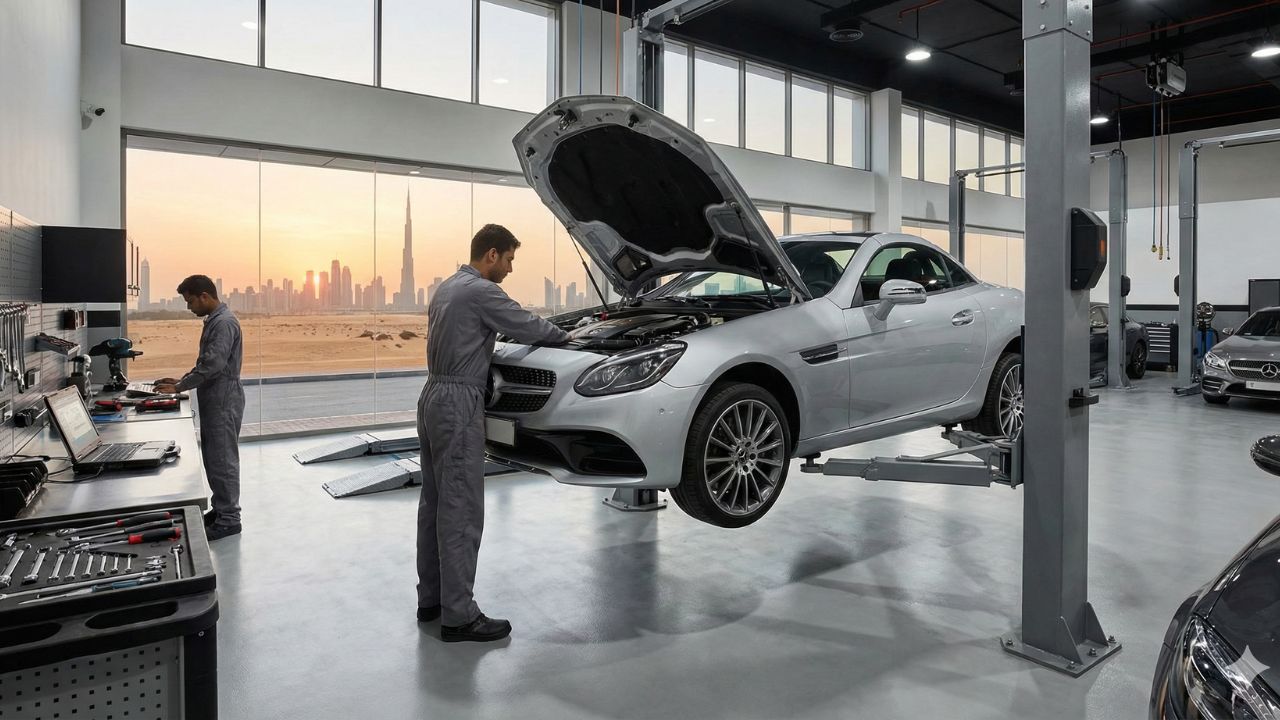
Picture this: You’re cruising down Sheikh Zayed Road at dusk, the Dubai skyline glittering like scattered diamonds, and your Mercedes-Benz SLC-Class has its retractable hardtop folded away. The wind whispers through your hair, and that legendary German engineering hums beneath you like a contented symphony. Then, without warning, a dashboard light flickers to life. Your heart sinks slightly because you know that maintaining a sophisticated roadster like the SLC-Class isn’t something you can entrust to just anyone.
The Mercedes-Benz SLC-Class (R172), produced from 2016 to 2020, represents the final evolution of the legendary SLK lineage. This isn’t merely a vehicle; it’s a technological marvel wrapped in seductive sheet metal. With its innovative Vario-roof that transforms from roadster to coupe in under twenty seconds, the SLC-Class demands a level of mechanical understanding that transcends basic automotive knowledge. Every system in this machine has been engineered to deliver precision performance, from its sophisticated direct-injection engines to its agile suspension geometry designed for spirited driving.
Dubai presents a particularly demanding environment for the SLC-Class. While this roadster was born in Stuttgart’s engineering laboratories, it must now thrive in conditions that would make those German engineers raise their eyebrows. Summer temperatures that kiss fifty degrees Celsius, fine desert sand that infiltrates every crevice, coastal humidity that challenges electrical connections, and traffic patterns that swing wildly between crawling gridlock and high-speed highway runs—these factors create a perfect storm of mechanical stress.
At Euro Car Repair, we’ve dedicated ourselves to mastering the intricacies of European luxury vehicles, with the Mercedes-Benz SLC-Class (R172) holding a special place in our expertise repertoire. Our facility doesn’t just service these roadsters; we understand them at a fundamental level that comes from years of hands-on experience with this specific generation. We recognize that the SLC-Class isn’t just another Mercedes—it’s a unique platform with distinct engineering characteristics that require specialized knowledge.
What separates us from the crowded Dubai automotive repair landscape? We’ve chosen a path that prioritizes your vehicle’s needs above everything else. Our decision to operate independently from insurance companies might seem unusual at first glance, but this choice liberates us to recommend exactly what your SLC-Class requires without external pressures or compromises. When we examine your roadster, our loyalty belongs entirely to you and your vehicle’s wellbeing.
The SLC-Class differs significantly from other Mercedes models in ways that matter tremendously during repair and maintenance. Its compact roadster architecture means tighter engine bay packaging, unique cooling requirements for the retractable hardtop mechanisms, specialized suspension components calibrated for dynamic handling, and electrical systems that manage everything from that remarkable roof to the advanced climate control. These aren’t challenges—they’re opportunities for specialists like us to demonstrate genuine expertise.
This guide will illuminate why Euro Car Repair has become the trusted destination for discerning SLC-Class owners throughout Dubai. We’ll explore the specific services your roadster requires, dive deep into common concerns that affect this model, explain our transparent approach to pricing and quality, and show you why choosing specialized independent expertise often surpasses dealership service in both value and attention to detail.
Your Mercedes-Benz SLC-Class deserves technicians who appreciate its engineering elegance. You deserve transparent communication, honest recommendations, and repairs executed with precision. Let’s explore how we deliver exactly that.
Why Choose Euro Car Repair for Your Mercedes-Benz SLC-Class (R172)
Specialized Mercedes-Benz SLC-Class (R172) Expertise
Walking into a repair facility and hearing “we work on all vehicles” might sound reassuring, but when you own an SLC-Class, that breadth actually becomes a weakness. Our technicians have invested hundreds of hours specifically studying the R172 generation, understanding its evolution from the SLK and recognizing the engineering decisions Mercedes-Benz implemented for this final roadster iteration.
Consider the SLC’s Vario-roof mechanism. This isn’t a simple convertible top—it’s an intricate ballet of synchronized motors, sensors, microswitch feedback systems, and hydraulic actuators that must coordinate flawlessly. Our team has dissected this system’s logic, traced its electrical pathways, and developed diagnostic protocols that identify issues before they cascade into expensive failures. When a generic shop sees a roof malfunction, they often resort to component replacement guesswork. We analyze fault codes with Mercedes-specific diagnostic software, test individual actuator responses, and pinpoint the exact failure point.
The SLC-Class came with multiple engine options across its production run: the SLC 180 and 200 with turbocharged four-cylinders, the SLC 300 with its refined turbo engine, and the magnificent SLC 43 AMG with its twin-turbo V6. Each powerplant has distinct characteristics, maintenance requirements, and common wear patterns. Our technicians don’t just recognize these differences—they’ve worked extensively with each variant, understanding the nuances of turbocharger oil feed systems, direct injection fuel delivery intricacies, and variable valve timing adjustments specific to these engines.
We’ve also invested in continuous training beyond initial certifications. Mercedes-Benz technology evolves rapidly, with software updates, technical service bulletins, and revised repair procedures emerging regularly. Our commitment to staying current means your SLC-Class benefits from the latest knowledge, not outdated practices that might have been adequate five years ago but fall short today.
Advanced Diagnostic Technology
Modern vehicles speak a digital language, and the SLC-Class communicates through dozens of control modules networked across multiple systems. Without the proper diagnostic equipment, a technician essentially works blind, reduced to educated guessing based on symptoms. This approach might work for simpler vehicles, but it fails miserably with sophisticated roadsters like yours.
Our diagnostic suite includes Mercedes-specific scanning equipment that interfaces directly with your SLC’s control modules, reading live data streams, freeze frame information, and fault codes with manufacturer-level depth. We’re not relying on generic OBD-II readers that provide surface-level information. Our tools communicate in the same language Mercedes engineers use, accessing proprietary data networks that reveal exactly what each system is experiencing in real-time.
Recently, an SLC 300 arrived at our facility with an intermittent check engine light that had baffled another repair shop. They had replaced the oxygen sensors based on generic fault codes, yet the problem persisted. Our diagnostic approach revealed something more nuanced: the direct injection fuel system was experiencing pressure fluctuations during specific operating conditions, triggering fuel trim adaptations that momentarily exceeded parameters. The actual culprit? A high-pressure fuel pump that was beginning to fail under heat stress—a common Dubai-climate issue that requires understanding both the vehicle’s systems and environmental factors.
This depth of diagnosis extends beyond engine management. Your SLC’s brake system includes electronic stability control, ABS coordination, and brake force distribution algorithms. When brake components wear or malfunction, the resulting symptoms can be subtle. Our diagnostic capabilities allow us to observe individual wheel speed sensor readings, brake pressure values, and control module responses under actual driving conditions, identifying problems that simpler testing methods would miss entirely.
Genuine Parts & Quality Alternatives
The parts debate in Mercedes-Benz repair often gets oversimplified into a false choice between expensive genuine parts and questionable aftermarket alternatives. Reality presents more nuanced options, and our approach prioritizes transparency about what you’re getting and why it makes sense for your specific situation.
For critical systems—engine internals, transmission components, safety-related elements, and electronic modules—we source genuine Mercedes-Benz OEM parts. These components carry the manufacturer’s engineering specifications, material quality standards, and design tolerances that ensure proper function within your SLC’s integrated systems. When we install an OEM part, you receive the same piece that would arrive at a Mercedes dealership, backed by manufacturer warranties and proven reliability.
However, the aftermarket has evolved significantly. Premium suppliers now produce certain components that meet or exceed OEM specifications, particularly for wear items like brake pads, filters, and some suspension components. When appropriate, we discuss these alternatives openly. For example, high-performance brake pad compounds from specialized manufacturers might actually outperform OEM pads for enthusiastic driving, offering better heat dissipation and more progressive pedal feel. We explain these options without pushing you toward any particular choice.
Our parts relationships also eliminate the delays that often plague dealership service. We maintain strategic supplier networks that deliver genuine and premium aftermarket components quickly, often within hours rather than days. This means your SLC-Class spends less time sitting idle and more time ready for your enjoyment.
Every part we install, regardless of source, comes with clear warranty coverage. We stand behind our work because we choose suppliers carefully, refusing to compromise quality for marginal cost savings that ultimately disappoint customers and damage our reputation.
Transparent Pricing Philosophy
Walk into most repair facilities with a European luxury vehicle, and you’ll encounter pricing that feels deliberately opaque. Estimates arrive as vague ranges, additional charges appear mysteriously during the repair process, and final invoices provoke sticker shock. We’ve built our business on the opposite approach because we believe informed customers make the best long-term partners.
Before any tool touches your SLC-Class, you receive a detailed written estimate that breaks down labor hours, parts costs, and any shop supplies. We explain what each repair entails, why it’s necessary, and what happens if you choose to defer certain services. This isn’t about pressuring you—it’s about empowering you to make decisions based on complete information.
Our pricing typically runs thirty to forty percent below Mercedes dealership rates for equivalent service quality. This difference doesn’t stem from cutting corners or using inferior parts. Instead, we avoid the overhead burden that dealerships carry: massive facilities, extensive administrative staff, corporate franchise fees, and profit expectations from parent companies. Our lean operation focuses resources where they matter most—skilled technicians, proper equipment, and quality parts.
We also eliminate hidden fees that inflate many repair bills. Our quoted labor rate includes standard shop supplies, diagnostic time gets credited toward repair work when you proceed with our recommendations, and we never charge “inspection fees” simply to look at your vehicle and tell you what it needs. You’ll never receive a surprise invoice that bears little resemblance to the estimate you approved.
For major services or unexpected repairs, we welcome questions about pricing. We’ll explain how we calculated labor times, show you parts pricing from our suppliers, and even discuss alternative approaches if you’re working within budget constraints. This open dialogue builds trust and ensures you never feel trapped or manipulated.
Customer-First Service Model
The SLC-Class attracts owners who appreciate quality, value their time, and expect professional treatment. Our service model reflects these priorities by treating each vehicle as a unique responsibility rather than another work order in a queue.
When you schedule an appointment, you speak with someone who understands Mercedes vehicles and can intelligently discuss your concerns. We gather detailed information about symptoms, driving conditions, and service history to prepare for your arrival. This pre-planning means our technicians can work efficiently when your SLC arrives, potentially diagnosing issues before you even drop off the vehicle.
Throughout the repair process, we maintain communication that respects your time while keeping you informed. If our diagnosis reveals additional concerns beyond your initial complaint, we call and explain what we’ve found before proceeding. You’ll understand not just what’s wrong, but why it matters and what consequences you might face by deferring the repair. This educational approach helps you prioritize expenditures intelligently.
We’ve also designed our scheduling around your convenience rather than our operational preferences. Early morning drop-offs, late afternoon pickups, and weekend appointments accommodate working professionals who can’t easily take time off. For situations where you simply cannot reach our facility, we offer pickup and delivery service throughout Dubai’s major areas, ensuring your SLC’s maintenance doesn’t disrupt your schedule.
Building long-term relationships matters more to us than maximizing revenue from individual transactions. We maintain detailed service records for your vehicle, proactively reminding you when scheduled maintenance approaches, and tracking your SLC’s history to identify patterns that might predict future needs. This relationship-based approach means we’re invested in your vehicle’s long-term health, not just the immediate repair.
Why We Don’t Work With Insurance
Our decision to operate independently from insurance companies puzzles some customers initially, but this policy represents one of our strongest competitive advantages. Understanding our reasoning reveals why this approach actually benefits you significantly.
Insurance company relationships create inherent conflicts of interest. When a repair shop depends on insurance approvals and referrals, they face pressure to minimize repair costs, accept lower labor rates, and sometimes compromise on parts quality to stay within insurance estimating systems. Your vehicle’s needs become secondary to maintaining good relationships with claims adjusters who control the workflow.
By refusing this dynamic, we eliminate those pressures completely. When we examine your SLC-Class and recommend repairs, those recommendations stem entirely from what the vehicle actually needs. We’re not gaming an insurance estimating system, inflating labor times to compensate for artificially low rates, or suggesting unnecessary work to hit claim thresholds. Our diagnostic conclusions and repair proposals exist in a pure space where your vehicle’s requirements drive every decision.
This independence also dramatically accelerates service delivery. Insurance approval processes inject delays at every stage—waiting for adjusters to inspect vehicles, negotiating repair methods, obtaining authorization for parts, and dealing with supplemental approvals when additional damage appears during disassembly. These delays can stretch simple repairs across weeks. Our direct-payment model means we begin work immediately upon your approval, source parts without waiting for claim adjustments, and complete repairs on schedules dictated by workflow efficiency rather than insurance bureaucracy.
For SLC-Class owners specifically, this matters tremendously. Your roadster contains sophisticated technology and premium components that require specific repair approaches. Insurance estimating systems often default to aftermarket parts, used components, or repair methods that technically address the damage but don’t restore Mercedes-Benz engineering standards. We specify proper parts and procedures without compromise, knowing you’ll appreciate the difference in long-term reliability and resale value.
The financial impact often surprises people. Without insurance middlemen extracting their margins and administrative overhead, our competitive pricing frequently approaches or even undercuts insurance deductibles for moderate repairs. You maintain complete control, avoid claim history impacts, and receive superior service quality.
Proven Track Record
Reputation in Dubai’s automotive repair industry doesn’t emerge from marketing claims—it develops through consistent delivery of quality service that generates word-of-mouth recommendations. Our track record with Mercedes-Benz SLC-Class owners spans years of successfully maintaining these roadsters through Dubai’s demanding conditions.
We measure success not through volume but through relationships. Our repeat customer rate exceeds eighty percent, meaning the vast majority of SLC owners who trust us once continue returning for all their maintenance and repair needs. These aren’t one-time transactions—they’re ongoing partnerships built on demonstrated competence and honest communication.
Customer satisfaction extends beyond simply fixing problems. It encompasses the entire experience: how we communicate technical issues in understandable language, respect your time and budget constraints, stand behind our work when questions arise, and proactively help you avoid future problems through preventive guidance. This holistic approach to service creates loyalty that transcends simple price comparisons.
Our facility has also earned recognition within Dubai’s European car enthusiast community. SLC-Class owners tend to be discerning individuals who research thoroughly before entrusting their vehicles to anyone. The fact that we’ve become a preferred destination through organic recommendations rather than aggressive marketing speaks to the quality and consistency we deliver daily.
Comprehensive Service Offerings for Your Mercedes-Benz SLC-Class (R172)
Engine Repair & Maintenance
The powerplants available in the SLC-Class represent modern Mercedes-Benz engineering at its finest, combining impressive performance with remarkable efficiency through technologies like direct fuel injection, turbocharging, and sophisticated engine management systems. These engines thrive when properly maintained but can develop issues when service intervals slip or Dubai’s extreme environment takes its toll.
The four-cylinder turbocharged engines found in the SLC 180, 200, and 300 share architectural similarities but differ in tuning and output. These M274 series engines utilize direct injection, variable valve timing, and twin-scroll turbochargers to extract impressive power from relatively small displacement. Their compact design packs considerable technology into tight engine bay spaces, making certain maintenance procedures more involved than older, simpler engines.
Common concerns with these turbocharged engines in Dubai’s climate center around heat management and oil degradation. Turbochargers generate tremendous heat during operation, and when drivers frequently shut down their engines immediately after highway driving, that heat has nowhere to dissipate. Over time, this thermal cycling can affect turbocharger bearing life and oil coking within the turbo’s oil passages. We address this through proper oil specifications, shortened change intervals suited to Dubai’s conditions, and customer education about allowing brief cool-down periods before shutting down after spirited driving.
The SLC 43 AMG’s twin-turbo V6 (M276 engine) represents a different engineering philosophy. This hand-built powerplant delivers exhilarating performance through biturbo technology and sophisticated tuning, but it demands equally sophisticated maintenance. Oil capacity is substantial, cooling system complexity increases, and component access requires more extensive disassembly for certain procedures.
Our engine maintenance services address both routine needs and complex repairs. Oil changes go beyond simple drain-and-fill procedures. We use genuine Mercedes-Benz approved synthetic oils meeting exact viscosity and specification requirements for your specific engine variant. Our technicians properly initialize the oil service indicator through diagnostic software, ensuring your vehicle’s engine management system accurately tracks service intervals.
Cooling system maintenance becomes critical in Dubai’s environment where ambient temperatures push cooling systems to their design limits. We pressure test systems to identify developing leaks before they strand you roadside, verify thermostat operation to ensure proper temperature regulation, test cooling fans and their control systems, and flush coolant according to Mercedes specifications using the correct antifreeze formulations that protect aluminum engine components.
When engine problems arise—check engine lights, unusual noises, oil leaks, or performance concerns—our diagnostic approach systematically isolates issues. We don’t guess and replace expensive components hoping to stumble onto the solution. Through strategic testing, live data analysis, and logical diagnosis, we identify root causes and recommend repairs that actually address the problem rather than just treating symptoms.
Oil leaks deserve special mention because they plague many vehicles operating in extreme heat. High temperatures cause gaskets and seals to harden and shrink, creating leakage paths that worsen over time. The SLC’s engine compartment design means even minor leaks can spread across multiple components, making leak source identification challenging. We use UV dye tracing and systematic cleaning to pinpoint exact leak origins, then execute repairs that properly seal affected areas using quality gaskets and correct installation procedures.
Transmission & Gearbox Services
The SLC-Class utilizes Mercedes-Benz’s 9G-TRONIC nine-speed automatic transmission, a sophisticated piece of engineering that delivers smooth shifts, impressive fuel efficiency, and quick responses to driving demands. This transmission represents a significant advancement over older designs, but that complexity requires understanding and proper maintenance to ensure longevity.
Unlike simpler automatic transmissions, the 9G-TRONIC employs multiple gear sets, precise hydraulic control, electronic clutch management, and adaptive learning algorithms that adjust shift patterns based on driving style. This adaptability creates wonderful driving experiences but means the transmission contains hundreds of precision components working in concert, regulated by complex valve body assemblies and electronic control modules.
Transmission fluid service sparks considerable debate in automotive circles. Mercedes-Benz initially marketed some transmissions as “filled for life,” suggesting no fluid changes needed. Real-world experience, particularly in demanding environments like Dubai, tells a different story. Transmission fluid degrades over time and miles, losing its lubrication properties and accumulating contaminants that accelerate wear. Heat accelerates this degradation exponentially.
We recommend transmission fluid service at intervals appropriate for Dubai conditions—typically every 60,000 to 80,000 kilometers depending on driving patterns. This service isn’t a simple drain-and-fill because the transmission holds significant fluid within its torque converter and valve body that won’t drain through the pan. We perform complete fluid exchanges using specialized equipment that circulates new fluid through the entire system while removing old fluid, ensuring fresh fluid reaches every component.
Equally important is using the correct specification fluid. The 9G-TRONIC requires specific automatic transmission fluid meeting Mercedes-Benz specifications. Substituting generic ATF or using incorrect specifications can cause shifting problems, clutch slippage, and accelerated wear. We source genuine Mercedes-Benz transmission fluid or approved alternatives that meet exact specifications.
Transmission problems often develop gradually. Early warning signs include delayed engagement when shifting from park to drive, harsh or delayed shifts during acceleration, unusual vibrations during gear changes, or transmission slipping momentarily under load. These symptoms shouldn’t be ignored because transmission damage often progresses rapidly once initiated. Our diagnostic capabilities allow us to read transmission control module data, observe shift quality parameters, and identify developing issues before catastrophic failure occurs.
When transmission repairs become necessary, we thoroughly diagnose the extent of damage before recommending approaches. Sometimes electronic issues—failed solenoids, sensor problems, or control module faults—create symptoms that mimic mechanical failure. Replacing an expensive transmission when an electrical component failure caused the problem represents unfortunate waste. Our systematic diagnosis prevents these misdiagnoses.
For transmissions requiring internal repair or replacement, we discuss all options transparently. Rebuilt transmissions can offer cost savings if properly executed by specialists using quality components. Remanufactured units from reputable sources provide middle-ground solutions. Genuine new transmissions deliver maximum reliability with full warranties. We explain the advantages and limitations of each approach, helping you make informed decisions based on your vehicle’s value, your budget, and your long-term ownership plans.
Brake System Services
Stopping power in the SLC-Class combines advanced materials, precise engineering, and sophisticated electronic control systems to deliver confident, fade-resistant braking that matches the roadster’s performance capabilities. Maintaining this system properly ensures both safety and the driving enjoyment that makes these vehicles special.
The SLC employs ventilated disc brakes at all four corners, with larger discs on AMG variants to handle increased performance demands. These discs work in conjunction with ABS (anti-lock braking), electronic brake force distribution, brake assist systems, and adaptive brake control that adjusts braking characteristics based on load and driving conditions. The integration of these electronic systems with mechanical components means brake service requires both traditional mechanical skills and diagnostic expertise.
Brake pad replacement intervals vary significantly based on driving patterns. Spirited driving and frequent hard braking accelerate wear dramatically compared to gentle driving styles. Dubai’s traffic patterns—combining highway speeds with sudden slowdowns—create moderate wear rates. We typically recommend brake pad inspection every 15,000 kilometers, with replacement intervals ranging between 30,000 and 50,000 kilometers depending on pad compound and driving style.
The SLC-Class benefits from premium brake pad compounds that resist fade under repeated hard braking and maintain consistent pedal feel across temperature ranges. We offer choices between OEM specifications that deliver the engineered balance Mercedes intended and performance compounds that can enhance braking response for enthusiastic driving. Each option carries specific advantages, and we discuss these based on how you actually use your roadster.
Brake disc (rotor) service extends beyond simple replacement when scoring becomes excessive. Modern braking systems are engineered as matched sets—specific disc designs work optimally with corresponding pad compounds. We measure disc thickness during every brake service, checking against minimum specifications and evaluating surface condition. Surface imperfections can often be corrected through precision machining if sufficient material remains, extending disc life and saving replacement costs.
However, Dubai’s heat creates challenges for brake discs. Extreme temperatures combined with frequent thermal cycling from hard braking can cause disc warping or develop stress cracks. These conditions mandate replacement rather than machining because compromised disc integrity creates safety risks. We never compromise on components that directly affect your safety.
Brake fluid service might seem like a minor detail, but it profoundly affects system performance and longevity. Brake fluid is hygroscopic—it absorbs moisture from the atmosphere over time. As water content increases, the fluid’s boiling point drops dramatically. Under hard braking, particularly in Dubai’s heat, contaminated brake fluid can boil, creating vapor bubbles that make your brake pedal feel spongy and reduce braking force significantly.
We recommend brake fluid replacement every two years regardless of mileage, using genuine Mercedes-Benz brake fluid meeting DOT 4 specifications. This interval prevents moisture accumulation and ensures consistent brake system performance. The procedure includes bleeding all brake circuits to remove old fluid completely and eliminate any trapped air that might affect pedal feel.
Electronic brake system components require specialized diagnostic attention. Wheel speed sensors, brake pressure sensors, ABS control modules, and hydraulic pump assemblies all contribute to modern braking performance. When electronic components fail, symptoms can range from illuminated dashboard warnings to altered brake pedal feel or unexpected ABS activation. Our Mercedes-specific diagnostic tools read system fault codes and allow component testing that identifies failures precisely.
Air Conditioning & Climate Control
Dubai’s relentless heat transforms air conditioning from a luxury feature into an absolute necessity. The SLC-Class climate control system faces extraordinary demands in this environment, working overtime to maintain cabin comfort when external temperatures approach levels that would overwhelm lesser systems.
The SLC’s air conditioning architecture differs from typical sedans due to its roadster configuration. With a retractable hardtop and compact cabin volume, the system must cool efficiently while accommodating significant temperature fluctuations when transitioning between top-up and top-down driving. Mercedes engineered the AC system with additional capacity to handle these demands, but that engineering excellence requires proper maintenance to sustain performance.
AC compressor health becomes critical in Dubai’s climate. The compressor serves as the system’s heart, compressing refrigerant to create the cooling cycle. Running continuously under high ambient temperatures subjects the compressor to tremendous stress. Internal components wear, seals age and leak, and bearing surfaces degrade over time. Early symptoms include unusual noises when the AC operates, reduced cooling performance during extreme heat, or intermittent operation that suggests electrical control issues.
Compressor replacement represents one of the more significant AC repairs, but addressing failing compressors promptly prevents secondary damage. When compressors fail catastrophically, metal debris circulates through the entire system, contaminating components and necessitating extensive replacement beyond just the compressor itself. We monitor compressor condition during routine services, identifying developing problems before they cascade into larger expenses.
Refrigerant specifications matter tremendously. The SLC-Class uses R134a refrigerant in most production years, though later variants might utilize newer refrigerant types. Using incorrect refrigerant or mixing types creates system inefficiencies and potential component damage. We verify refrigerant types, ensure proper charge quantities, and never compromise with substitute refrigerants that might save costs but create long-term problems.
Refrigerant leaks develop in various system locations—evaporator cores, condenser units, O-ring seals at hose connections, and occasionally through compressor shaft seals. Identifying leak locations requires specialized equipment because refrigerant is invisible and dissipates quickly when released. We use electronic leak detectors and UV dye tracing to pinpoint leak sources, then execute repairs that properly seal the system rather than simply adding refrigerant that will leak out again.
The evaporator core presents a particular concern in Dubai’s dusty, humid environment. Located inside the dashboard, the evaporator cools air passing across its fins while condensing humidity from that air. This moisture collects on the evaporator surface and should drain from the vehicle. However, dust particles mix with this moisture, creating a biological growth environment that can develop musty odors. We recommend annual evaporator cleaning treatments that sanitize surfaces and restore fresh air quality.
Cabin air filtration plays an often-overlooked role in climate control performance and occupant comfort. The SLC’s cabin air filter prevents dust, pollen, and contaminants from entering the ventilation system. Dubai’s dusty conditions rapidly load these filters, reducing airflow and forcing the climate control system to work harder. We recommend cabin filter replacement every 10,000 to 15,000 kilometers in Dubai conditions—more frequently than Mercedes standard intervals but appropriate for our environment.
AC condenser damage represents another Dubai-specific concern. Located ahead of the radiator, the condenser releases heat from compressed refrigerant. Road debris, stone impacts, and corrosion from coastal environments can damage condenser fins or create puncture leaks. Unlike evaporator replacement which requires extensive dashboard disassembly, condenser access is simpler, making replacement less labor-intensive when damage occurs.
Climate control electronics add another layer of complexity. The SLC features automatic climate control that adjusts fan speed, temperature blend, and air distribution based on interior and exterior temperature sensors, sun load sensors, and occupant settings. When electronic components fail—blend door actuators, temperature sensors, control modules—symptoms include incorrect temperature output, unusual noises from the dashboard, or loss of certain modes like defrost or floor heating. Our diagnostic capabilities extend to these electronic systems, identifying control issues that might otherwise be misdiagnosed as core AC problems.
Suspension & Steering
The SLC-Class delivers the agile, connected handling that makes roadsters so rewarding to drive. This dynamic capability stems from precisely engineered suspension geometry, carefully tuned spring and damper rates, and quick-ratio steering designed for enthusiastic driving. Maintaining these systems preserves both the driving pleasure and the safety margins that make the SLC such a capable performer.
Mercedes fitted the SLC with an independent suspension at all four corners—multi-link designs that control wheel movement precisely while maintaining tire contact through corners and over road imperfections. This sophistication creates wonderful handling but means more components and pivot points that require maintenance as mileage accumulates.
Suspension component wear in Dubai follows predictable patterns influenced by road conditions, heat, and driving styles. Front suspension components typically wear faster due to steering forces and greater weight bias. Control arm bushings, particularly the lower control arm bushings, develop deterioration as rubber compounds harden in heat and degrade from ozone exposure. Early symptoms include imprecise steering response, unusual tire wear patterns, or subtle clunking noises over bumps.
Shock absorbers (dampers in technical terminology) control spring oscillations and maintain tire contact with road surfaces. The SLC’s dampers are engineered for sporty handling with controlled body motions during cornering and braking. As dampers wear internally, that control degrades. You might notice excessive body roll in corners, nosedive during braking, or a generally floaty ride quality that feels disconnected from the road. Because damper wear occurs gradually over thousands of kilometers, many drivers don’t recognize the degradation until replacement restores the original handling precision.
We assess suspension condition through multiple evaluation methods. Visual inspection reveals obvious damage, fluid leaks from worn dampers, torn bushings, and loose components. Physical testing includes evaluating play in ball joints and tie rod ends, checking bushing condition, and bounce testing to assess damper function. For subtle problems, test drive evaluation by experienced technicians can identify handling abnormalities that suggest developing issues.
Steering system maintenance in the SLC-Class encompasses both mechanical and electronic elements. The vehicle uses electric power steering rather than traditional hydraulic systems, eliminating power steering fluid maintenance but introducing electronic complexity. The electric steering motor, control module, and torque sensors all contribute to steering feel and assist characteristics. When electronic steering components fail, symptoms range from heavy steering effort to complete loss of power assist and illuminated warning lights.
Alignment specifications deserve careful attention because the SLC’s suspension geometry was calibrated for specific alignment parameters that optimize tire wear and handling characteristics. Dubai’s roads—with expansion joints, potholes, and sudden elevation changes—can alter alignment settings over time. We recommend alignment checks annually or after any suspension component replacement, using Mercedes-specific alignment specifications rather than generic settings.
Tire wear patterns often reveal suspension or alignment problems before you notice handling changes. Inside or outside shoulder wear suggests camber misalignment. Feathering across tread blocks indicates toe misalignment. Cupping or scalloping points toward damper wear or out-of-balance wheels. During every service, we inspect tire wear patterns as diagnostic indicators, catching developing problems early.
The SLC’s ride height and suspension geometry make it particularly vulnerable to underside impacts that might not affect higher-riding vehicles. Parking stops, steep driveways, and speed bumps can contact suspension components or undercarriage panels if approached without care. We’ve repaired damage from impacts that surprised owners who didn’t realize their approach angle exceeded the roadster’s ground clearance. Preventive awareness saves expensive repairs.
Electrical System Diagnostics
Modern luxury vehicles like the SLC-Class contain more computing power than early spacecraft, with dozens of electronic control modules managing everything from engine performance to climate control, from safety systems to entertainment features. This electronic sophistication delivers the comfort and performance Mercedes-Benz owners expect, but it also creates diagnostic challenges when problems arise.
The SLC’s electrical architecture follows a networked design where control modules communicate across data buses, sharing information and coordinating functions. When one module experiences issues, the symptoms might appear in seemingly unrelated systems because of these interconnected relationships. Traditional diagnostic approaches that isolate individual circuits often fail with modern vehicles—successful diagnosis requires understanding system integration and data communication.
Battery health affects far more than just starting reliability in vehicles with extensive electronics. The SLC requires stable electrical supply with specific voltage characteristics to keep control modules functioning properly. As batteries age, their ability to maintain consistent voltage degrades, particularly under heavy electrical loads or during hot weather that accelerates chemical degradation. Weak batteries create voltage fluctuations that can cause bizarre electrical symptoms—intermittent warning lights, erratic gauge behavior, random system resets.
Battery replacement in the SLC-Class isn’t as simple as disconnecting cables and bolting in a new battery. The vehicle’s electrical system must be properly initialized to recognize the new battery and adjust charging algorithms accordingly. Without this initialization procedure, the alternator might overcharge or undercharge the new battery, reducing its service life significantly. Our diagnostic equipment performs this initialization correctly, ensuring the electrical system adapts to the new battery.
Mercedes electrical systems also employ “sleep mode” protocols that shut down non-essential systems when the vehicle is parked to prevent battery drain. Faulty modules or component problems can prevent proper sleep, creating parasitic drain that depletes the battery overnight. Diagnosing parasitic drain requires systematic current draw testing across electrical circuits to identify which system is remaining active. We’ve identified drain issues from malfunctioning convenience modules, faulty door lock actuators maintaining current draw, and even aftermarket accessories installed without proper relay controls.
Sensor failures represent common electrical problems that affect various systems. Oxygen sensors, mass airflow sensors, camshaft position sensors, wheel speed sensors, tire pressure sensors—modern vehicles employ dozens of sensors feeding data to control modules. When sensors fail or report incorrect data, the results range from check engine lights to degraded performance, from climate control malfunctions to safety system warnings.
Our diagnostic approach to electrical problems follows systematic methodology rather than random component replacement. We read fault codes from all relevant control modules, analyze live data to verify sensor readings match expected values, perform activation tests to confirm modules can control their outputs, and trace wiring when circuit integrity becomes suspect. This systematic process identifies root causes efficiently, minimizing diagnostic time and preventing unnecessary parts replacement.
Fluid Leak Detection & Repair
The SLC-Class contains numerous fluid systems—engine oil, coolant, transmission fluid, brake fluid, power steering fluid (in early models), differential oil, and refrigerant in the AC system. Leaks from any of these systems can create problems ranging from minor annoyances to catastrophic mechanical failure if left unaddressed.
Oil leaks particularly plague vehicles operating in extreme heat because high temperatures accelerate gasket degradation and cause seals to shrink and harden. The SLC’s engine bay contains numerous potential leak points: valve cover gaskets, oil pan gaskets, front and rear crankshaft seals, oil cooler seals, turbocharger oil feed and return lines. Identifying the exact leak source becomes challenging because oil spreads across components due to engine vibration and airflow, making the visible leak location different from the actual source.
Our leak detection process begins with thorough cleaning to remove old oil residue that obscures leak origins. For persistent or intermittent leaks, we inject UV fluorescent dye into the engine oil, then operate the engine and inspect with UV light to trace the leak path back to its source. This technique reveals even minor leaks that might not be visible through conventional inspection.
Coolant leaks demand immediate attention because overheating can destroy engines rapidly. The SLC’s cooling system operates under pressure with multiple connections, hoses, and heat exchangers that can develop leaks. Water pump seals, radiator end tanks, heater core connections, and thermostat housing gaskets all represent potential failure points. Coolant leaks sometimes manifest as sweet smells from the vents, mysterious coolant loss without visible leaks (internal combustion chamber leaks), or steam from under the hood.
We pressure test cooling systems to identify leaks that might not be apparent during normal operation. This testing reveals marginal connections and developing seal failures before they strand you with an overheated engine. For internal leaks where coolant enters the combustion chamber, we perform combustion gas testing on coolant samples, identifying cylinder pressure contamination that indicates head gasket or other internal sealing failures.
Preventive measures for Dubai’s climate include regular inspection of hoses and connections, cooling system pressure testing during routine maintenance, and proactive replacement of components showing age deterioration before they fail at inconvenient times. This preventive mindset saves the expense and hassle of breakdown-related repairs.
Additional Specialized Services
Beyond core mechanical systems, we provide comprehensive services that address all aspects of SLC-Class ownership and maintenance.
Tire replacement involves more than simply mounting new rubber. The SLC’s tire pressure monitoring system (TPMS) uses sensors in each wheel that must be properly programmed to communicate with the vehicle’s receiver module. When installing new tires or replacing TPMS sensors, we perform the initialization procedures that link sensors to the vehicle, ensuring accurate pressure monitoring and preventing dashboard warning lights.
Tire selection for Dubai conditions requires balancing multiple factors. Summer performance tires deliver maximum grip but wear rapidly in extreme heat. Touring tires offer longer tread life and potentially better heat resistance but might sacrifice some handling precision. We discuss these tradeoffs based on your driving priorities and provide recommendations from reputable tire manufacturers whose products we’ve proven through experience.
The SLC’s retractable hardtop represents one of its most distinctive features and occasionally requires maintenance or repair. The Vario-roof mechanism includes multiple motors, a complex linkage assembly, microswitch safety systems, and hydraulic components working in precise sequence. Common issues include slow roof operation, unusual noises during movement, or complete failure to operate. We’ve developed expertise in diagnosing these systems, whether the problem stems from mechanical binding, electrical component failure, or hydraulic pressure loss.
Sunroof drains deserve attention in Dubai’s occasional heavy rains. The SLC’s roof design includes drain channels that route water away from the cabin. These drains can clog with debris, causing water to overflow into the interior when it rains. We inspect and clear drain tubes during services, preventing water damage to interior components and electronics.
Paint and scratch repair maintains your SLC’s appearance and protects against corrosion. Dubai’s environment accelerates paint degradation through intense UV exposure, sand abrasion, and occasional salt exposure from coastal areas. We offer paint correction services ranging from minor scratch repair to comprehensive detailing that restores finish quality.
Pre-purchase inspections provide invaluable protection for buyers considering used SLC-Class vehicles. These roadsters contain sufficient complexity that apparent condition can mask developing problems. Our thorough pre-purchase evaluation includes comprehensive testing of all systems, diagnostic scanning for stored fault codes, suspension and undercarriage inspection, assessment of service history and maintenance condition, and test drive evaluation by experienced technicians. The modest inspection cost often saves thousands by revealing problems before purchase or providing negotiating leverage on pricing.
Scheduled maintenance packages offer convenience and value for owners who prefer comprehensive service planning. We create custom maintenance schedules based on your driving patterns and Dubai’s demanding conditions, bundling services at package pricing that saves money compared to individual service appointments. These packages ensure your SLC receives consistent, appropriate care that maintains its performance and reliability.
Common Mercedes-Benz SLC-Class (R172) Problems We Solve
Vario-Roof Operation Failures
The SLC’s signature retractable hardtop occasionally develops operational issues that prevent the roof from opening, closing, or completing its transformation sequence. The Vario-roof system contains approximately two dozen individual sensors and microswitches that verify proper positioning before allowing movement to the next sequence step. This safety design prevents damage but means even minor misalignments can halt operation.
Common causes include trunk latch sensors failing to confirm the trunk is properly closed, door lock microswitches not verifying both doors are secured, or roof position sensors providing conflicting data to the control module. Dubai’s heat and dust can cause sensor connections to corrode or accumulate debris that affects operation.
Our diagnostic process reads fault codes from the roof control module, tests individual sensor responses, and verifies electrical continuity throughout the control circuits. Often, the solution involves cleaning sensor contacts, adjusting mechanical components to proper specifications, or replacing individual sensors rather than expensive assemblies. We also verify hydraulic system pressure because insufficient hydraulic pressure prevents motors from generating the force needed to move the heavy roof structure.
Prevention involves periodic roof operation throughout the year, even if you rarely lower the top. Extended periods without operation can cause components to stick or lubrication to deteriorate. We also recommend keeping the roof mechanism clean and ensuring trunk compartments remain clear of items that might obstruct movement.
Turbocharger Oil Leaks and Failure
The turbocharged engines in most SLC-Class variants deliver impressive performance through forced induction, but turbochargers operating in Dubai’s heat face considerable stress. Oil leaks from turbocharger seals represent a common issue, particularly in vehicles that see frequent short trips or immediate shutdown after hard driving.
Turbochargers spin at extraordinary speeds—over 100,000 RPM—with internal bearings relying on pressurized oil for lubrication and cooling. When engines shut down immediately after high-speed driving, that oil supply stops while the turbocharger housing remains extraordinarily hot. This heat can cook the remaining oil within the turbo’s center section, creating carbon deposits that damage bearings and seals over time.
Symptoms of turbocharger problems include blue smoke from the exhaust indicating oil burning, loss of power during acceleration, unusual whistling or whining noises from the engine compartment, or excessive oil consumption. We diagnose turbocharger issues through boost pressure testing, inspection of intake and exhaust components for oil contamination, and listening for bearing noise with specialized tools.
Prevention focuses on proper oil maintenance using quality synthetic oils meeting Mercedes specifications and allowing brief cool-down periods after hard driving before shutting down the engine. When turbocharger replacement becomes necessary, we also inspect and address any underlying issues that contributed to the failure, such as oil supply restrictions or contamination that would damage the replacement unit.
Direct Injection Carbon Buildup
The direct injection fuel systems in SLC engines deliver impressive efficiency and performance but create a specific maintenance challenge unknown in older port-injection engines. Direct injection sprays fuel directly into combustion chambers rather than into intake ports. This means fuel never washes across intake valve surfaces, allowing carbon deposits to accumulate over time.
These carbon deposits gradually restrict airflow into cylinders, reducing engine performance, causing rough idle, creating hesitation during acceleration, or triggering check engine lights related to fuel trim or misfire. The problem develops slowly over tens of thousands of kilometers, so many owners don’t recognize the gradual performance degradation until service restores original responsiveness.
Addressing carbon buildup requires specialized cleaning procedures. We use chemical treatments introduced through the intake system to dissolve deposits, sometimes combined with mechanical cleaning methods for heavy accumulation. Prevention involves periodic cleaning services at intervals appropriate for Dubai driving conditions—typically every 40,000 to 60,000 kilometers depending on driving patterns.
Air Conditioning Weak Performance
Given Dubai’s climate, diminished AC cooling performance represents one of the most frustrating problems SLC owners encounter. Multiple factors can contribute to insufficient cooling: low refrigerant charge from system leaks, compressor wear reducing cooling capacity, condenser blockage or damage reducing heat rejection, evaporator contamination affecting heat absorption, or cooling fan failures preventing adequate airflow through heat exchangers.
Diagnosis requires systematic testing. We measure vent temperatures, monitor compressor clutch operation, verify proper refrigerant pressures in both high and low pressure sides of the system, check cooling fan operation under various load conditions, and inspect heat exchangers for damage or blockage.
Sometimes the problem isn’t mechanical but rather related to sun load and heat soak. The SLC’s compact cabin and extensive glass area create significant solar heat gain. Black interior vehicles parked in Dubai sun can reach interior temperatures exceeding 80 degrees Celsius. Even perfectly functioning AC systems need time to overcome this heat load. We educate owners about realistic expectations and techniques like ventilating the cabin before starting AC operation.
Suspension Knocking Noises
Unusual noises from the suspension—clunks, knocks, or rattles over bumps—concern owners and sometimes indicate developing component wear. The SLC’s multi-link suspension contains numerous pivot points with rubber bushings that deteriorate in heat. Control arm bushings, sway bar links, shock absorber mounts, and subframe bushings all represent potential noise sources.
Diagnosis requires systematic testing. We perform detailed suspension inspection with the vehicle raised, checking each component for excess play, torn bushings, or loose hardware. Road testing over various surface conditions helps locate noise sources that might not be apparent during stationary inspection.
Many suspension noises stem from relatively minor components—sway bar links, for example, often fail first because they experience significant movement during cornering. Replacing failed components promptly prevents accelerated wear in other suspension parts that must compensate for the failed component’s lack of control.
Electrical Gremlins and Warning Lights
Modern Mercedes electrical systems occasionally develop intermittent problems that frustrate owners—warning lights that illuminate randomly, features that work inconsistently, or unexplained system resets. These issues often stem from corroded connections, failing control modules, or software conflicts rather than major component failures.
Dubai’s coastal humidity accelerates electrical connection corrosion, particularly in areas where water might intrude—door jamb connectors, underhood junction boxes, and ground point connections. We’ve resolved countless “mysterious” electrical problems by simply cleaning corroded connections and applying protective treatments.
Software updates also address known issues that Mercedes engineers identify after production. We maintain access to current software versions and technical service bulletins that guide us toward solutions for recurring electrical anomalies specific to the SLC-Class.
Brake Judder and Vibration
Steering wheel vibration during braking suggests brake disc (rotor) problems—warping from heat cycling, thickness variation from uneven wear, or improper installation creating runout. The SLC’s performance-oriented braking system generates substantial heat, and Dubai temperatures exacerbate thermal stress on brake components.
Addressing brake judder requires measuring disc thickness at multiple points, checking for lateral runout, and assessing surface condition. Sometimes machining can restore smooth surfaces if sufficient material remains. Other situations demand disc replacement, particularly when heat stress has created crystallization or cracking that machining cannot address.
Proper bedding procedures after brake service prevent premature judder recurrence. New pads and discs require gradual heat cycling to transfer pad material evenly across disc surfaces, creating the friction interface that enables effective braking without vibration.
Coolant Loss Without Visible Leaks
Owners sometimes report mysterious coolant loss—the overflow reservoir level drops steadily, yet no puddles appear under the vehicle and no steam erupts from the hood. This pattern often indicates internal coolant leaks where coolant enters the combustion chamber through head gasket or cylinder head failures and exits through the exhaust as steam.
We diagnose internal coolant leaks through combustion gas testing, which identifies cylinder pressure gases contaminating the cooling system. Pressure testing also reveals patterns consistent with internal leaks—pressure that continues building beyond the cap’s release point or pressure that develops without the engine running as combustion gases force their way into the cooling system.
Internal coolant leaks demand prompt attention because continued operation can cause severe engine damage. Coolant entering combustion chambers dilutes engine oil, compromising lubrication. Overheating from coolant loss can warp cylinder heads or damage head gaskets further, cascading into major engine repairs.
Our Expert Technicians
Technical expertise separates adequate repair shops from exceptional ones. At Euro Car Repair, our technician team represents our greatest competitive advantage—highly trained specialists who combine formal education with extensive hands-on experience specifically in European luxury vehicles like your Mercedes-Benz SLC-Class.
We invest heavily in technician development because automotive technology evolves constantly. The Mercedes-Benz you drive today contains engineering that didn’t exist a decade ago. Maintaining competence requires continuous learning, not resting on certifications earned years past. Our technicians attend regular training sessions covering new technologies, diagnostic techniques, and repair procedures specific to Mercedes-Benz vehicles.
This specialized knowledge extends beyond generic automotive repair skills. Understanding how to rebuild a carburetor doesn’t help diagnose a turbocharged direct-injection engine management system. Knowing traditional brake systems doesn’t prepare someone for electronic brake control integration. The SLC-Class demands specialists who understand its specific engineering rather than generalists applying broad knowledge.
Our hiring process prioritizes both aptitude and experience. We seek technicians with proven Mercedes-Benz backgrounds who demonstrate diagnostic thinking rather than parts-replacement approaches. During interviews, we present real-world diagnostic scenarios specific to vehicles like the SLC-Class, evaluating problem-solving methodology rather than memorized facts. This reveals whether candidates actually understand automotive systems or simply follow cookbook procedures.
Certification provides baseline competence verification, but we value continuous professional development more highly than credentials alone. Our technicians maintain industry certifications while also participating in specialized training programs that go beyond certification requirements. This includes Mercedes-specific coursework, advanced diagnostic training, and specialized programs for technologies like hybrid systems and electric vehicles that will become increasingly relevant.
Hands-on experience with the SLC-Class specifically sets our team apart from technicians who might work on various Mercedes models occasionally. We’ve disassembled these systems, diagnosed their common failures, and developed efficient repair procedures through repetition. This familiarity creates efficiency—our technicians recognize patterns, anticipate complications, and work with confidence that reduces diagnostic time and prevents comebacks from incomplete repairs.
Diagnostic expertise particularly separates our technicians from typical mechanics. Modern vehicles present complex symptoms that require systematic analysis rather than intuitive guessing. Our team follows logical diagnostic processes: gathering comprehensive symptom descriptions from customers, performing thorough initial inspections, using diagnostic equipment to gather data, forming hypotheses about failure causes, testing those hypotheses systematically, and recommending repairs that address root causes rather than treating symptoms.
Customer communication skills complement technical ability. Explaining complex technical problems in understandable terms without condescension or oversimplification requires thoughtfulness. Our technicians excel at translating diagnostic findings into language that empowers you to make informed decisions. They answer questions patiently, explain why certain repairs make sense, and help prioritize when multiple issues exist.
Quality control processes ensure consistent results across all repairs. After completing work, our technicians perform final checks verifying that repairs addressed the original concern, no new problems were introduced, all components were properly installed, and the vehicle operates as intended. We maintain documentation of all procedures performed, creating service records that benefit both ongoing maintenance and resale value.
Dubai’s Unique Challenges for Your Mercedes-Benz SLC-Class
Dubai’s environment creates a perfect storm of automotive stress factors that accelerate wear and create problems rarely seen in moderate climates. Understanding these unique challenges helps explain why Dubai-specific maintenance approaches deliver better results than following standard service intervals developed for global markets.
Extreme heat dominates the list of environmental stressors. Summer temperatures routinely exceed fifty degrees Celsius, with surfaces exposed to direct sun reaching even higher temperatures. Your SLC-Class parks under this assault, with its black leather seats absorbing heat, plastic dashboard components expanding, and rubber seals deteriorating from UV exposure and thermal cycling.
Mechanical systems suffer equally. Engine oil subjected to these temperatures breaks down faster, losing its lubricating properties more rapidly than in moderate climates. Coolant faces greater stress trying to maintain proper engine temperatures when ambient air provides little cooling assistance. Brake fluid absorbs moisture faster in humid coastal areas, reducing its boiling point just when hot weather makes boiling more likely. Transmission fluid degrades under heat stress, particularly when stuck in traffic where cooling airflow disappears.
Sand and dust infiltration affects virtually every system on your SLC. Despite sophisticated air filtration, fine desert dust finds its way into air intake systems, loading filters and potentially abrading sensitive mass airflow sensors. The cabin air filter clogs rapidly, reducing HVAC performance and forcing the system to work harder. Dust accumulates on cooling system heat exchangers—radiators, AC condensers, intercoolers—reducing their efficiency precisely when maximum cooling capability is needed.
We’ve also observed dust infiltration into unexpected areas: headlight assemblies developing haze from dust accumulation inside sealed housings, engine compartment electronics showing dust contamination that affects connections, and even brake dust combining with environmental dust to create paste-like accumulations that affect caliper slider operation.
Coastal humidity creates additional challenges despite Dubai’s desert location. The combination of salty sea air and moisture accelerates corrosion on electrical connections, brake components, exhaust systems, and underbody parts. This corrosion appears faster than in dry desert environments or humid but non-coastal locations. We frequently discover corroded electrical connections in vehicles that look pristine externally, the hidden damage caused by salt-laden humidity infiltrating connection points.
Traffic patterns in Dubai contribute to unique wear characteristics. The city’s rapid growth created road networks that regularly experience congestion, particularly during peak hours and on major routes like Sheikh Zayed Road. This stop-and-go traffic prevents engines from reaching stable operating temperatures, subjects brake systems to repeated heat cycles, and creates transmission wear from constant shifting between low gears.
Conversely, highway speeds during off-peak hours subject engines to sustained high-load operation in extreme heat. Turbocharged engines running at high boost pressures in fifty-degree ambient temperatures create tremendous heat that stresses cooling systems, turbochargers, and oil. This combination—harsh stop-and-go alternating with high-speed cruising, all in extreme heat—creates wear patterns different from either pure city driving or pure highway operation in moderate climates.
Parking environments dramatically affect vehicle condition. Covered parking protects vehicles from direct sun exposure, reducing interior heat soak and UV degradation of exterior surfaces. Vehicles parked outdoors face the full assault of desert sun, with paint oxidizing faster, rubber components deteriorating more rapidly, and interior surfaces suffering accelerated aging. The temperature difference between covered and outdoor parking easily exceeds twenty degrees, translating directly to reduced component stress.
Our Dubai-specific service approach addresses these challenges through modified maintenance intervals and targeted preventive measures. We recommend more frequent oil changes than Mercedes standard intervals—typically every 10,000 kilometers rather than 15,000—because oil degrades faster in this climate. Air filter replacement occurs at shorter intervals to prevent engine damage from loaded filters restricting airflow. Coolant condition gets verified during every service because cooling system failures in Dubai heat can destroy engines rapidly.
We also focus on preventive inspection of heat-vulnerable components: cooling system hoses that might show internal degradation before external symptoms appear, rubber suspension bushings developing cracks from UV exposure and heat cycling, electrical connections showing early corrosion before complete failure occurs. This preventive mindset catches problems early when repairs remain simple and affordable rather than waiting for catastrophic failures that cost exponentially more.
Seasonal service recommendations acknowledge the intensity of Dubai’s summer months. Before summer arrives, we suggest comprehensive cooling system service, AC system performance verification, and battery health testing. These proactive measures prevent summer breakdowns when intense heat pushes marginal components past their limits. Similarly, before winter when temperatures moderate slightly, we recommend addressing deferred maintenance items while weather conditions make working conditions better for both vehicles and technicians.
Pricing & Value Proposition
Transparency in pricing builds trust and eliminates the anxiety many customers feel when seeking automotive repairs, particularly for European luxury vehicles with reputations for expensive service. We believe you deserve to understand what you’re paying for and why the investment makes sense.
Our pricing structure reflects several fundamental principles. First, we refuse to sacrifice quality to achieve the lowest possible price. Rock-bottom pricing typically indicates compromises—inferior parts, inexperienced technicians, rushed work, or corners cut in ways that create future problems. We price services to allow adequate time for proper work, use quality components, and compensate skilled technicians appropriately. This approach delivers value through longevity and reliability rather than temporary cost savings.
Compared to Mercedes-Benz dealerships, our pricing typically runs thirty to forty percent lower for equivalent service quality. This differential doesn’t stem from inferior work or parts—it reflects our lean operational model. We don’t carry dealership overhead: massive facilities designed more for showroom impression than service efficiency, extensive administrative staff managing franchise requirements, brand-mandated facility standards that drive costs regardless of actual necessity, and profit expectations from parent corporations.
Instead, we’ve built our operation around service excellence. Our facility provides everything necessary for proper Mercedes-Benz repair without expensive features that primarily enhance atmosphere rather than repair quality. This efficiency translates directly to pricing that delivers better value—you’re not subsidizing showroom marble floors or elaborate customer lounges.
Our estimate process begins before you authorize any work. When you describe symptoms or request specific services, we provide detailed written estimates breaking down labor hours at our published hourly rate, parts costs showing both OEM and quality aftermarket options where applicable, any shop supplies or miscellaneous charges, and the total expected investment. This transparency allows you to make informed decisions without pressure.
We also explain the reasoning behind our recommendations. When diagnostics reveal multiple issues, we discuss which repairs address safety concerns requiring immediate attention, which prevent further damage if addressed promptly, and which could reasonably be deferred without significant risk. This prioritization helps you allocate resources effectively, addressing critical needs within budget constraints rather than feeling forced into unnecessary immediate expenditure.
Package deals and maintenance programs offer additional value for owners who prefer comprehensive care. We bundle common service items—oil changes, filter replacements, fluid services, inspections—at package pricing that saves money compared to individual service appointments. These packages ensure your SLC receives appropriate care at proper intervals while simplifying budgeting through predictable costs.
Our no-hidden-fees policy means the estimate you approve matches the final invoice you receive, except when we discover additional problems during work and contact you for approval before proceeding. Labor rates include shop supplies—the rags, cleaners, and miscellaneous items many shops charge separately. Diagnostic time gets credited toward repair work when you approve our recommendations. We don’t charge “vehicle inspection fees” simply to look at your car and tell you what it needs.
When unexpected issues arise during repairs—a fairly common occurrence when working on complex vehicles—we contact you immediately to discuss findings, explain implications, and provide pricing for addressing the additional problems. You make the decision about how to proceed with complete information. We never simply perform additional work and surprise you with expanded invoices.
Long-term cost savings often exceed the immediate price differences between service options. Using quality parts and proper repair procedures prevents comebacks and premature failures that seem like savings initially but cost more over time. A cheap repair that fails within months costs more than a proper repair that lasts years. We educate customers about this total-cost perspective, helping you understand why initial price shouldn’t be the only consideration.
Payment flexibility accommodates different customer preferences. We accept multiple payment methods, discuss financing options for major unexpected repairs, and work with you to schedule extensive repairs in phases if budget constraints make addressing everything simultaneously difficult. Our goal is maintaining your SLC’s health, and we’d rather work with you on scheduling and payment than see necessary repairs deferred until problems worsen.
Finally, we provide detailed service records documenting all work performed, parts installed, and maintenance completed. These records support resale value when you eventually sell your SLC-Class because prospective buyers value comprehensive service history from reputable specialists. The documentation also helps us maintain your vehicle more effectively, tracking maintenance intervals and identifying patterns that might predict future needs.
Customer Experience & Convenience
Superior technical work means little if the overall service experience creates frustration, wastes your time, or fails to communicate effectively. We’ve designed our customer experience around principles that respect your schedule, keep you informed, and make the repair process as painless as possible.
Scheduling appointments should be simple and accommodating rather than challenging and restrictive. We offer extended hours that work around professional schedules, including early morning drop-offs for customers heading to work and late afternoon pickups for those who can’t leave work mid-day. Weekend appointments accommodate those whose weekday schedules make service visits impossible.
Our online scheduling system allows appointment booking at your convenience without phone tag during business hours. Simply select your preferred time, describe the service needed or symptoms experienced, and receive confirmation. For customers who prefer speaking with someone, our knowledgeable service advisors discuss your concerns, gather detailed symptom information, and schedule appointments that allow adequate time for proper diagnosis and repair.
We also offer pickup and delivery service throughout Dubai’s major areas. If bringing your SLC to our facility creates scheduling complications, we’ll collect it from your location at a time that works for you, perform the necessary service, and return it when completed. This convenience eliminates service-related schedule disruption while ensuring your roadster receives the care it requires.
Our facility provides comfortable waiting amenities for customers who prefer staying during service. Clean, air-conditioned space with wifi connectivity, refreshments, and a professional environment allows you to work remotely or simply relax while your vehicle receives attention. However, we recognize that watching repairs rarely represents the best use of your time, so we encourage taking advantage of our pickup service or using our convenient location near Dubai Marina to handle other tasks while we work.
Communication throughout the repair process keeps you informed without overwhelming you with unnecessary updates. After initial diagnosis, we contact you with detailed findings and recommendations. If additional issues appear during work, you hear from us before we proceed. As repairs progress, we’re available to answer questions and provide status updates. When work completes, we review everything performed and answer any concerns before you collect your vehicle.
We’ve also implemented digital service records that provide permanent documentation of all maintenance and repairs performed. You receive detailed invoices showing parts installed, labor performed, and recommendations for future service. These records sync across appointments, creating comprehensive service history that supports your vehicle’s value and helps us track maintenance intervals.
Our warranty on repairs demonstrates confidence in our work quality. We stand behind both parts and labor, addressing any issues that arise from our service promptly and professionally. This commitment means you’re not gambling on repairs—if something goes wrong related to our work, we make it right at no additional charge.
After-service support extends beyond simply finishing repairs and moving to the next customer. We follow up to ensure repairs addressed your concerns completely, answer questions that might arise after you’ve driven the vehicle, and remain available if any issues develop. This ongoing relationship approach means you’re working with service partners invested in your long-term satisfaction rather than transactional vendors focused solely on individual repairs.
Emergency repair availability acknowledges that mechanical problems don’t respect schedules. When urgent issues arise—overheating, brake problems, or situations affecting safety or mobility—we prioritize fitting your SLC into our schedule even during busy periods. While we can’t guarantee immediate service for every emergency, we make every reasonable effort to address urgent needs quickly.
Frequently Asked Questions
Q1: How much does Mercedes-Benz SLC-Class (R172) repair cost in Dubai?
Repair costs vary significantly based on what your SLC actually needs, making blanket pricing statements misleading. A routine oil service might cost AED 800-1200, while transmission repair could reach AED 8,000-15,000 depending on the extent of work required. Major engine repairs naturally cost more than simple maintenance procedures.
Several factors influence pricing: the specific problem requiring attention, whether genuine Mercedes parts or quality aftermarket alternatives make sense for your situation, labor complexity and time requirements, and your vehicle’s specific configuration. SLC 43 AMG models sometimes require different parts than SLC 300 variants, affecting costs accordingly.
Compared to dealership pricing, our services typically cost thirty to forty percent less while maintaining equivalent quality standards. This difference stems from our efficient operations rather than quality compromises. We’re happy to provide detailed estimates for specific repairs after diagnosing your vehicle’s actual needs, breaking down parts costs and labor hours transparently so you understand exactly what you’re paying for and why.
The most cost-effective approach combines preventive maintenance that prevents expensive repairs with prompt attention to developing problems before they escalate. A small fluid leak ignored might eventually cause major component failure costing exponentially more than addressing the leak promptly. We help you understand these relationships, making informed decisions that balance immediate costs against long-term value.
Q2: Do you use genuine Mercedes parts for Mercedes-Benz SLC-Class (R172)?
We offer both genuine Mercedes-Benz OEM parts and premium aftermarket alternatives, discussing which makes sense for your specific situation. For critical components—engine internals, transmission elements, safety systems, and electronic modules—we strongly recommend genuine Mercedes parts because they guarantee exact engineering specifications and compatibility with your SLC’s integrated systems.
Genuine parts come with manufacturer warranties and proven reliability records. You’re getting exactly what Mercedes engineers specified for your vehicle, manufactured to their quality standards and tested for compatibility with other systems. This matters tremendously in modern vehicles where components interact through electronic networks and precise tolerances affect performance.
For certain maintenance items and wear components, premium aftermarket options from reputable manufacturers can deliver equal or sometimes superior performance. High-performance brake pad compounds, for instance, might actually enhance braking compared to OEM specifications. Oil filters from premium suppliers can meet Mercedes filtration standards while costing less than parts wearing the Mercedes star.
We source all parts, whether OEM or aftermarket, from established suppliers with proven quality reputations. We’ve tested various suppliers over years of use, identifying which deliver consistent quality and which create problems through inferior manufacturing or incorrect specifications. This experience protects you from the false economy of cheap parts that fail prematurely.
Every part we install carries clear warranty coverage. Genuine Mercedes parts include manufacturer warranties, while quality aftermarket components come with supplier warranties we’ll honor. If a part fails within warranty period, we handle the replacement at no additional charge for parts or labor related to the warrantied component.
Q3: How long does typical Mercedes-Benz SLC-Class (R172) service take?
Service duration depends entirely on what your SLC requires. Routine maintenance—oil changes, filter replacements, fluid level checks, and basic inspections—typically completes within ninety minutes to two hours. We’ve streamlined these procedures through experience while maintaining thoroughness that ensures nothing gets overlooked.
Diagnostic services require variable time depending on symptom complexity. Straightforward issues with clear fault codes might be diagnosed within an hour. Intermittent problems or complex symptoms requiring extensive testing can demand several hours or even multiple days if we need to observe the issue under specific operating conditions. We provide realistic timeframe estimates when scheduling diagnostic appointments.
Brake service duration varies by what’s needed. Pad replacement alone might take two to three hours. Complete brake system work including disc replacement, caliper service, and fluid replacement can require four to six hours when performed properly with attention to details like proper bedding procedures and thorough bleeding.
Major repairs naturally require more time. Transmission work might span several days between diagnosis, parts acquisition, disassembly, repair or replacement, and reassembly with proper testing. Engine repairs follow similar timeframes depending on complexity. We provide realistic estimates when recommending these services, explaining why proper repairs cannot be rushed without compromising quality.
We also maintain realistic scheduling that allows proper time for each vehicle rather than overbooking and rushing work to meet unrealistic timelines. Your SLC receives the attention it requires to achieve quality results, not whatever can be accomplished in an artificially compressed timeframe that creates comebacks from incomplete work.
Q4: Why don’t you work with insurance companies?
Our independence from insurance company relationships represents a deliberate choice that benefits our customers significantly. Insurance involvement creates inherent conflicts of interest that compromise repair quality and slow service delivery.
When repair shops depend on insurance referrals, they face pressure to minimize costs to satisfy claims adjusters controlling their workflow. This pressure encourages use of cheaper aftermarket parts that might not meet Mercedes specifications, shortcut repair procedures to reduce labor hours, and sometimes defer addressing issues that should be corrected because insurance won’t cover them. Your vehicle’s needs become secondary to maintaining good relationships with insurance adjusters.
We’ve eliminated this conflict entirely. Our recommendations stem purely from what your SLC actually requires—proper parts, correct procedures, and adequate time to achieve quality results. We’re not gaming an estimating system or padding bills to compensate for artificially low insurance-approved labor rates. Every recommendation we make serves your vehicle’s health rather than insurance company cost minimization.
The speed advantage also matters tremendously. Insurance approval processes inject delays at every stage: waiting for adjusters to inspect damage, negotiating repair methods and parts choices, obtaining authorization for supplements when additional issues appear during disassembly, and dealing with claim documentation requirements. These administrative requirements can stretch simple repairs across weeks.
With direct payment, we begin work immediately upon your approval, source parts without claim approval delays, and complete repairs based on workflow efficiency rather than insurance bureaucracy. Your SLC returns to service faster, minimizing your inconvenience.
For your specific roadster, this independence proves particularly valuable. The SLC contains sophisticated technology requiring specific repair approaches. Insurance estimating systems often default to generic solutions that technically address damage but don’t restore Mercedes engineering standards. We specify proper parts and procedures without compromise, maintaining your vehicle’s value and reliability.
Financially, the comparison often surprises customers. Without insurance middlemen extracting administrative overhead, our competitive pricing frequently approaches insurance deductibles for moderate repairs. You avoid claim history impacts that can affect future insurance costs while receiving superior service quality and faster completion.
Q5: What makes Euro Car Repair better than Mercedes dealerships for Mercedes-Benz SLC-Class (R172)?
We offer several distinct advantages compared to dealership service while matching or exceeding their technical capabilities. Our technicians possess equivalent Mercedes-specific training and expertise but operate without dealership constraints that often compromise customer experience.
Pricing represents the most obvious difference—our services cost thirty to forty percent less than dealership rates for equivalent quality. This isn’t accomplished through quality shortcuts but rather through efficient operations that avoid dealership overhead burdens. You’re not paying for showroom marble, corporate franchise fees, or administrative bureaucracy. Your money goes directly into skilled labor and quality parts.
Personalized attention distinguishes our approach from the assembly-line feel of dealership service departments processing dozens of vehicles daily. At dealerships, you’re typically one of many customers, assigned to whoever’s available in rotation. We build ongoing relationships with our clients, remembering your vehicle’s history, understanding your priorities, and providing continuity across service visits.
Flexibility exceeds dealership rigidity in scheduling, service options, and problem-solving. Dealerships follow corporate protocols that sometimes prioritize process over pragmatic solutions. We can customize approaches to your specific situation, whether that means creative scheduling to accommodate your availability, phased repair plans that work within budget constraints, or simply taking time to thoroughly explain technical issues without rushing to the next appointment.
Independence in parts and repair recommendations liberates us from dealership pressures to maximize parts sales or push specific products. When quality aftermarket alternatives make sense, we discuss them openly rather than insisting on only Mercedes-branded parts that might cost more without delivering additional value. Conversely, when genuine parts are truly necessary, we explain why and source them through the same channels dealerships use.
We also avoid the dealership tendency toward replacing entire assemblies rather than repairing components. Dealership technicians often work under time pressures that encourage “swap and replace” approaches—replacing complete assemblies rather than diagnosing and repairing the actual failed component. This approach might be efficient for the dealership but costs you significantly more. We invest diagnostic time to identify exact failures, repairing when appropriate rather than automatically defaulting to expensive assembly replacement.
Communication quality reflects our smaller scale and relationship focus. You speak with people who know your vehicle and understand your concerns rather than service writers juggling dozens of customers. Technical explanations come from technicians themselves when needed, not filtered through multiple layers that dilute accuracy and understanding.
Q6: Can you handle Mercedes-Benz SLC-Class (R172) warranty repairs?
Mercedes-Benz new vehicle warranty repairs must be performed at authorized dealerships to maintain warranty coverage. If your SLC remains under factory warranty, we recommend having warranty-covered repairs completed at dealerships to protect your coverage rights. However, we can handle non-warranty repairs even while your vehicle remains under warranty—the Magnuson-Moss Warranty Act prevents manufacturers from voiding warranties simply because you chose independent service providers for maintenance or non-warranty repairs.
Once your factory warranty expires, we become your best option for continued service. We provide everything dealerships offer technically while delivering better value and customer experience. Post-warranty, there’s no advantage to dealership service except possibly for customers who value brand association more than practical considerations like pricing and attention.
Extended warranties and service contracts present more nuanced situations. Some extended warranty providers restrict repairs to dealerships, while others allow independent shops meeting certain criteria. We recommend reviewing your specific warranty or service contract terms. If it permits independent shop use, we’re happy to work within those programs. If it requires dealership service, we can still handle non-covered repairs while you use dealership service for warranty items.
We also provide comprehensive pre-purchase inspections for used SLC-Class vehicles you’re considering. These inspections reveal existing problems and help you assess whether remaining warranty coverage provides meaningful protection or whether the vehicle’s condition suggests you’ll face expenses beyond warranty scope.
Q7: How often should I service my Mercedes-Benz SLC-Class (R172) in Dubai?
Dubai’s extreme environment necessitates more frequent service than Mercedes-Benz standard intervals developed for moderate global climates. We recommend oil changes every 10,000 kilometers or annually, whichever arrives first—more frequent than the 15,000-kilometer intervals Mercedes specifies, because oil degrades faster in constant heat.
Comprehensive inspections should occur every 10,000 kilometers, checking fluid levels and condition, examining wear items like brake pads and tires, inspecting cooling system components, evaluating suspension condition, and scanning for developing issues before they create problems. These inspections catch developing problems early when corrections remain simple and affordable.
Air filter replacement should occur every 15,000 kilometers in Dubai conditions rather than the longer intervals appropriate for less dusty environments. Cabin air filters merit even more frequent replacement—every 10,000 kilometers—because they load rapidly with dust and directly affect climate control performance.
Brake fluid replacement every two years regardless of mileage prevents moisture accumulation that lowers boiling points and accelerates internal corrosion. Coolant service every three to four years maintains proper corrosion protection and cooling performance. Transmission fluid service at 60,000 to 80,000-kilometer intervals, despite “lifetime fill” claims, extends transmission life significantly in Dubai’s demanding conditions.
These are general guidelines—your specific driving patterns influence optimal intervals. Severe use conditions like extensive idling in traffic, frequent short trips, or spirited driving accelerate wear and might warrant even shorter intervals for certain services. We customize maintenance schedules based on how you actually use your SLC rather than applying one-size-fits-all formulas.
Q8: Do you offer mobile repair or pickup/delivery for Mercedes-Benz SLC-Class (R172)?
While we don’t perform repairs at customer locations—proper Mercedes-Benz service requires specialized equipment and controlled shop environments impossible to replicate in mobile settings—we offer comprehensive pickup and delivery service throughout Dubai’s major areas that provides equivalent convenience.
Our pickup service collects your SLC from your location at a scheduled time that suits your availability. Whether at your residence, workplace, or elsewhere in our service radius, we’ll collect the vehicle, transport it to our facility for proper service, and return it when completed. This eliminates the need for you to drive to our shop, arrange alternative transportation, and disrupt your schedule around automotive service needs.
Service areas include Dubai Marina, JBR, Downtown Dubai, Business Bay, DIFC, Sheikh Zayed Road corridor, Jumeirah areas, and other major neighborhoods throughout Dubai. We’ve designed our service radius to cover where most SLC owners live and work while maintaining reasonable transportation logistics.
For customers who prefer staying engaged during service or simply enjoy visiting our facility, we welcome that approach equally. Some owners appreciate seeing where their vehicles receive care and meeting the technicians personally. We accommodate both preferences—remote service via pickup and delivery for maximum convenience, or personal involvement if you prefer that connection.
The only services we don’t provide remotely are emergency roadside repairs when vehicles become immobile due to mechanical failure. For breakdown situations, we can arrange towing to our facility where proper diagnosis and repair occur with appropriate equipment and parts availability.
Q9: What areas of Dubai do you serve?
Our primary service area encompasses central Dubai and its major surrounding areas. We regularly serve customers in Dubai Marina, JBR, Downtown Dubai, Business Bay, DIFC, Jumeirah neighborhoods, Sheikh Zayed Road corridor, Arabian Ranches, Dubai Sports City, and similar established areas.
Our facility’s location provides convenient access from these neighborhoods, and our pickup and delivery service covers this entire radius. While we can sometimes accommodate customers from farther areas like International City or Dubai Silicon Oasis, our primary focus centers on central Dubai where the majority of European luxury vehicle owners reside.
The choice to concentrate service geographically rather than attempting to cover all of Dubai and surrounding emirates reflects our commitment to service quality. By maintaining reasonable service radius, we ensure pickup and delivery service operates efficiently, we can provide reasonable response times, and our technicians aren’t stretched across impossible geographic ranges.
If you’re located outside our typical service area but own an SLC-Class needing specialized attention, contact us to discuss options. We occasionally make exceptions for complex repairs requiring our specific expertise or for customers willing to arrange their own vehicle transportation to our facility.
Q10: How do I know if my Mercedes-Benz SLC-Class (R172) needs immediate repair?
Several warning signs demand prompt professional attention rather than casual observation or delayed response. Understanding these signals helps you differentiate between minor concerns that can wait for scheduled maintenance and urgent issues requiring immediate service.
Dashboard warning lights, particularly red-colored warnings, always merit immediate attention. The check engine light, though sometimes triggered by minor issues, can also indicate serious problems affecting emissions, engine performance, or safety systems. Brake system warning lights, ABS warnings, and stability control indicators all relate to critical safety systems that shouldn’t be ignored. Temperature warning lights suggesting overheating require immediate shutdown to prevent catastrophic engine damage.
Unusual noises often signal developing problems. Grinding sounds during braking indicate worn brake pads have reached their backing plates and are damaging brake discs—continuing to drive risks brake failure and dramatically increases repair costs. Squealing or whining from the engine compartment might indicate belt problems, bearing failures, or accessory component issues that could leave you stranded. Clunking from the suspension or steering suggests component failure that could affect vehicle control.
Fluid leaks demand investigation based on what’s leaking and how rapidly. Oil puddles under your SLC should be evaluated promptly—running an engine low on oil destroys it rapidly and completely. Coolant leaks risk overheating that can warp cylinder heads or crack engine blocks. Brake fluid leaks compromise stopping ability and create serious safety risks.
Performance changes—unexpected loss of power, rough running, stalling, or difficulty starting—often indicate problems that will worsen if ignored. Modern vehicles like the SLC are sufficiently complex that apparently minor symptoms sometimes signal serious underlying issues. Professional diagnosis when symptoms first appear prevents minor problems from escalating into major failures.
Safety-related concerns should never be deferred. If your brakes feel soft, your steering seems loose, or your vehicle behaves unpredictably, seek immediate professional evaluation. The money saved by delaying safety-related repairs pales compared to the potential consequences of mechanical failure.
For less urgent issues—minor warning lights without performance changes, cosmetic concerns, or features operating suboptimally but not affecting vehicle safety or mobility—you can typically schedule service at reasonable convenience rather than demanding emergency attention. When uncertain whether a symptom requires immediate attention, calling our service advisors for telephone discussion helps you make informed decisions about urgency.
Conclusion: Your SLC-Class Deserves Specialized Excellence
Owning a Mercedes-Benz SLC-Class (R172) represents more than simple transportation—it’s an investment in driving pleasure, engineering excellence, and the refined experience that distinguishes luxury roadsters from ordinary vehicles. Protecting that investment through proper maintenance and expert repair ensures your SLC continues delivering the performance, reliability, and enjoyment Mercedes intended.
Dubai’s extreme environment, while offering incredible lifestyle opportunities, creates demanding conditions for sophisticated vehicles. Your roadster requires care from specialists who understand both its unique engineering characteristics and the specific challenges our climate presents. Generic repair shops might possess basic automotive knowledge, but the SLC’s complexity demands deeper expertise—understanding its turbocharged engines, complex Vario-roof mechanism, sophisticated electronic systems, and performance-oriented suspension requires specific experience.
At Euro Car Repair, we’ve dedicated ourselves to mastering European luxury vehicles with the SLC-Class holding a special place in our expertise portfolio. Our technicians don’t simply work on these roadsters occasionally—they’ve invested countless hours studying their systems, diagnosing their common issues, and developing efficient repair procedures. This specialization translates directly into superior service for your vehicle.
Our independence from insurance company constraints means every recommendation stems purely from your SLC’s needs rather than external pressures to minimize costs or compromise quality. This freedom allows us to suggest exactly what your vehicle requires, using appropriate parts and procedures without shortcuts that might save money initially but create problems long-term.
Transparent pricing that consistently runs thirty to forty percent below dealership rates without quality compromises delivers genuine value. You’re not paying for corporate overhead or showroom atmosphere—your investment goes directly into skilled labor, quality components, and the attention your sophisticated roadster deserves. Detailed estimates before work begins, no hidden fees, and comprehensive warranties on repairs create confidence that eliminates the anxiety often associated with European luxury vehicle service.
We’ve also designed our customer experience around your convenience and preferences. Flexible scheduling, pickup and delivery service, clear communication throughout repairs, and long-term relationship building transform automotive service from a necessary inconvenience into a partnership focused on your vehicle’s health and your satisfaction.
The comprehensive services we provide address every aspect of SLC-Class ownership—from routine maintenance that prevents problems to complex repairs that restore performance, from climate-specific services addressing Dubai’s heat to specialized expertise with the roadster’s unique systems. When you entrust your SLC to our care, you’re working with specialists who genuinely appreciate these vehicles and understand what makes them special.
Your Mercedes-Benz SLC-Class deserves better than generic service from technicians who view it as just another car. It merits attention from specialists who recognize its engineering sophistication, understand its specific requirements, and possess the expertise to maintain it properly. That’s exactly what we deliver daily.
Don’t settle for service providers who treat your refined roadster like an ordinary vehicle. Contact Euro Car Repair today to experience the difference specialized expertise, honest communication, and customer-focused service make. Whether you need routine maintenance, complex repairs, or simply trustworthy advice about your SLC’s care, we’re ready to demonstrate why discerning Mercedes-Benz owners throughout Dubai choose us for their service needs.
Your SLC-Class brought you driving pleasure and engineering excellence. Let us help you protect that investment and ensure it continues delivering the experience you value for years to come. Call us now or schedule your appointment online—your roadster’s next service should be in hands that truly understand and appreciate what makes it special.