
Picture this: You’re cruising down Sheikh Zayed Road at 6 AM, your Mercedes-Benz Sprinter (W906) loaded with essential cargo for a critical delivery. The sun hasn’t fully risen, yet you can already feel the promise of another scorching Dubai day. Suddenly, you notice the temperature gauge creeping upward, or perhaps there’s an unfamiliar vibration through the steering wheel. Your stomach drops. This isn’t just any vehicle—this is your business on wheels, your livelihood, your trusted companion through countless kilometers across the Emirates.
The Mercedes-Benz Sprinter W906, produced from 2006 to 2018, represents a fascinating chapter in commercial vehicle evolution. Unlike the luxury sedans and sports cars that typically grace Dubai’s streets, this generation of Sprinter serves as the backbone of countless businesses, shuttle services, and logistics operations throughout the UAE. Yet finding someone who truly understands this workhorse—who sees beyond its commercial exterior to appreciate its sophisticated engineering—can feel like searching for an oasis in the desert.
Here’s something most Sprinter owners discover the hard way: this vehicle demands respect. The W906 generation introduced advanced common-rail diesel technology, electronic stability programs, and adaptive suspension systems that were revolutionary for their time. These aren’t simple delivery vans. They’re precision instruments designed by German engineers who probably spent more time perfecting the turbocharger mapping than most mechanics spend learning about the entire vehicle.
Dubai’s automotive repair landscape presents a peculiar challenge for Sprinter owners. You’ll find dealerships that charge premium prices for standard service, generic repair shops that treat your sophisticated commercial vehicle like a simple pickup truck, and everything in between. The sweet spot—a facility that combines genuine expertise with reasonable pricing and personalized attention—seems perpetually elusive.
This is precisely where Euro Car Repair enters the conversation, but not in the way you might expect. We’re not here to make grandiose promises or claim we’re the only option in Dubai. Instead, we’re offering something increasingly rare: honest expertise specifically focused on European luxury and commercial vehicles, delivered by technicians who’ve dedicated years to understanding the nuances of models like your W906 Sprinter.
What makes the Mercedes-Benz Sprinter (W906) different from other Mercedes models? Think of it this way: if a Mercedes S-Class is a symphony performed by a prestigious orchestra, the Sprinter is a powerful rock concert—different genre, different purpose, but requiring equally skilled musicians. The W906 generation features heavy-duty diesel engines (often the OM642 V6 or OM651 four-cylinder), robust transmission systems designed for constant use, and electrical architecture that manages everything from adaptive cruise control to complex cargo monitoring systems. This isn’t luxury for comfort’s sake; it’s luxury engineering applied to industrial-strength reliability.
Throughout this comprehensive guide, we’ll explore exactly why Euro Car Repair has become the trusted choice for Mercedes-Benz Sprinter (W906) owners across Dubai. We’ll delve into the specific challenges your vehicle faces in this unique climate, the common issues plaguing this generation of Sprinter, and why our approach to service delivers results that keep your business moving forward. More importantly, we’ll explain our philosophy toward repair work—one that prioritizes your vehicle’s long-term health over short-term profits, your convenience over bureaucratic insurance processes, and transparent communication over mysterious “mechanic speak.”
Whether you’re running a luxury hotel shuttle service in Dubai Marina, operating a logistics company that crisscrosses the Emirates daily, or using your Sprinter for specialized commercial applications, understanding how to properly maintain this vehicle in Dubai’s extreme environment isn’t optional—it’s essential for protecting your investment and ensuring uninterrupted operations.
Why Euro Car Repair Stands Apart for Mercedes-Benz Sprinter (W906) Service
Specialized Mercedes-Benz Sprinter (W906) Expertise That Goes Beyond Surface Knowledge
When you bring your Mercedes-Benz Sprinter (W906) to Euro Car Repair, you’re not dealing with generalists who occasionally work on commercial vehicles. Our technicians have pursued specialized training specifically focused on the W906 generation, understanding the critical differences between the early 2006-2009 models and the revised 2010-2018 versions. This matters more than you might realize.
Consider the engine management system. The early W906 models used a different iteration of Mercedes’ electronic control unit compared to later models. A generic mechanic might read fault codes without understanding the contextual differences in how these systems behave under Dubai’s extreme temperatures. Our team knows that a P0401 code (EGR flow insufficient) on a 2008 Sprinter requires a completely different diagnostic approach than the same code on a 2015 model, because Mercedes fundamentally redesigned the EGR system between these production years.
Our expertise extends to the unique challenges of the Sprinter’s commercial applications. We’ve worked on vehicles configured as luxury passenger shuttles, refrigerated cargo vans, mobile workshops, and everything imaginable in between. This breadth of experience means we understand how different usage patterns create different wear characteristics. A Sprinter running constant airport shuttles experiences transmission stress in entirely different ways than one making short-distance deliveries throughout Dubai’s commercial districts.
The technicians at our facility don’t just hold generic automotive certifications. They’ve invested hundreds of hours studying Mercedes-Benz specific systems, attending specialized training programs, and staying current with technical service bulletins that address known issues with the W906 platform. When Mercedes releases an updated procedure for bleeding the fuel system or a revised torque specification for suspension components, we’re aware within days, not months or years.
This level of specialization creates tangible benefits. We can diagnose intermittent issues that other shops dismiss as “impossible to find.” We understand the subtle symptoms that indicate a failing glow plug controller versus a weak battery versus a problematic fuel pressure regulator. These distinctions prevent unnecessary part replacements and save you both time and money.
Advanced Diagnostic Technology Specifically Calibrated for Mercedes Systems
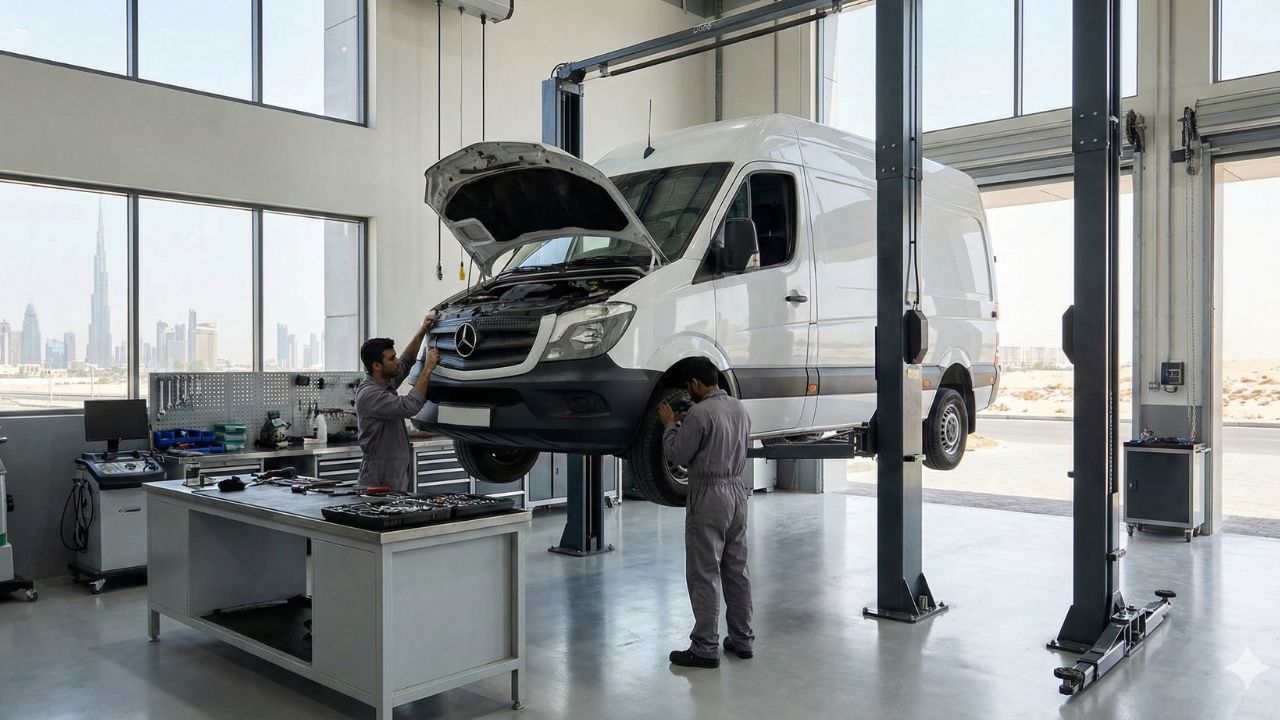
Walking into our diagnostic bay, you’ll notice equipment that looks distinctly different from what you’d find at a typical garage. We’ve invested heavily in Mercedes-specific diagnostic tools, not generic OBD-II scanners that can only read basic codes. Our Xentry diagnostic system communicates directly with your Sprinter’s various control modules using the same protocols as Mercedes dealerships.
Why does this matter for your Mercedes-Benz Sprinter (W906)? Modern Sprinters contain dozens of interconnected control modules managing everything from engine performance to automatic climate control. When a problem occurs, the symptoms you experience might originate from a completely different system than you’d expect. Generic scanners show you the smoke; our Mercedes-specific equipment reveals the fire.
Recently, we diagnosed a Sprinter whose owner had visited three different repair shops for a persistent engine hesitation issue. Each shop replaced different components—fuel filter, air mass sensor, throttle body—without improvement. Our diagnostic system revealed communication errors between the transmission control module and the engine management system, caused by corroded pins in a wiring harness connector. The fix cost a fraction of what the owner had already spent on unnecessary parts.
Beyond diagnostic scanners, we utilize specialized equipment for testing components under realistic operating conditions. Our fuel pressure testing equipment can monitor rail pressure fluctuations that occur only under specific load conditions. Our oscilloscope allows us to visualize electrical signals in real-time, revealing problems invisible to standard multimeters. These capabilities transform guesswork into precision.
We also maintain comprehensive technical documentation for the W906 platform, including wiring diagrams, component locations, and service procedures specific to different model years and configurations. This library proves invaluable when diagnosing unusual problems or working on Sprinters with specialized equipment installations.
Genuine Parts and Quality Alternatives: Your Choice, Clearly Explained
The parts conversation presents interesting dynamics for Mercedes-Benz Sprinter (W906) owners. Unlike luxury passenger cars where genuine parts are virtually mandatory for maintaining value, commercial vehicles often benefit from carefully selected premium aftermarket alternatives that deliver equivalent performance at substantially lower cost.
We source genuine Mercedes-Benz OEM parts directly from authorized suppliers, ensuring you receive components meeting original equipment specifications. For critical systems—engine internal components, transmission parts, electronic modules—we typically recommend genuine parts because the cost difference doesn’t justify the potential reliability risks.
However, for components like brake pads, filters, and certain wear items, we offer premium aftermarket alternatives that meet or exceed OEM specifications. These aren’t cheap knockoffs from questionable manufacturers. We’re talking about brands like Bosch, Bilstein, and Mahle—companies that often supply Mercedes directly but also produce aftermarket versions at lower price points.
Here’s our approach: we present both options with transparent pricing and honest recommendations. If a genuine Mercedes brake rotor costs 40% more than a premium Brembo rotor that we’ve installed on hundreds of Sprinters without issue, we’ll tell you exactly that. The choice remains yours, informed by our experience and your budget considerations.
Every part we install, whether genuine or premium aftermarket, comes with warranty coverage. We stand behind the components we recommend because we’ve tested them through Dubai’s demanding conditions. If a part fails prematurely, we replace it without argument or hidden charges.
We also maintain relationships with suppliers that allow us to source parts quickly. Many components arrive within 24 hours, minimizing your vehicle’s downtime. For urgent repairs, we often stock common failure items specific to the W906 platform, enabling same-day completion of many services.
Transparent Pricing Philosophy: No Surprises, No Hidden Charges
The pricing conversation at Euro Car Repair begins before we touch your Mercedes-Benz Sprinter (W906). Our process follows a straightforward path: comprehensive diagnosis, detailed written estimate, your approval, then execution. No work commences without your explicit understanding of what we’re doing and why it costs what it costs.
When you arrive with a concern, we first invest time in accurate diagnosis. Rushing to conclusions serves nobody. Once we’ve identified the problem, we provide a detailed estimate breaking down labor costs, parts costs, and any additional fees. This isn’t a vague range or a “starting from” figure. It’s the actual price you’ll pay unless we discover additional issues requiring your approval.
Compared to Mercedes dealerships, our pricing typically runs 30-40% lower for equivalent services using genuine parts. This gap widens considerably when using premium aftermarket components where appropriate. The savings come from our lower overhead, efficient operations, and absence of franchise fees—not from cutting corners or compromising quality.
We also offer package pricing for routine maintenance services. A comprehensive service including oil change, filters, brake inspection, and fluid top-up comes at a bundled rate lower than purchasing services individually. These packages provide predictable maintenance costs while ensuring nothing gets overlooked.
Our invoices detail every component replaced and every labor operation performed. You’ll never see mysterious line items or vague charges. If something costs more than estimated due to unforeseen complications, we contact you for approval before proceeding. This transparency builds trust and eliminates the anxiety many people feel when leaving their vehicle at a repair shop.
Customer-First Service Model Built Around Your Schedule
Operating a commercial vehicle means your time carries direct financial value. Every hour your Mercedes-Benz Sprinter (W906) sits idle represents lost revenue or operational disruption. We’ve designed our service model around minimizing this impact while maximizing repair quality.
Our scheduling system offers flexibility unusual in the repair industry. We accommodate early morning drop-offs, late evening pickups, and weekend appointments when necessary. For routine maintenance that doesn’t require extensive time, we offer express service lanes that complete standard oil changes and inspections while you wait.
Communication represents another cornerstone of our approach. When your Sprinter undergoes diagnosis or repair, you receive updates at key milestones. We’ll call when diagnosis is complete, text when parts arrive, and notify you when the vehicle is ready for collection. You’re never left wondering about status or timing.
For customers unable to bring vehicles to our facility, we offer pickup and delivery service throughout Dubai. Our driver collects your Sprinter at your location, we perform the necessary service, and return it to you—often the same day for routine work. This concierge approach recognizes that your time carries value worth protecting.
We also maintain digital service records for your vehicle, creating a comprehensive maintenance history accessible whenever needed. This documentation proves invaluable for resale value, warranty claims, or simply tracking your vehicle’s service intervals and repair history.
Why We Don’t Work With Insurance: The Independence You Deserve
Our decision to operate independently from insurance companies surprises some customers initially, but the reasoning becomes clear quickly. Insurance involvement in mechanical repairs creates conflicts between your interests and cost minimization pressures that rarely benefit your Mercedes-Benz Sprinter (W906).
When repair shops work directly with insurance companies, they face pressure to use cheaper parts, minimize labor hours, and avoid comprehensive repairs in favor of quick fixes. The insurance company’s goal—reducing claim costs—fundamentally opposes your goal of restoring your Sprinter to reliable operating condition.
By operating outside insurance frameworks, we’re free to recommend what your vehicle actually needs. If your Sprinter requires genuine Mercedes components for reliable repair, we specify them without worrying about insurance adjusters questioning costs. If a problem requires additional diagnostic time to accurately identify, we invest that time without artificial constraints.
The speed advantage proves equally significant. Insurance repairs involve estimates, approvals, potentially supplemental estimates when hidden damage appears, and payment processing delays. Direct payment eliminates these bottlenecks. We diagnose, estimate, receive your approval, and proceed immediately. What might take two weeks through insurance often completes in days through direct payment.
This independence also protects you from insurance company tactics like “betterment” charges—where they argue you’re benefiting from new parts replacing worn components, so you should pay a portion. We don’t play these games. You pay for repair services at our standard transparent rates, period.
For customers concerned about out-of-pocket costs, we offer payment flexibility including installment plans for major repairs. This approach maintains the independence benefits while addressing budget concerns practically.
Proven Track Record Serving Dubai’s Mercedes-Benz Sprinter Community
Euro Car Repair’s reputation among Mercedes-Benz Sprinter (W906) owners stems from results, not marketing. We’ve built our business on referrals from satisfied customers who’ve experienced the difference between our approach and alternatives available throughout Dubai.
Our customer retention rate exceeds 85%, meaning the vast majority of Sprinter owners who try our service return for future maintenance and repairs. This statistic matters because commercial vehicle operators are practical people who make decisions based on results and value, not flashy advertising or empty promises.
The diversity of our Sprinter customer base speaks to our capabilities. We service vehicles operated by luxury hotels, logistics companies, tour operators, corporate shuttle services, and individual business owners. Each application presents unique demands, yet all share common ground: reliability requirements that make substandard repairs unacceptable.
Word-of-mouth remains our primary growth driver. When a tour company operator recommends us to another business owner, that endorsement carries weight no advertisement can match. These organic referrals reflect genuine satisfaction with our service quality, pricing fairness, and communication standards.
We’ve been serving Dubai’s European luxury and commercial vehicle community for years, building institutional knowledge about how these vehicles behave in local conditions. This accumulated experience informs every diagnosis we perform and every repair we execute.
Comprehensive Service Offerings for Your Mercedes-Benz Sprinter (W906)
Engine Repair and Maintenance: Keeping Your Powerplant Healthy
The Mercedes-Benz Sprinter (W906) typically utilizes either the OM642 3.0L V6 turbodiesel or the OM651 2.1L four-cylinder turbodiesel engine, depending on model year and specification. These powerplants represent sophisticated engineering, combining impressive torque output with reasonable fuel economy despite moving substantial weight. However, Dubai’s extreme conditions challenge these engines in ways German engineers never fully anticipated during development testing.
Engine maintenance begins with understanding how your Sprinter’s specific usage pattern affects component wear. A vehicle running constant highway speeds between Dubai and Abu Dhabi experiences different stress than one making frequent stops for urban deliveries. Highway operation keeps engines at optimal operating temperature and prevents carbon buildup, while stop-and-go driving increases wear on components like the dual-mass flywheel and creates deposits in the EGR system.
Our engine services encompass everything from routine oil changes to comprehensive rebuilds. Oil quality proves absolutely critical in Dubai’s heat. We recommend synthetic oils meeting Mercedes MB 229.51 specification, with change intervals adjusted based on operating conditions. Vehicles running in dusty environments or making frequent short trips need more frequent changes than those primarily operating on highways.
Common engine issues we address include turbocharger failures, which often result from oil starvation during Dubai’s extreme heat. The W906’s turbo relies on engine oil for lubrication and cooling. When oil degrades or levels drop, turbine bearings suffer catastrophic damage. We’ve developed diagnostic procedures that identify early warning signs before complete failure occurs, potentially saving thousands in repair costs.
EGR valve carbon buildup represents another frequent problem, particularly on earlier W906 models. The exhaust gas recirculation system routes exhaust back through the intake to reduce NOx emissions, but this creates soot accumulation over time. In Dubai’s heat, this buildup accelerates. We perform EGR cleaning and, when necessary, replacement with updated components less prone to clogging.
Cooling system integrity becomes paramount when ambient temperatures exceed 50°C. The W906’s cooling system includes the main radiator, intercooler for reducing turbocharger outlet temperature, transmission cooler, and in some configurations, an air conditioning condenser all stacked together. We inspect for leaks, test thermostat operation, and verify coolant concentration annually. Using incorrect coolant or letting levels drop can lead to expensive engine damage surprisingly quickly in extreme heat.
Fuel system maintenance includes filter replacement at specified intervals, but we also address common injector issues. The high-pressure common-rail diesel injection system in the W906 operates at pressures exceeding 2,000 bar. Injector failure symptoms include rough idling, black smoke, and loss of power. Our diagnostic equipment can test individual injector contribution and identify failing units before they cause engine damage.
Oil leaks require particular attention on higher-mileage Sprinters. Common leak points include valve cover gaskets, oil cooler seals, and various housing gaskets that deteriorate faster in extreme heat. We don’t just stop leaks; we identify why they occurred and address any underlying issues causing excessive pressure or premature seal failure.
Transmission and Gearbox Services: Smooth Power Delivery
Mercedes-Benz equipped the W906 Sprinter with various transmission options, but most Dubai-market vehicles feature the 5G-Tronic five-speed automatic or the later 7G-Tronic seven-speed automatic. These transmissions handle impressive torque while providing reasonable fuel economy, but they demand proper maintenance to achieve their design longevity.
Transmission service intervals spark considerable debate. Mercedes’ official recommendations suggest lifetime fluid in some applications, but our experience in Dubai’s conditions tells a different story. Heat accelerates transmission fluid degradation significantly. We recommend fluid and filter service every 60,000 kilometers for vehicles in commercial service, half the official interval.
The transmission fluid change process on the W906 requires specific procedures. Simply draining the pan only removes about 40% of the total fluid capacity. We perform complete fluid exchanges using specialized equipment that forces new fluid through the transmission’s hydraulic circuits, ensuring comprehensive replacement. This thorough approach prevents old degraded fluid from contaminating fresh fluid.
Common transmission issues we encounter include torque converter lockup problems, which create shuddering during light acceleration or cruising. This often results from degraded fluid or internal clutch wear. Early intervention through fluid service sometimes resolves the issue; delayed action typically requires torque converter replacement.
Valve body failures present another concern, particularly in earlier 5G-Tronic equipped models. The valve body contains solenoids and passages controlling hydraulic flow for gear changes. Electrical failures or internal wear create shifting problems ranging from harsh shifts to complete loss of certain gears. We diagnose these issues electronically and mechanically to determine whether repair or replacement provides the best value.
The transmission’s electronic control module learns driving patterns and adapts shift points accordingly. After major repairs or battery replacement, we perform adaptation procedures using our diagnostic equipment to ensure optimal shift quality. This programming step, often overlooked by general repair shops, significantly impacts driving experience.
For Sprinters experiencing complete transmission failure, we provide honest assessments of repair versus replacement economics. Rebuilding a 7G-Tronic transmission represents substantial investment, sometimes approaching the cost of a quality remanufactured unit with warranty coverage. We present both options with realistic cost projections and reliability expectations.
Brake System Services: Stopping Power You Can Trust
The Mercedes-Benz Sprinter (W906) employs a robust brake system scaled appropriately for its weight class. Front disc brakes handle the majority of stopping force, with rear drums or discs depending on model specification. Given Dubai’s traffic patterns—sudden stops on Sheikh Zayed Road, frequent heavy braking in urban areas—brake maintenance becomes safety-critical.
Brake inspection should occur at least every 10,000 kilometers or six months. We measure pad thickness, inspect rotor surfaces for scoring or warping, and check caliper operation. Dubai’s heat affects brake components uniquely. Rotors expand and contract through extreme temperature ranges, potentially causing warping. Brake fluid absorbs moisture over time, lowering its boiling point and risking vapor lock during hard braking in extreme heat.
Brake pad replacement on the W906 isn’t simply bolting on new pads. The system requires electronic integration in many model years. The brake pad wear sensor connects to the vehicle’s monitoring system, and after replacement, we must reset these indicators using diagnostic equipment. Failing to perform this step leaves warning lights illuminated and prevents accurate wear monitoring.
We offer various brake pad compounds depending on your priorities. Ceramic pads produce less dust and operate quietly but cost more. Semi-metallic pads offer excellent stopping power and heat dissipation at lower cost but generate more dust. We explain trade-offs and recommend options based on your specific usage pattern.
Rotor replacement becomes necessary when thickness falls below minimum specifications or surface damage prevents effective pad contact. On the W906, front rotors typically need replacement every second pad change under normal conditions, though heavy-duty usage accelerates this timeline. We measure rotors precisely rather than assuming replacement necessity.
Brake fluid service occurs every two years regardless of mileage. The hygroscopic nature of brake fluid means it inevitably absorbs atmospheric moisture, degrading performance. We perform complete fluid exchanges using pressure bleeding equipment that purges all old fluid from the system, ensuring optimal pedal feel and maximum boiling point.
The W906’s brake system includes features like ABS, traction control, and electronic stability control. These systems rely on wheel speed sensors that can fail or become contaminated with metallic brake dust. We clean and test these sensors during brake services, preventing electronic system faults that disable safety features.
Air Conditioning and Climate Control: Essential Comfort in Dubai’s Heat
Declaring air conditioning “important” for a Mercedes-Benz Sprinter (W906) in Dubai understates reality dramatically. When outside temperatures reach 50°C, a functioning AC system separates tolerable working conditions from dangerous heat exposure. Commercial Sprinter operators can’t afford AC failures that force passengers or drivers to endure extreme heat.
The W906’s climate control system complexity varies by specification. Basic models feature manual AC controls, while higher specifications include automatic dual-zone climate control with separate driver and passenger settings. Understanding your specific system helps diagnose problems accurately and avoid unnecessary component replacement.
Common AC issues in Dubai include compressor failures, often resulting from the system running continuously for months during summer. The compressor represents the AC system’s heart, pressurizing refrigerant and circulating it through the system. When compressors fail, the culprit is usually either electrical failure of the magnetic clutch or mechanical seizure from lack of lubrication.
We diagnose AC problems systematically. First, we verify refrigerant level and pressure using manifold gauges. Low refrigerant indicates leaks requiring identification and repair before recharging. We use electronic leak detectors and UV dye to locate even tiny leaks that might escape visual inspection.
The evaporator—located inside the dashboard—presents particular challenges. This component absorbs heat from cabin air, cooling it before distribution. Evaporator leaks require substantial dashboard disassembly for access, making prevention through regular maintenance worthwhile. We recommend annual AC system inspections including evaporator drain cleaning, which prevents water accumulation that accelerates corrosion.
AC compressor replacement on the W906 requires more than physical installation. The system must be properly evacuated to remove air and moisture, then recharged with precise refrigerant quantities. Too little refrigerant reduces cooling capacity; too much can damage the compressor. We use specialized equipment that evacuates, vacuum-tests for leaks, and recharges to exact specifications.
Cabin air filter replacement affects both AC performance and air quality. These filters trap dust, pollen, and particulates, but they clog quickly in Dubai’s dusty environment. We recommend replacing cabin filters every 10,000 kilometers or annually, whichever comes first. Fresh filters improve airflow, enhance cooling efficiency, and protect your respiratory health.
The condenser, mounted ahead of the radiator, releases heat extracted from the cabin. Stone damage and corrosion can perforate condenser coils, causing refrigerant leaks. We inspect condensers during service and can protect new units with aftermarket guards that prevent damage without restricting airflow.
Refrigerant specifications matter. The W906 uses R134a refrigerant in most models, though some late-production units may use newer R1234yf. Using incorrect refrigerant damages components and reduces efficiency. We verify specifications before servicing any AC system.
Suspension and Steering: Smooth Ride Despite Rough Conditions
The Mercedes-Benz Sprinter (W906) employs independent front suspension with coil springs and anti-roll bars, paired with a solid rear axle on leaf springs or coil springs depending on specification. This configuration balances ride comfort with load-carrying capability, but Dubai’s road conditions—speed bumps, occasional unpaved areas, thermal stress—accelerate wear on suspension components.
Front suspension inspection should occur every 20,000 kilometers or annually. We check ball joint play, control arm bushings, shock absorber condition, and anti-roll bar link integrity. Failed bushings create clunking noises and affect handling precision. Ball joint failure can cause sudden loss of steering control, making early detection critical.
Shock absorbers wear gradually, making degradation hard to notice during daily driving. We test shocks using specialized equipment that measures damping force, identifying worn units even when visual signs aren’t apparent. Failed shocks allow excessive body motion, increasing stopping distances and reducing load stability.
The W906’s steering system typically uses hydraulic power assist, though some later models feature electro-hydraulic systems. Power steering fluid should be inspected during every service for level and condition. Fluid degradation or leaks can cause steering effort to increase or create noise during turns.
Steering rack failures occasionally occur, particularly in Sprinters used in tight urban environments requiring frequent full-lock turns. Symptoms include fluid leaks, increased steering effort, or clunking during parking maneuvers. Rack replacement requires proper alignment afterward to ensure straight-line stability and even tire wear.
Wheel alignment proves especially important for commercial vehicles covering high annual mileage. Misalignment causes uneven tire wear, increased fuel consumption, and wandering during highway driving. We perform four-wheel alignment using computerized equipment that sets camber, caster, and toe to Mercedes specifications for your specific model and load configuration.
The rear suspension’s leaf springs or coil springs require inspection for cracks, sagging, or bushing wear. Overloaded operation or age-related fatigue can cause springs to sag, reducing ground clearance and affecting ride quality. We measure ride height and compare against specifications to determine if spring replacement is necessary.
Steering knuckle and spindle assemblies require attention on higher-mileage vehicles. These components support wheel hubs and connect to suspension and steering linkages. Wear in knuckle bushings creates imprecise steering response and uneven tire wear. We inspect these often-overlooked components during comprehensive suspension services.
Electrical System Diagnostics: Taming Complex Electronics
Modern Mercedes-Benz Sprinter (W906) models contain sophisticated electrical architecture managing dozens of interconnected systems. From the engine control module coordinating fuel injection and turbo boost to the body control module managing lighting and convenience features, electrical problems can manifest as seemingly unrelated symptoms requiring systematic diagnosis.
Battery health becomes critical in Dubai’s heat. Extreme temperatures accelerate battery degradation through increased chemical reaction rates and fluid evaporation. We test batteries using conductance testing equipment that assesses both current cranking capability and remaining capacity. Batteries showing degradation get replaced before failure strands you somewhere inconvenient.
Battery replacement on the W906 isn’t simply disconnecting the old unit and connecting a new one. The vehicle’s electrical system requires initialization procedures to recognize the new battery and adjust charging parameters accordingly. Without proper initialization, the alternator may overcharge or undercharge the new battery, causing premature failure.
Common electrical issues include alternator failures, which often develop gradually. Early symptoms include dimming lights, slow cranking, or battery warning lights. We test alternator output under load, checking voltage regulation and current capacity. Failed alternators get replaced with units meeting Mercedes specifications for charging current and voltage regulation precision.
Sensor failures create numerous problems from check engine lights to inoperative systems. Mass airflow sensors, oxygen sensors, coolant temperature sensors, and countless others feed critical data to control modules. We diagnose sensor problems using both electrical testing and data stream analysis from our diagnostic equipment, distinguishing between failed sensors and wiring problems.
Wiring harness issues plague some W906 models, particularly in areas exposed to heat and vibration. Engine bay harnesses near turbochargers experience extreme temperatures that can melt insulation. Transmission harnesses under the vehicle encounter road debris and moisture. We inspect harnesses systematically and repair damaged sections using proper techniques and materials.
The W906’s CAN bus communication network allows control modules to share information, but faults in this network cause cascading problems affecting multiple systems. We diagnose CAN bus issues using specialized equipment that monitors network traffic and identifies communication failures, short circuits, or module faults.
Glow plug system failures affect cold starting, though “cold” is relative in Dubai. The diesel engine’s glow plugs heat combustion chambers to facilitate starting, controlled by a glow plug control module. Failed plugs or controller problems create hard starting and excessive white smoke during warm-up. We test individual glow plugs and verify controller operation during diagnosis.
Fluid Leak Detection and Repair: Keeping Everything Contained
Fluid leaks on a Mercedes-Benz Sprinter (W906) range from minor nuisances to harbingers of expensive damage. Identifying leak sources requires systematic inspection because fluids often travel along components before dripping, obscuring actual leak locations.
Engine oil leaks commonly originate from valve cover gaskets, which deteriorate faster in extreme heat. These gaskets seal the junction between valve covers and cylinder heads, containing oil splashed by moving valve train components. Failed gaskets create visible oil accumulation and eventually lead to oil consumption requiring frequent top-ups.
Oil cooler seal failures represent another common leak source. The W906’s engine oil cooler uses seals that deteriorate over time, causing oil to seep externally or mix with coolant internally. External leaks create visible oil accumulation; internal leaks contaminate coolant with oil, creating a milky appearance and potentially damaging the cooling system.
Coolant leaks demand immediate attention in Dubai’s climate. Even small leaks can cause overheating when ambient temperatures exceed 45°C. Common coolant leak points include radiator cores, hose connections, water pump seals, and expansion tank cracks. We use pressure testing equipment to locate leaks that might not be visible during normal operation.
Transmission fluid leaks often stem from output shaft seals, pan gaskets, or cooler line connections. Automatic transmission fluid is red when fresh, turning brown as it ages. Leaks not only require constant fluid top-ups but also create fire hazards when fluid contacts hot exhaust components.
Power steering fluid leaks typically occur at rack end seals, pressure hose connections, or reservoir cap seals. These leaks can be subtle, only appearing during turning maneuvers when system pressure peaks. Ignoring power steering leaks eventually causes pump failure from running low on fluid.
Diesel fuel leaks require urgent attention for safety reasons. The high-pressure fuel system can develop leaks at injector seals, supply lines, or the fuel filter housing. Fuel leaks create fire hazards and should never be driven with active fuel leaking.
We locate leaks using various techniques including pressure testing, UV dye tracing, and systematic cleaning followed by observation. Once located, we don’t just stop the leak; we investigate why it occurred and address any underlying issues like excessive system pressure or premature component degradation.
Additional Specialized Services: Complete Care Solutions
Tire replacement and service on the Mercedes-Benz Sprinter (W906) involves more than mounting new rubber. The tire pressure monitoring system (TPMS) requires programming when sensors are replaced or wheels are rotated. We perform this programming using Mercedes-specific equipment, ensuring accurate pressure monitoring that alerts you to potential problems before they cause tire damage or blowouts.
Tire selection for Sprinters requires balancing load capacity, longevity, and cost. Commercial-grade tires rated for your vehicle’s gross weight prove essential. We recommend tire brands with proven Dubai performance, considering factors like heat resistance and durability on the region’s road surfaces.
Sunroof repair and maintenance addresses both mechanical and electrical components. The W906’s sunroof mechanism includes cables, tracks, and motor assemblies that can fail. Drainage tubes prevent water intrusion but become clogged with debris, causing leaks into the cabin. We service sunroof mechanisms comprehensively, cleaning drains and lubricating moving parts to ensure reliable operation.
Scratch and paint repair maintains your Sprinter’s professional appearance. Commercial vehicles inevitably suffer minor damage from loading operations, tight parking, and daily use. We offer various solutions from touch-up paint for small scratches to panel repair and repainting for more substantial damage. Color matching ensures repairs blend seamlessly with original paint.
Pre-purchase inspection services protect buyers considering used Mercedes-Benz Sprinter (W906) purchases. We perform comprehensive 150-point inspections examining mechanical systems, electrical components, body condition, and maintenance history. Our detailed reports identify existing problems, estimate repair costs, and provide negotiating leverage or confidence to proceed with purchase.
Scheduled maintenance packages bundle services at package pricing. Our comprehensive service includes engine oil and filter change, transmission fluid inspection, brake inspection, tire rotation, all fluid level checks, and multi-point safety inspection. Bundling these services saves money compared to purchasing individually while ensuring nothing gets overlooked.
Common Mercedes-Benz Sprinter (W906) Problems We Solve Daily
Turbocharger Failure: Understanding the W906’s Boost Issues
Turbocharger failures represent one of the most expensive and unfortunately common problems affecting Mercedes-Benz Sprinter (W906) models, particularly those operating in Dubai’s extreme heat. The turbocharger functions like a small jet engine, using exhaust gases to spin a turbine at speeds exceeding 100,000 RPM. This turbine drives a compressor that forces additional air into the engine, increasing power output substantially. When this precision component fails, your Sprinter transforms from capable workhorse to gutless disappointment.
Early warning signs include reduced power during acceleration, unusual whistling noises from the engine bay, excessive blue or black exhaust smoke, and oil consumption that seems to increase mysteriously. Many owners initially attribute these symptoms to other issues, delaying diagnosis until catastrophic turbo failure occurs.
Why do these failures happen? Dubai’s relentless heat accelerates oil degradation, and the turbocharger depends entirely on engine oil for lubrication and cooling. When oil quality deteriorates or becomes contaminated, the turbo’s bearing surfaces suffer microscopic damage that progresses to complete failure. Additionally, many Sprinter operators allow engines to idle for extended periods while running air conditioning—a practice that starves the turbo of adequate cooling during shutdown.
Our diagnostic approach uses multiple methods to assess turbocharger health before complete failure. We inspect for excessive shaft play, examine turbine and compressor wheels for damage, check boost pressure under load conditions, and analyze oil consumption patterns. These tests distinguish between turbos requiring replacement and those still functioning adequately despite minor wear.
Repair involves either turbocharger replacement or, in some cases, rebuild with new cartridge assemblies. We source quality replacement turbos from reputable suppliers, ensuring components meet or exceed original specifications. Installation includes addressing any factors that contributed to the original failure—oil system cleaning, proper break-in procedures, and operator education about turbocharger care.
Prevention proves far less expensive than repair. We recommend synthetic oil changed at conservative intervals, proper warm-up and cool-down procedures for the engine, and annual boost pressure testing to identify declining turbo performance before failure. These simple practices dramatically extend turbocharger service life even in Dubai’s challenging climate.
DPF Regeneration Issues: The Diesel Particulate Filter Challenge
The Diesel Particulate Filter (DPF) system represents one of the W906 Sprinter’s most sophisticated emissions control technologies—and one of its most frustrating when problems occur. Later model W906 Sprinters include DPF systems that trap soot particles from exhaust gases, periodically burning accumulated soot through regeneration cycles that heat the filter to approximately 600°C.
Problems arise when operating conditions prevent successful regeneration. Sprinters used for short-distance urban deliveries never reach the sustained highway speeds and loads necessary for passive regeneration. The DPF fills with soot, eventually triggering warning lights and, if ignored, entering limp mode with dramatically reduced power.
Symptoms of DPF problems include increased fuel consumption, loss of power, unusual exhaust odors, and dashboard warnings specific to the DPF system. Many owners don’t understand these warnings and continue driving, compounding the problem until the DPF becomes completely clogged and requires replacement—an expensive consequence of delayed action.
Our approach begins with reading fault codes and measuring DPF pressure differential to assess clogging severity. If caught early, we can perform forced regeneration using diagnostic equipment that initiates the burn cycle while the vehicle remains stationary. This process takes approximately 45 minutes and clears accumulated soot without DPF removal.
For severely clogged filters, removal and professional cleaning or replacement becomes necessary. We explain both options transparently. DPF cleaning costs considerably less than replacement but doesn’t always restore full function if internal filter damage has occurred. Replacement guarantees proper operation but represents significant investment.
Prevention centers on operating pattern modifications. We educate owners about the importance of regular highway drives that allow natural regeneration. For Sprinters trapped in urban delivery routes, we recommend scheduled “DPF exercise” drives—monthly trips on highways at consistent speeds that facilitate regeneration.
Some customers inquire about DPF removal, a modification illegal in many jurisdictions and detrimental to environmental standards. We decline these requests, instead focusing on solutions that maintain emissions compliance while addressing operational realities.
Injector Failures: High-Pressure Fuel System Issues
The common-rail diesel fuel injection system in the Mercedes-Benz Sprinter (W906) operates at astonishing pressures, delivering precisely metered fuel directly into combustion chambers. This technology enables impressive power output and efficiency, but injector failures create problems ranging from rough running to complete engine damage.
Injector issues manifest as rough idling, excessive black smoke during acceleration, starting difficulties, and noticeably reduced power. Individual injector failures often create a distinctive miss that feels like the engine running on fewer cylinders than normal. Advanced failures can cause fuel dilution of engine oil—a dangerous condition that reduces lubrication and accelerates engine wear.
Why do injectors fail? Fuel quality represents the primary culprit. Diesel fuel containing excessive sulfur or contamination damages the precision surfaces inside injectors. Dubai’s heat also affects injector sealing—the extreme temperatures cause rubber seals to harden and crack, allowing fuel leakage. Additionally, the mechanical wear from billions of injection cycles eventually causes internal components to deteriorate beyond acceptable tolerances.
Diagnosis requires sophisticated equipment capable of testing individual injector contribution. We use balance tests that isolate each cylinder, measuring power contribution and fuel delivery. This identifies which specific injector or injectors are failing, preventing unnecessary replacement of functioning units.
Injector replacement involves more than installing new components. The fuel system requires careful preparation including filtering to remove any contamination that might damage new injectors. After installation, injectors must be coded to the engine control module—each injector has unique characteristics, and programming this data ensures optimal performance.
We also address the root causes that led to injector failure. If fuel contamination caused the problem, we recommend fuel system flushing and filter replacement. If seal failure occurred, we investigate whether excessive heat or age prompted deterioration. This comprehensive approach prevents repeat failures.
Prevention includes using quality diesel fuel, changing fuel filters at recommended intervals, and avoiding completely emptying the fuel tank which can introduce sediment into the injection system. We also recommend fuel system cleaning additives during routine services to prevent internal deposit formation.
AdBlue System Malfunctions: DEF System Complications
Later Mercedes-Benz Sprinter (W906) models incorporate AdBlue (Diesel Exhaust Fluid or DEF) systems to reduce NOx emissions. This system injects urea solution into the exhaust stream, where it chemically reacts with nitrogen oxides to produce harmless nitrogen and water vapor. When functioning properly, the system operates transparently. When problems occur, they can prevent vehicle starting entirely.
Common AdBlue system issues include frozen DEF (irrelevant in Dubai), contaminated fluid, failed injector nozzles, sensor failures, and control module problems. Symptoms range from warning messages about reduced driving range to complete starting prevention once the AdBlue tank empties or system malfunctions are detected.
The system’s complexity creates diagnostic challenges. Multiple sensors monitor DEF level, quality, temperature, and injection quantity. A failure in any component can trigger system faults that disable the vehicle. Additionally, contamination from incorrect fluid or water intrusion causes crystallization that clogs injectors and supply lines.
Our diagnostic process includes testing DEF quality, verifying sensor operation, checking for error codes, and examining physical components for contamination or damage. We use Mercedes-specific diagnostic equipment that communicates directly with the AdBlue control module, accessing detailed fault information unavailable to generic scanners.
Repairs vary from simple DEF refilling to complete injector replacement, control module updates, or even entire system component replacement in severe contamination cases. We always determine why the failure occurred—for instance, if someone accidentally filled the AdBlue tank with diesel fuel, extensive flushing and component replacement becomes necessary.
Prevention focuses on using correct DEF fluid from reputable suppliers and maintaining proper fluid levels. The W906’s AdBlue tank should never be allowed to empty completely, as air introduction into the system can damage the supply pump. Regular AdBlue system inspection during service appointments identifies potential problems before they cause breakdowns.
Dual Mass Flywheel Deterioration: Drivetrain Vibration Problems
The dual mass flywheel (DMF) represents sophisticated engineering designed to isolate drivetrain vibrations from diesel engine power pulses. Unlike conventional solid flywheels, the DMF contains two rotating masses connected by springs, absorbing torsional vibration before it reaches the transmission. When functioning properly, it creates remarkably smooth operation for a commercial diesel vehicle. When failing, it creates dramatic symptoms impossible to ignore.
Failed DMF symptoms include rattling noises during idle or startup, vibrations through the vehicle at specific RPM ranges, difficulty shifting gears, and in severe cases, complete clutch operation failure. The noise often resembles loose stones in a can, particularly noticeable when starting the engine or during low-speed maneuvering.
DMF failures accelerate in stop-and-go traffic common throughout Dubai. The constant load cycling and heat generation from clutch operation in heavy traffic fatigue the DMF’s internal springs. Additionally, operating techniques like riding the clutch or aggressive starts accelerate wear substantially.
Diagnosis involves physical inspection requiring transmission removal. The flywheel’s internal springs can be tested for excessive play by attempting to rotate the primary and secondary masses relative to each other. Excessive movement or metallic debris visible between the masses indicates failure requiring replacement.
Repair necessitates complete clutch system replacement in most cases. When accessing the flywheel, we recommend replacing the clutch disc, pressure plate, and release bearing simultaneously. These components have similar service lives, and the labor required for access makes replacing everything economically sensible.
Choosing replacement components involves decisions about quality levels. Genuine Mercedes DMF and clutch kits cost substantially more than aftermarket alternatives but typically offer superior longevity. We present both options with honest assessments based on your vehicle’s intended service life and usage pattern.
Prevention includes proper clutch operation technique—avoiding clutch riding, minimizing hill starts, and using appropriate throttle inputs during engagement. These practices reduce thermal stress and cyclic loading that fatigue DMF components.
EGR Valve Carbon Buildup: Emissions System Challenges
The Exhaust Gas Recirculation (EGR) valve routes a portion of exhaust gases back into the intake manifold, reducing combustion temperatures and thereby lowering NOx emissions. While environmentally beneficial, this system creates maintenance challenges as exhaust soot accumulates on valve components, eventually restricting operation.
Symptoms of EGR problems include rough idling, reduced power, increased fuel consumption, and check engine lights with specific EGR-related fault codes. In severe cases, the valve becomes completely stuck either open or closed, dramatically affecting engine performance and emissions.
Dubai’s driving conditions—extended idling, low-speed operation, and heat—accelerate EGR carbon buildup. The EGR system functions most problematically during these conditions, creating maximum soot flow through components already stressed by extreme temperatures.
Our diagnosis includes reading fault codes, inspecting EGR valve operation, examining intake manifold contamination levels, and testing differential pressure across the EGR cooler. These assessments determine whether cleaning suffices or component replacement becomes necessary.
For moderately contaminated systems, we perform thorough cleaning using specialized solvents that dissolve carbon deposits without damaging aluminum components. This involves removing the EGR valve, cleaning all passages, and verifying proper operation after reinstallation. The process restores function at substantially lower cost than replacement.
Severely damaged EGR valves require replacement. We source quality replacement components meeting emissions specifications. Installation includes cleaning associated passages to prevent immediate re-contamination. Some W906 models also require EGR valve position learning procedures using diagnostic equipment.
Maintenance strategies include regular EGR inspection during services, using quality diesel fuel that produces less soot, and ensuring the DPF system functions properly. A malfunctioning DPF increases soot production, accelerating EGR contamination.
Glow Plug and Controller Failures: Cold Start Issues
While “cold” represents a relative term in Dubai, the diesel engine’s glow plug system remains critical for proper starting and smooth operation during warm-up. Glow plugs are heating elements installed in each cylinder that raise combustion chamber temperature, enabling fuel ignition even when the engine is relatively cool.
Failed glow plugs create hard starting, particularly during Dubai’s mild winter mornings when temperatures might drop to 15-20°C. Symptoms include extended cranking before the engine fires, excessive white smoke during warm-up, rough running until the engine reaches operating temperature, and check engine lights with glow plug circuit faults.
The W906 typically uses either single-coil or more advanced ceramic glow plugs depending on model year and engine specification. Ceramic plugs heat faster and last longer but cost more to replace. Single-coil plugs are less expensive but have shorter service lives.
Diagnosis begins with reading fault codes that often identify which specific glow plug circuit has failed. We then measure electrical resistance of each glow plug, comparing against specifications. Failed plugs show infinite resistance (open circuit) or dramatically different values than functional plugs.
However, not all glow plug problems stem from the plugs themselves. The glow plug control module energizes the plugs for appropriate duration based on engine temperature and conditions. Control module failures prevent any glow plugs from operating, creating symptoms similar to multiple plug failures. We test the control module’s output before condemning individual glow plugs.
Replacement involves removing glow plugs carefully to avoid breakage. On higher-mileage engines, carbon buildup can cause glow plugs to seize in their threads. Broken glow plugs left partially in the cylinder head create expensive repair complications. We use proper removal techniques including penetrating oils and controlled force to minimize breakage risk.
Prevention includes replacing glow plugs proactively at recommended intervals rather than waiting for failures. The relatively modest cost of preventive replacement avoids the inconvenience of starting problems and potential complications from broken plugs during emergency repairs.
Coolant Leaks and Overheating: Critical Heat Management
Cooling system integrity represents absolutely critical importance for Mercedes-Benz Sprinter (W906) operation in Dubai’s extreme heat. When ambient temperatures exceed 45°C, your engine’s cooling system operates near its design limits constantly. Even minor cooling system problems can cause overheating that leads to expensive engine damage.
Common coolant leak sources include radiator core deterioration, plastic radiator tank failures, water pump seal leaks, expansion tank cracks, and deteriorated hoses. The W906’s cooling system components suffer accelerated aging from thermal cycling between extreme heat and air-conditioned cool-downs.
Overheating symptoms range from gradual temperature gauge creep to sudden dramatic spikes. Warning lights indicate coolant temperature problems, but severe overheating can occur rapidly enough that irreversible damage precedes warning recognition. White steam from under the hood represents an obvious emergency requiring immediate engine shutdown.
Our cooling system diagnosis includes pressure testing to identify leaks, thermostat operation verification, coolant concentration testing, water pump inspection, and radiator flow testing. These comprehensive checks distinguish between simple fixes like hose replacement and major repairs like radiator or water pump replacement.
Radiator replacement on the W906 requires removing multiple components depending on configuration. The radiator, intercooler, and AC condenser stack together, necessitating careful disassembly. We inspect all cooling system components during radiator replacement, addressing any marginal parts while the system is already disassembled.
Water pump failures create catastrophic results if the engine continues running after pump seizure or impeller failure. Belt-driven water pumps show warning signs like bearing noise or coolant seepage from the pump shaft seal. We catch these symptoms during routine inspections, preventing on-road failures.
Coolant selection matters significantly. The W906 requires specific coolant formulations that protect aluminum components and maintain proper freeze/boil protection. Using incorrect coolant or plain water causes corrosion and reduces heat transfer efficiency. We always use Mercedes-approved coolant during services.
Prevention centers on regular cooling system inspection, annual coolant replacement in Dubai’s climate, and immediate attention to any temperature gauge abnormalities. The cost of preventive maintenance represents a fraction of engine repair costs from overheating damage.
Our Expert Technicians: The Heart of Euro Car Repair’s Excellence
Behind every successfully diagnosed problem and professionally executed repair stands technicians whose skills and dedication define our service quality. The automotive repair industry contains vast variation in technician capability—from parts-changers who follow checklists without understanding to master diagnosticians who can unravel the most complex vehicle problems through systematic analysis.
Our hiring standards prioritize both technical competence and continuous learning mindset. We seek technicians with proven experience on European luxury and commercial vehicles, but we also value the intellectual curiosity that drives someone to understand why problems occur rather than simply how to fix them. This distinction separates mechanics who replace components from technicians who solve problems.
Specialized training specifically focused on Mercedes-Benz systems forms the foundation of our technical team’s expertise. While automotive technology shares many common principles across manufacturers, Mercedes engineering philosophy creates unique diagnostic and repair requirements. Understanding these nuances requires dedicated study of Mercedes-specific systems, architecture, and service procedures.
Our technicians participate in ongoing education programs that keep pace with evolving automotive technology. Mercedes continuously updates diagnostic procedures, releases technical service bulletins addressing known issues, and modifies repair techniques based on field experience. We ensure our team remains current with these developments through regular training sessions, technical publication review, and hands-on skill development.
Certifications provide objective validation of technical competence. Our technicians hold various industry certifications demonstrating proficiency in areas like electrical diagnosis, engine performance, and advanced diagnostics. These credentials aren’t wall decorations—they represent hundreds of hours invested in formal education and tested knowledge.
Hands-on experience with Mercedes-Benz Sprinter (W906) models specifically translates into diagnosis confidence and repair efficiency. Textbook knowledge provides essential foundation, but real-world problem-solving develops only through wrestling with actual vehicle issues. Our team’s collective experience spans thousands of W906 repairs, creating institutional knowledge about common failures, diagnostic shortcuts, and repair best practices.
Diagnostic expertise separates our technicians from typical mechanics. Modern vehicles present problems that won’t yield to parts-swapping or guesswork. Effective diagnosis requires understanding electrical systems, computer networking, mechanical relationships, and system interactions. Our technicians approach problems methodically, using diagnostic equipment skillfully and interpreting results through deep system knowledge.
Problem-solving ability extends beyond technical knowledge into creative thinking. Some vehicle problems don’t fit standard patterns or present symptoms that seem contradictory. Solving these challenging cases requires intellectual flexibility—the ability to question assumptions, test hypotheses systematically, and persevere through dead ends until root causes become clear.
Customer communication skills prove equally important as technical expertise. Understanding customer concerns, explaining technical issues in accessible language, and providing realistic recommendations requires interpersonal abilities that complement technical knowledge. Our technicians take time to listen carefully to symptom descriptions, explain diagnosis results clearly, and discuss repair options honestly.
Quality control processes ensure consistent excellent results. After completing repairs, vehicles undergo systematic verification testing to confirm problems are resolved and no new issues have been introduced. This attention to detail prevents the frustration of returned vehicles requiring additional work to address incomplete repairs.
Our team approach encourages collaboration on complex problems. When individual technicians encounter challenging diagnoses, they can consult colleagues whose different experiences and perspectives often illuminate solutions. This collaborative culture accelerates problem resolution and creates continuous learning opportunities.
Tool and equipment proficiency maximizes diagnostic accuracy and repair efficiency. Our facility provides technicians with specialized equipment specifically designed for Mercedes-Benz service. However, tools prove valuable only when wielded by skilled operators who understand their capabilities and limitations. Our training emphasizes not just what tools do, but how to use them effectively.
The pride our technicians take in their work manifests in repair quality and attention to detail. They understand that your Mercedes-Benz Sprinter (W906) represents significant investment and possibly your livelihood. This awareness creates personal commitment to excellence that transcends simply completing assigned tasks.
Dubai’s Unique Challenges for Mercedes-Benz Sprinter (W906)
Operating a Mercedes-Benz Sprinter (W906) in Dubai subjects the vehicle to environmental stresses that German engineers considered during development but perhaps underestimated in severity. Understanding these unique challenges helps explain why maintenance requirements differ substantially from temperate climates and why choosing repair facilities familiar with local conditions matters significantly.
Extreme heat represents the most obvious challenge. When ambient temperatures reach 50°C, every component in your Sprinter operates under thermal stress. Engine cooling systems run at design limits constantly during summer months. Rubber components—hoses, belts, seals—deteriorate faster due to accelerated aging from heat exposure. Plastic components become brittle and prone to cracking. Battery life shortens dramatically as heat accelerates internal chemical reactions that gradually reduce capacity.
The W906’s air conditioning system faces relentless demand during Dubai summers. While Sprinters in European climates might run AC occasionally during brief warm periods, Dubai operation requires constant maximum cooling capacity for months. Compressors designed for intermittent use run continuously, accelerating wear and increasing failure probability. Refrigerant pressure operates near maximum specifications constantly, stressing hoses and seals that might last years in moderate climates but fail within months here.
Sand and dust infiltration affects the W906’s sophisticated air filtration system specifically. The engine air intake system must filter massive dust quantities to protect internal components from abrasive wear. Clogged air filters reduce engine performance and fuel economy, but delayed replacement allows dust passage that accelerates turbocharger and engine wear. The cabin air filter similarly battles constant dust loading, requiring more frequent replacement than temperate climate operations would suggest.
Dubai’s traffic patterns create specific mechanical stress. Morning and evening commutes on Sheikh Zayed Road involve extended idling in heavy congestion followed by high-speed highway driving. This cycling between extremes challenges engine cooling, transmission temperature management, and brake systems. Stop-and-go traffic prevents proper cooling airflow while generating maximum heat from idling and low-speed operation. Subsequently, highway speeds demand maximum power output when systems are already heat-soaked.
Coastal humidity adds unexpected complications to electrical system reliability. While Dubai’s daytime humidity feels minimal due to high temperatures, nighttime humidity rises substantially, particularly in coastal areas like JBR and Dubai Marina. This moisture infiltrates electrical connections, creating corrosion that causes intermittent faults and component failures. The W906’s sophisticated electrical architecture contains hundreds of connections potentially affected by corrosion-induced voltage drops or short circuits.
Parking challenges significantly impact vehicle condition. Sprinters parked outdoors endure relentless UV radiation that fades paint, cracks plastic trim, and deteriorates rubber components. Interior temperatures in closed Sprinters can exceed 70°C, cooking dashboard plastics and stressing electronic components. Covered parking mitigates these issues substantially but isn’t always available for commercial vehicles.
Road surface quality varies dramatically across Dubai. Modern highways maintain excellent conditions, but older areas, construction zones, and industrial districts present potholed surfaces that stress suspension components. The W906’s suspension design balances comfort and load capacity, but it wasn’t optimized for dramatic road quality variations often encountered within single delivery routes.
Salt exposure from coastal environments accelerates corrosion on undercarriage components. While not subjected to road salt application like vehicles in northern climates, Dubai’s coastal areas expose vehicles to salt-laden air that promotes rust formation on steel components. The W906’s body construction uses various materials including steel, aluminum, and plastic, each responding differently to this corrosive environment.
Our service approach specifically addresses these Dubai-unique challenges. We recommend more frequent fluid changes than manufacturer specifications suggest for temperate climates. Engine oil, transmission fluid, coolant, and brake fluid all degrade faster in extreme heat. We specify heat-resistant component upgrades where available—premium hoses, uprated cooling fans, higher-capacity batteries designed for hot climates.
Preventive maintenance scheduling adapts to Dubai’s seasonal patterns. We encourage comprehensive pre-summer inspections in March or April, addressing any marginal components before heat stress causes failures. Similarly, the mild winter period provides opportunity for maintenance that might be uncomfortable or inconvenient during summer heat.
Air filtration system attention receives priority in our service recommendations. We inspect and replace air filters more frequently than standard intervals, recognizing that Dubai’s dust loading exceeds what manufacturers anticipated. This simple maintenance prevents expensive downstream damage from inadequate filtration.
Cooling system vigilance becomes paramount. We pressure-test cooling systems annually, replace coolant regardless of appearance, and address even minor leaks immediately. The margin between adequate cooling and overheating shrinks to nearly nothing during Dubai summers—minor problems tolerated in moderate climates cause catastrophic failures here.
Electrical system protection includes dielectric grease application on critical connections, regular battery testing, and proactive replacement before failures occur. We don’t wait for batteries to fail in Dubai’s heat; we recommend replacement when testing shows declining capacity, preventing the inconvenience and potential safety concerns of roadside battery failures.
Pricing and Value Proposition: Transparent Costs, Exceptional Value
Understanding what you’ll pay for Mercedes-Benz Sprinter (W906) repair service before work begins should be standard practice, yet many repair facilities operate with opaque pricing that leaves customers anxious and uncertain. Euro Car Repair’s pricing philosophy centers on complete transparency, honest communication, and delivering value that extends far beyond the invoice total.
Our estimate process begins with accurate diagnosis. We refuse to quote repair costs before understanding exactly what requires attention. Guessing at pricing based on symptoms creates either artificially low estimates that balloon during repair or unnecessarily high quotes that discourage needed service. Instead, we invest time in proper diagnosis, then provide detailed written estimates breaking down labor costs, parts costs, and any miscellaneous fees.
Labor rates reflect our technicians’ expertise and facility overhead while remaining substantially below Mercedes dealership pricing. Dealerships carry franchise fees, corporate overhead, and facility costs that translate into labor rates often 40-50% higher than independent specialists. We deliver equivalent or superior service quality without these premium charges, passing savings directly to customers.
Parts pricing similarly offers advantages over dealership costs. We source genuine Mercedes parts from authorized suppliers at competitive pricing, typically 20-30% below dealership retail. For components where premium aftermarket alternatives provide equivalent quality, we offer both options with transparent pricing allowing informed decisions based on your priorities and budget.
Service comparisons illustrate tangible value differences. Consider routine comprehensive service including engine oil and filter change, transmission fluid service, brake inspection, tire rotation, and multi-point safety inspection. A Mercedes dealership might charge 3,500-4,500 AED for this service. Our bundled pricing typically runs 2,000-2,800 AED using equivalent quality components and providing equally thorough attention.
Major repair cost differences become even more dramatic. Turbocharger replacement at a dealership might cost 12,000-15,000 AED. We typically complete this same repair using quality components for 8,000-10,000 AED—substantial savings that don’t compromise reliability or longevity.
Package deals and maintenance programs provide additional value for regular customers. Our scheduled maintenance packages bundle common services at reduced rates compared to purchasing individually. These programs encourage proper maintenance timing while making premium service more accessible financially.
Hidden fees don’t exist in our pricing structure. The estimate you receive includes everything—parts, labor, fluids, and shop supplies. We don’t add mysterious surcharges or unexpected fees when you collect your vehicle. If additional work becomes necessary after beginning repair, we contact you for approval before proceeding with revised estimates.
Payment flexibility accommodates various financial situations. While we don’t work with insurance companies, we accept all major credit cards, offer bank transfer options, and can arrange payment plans for major repairs when needed. These arrangements make necessary repairs accessible without forcing customers into financial stress.
Value extends beyond monetary considerations into service quality dimensions. Our technicians take pride in workmanship, ensuring repairs don’t just fix immediate problems but address underlying causes and prevent future failures. This attention to detail delivers long-term value through improved reliability and reduced frequency of repairs.
Warranty coverage on repairs provides peace of mind. Parts carry manufacturer warranties, and our labor warranty ensures that if any issue arises from our work, we’ll address it promptly without additional charges. This guarantee reflects confidence in our technical capabilities and commitment to customer satisfaction.
Efficiency delivers additional value through reduced downtime. Our systematic diagnostic approach and experienced technicians complete repairs in less time than facilities where mechanics fumble through unfamiliar procedures. For commercial Sprinter operators, every hour saved translates directly into reduced business disruption.
Communication throughout the repair process represents intangible value that customers appreciate deeply. You’ll never wonder about repair status or timing. We provide updates proactively, explaining what we’ve found, what we’re doing, and when completion is expected. This respect for your time and reducing your uncertainty enhances overall service experience significantly.
Long-term cost savings emerge from quality repairs executed properly the first time. While cheap fixes might seem attractive initially, they often require repeat service or create additional problems that make total cost far exceed quality repairs. We prioritize doing things right rather than doing things cheaply, protecting your long-term interests even when immediate costs run slightly higher.
Honest recommendations prevent unnecessary spending. If your Sprinter doesn’t need service a dealership might suggest for revenue purposes, we won’t recommend it. We suggest only maintenance and repairs that genuinely benefit your vehicle’s reliability and longevity. This integrity builds trust and ensures you’re never paying for unneeded work.
Customer Experience and Convenience: Service Beyond the Repair
Technical excellence in diagnosing and repairing Mercedes-Benz Sprinter (W906) vehicles forms our foundational capability, but the overall service experience encompasses far more than mechanical work quality. We’ve designed customer interaction processes to minimize inconvenience, maximize communication, and treat your valuable time with appropriate respect.
Scheduling appointments accommodates busy commercial schedules. We offer online booking through our website, phone scheduling during extended hours, and even WhatsApp messaging for quick appointment setting. Early morning drop-offs allow you to leave your Sprinter before normal business hours begin, and late pickups accommodate schedules that don’t align with standard garage hours.
Our facility location in Dubai provides convenient access from major areas throughout the emirate. Whether you’re based in Dubai Marina, Business Bay, or industrial areas like Al Quoz, reaching our location doesn’t require extensive travel time that compounds the inconvenience of vehicle service.
The waiting area provides comfort if you choose to stay during service. Air-conditioned seating, complimentary refreshments, WiFi connectivity, and television allow productive or relaxing time while technicians work on your Sprinter. For customers who can’t afford several hours away from business operations, our pickup and delivery service offers superior convenience.
Pickup and delivery service eliminates the need to visit our facility personally. Our driver collects your Mercedes-Benz Sprinter (W906) from your location—whether business premises, residential address, or another convenient spot within Dubai. After completing service, we return the vehicle to your specified location. This concierge approach recognizes that your time carries value worth protecting.
Progress updates during repair maintain communication continuity. When diagnosis reveals the problem, we call immediately to discuss findings and obtain approval for repairs. If additional issues emerge during work, we contact you rather than making unilateral decisions about expanding repair scope. When service completes, we notify you promptly so you can plan vehicle collection or delivery timing.
Digital service records create permanent maintenance history accessible whenever needed. Every service, repair, and inspection we perform gets documented electronically. You can request complete service history at any time—valuable for resale, warranty purposes, or simply tracking maintenance schedules. These records prove especially helpful for fleet operators managing multiple vehicles.
Detailed explanation of completed work ensures you understand exactly what was done and why. We don’t hand you keys and an invoice without discussion. Technicians or service advisors walk through completed repairs, explaining what was wrong, how it was fixed, and any additional observations about your vehicle’s condition. This education helps you understand your Sprinter better and make informed maintenance decisions.
After-service support continues beyond vehicle collection. If questions arise about repairs or vehicle behavior, we welcome follow-up calls. If you’re uncertain whether a new symptom relates to recent service, contact us for guidance. This ongoing support reflects our commitment to long-term relationships rather than transactional encounters.
Warranty on repairs provides assurance that our work meets high standards. Parts carry manufacturer warranties, and we warranty our labor as well. If any issue arises that relates to our work, we’ll address it promptly without additional charges. This guarantee eliminates worry about post-repair problems creating additional expense.
Emergency repair availability recognizes that commercial vehicle breakdowns don’t follow convenient schedules. While we can’t guarantee immediate service for walk-in emergencies, we make genuine efforts to accommodate urgent situations when possible. If your Sprinter experiences breakdown, call us—we’ll advise whether we can help immediately or schedule urgent service at the earliest possible time.
Vehicle condition reporting includes observations beyond immediate repair reasons. Our comprehensive inspections note items requiring attention soon, components showing early wear, and anything affecting safety or reliability. This information helps you plan future maintenance and avoid unexpected failures.
Test drive verification ensures repairs resolved the original problems. Before returning your Mercedes-Benz Sprinter (W906), technicians test-drive the vehicle when appropriate, verifying that symptoms have been eliminated and no new issues have been introduced. This quality control prevents the frustration of collecting your vehicle only to discover problems persist.
Clean vehicle return demonstrates respect for your property. We protect interior cleanliness during service work and clean any areas we’ve contacted. Your Sprinter returns in equal or better condition than when you brought it—not covered in handprints, oil smudges, or workshop debris.
Payment processing accommodates various preferences. We accept cash, all major credit cards, bank transfers, and can arrange installment payments for major repairs when needed. Invoice copies are provided immediately, and digital copies can be emailed for your records.
Feedback opportunities allow continuous improvement. We genuinely want to hear about your service experience—both positive aspects and areas where we fell short of expectations. This feedback drives service improvements and helps maintain the quality standards we’ve established.
Frequently Asked Questions About Mercedes-Benz Sprinter (W906) Repair
How much does Mercedes-Benz Sprinter (W906) repair cost in Dubai?
Mercedes-Benz Sprinter (W906) repair costs vary tremendously based on specific services required, parts quality selected, and facility performing the work. Routine maintenance including comprehensive service with genuine parts typically costs 2,000-3,000 AED at our facility, representing 30-40% savings compared to dealership pricing. More substantial repairs vary accordingly: brake system service might run 1,500-3,500 AED depending on components needing replacement, while transmission service ranges from 1,200-2,500 AED for fluid service up to 8,000-12,000 AED for major repairs or replacement.
Engine repairs span the widest cost range. Replacing failed turbocharger typically costs 8,000-10,000 AED including quality replacement parts and labor, whereas complete engine rebuilds can reach 25,000-40,000 AED depending on extent of damage. Air conditioning repairs range from 800 AED for refrigerant recharge to 4,000-6,000 AED for compressor replacement. Suspension work varies from 1,200-2,000 AED for shock replacement to 3,000-5,000 AED for comprehensive suspension rebuild.
These figures represent approximate ranges using quality parts and professional labor. Exact pricing depends on your specific vehicle configuration, model year, and problem details. We provide detailed written estimates before beginning work, ensuring you understand costs precisely before committing. Our pricing consistently runs 30-40% below Mercedes dealership rates while maintaining equivalent service quality and using comparable parts. This value proposition doesn’t compromise reliability or longevity—you’re receiving premium service without premium facility overhead costs.
Do you use genuine Mercedes parts for Mercedes-Benz Sprinter (W906)?
We maintain relationships with authorized Mercedes-Benz parts suppliers, enabling us to source genuine OEM components for any Sprinter repair. For critical systems—engine internals, transmission components, electronic control modules, safety systems—we typically recommend genuine parts because the reliability assurance justifies their premium pricing. These components directly affect your Sprinter’s performance, safety, and longevity, making parts quality non-negotiable.
However, commercial vehicle economics often benefit from carefully selected premium aftermarket alternatives for appropriate components. Brands like Bosch, Bilstein, Sachs, Mahle, and other tier-one suppliers often manufacture components meeting or exceeding OEM specifications at lower price points. For items like brake pads, shock absorbers, filters, and certain wear components, these alternatives deliver equivalent performance and reliability while providing substantial cost savings.
Our approach involves presenting both options transparently. We’ll explain exactly what you’d receive with genuine Mercedes parts versus premium aftermarket alternatives, including pricing differences and our professional recommendation based on the specific application. For instance, genuine Mercedes brake pads might cost 40% more than premium Brembo pads we’ve installed successfully on hundreds of Sprinters. The choice remains yours, informed by our experience and your budget priorities.
Every component we install, whether genuine or premium aftermarket, carries appropriate warranty coverage. Genuine parts include manufacturer warranties typically spanning 12-24 months depending on component type. Premium aftermarket parts similarly include supplier warranties. Additionally, we warranty our labor on all installations. This comprehensive coverage ensures you’re protected regardless of which parts option you select. We stand behind everything we install because we’ve vetted suppliers carefully and won’t compromise your Sprinter’s reliability to reduce costs marginally.
How long does typical Mercedes-Benz Sprinter (W906) service take?
Service duration varies significantly based on work scope and complexity. Routine comprehensive maintenance including engine oil and filter change, fluid inspections, tire rotation, and multi-point safety inspection typically completes within 2-3 hours when scheduled. We can often accommodate express service for basic oil changes, completing them in approximately one hour if you prefer to wait.
More involved services require additional time. Brake system service including pad and rotor replacement generally takes 3-4 hours. Transmission fluid service requires 2-3 hours for complete fluid exchange and filter replacement. Air conditioning diagnosis and repair timing depends on problem complexity—refrigerant recharge might complete in one hour, while compressor replacement requires 4-6 hours including system evacuation, component installation, and proper recharging procedures.
Major repairs naturally demand more time. Turbocharger replacement typically requires one full day, sometimes extending to two days if additional cleaning or component replacement proves necessary. Engine repairs range from single-day operations for minor work to several days for comprehensive rebuilds. Electrical diagnosis for complex intermittent problems might require multiple days as we recreate failure conditions and systematically eliminate potential causes.
Several factors influence actual completion time. Parts availability affects scheduling most significantly—if components require ordering, repair completion waits for delivery even though diagnosis might finish quickly. Unexpected complications discovered during repair sometimes extend timelines, though we contact you immediately when additional work becomes necessary. Workshop scheduling affects timing as well; during busy periods, even routine services might require appointment scheduling several days out.
We provide realistic time estimates when scheduling service and update you promptly if situations change. For commercial operators where downtime directly impacts revenue, we prioritize efficient completion while maintaining quality standards. Our experienced technicians’ familiarity with W906 systems enables faster, more accurate work than facilities where mechanics consult manuals for unfamiliar procedures. This efficiency minimizes your vehicle’s downtime without compromising repair quality.
Why don’t you work with insurance companies?
Our decision to operate independently from insurance companies stems from fundamental alignment of interests with your vehicle’s welfare. Insurance companies’ financial motivations inherently conflict with comprehensive quality repairs—their goal of minimizing claim costs opposes your goal of restoring your Mercedes-Benz Sprinter (W906) to reliable operating condition.
When repair shops work directly with insurance, they face constant pressure to reduce costs through cheaper parts, minimized labor hours, and avoiding comprehensive repairs in favor of quick patches. Insurance adjusters routinely question repair estimates, demanding justification for every component and labor hour, creating adversarial relationships that don’t benefit vehicle owners. This pressure tempts shops to cut corners, use inferior parts, or perform incomplete repairs just adequate enough to satisfy insurance approval without delivering long-term reliability.
Operating independently frees us to recommend what your Sprinter actually needs. If a repair requires genuine Mercedes components for reliable results, we specify them without worrying about insurance pushback on costs. If comprehensive diagnosis requires additional time beyond insurance company guidelines, we invest that time to identify root causes rather than guessing. This independence ensures recommendations serve your interests exclusively.
Speed advantages prove equally significant. Insurance repairs involve estimates, claims submission, adjuster approval, potentially supplemental estimates when hidden damage appears, and payment processing delays that extend timelines substantially. Direct payment eliminates bureaucratic bottlenecks entirely. We diagnose, provide detailed estimates, receive your approval, and proceed immediately. What might consume two weeks through insurance processes often completes in days through direct payment relationships.
This approach also protects you from insurance tactics like “betterment” charges—arguments that you’re benefiting from new parts replacing worn components, so you should pay portions of costs. We don’t engage these games. You pay our transparent standard rates for services provided, period. For customers concerned about out-of-pocket expenses, we offer payment flexibility including installment arrangements for major repairs, maintaining independence benefits while addressing budget concerns practically.
What makes Euro Car Repair better than Mercedes dealerships for Mercedes-Benz Sprinter (W906)?
Comparing our service to Mercedes dealerships reveals advantages across multiple dimensions. Pricing represents the most obvious difference—our rates typically run 30-40% below dealership charges for equivalent services using comparable parts quality. This savings doesn’t result from compromised quality but from lower overhead, efficient operations, and absence of franchise fees that dealerships must recover through premium pricing.
Service quality matches or exceeds dealerships despite lower costs. Our technicians specialize in European luxury vehicles including Mercedes, dedicating their careers to mastering these specific systems. Dealership technicians might work on Mercedes exclusively, but they also rotate through every Mercedes model from compact cars to commercial vehicles, diluting specialization. Our focused expertise on models like your W906 creates deeper knowledge and more efficient diagnosis than generalist approaches.
Flexibility and personalized attention distinguish independent service fundamentally from dealership experiences. Dealerships operate under corporate policies regarding service procedures, parts usage, and customer interactions. We adapt to individual customer needs, offering creative solutions, flexible scheduling, and personalized communication that large franchise operations struggle to provide. You’re not account number 47,892; you’re a valued customer whose business we genuinely appreciate.
Communication quality at independent specialists typically surpasses dealership standards. Our technicians and service advisors invest time explaining problems, repair options, and maintenance recommendations in clear language without condescension. Dealerships often rush through service interactions, focused on processing maximum customers rather than building relationships and ensuring understanding.
Dealerships face pressure to sell additional services whether needed or not—maintenance plans, extended warranties, unnecessary repairs that boost revenue metrics managers track. We recommend only what genuinely benefits your Sprinter’s reliability and longevity. If your vehicle doesn’t need service, we’ll tell you honestly even though declining revenue opportunities seems counterintuitive. This integrity builds trust that benefits both parties long-term.
Convenience features like pickup and delivery service, flexible scheduling, and rapid service completion often exceed dealership offerings. Our business model prioritizes customer convenience because satisfied customers return and refer others. Dealerships rely more on brand loyalty and manufacturer relationships, sometimes taking customer retention for granted.
Can you handle Mercedes-Benz Sprinter (W906) warranty repairs?
Manufacturer warranty coverage creates specific limitations on where service can be performed while maintaining warranty protection. If your Mercedes-Benz Sprinter (W906) remains under original manufacturer warranty (typically three years or 100,000 kilometers, whichever comes first), warranty-covered repairs must be performed at authorized Mercedes-Benz dealerships to maintain coverage. Attempting warranty repairs at independent facilities risks warranty denial for related future claims.
However, manufacturer warranty coverage doesn’t prohibit independent facility maintenance for non-warranty items. You can absolutely use our services for routine maintenance like oil changes, tire rotations, and brake service while your Sprinter remains under warranty without affecting warranty coverage on unrelated components. We document all service meticulously, providing records that satisfy warranty requirements if questions arise about maintenance history.
Extended warranty situations vary based on specific coverage terms. Some extended warranties require dealership service exclusively; others accept independent specialist repairs if we meet specific criteria. We’re happy to review your extended warranty documentation and advise whether we can perform covered repairs while maintaining your protection. Many customers discover their extended warranties actually permit independent service, providing cost savings without coverage sacrifices.
For Sprinters beyond warranty coverage—the vast majority of vehicles we service—our capabilities exceed dealerships in most respects while delivering substantially better value. We’re not constrained by warranty claim procedures or manufacturer policies about parts and service methods. We can recommend optimal solutions based purely on your vehicle’s needs and your priorities rather than navigating warranty approval bureaucracy.
The post-warranty period represents when our advantages become most apparent. Dealerships often maintain premium pricing regardless of warranty status. Our consistently fair pricing, quality parts options, and expert service deliver superior value for owners whose vehicles no longer enjoy warranty protection. Many customers initially visit us after warranty expiration and wish they’d found us sooner for maintenance services that wouldn’t have affected coverage.
How often should I service my Mercedes-Benz Sprinter (W906) in Dubai?
Maintenance interval recommendations must account for Dubai’s extreme operating conditions that accelerate wear and degradation compared to temperate climate operations. Standard Mercedes-Benz service intervals assume moderate climate and typical usage patterns—assumptions invalid for Dubai’s environment. We recommend more conservative intervals that protect your investment through proper preventive maintenance.
Engine oil and filter changes should occur every 10,000 kilometers or six months, whichever comes first. Mercedes may suggest longer intervals based on oil life monitoring systems, but Dubai’s heat accelerates oil degradation substantially. The minimal cost of frequent oil changes represents excellent value for preventing expensive engine damage from inadequate lubrication. For Sprinters in severe service—constant stop-and-go traffic, frequent short trips, heavy loading—we recommend even shorter 7,500-kilometer intervals.
Transmission fluid service deserves attention every 60,000 kilometers despite Mercedes suggesting lifetime fluid in some applications. Heat degrades transmission fluid significantly, and Dubai’s climate subjects automatic transmissions to thermal stress that makes fluid replacement essential for longevity. This conservative interval prevents expensive transmission repairs from fluid degradation.
Brake system inspection should occur every 10,000 kilometers or six months, with fluid replacement every two years regardless of mileage. Brake fluid absorbs moisture over time, lowering boiling point and risking vapor lock during hard braking in extreme heat. Regular inspection catches pad wear before metal-to-metal contact damages rotors, saving money through timely maintenance.
Air conditioning system inspection annually before summer heat arrives identifies potential problems before they cause failures. Refrigerant level checks, leak detection, and component inspection prevent mid-summer AC failures that create dangerous heat exposure and expensive emergency repairs.
Cooling system attention deserves annual intervals minimum. Pressure testing, coolant replacement, and hose inspection protect against overheating that can cause catastrophic engine damage surprisingly quickly in 50°C ambient temperatures. The modest annual cooling system service cost prevents disaster.
Air filter replacement intervals must account for Dubai’s dusty environment. Engine air filters typically need replacement every 15,000-20,000 kilometers, substantially more frequently than manufacturer suggestions. Cabin air filters similarly require frequent changes to maintain air quality and AC efficiency.
Comprehensive multi-point inspections should occur at least annually, examining all vehicle systems systematically. These inspections identify developing problems before they cause breakdowns, allowing planned repairs rather than emergency service. For high-mileage commercial Sprinters, semi-annual comprehensive inspections prove worthwhile.
Usage patterns modify these recommendations. Highway-driven Sprinters covering long distances between Dubai and other Emirates experience different wear than urban delivery vehicles making frequent stops. We customize maintenance recommendations based on your specific operating patterns, ensuring appropriate attention without unnecessary expense.
Do you offer mobile repair or pickup/delivery for Mercedes-Benz Sprinter (W906)?
While we don’t offer full mobile repair service bringing our workshop to your location, we provide comprehensive pickup and delivery service throughout Dubai that delivers comparable convenience. Mobile repair limitations include restricted diagnostic equipment access, parts availability constraints, and safety concerns working in uncontrolled environments. Our facility-based approach ensures proper equipment availability, safe working conditions, and access to parts inventory necessary for efficient repairs.
Our pickup and delivery service operates simply: schedule your service appointment by phone, website, or WhatsApp, and specify your preferred vehicle collection location and time. Our driver arrives at your designated address—whether business premises, residential location, or another convenient spot within our service area—collects your Mercedes-Benz Sprinter (W906), and transports it to our facility for service.
We perform all necessary diagnosis and repairs at our properly equipped workshop, maintaining you informed throughout the process. Upon completion, we deliver your Sprinter back to your specified location, often completing the entire process within a single day for routine maintenance or minor repairs. This approach combines mobile service convenience with facility-based service quality.
Service area coverage spans Dubai’s major residential and commercial districts including Dubai Marina, JBR, Business Bay, Downtown Dubai, DIFC, Jumeirah, Al Quoz, Deira, and surrounding areas. For locations outside our standard service radius, we’re often willing to accommodate special arrangements—contact us to discuss specific needs.
This pickup and delivery service particularly benefits commercial operators whose time carries direct financial value. Rather than allocating hours to vehicle transport and service facility visits, you continue productive work while we handle the logistics. The convenience often justifies our service even for customers with nearby alternative repair options.
For roadside breakdowns or situations where vehicles won’t start, we can arrange flatbed towing to our facility. While we don’t provide emergency mobile repair, we coordinate with reputable towing services to transport your Sprinter safely. Upon arrival at our workshop, we prioritize breakdown diagnosis and repairs to minimize your vehicle’s downtime.
What areas of Dubai do you serve?
Euro Car Repair’s service area encompasses Dubai and immediate surrounding areas, providing convenient access for Mercedes-Benz Sprinter (W906) owners throughout the emirate. Our facility location offers straightforward access from major highways and commercial districts, minimizing travel time for customers bringing vehicles directly.
We actively serve customers from Dubai Marina, Jumeirah Beach Residence (JBR), Business Bay, Downtown Dubai, Dubai International Financial Centre (DIFC), Sheikh Zayed Road corridor, Jumeirah, Al Barsha, Dubai Media City, Dubai Internet City, Tecom, Al Quoz industrial area, Deira, Bur Dubai, Karama, and similar central Dubai locations. These areas represent our primary service concentration where most customers originate.
For customers in areas like Arabian Ranches, Dubai Silicon Oasis, Dubai Sports City, or Motor City—slightly further from our facility—we remain fully accessible and often provide pickup and delivery service that eliminates travel concerns entirely. Our service radius extends reasonably throughout Dubai’s inhabited areas without arbitrary geographic restrictions.
Customers from neighboring emirates occasionally utilize our services when seeking specialized Mercedes-Benz expertise unavailable locally. We’ve served Sprinter owners from Sharjah, Ajman, and even Abu Dhabi when our specialized capabilities justify the modest additional travel. For these customers, our pickup and delivery service sometimes extends coverage with special arrangements.
Commercial fleet operators with vehicles based throughout Dubai benefit from our centralized service capable of handling multiple vehicles efficiently. We can coordinate pickup of several Sprinters requiring service, complete maintenance on all simultaneously, and return them to various locations, minimizing operational disruption for businesses dependent on their commercial vehicle fleets.
Our facility’s accessibility via major roads makes direct vehicle drop-off convenient regardless of origin point within Dubai. Clear signage, ample parking, and straightforward navigation from Sheikh Zayed Road or other major routes eliminate the frustration of locating hard-to-find repair facilities in confusing industrial areas.
How do I know if my Mercedes-Benz Sprinter (W906) needs immediate repair?
Recognizing symptoms requiring urgent attention versus issues that can wait for scheduled service protects both safety and your vehicle’s long-term health. Certain warning signs demand immediate professional evaluation to prevent dangerous situations or expensive damage from continued operation.
Temperature gauge showing overheating or climbing toward red zone requires immediate engine shutdown and professional assistance. Continuing to drive an overheating engine can cause catastrophic damage within minutes—warped cylinder heads, blown head gaskets, or complete engine seizure. If temperature warning lights illuminate or the gauge shows abnormal readings, stop safely and contact us immediately.
Red oil pressure warning lights or unusual engine noises like knocking, rattling, or grinding demand immediate shutdown. Oil pressure loss can destroy engine bearings catastrophically within seconds. Unusual mechanical noises often indicate serious internal problems that worsen dramatically with continued operation. Don’t risk expensive damage by continuing to drive—have the vehicle transported to our facility.
Brake system warning lights, dramatically reduced brake pedal resistance, or pedals sinking to the floor indicate potentially dangerous brake system failures. While you might limp slowly to our facility if very nearby, safer approaches involve parking safely and arranging flatbed transport. Brake failures create obvious safety hazards not worth risking.
Transmission problems causing sudden loss of drive, inability to engage gears, or dramatic shifting harshness suggest serious malfunctions requiring immediate attention. While transmission failures don’t typically create safety hazards like brake failures, continued operation often worsens damage and increases eventual repair costs substantially.
Unusual smells provide important warning signs. Burning odor might indicate overheating components, short circuits, or friction material degradation. Fuel smell suggests dangerous leaks requiring immediate investigation. Sweet smell often indicates coolant leaks. Any unfamiliar smell deserves professional evaluation, particularly if accompanied by other symptoms.
Fluid leaks deserve varying urgency levels depending on type and severity. Large coolant leaks require immediate attention to prevent overheating. Significant oil leaks create fire hazards and engine damage risks. Brake fluid leaks compromise braking safety. Even minor leaks should be addressed within days rather than ignored indefinitely.
Warning lights on the instrument cluster vary in urgency. Red warnings generally indicate immediate attention requirements—stop safely and seek assistance. Amber/yellow warnings suggest problems requiring prompt but not necessarily emergency service. While you might complete your immediate journey, schedule professional diagnosis quickly rather than ignoring warnings indefinitely.
Unusual vibrations, pulling during braking, or dramatic handling changes suggest suspension, steering, or brake problems potentially affecting safety. While these might not require immediate roadside shutdown, they deserve prompt professional evaluation before continued regular use.
Performance losses like dramatically reduced power, rough running, or difficulty starting might not create immediate safety concerns but indicate problems requiring diagnosis before worsening or causing secondary damage. Schedule service promptly rather than adapting to degraded performance.
When uncertain whether symptoms require immediate attention or can wait for scheduled service, call us. We’ll ask appropriate questions to assess urgency and provide honest guidance. We’d rather field unnecessary concern calls than have customers ignore serious problems from uncertainty about symptom severity. Your safety and your Sprinter’s longevity represent our priorities, not just repair revenue.
Conclusion: Your Partner in Mercedes-Benz Sprinter (W906) Excellence
Choosing where to service your Mercedes-Benz Sprinter (W906) in Dubai represents far more than a simple transaction selection. This decision affects your vehicle’s reliability, longevity, operating costs, and the peace of mind you experience knowing your commercial workhorse receives proper attention from professionals who understand its sophisticated engineering.
Euro Car Repair’s commitment to Mercedes-Benz Sprinter (W906) owners stems from genuine appreciation for these remarkable vehicles and respect for the businesses and livelihoods they support. We’ve invested years developing expertise specific to the W906 platform, understanding its quirks, common failures, and the unique challenges Dubai’s extreme environment creates. This specialized knowledge translates directly into accurate diagnosis, efficient repairs, and preventive recommendations that protect your investment.
Our transparent pricing philosophy, quality parts options, and expert service deliver exceptional value compared to dealership alternatives while maintaining the technical excellence your sophisticated commercial vehicle demands. We understand commercial vehicle economics—every dirham spent on maintenance and repairs directly impacts your bottom line. We approach service recommendations with this reality in mind, suggesting only what genuinely benefits your Sprinter’s reliability without padding invoices with unnecessary work.
The decision to operate independently from insurance companies reflects our commitment to serving your interests exclusively. Without insurance company pressure to minimize costs through inferior parts or incomplete repairs, we’re free to recommend optimal solutions that prioritize long-term reliability over short-term expense reduction. This independence creates alignment between our recommendations and your vehicle’s welfare.
Our customer-first service model—flexible scheduling, pickup and delivery convenience, transparent communication, comprehensive warranties—recognizes that technical excellence alone doesn’t constitute complete service. Your time carries value, your peace of mind matters, and your satisfaction determines our success. These principles guide every customer interaction from initial contact through completed repairs and beyond.
Dubai’s unique automotive environment demands specialized expertise that generic repair facilities can’t provide. The extreme heat, dust, traffic patterns, and operating conditions your Mercedes-Benz Sprinter (W906) endures require service providers familiar with these challenges and equipped to address them effectively. Our years serving Dubai’s commercial vehicle operators have created institutional knowledge about maintaining Sprinters in conditions that test their engineering limits.
Whether your Sprinter serves luxury hotel guests, supports critical logistics operations, enables specialized commercial services, or fulfills any of countless commercial applications throughout Dubai, its reliability directly impacts your success. Entrusting its service to facilities lacking proper expertise, equipment, or commitment to quality represents false economy that ultimately costs far more through repeated repairs, premature failures, and operational disruptions.
We invite you to experience the Euro Car Repair difference for your Mercedes-Benz Sprinter (W906) service needs. Contact us today to schedule maintenance, discuss repair requirements, or simply learn more about our specialized capabilities. Our team stands ready to provide the expert service your sophisticated commercial vehicle deserves and your business operations demand.
Your Mercedes-Benz Sprinter (W906) represents significant investment and essential business asset. Protect both through partnership with specialists who understand, respect, and excel at maintaining these remarkable vehicles. Euro Car Repair—where European luxury vehicle expertise meets transparent pricing, customer-first service, and genuine commitment to your success.